


Table of Contents
Most Western guides treat Busan as "Korea's second city," which sells the place short and misreads how Koreans actually use it. I've been working in and around Hallyu and Korean travel content for over a decade, and the cleaner frame is this: Seoul is where Korea does business, Busan is where Korea exhales. The KTX from Seoul Station to Busan Station runs 2 hours 20 minutes city center to city center. That's not a separate trip. That's a weekend escape, and increasingly a weeknight one, which is exactly why Busan reads less like a tourist destination and more like a coastal lifestyle annex to the capital. The practical guide below skips the obvious sightseeing checklist and instead breaks down how transit, neighborhoods, and food districts actually work, with the industry context that explains why locals love what they love.
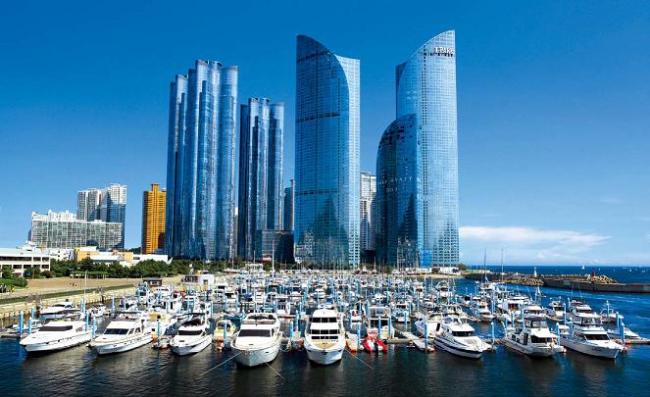
The KTX Changes Everything About How You Plan Busan
Before the high-speed rail came online in 2004, a Seoul to Busan trip meant either a five-hour Mugunghwa train, a six-hour bus ride, or an early-morning Gimpo flight. Locals went down maybe once or twice a year. Now Friday-evening KTX trains out of Seoul Station are routinely full of Seoul office workers in casual clothes carrying overnight bags, returning Sunday night. That weekend-flow pattern is what gives Busan its current rhythm. Beachfront 회 (hwe, raw fish) restaurants in Haeundae do their biggest covers Friday through Sunday. The high-rise hotels along Gwangalli Beach price-spike weekends. Even the pojangmacha (street food tents) on Gwangalli's promenade open earlier on Fridays because the Seoul crowd lands at Busan Station around 8 p.m. and is on the beach by 9.
Practical layer for the guide. Book the KTX through Korail's app (English supported), aim for a window seat on the right side going south for coastal views past Daegu, and budget around 60,000 KRW one way for a standard seat. Once you're at Busan Station, the Busan subway connects everywhere you'll actually want to go. Line 1 runs north-south through the old city core (Nampo-dong, Seomyeon, Busan Station), Line 2 runs east-west out to Haeundae and Gwangalli, and Line 3 catches Gimhae International if you fly in. T-money card works the same as Seoul. The whole network is intuitive in a way the JR Tokyo map will never be.
Haeundae Versus Gwangalli: The Two Beach Cultures Locals Actually Pick Between
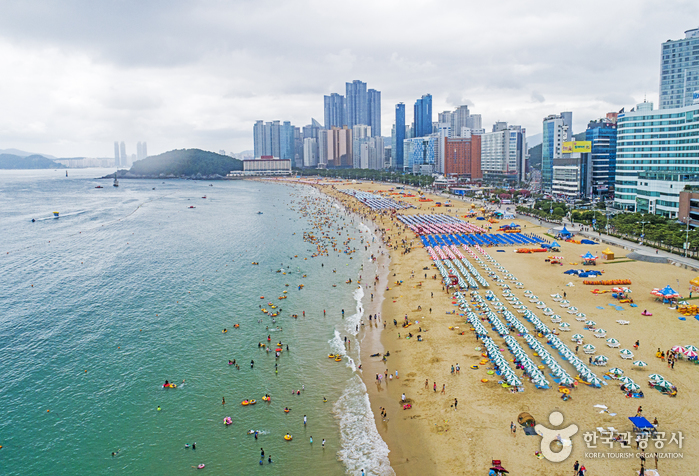
Foreign guides always default to Haeundae. Locals don't, and the reason matters. Haeundae (해운대) is the showpiece. It's where the Westin Chosun and the Park Hyatt sit, where K-drama production designers film their "successful Seoul executive vacations in Busan" cutaways, and where the August beach scene gets covered by national news because Korea's largest umbrella-density photos always come from here. The strip is genuinely impressive: a 1.5-kilometer crescent of fine sand wedged between forested headlands, with the Marine City skyline closing the eastern end. What makes it uniquely Korean is the density. Within a 500-meter walk of the water you have a Lotte Department Store, the Sea Life Aquarium, dozens of high-end raw-fish places, an entire underground market of street food, and at least four major jjimjilbang. No European beach city compresses that much commercial life into the beachfront. Spanish costas spread it out. Busan stacks it.
Gwangalli (광안리) is where locals actually go to hang out. The beach is smaller, the water is murkier, the sand is coarser, none of which matters because the point is the view of Gwangan Bridge (광안대교) lit up at night and the pojangmacha rows lining the promenade. The crowd skews younger, the cafes have better Wi-Fi, the craft beer scene is real, and the rent on the apartments behind the beach is genuinely affordable, which means the people in them aren't tourists. They're Busanites in their late twenties. For an honest read of how Korean coastal lifestyle works, skip a Haeundae night and stay in Gwangalli.

Gamcheon Culture Village: Stop Calling It Instagram Bait
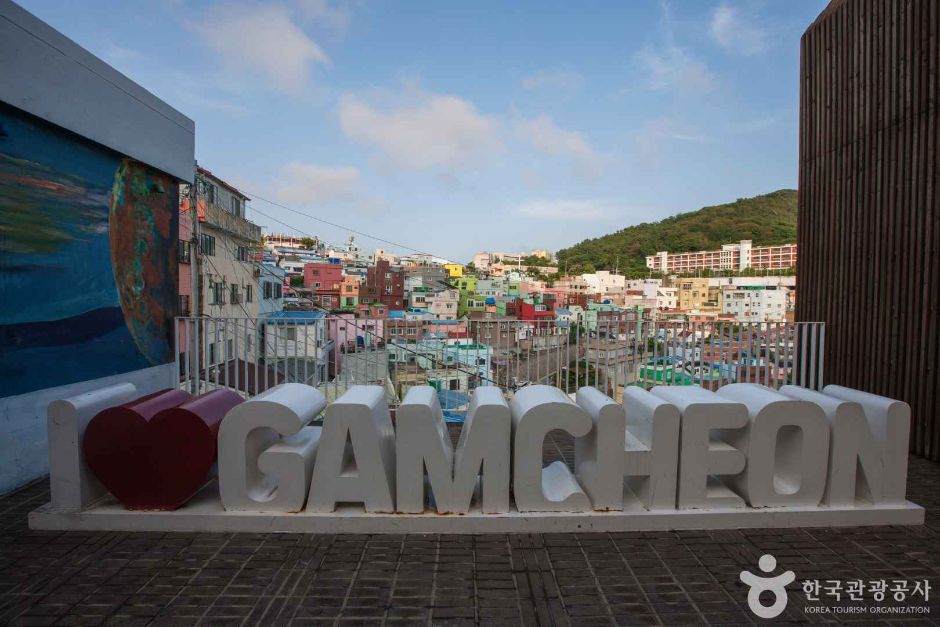
The Gamcheon story gets flattened in nearly every travel article: "colorful village, looks pretty, take selfies." The actual history matters, and locals notice when foreigners don't know it. Gamcheon-dong was a refugee settlement built during the Korean War, when Busan briefly served as South Korea's provisional capital after Seoul fell to the North in 1950. Members of the Taegukdo religious movement built tightly packed houses up the hillside in the unspoken rule that no house could block another's view of the sea below. By the 2000s, the neighborhood had emptied out, residents had aged, and the area was scheduled for the kind of redevelopment that erases its texture entirely.
In 2009, the Busan city government and the Ministry of Culture, Sports and Tourism funded a public-art commission called "Dreaming of Machu Picchu in Busan," partnering with local artists and remaining residents to paint murals, install sculptures, and reroute foot traffic into a curated walking path. That commission is the reason Gamcheon looks the way it does. It's not organic graffiti, and it's not Instagram bait by accident. It's a state-funded heritage-preservation project that turned an evacuating neighborhood into a sustainable tourism asset while keeping roughly 8,000 residents in place. The murals get refreshed on a rotation. The cafes pay rent that flows back into community maintenance. Korean travel writers cover Gamcheon as a successful example of culture-led urban regeneration, the same conversation that frames Detroit's Heidelberg Project or Naples' Quartieri Spagnoli. The pretty pastel houses are the visible top of a deliberate policy stack.
Practical note. Get there via subway Line 1 to Toseong Station, then a short bus ride or taxi up the hill. Visit on weekday mornings to avoid the worst tour-group crush. And keep your voice down. It's still a residential neighborhood, and the patience of remaining residents is what holds the whole thing together.
Jagalchi and Gukje: Living Museums of Korean Seafood Culture

Two markets, both in the Nampo-dong area, both essential, both doing different jobs. Jagalchi Market (자갈치시장) is the working seafood market that supplies a meaningful share of the country's restaurant-grade fish. The ground floor is wet market, run for over six decades by the so-called "Jagalchi Ajumma," the women who became postwar Korea's primary seafood-trade workforce and whose nighttime auctions still set wholesale prices for everything from hagfish to abalone. The upper floors are where you take whatever you just pointed at downstairs and have it cleaned and served. Yes, the tourist markup is real. The mark-up for foreigners can run 30 to 50 percent above what a Korean buyer pays, and the menus often skip the price column entirely. But the supply chain underneath is genuine. The fish in front of you was on a boat in the Korean Strait yesterday morning. That's not something the Tsukiji-replacement Toyosu Market can easily say at 1 p.m.
Gukje Market (국제시장) is the dry-goods and street-food counterpart, a few blocks inland from Jagalchi. It started in the late 1940s as a marketplace for goods left behind by Japanese colonial administrators and was solidified by Korean War refugees who set up stalls there. The 2014 film Ode to My Father (국제시장) is set here, and the movie is the reason older Korean tourists make a pilgrimage to Gukje the way younger Korean tourists go to Gamcheon. The food alleys cover everything: bibim dangmyeon (spicy mixed glass noodles), ssiat hotteok (Busan's specific stuffed-pancake variant), dwaeji gukbap (the milky pork-and-rice soup that locals will tell you only tastes right in Busan), and the milmyeon cold noodles that don't really exist elsewhere in Korea. Walking these alleys with a Korean friend is the fastest way to understand what working-class postwar Korean food actually tasted like, before the country got rich enough to refine it into the polished gastropub versions you find in Seoul.
The Dialect Tells You You're Not in Seoul Anymore
One of the first things you notice in Busan: the language sounds different. 부산 사투리 (Busan dialect) is the most prominent of the southeastern Gyeongsang dialects, and it's distinct enough from Seoul standard that K-dramas use it as a deliberate character marker. Think Hometown Cha-Cha-Cha, where Kim Sun-ho's character Chief Hong slipping into gentle southeast inflections signals his rooted-in-the-coast warmth. Think Reply 1997, set in 1990s Busan, where the entire cast's dialect work was the show's signature. Think Friend (친구), Kwak Kyung-taek's 2001 gangster film that made nationwide audiences finally take Busan dialect seriously instead of treating it as comic relief.
The dialect's pitch accent is different from Seoul standard (Korean is usually described as non-tonal, but Gyeongsang dialects retain pitch accent in ways Seoul doesn't), the vocabulary swaps in unique words (마이 무따 for "ate a lot" instead of 많이 먹었다), and the cadence is faster and more clipped. Practical implication for the traveler: even if you've studied Korean, you'll catch maybe 60 percent of what you hear in a Busan market. Locals know this and switch to standard Korean when they notice. The reason this matters for industry context is that Busan dialect's recent re-coding from "country bumpkin" to "warm-and-cool" is a real K-content production choice over the last decade. PD-level interviews credit Busan-set dramas with intentionally repositioning the regional accent as aspirational coastal character, not a class marker. You're hearing that work in real time when a barista in Gwangalli speaks to her regulars in dialect and to you in standard.
Where to Stay: A Practical Neighborhood Breakdown
Haeundae makes sense if you want hotel infrastructure and beach access in one walk. The Park Hyatt, the Westin Chosun, and the Paradise Hotel sit directly on the sand. Cost runs Seoul-five-star equivalent. Good for first-time visitors who want a single trip with everything in walking distance. Less interesting as a window into Busan-actual.
Gwangalli is the better trade-off. Mid-tier hotels and well-designed Korean boutique stays sit one street back from the promenade. Half the price of Haeundae, twice the local color, walking access to the best craft beer in Korea outside Seoul's Itaewon. The Park Hyatt-equivalent for design-conscious travelers is the Avani Central Busan, but the area's smaller boutique stays (search Naver Map, not Google) are where Korean weekenders actually book.
Nampo-dong is the old-city play. Stay near BIFF Square if you're coming for the Busan International Film Festival in October, or for the immersive market access. Rooms here are smaller and rooms with views are rare, but you're walking distance to Jagalchi, Gukje, and the Lotte Department Store flagship that locals shop at. Skip Seomyeon unless you specifically want the bar-and-shopping nightlife district and don't mind being away from the coast.
Day-by-Day, How a Local Would Actually Spend a Weekend
Friday night, KTX in. Drop bags at a Gwangalli hotel, walk down to the beach, find a pojangmacha tent for grilled shellfish and soju, watch the bridge light show that runs roughly every hour after sunset. Saturday morning, taxi to Jagalchi, breakfast on raw fish with a 90-something-year-old Jagalchi Ajumma scolding you about your chopstick technique, then walk to Gukje for ssiat hotteok and people-watching. Saturday afternoon, subway up to Toseong for Gamcheon, give yourself two hours of slow walking, then descend to Songdo for the cable car and the coastal cliff walk. Saturday night, back to Gwangalli for dinner at a 회 spot, then craft beer at one of the breweries behind the beach.
Sunday morning, the move locals always make is a jjimjilbang. Spa Land at Centum City (the world's largest department store, which is in Busan, not Seoul) is the most accessible international-friendly option. Two to three hours of bathhouse, sauna, and sleep room reset the body before the train back. Sunday afternoon, optional Haedong Yonggungsa Temple if you have the energy, otherwise just back to Busan Station and a 5 p.m. KTX gets you to Seoul by 7:30. That's the rhythm. The city was always designed to be visited like this.
Explore More of Korea with Daebak
Want to bring a little piece of Korea into your life? The Daebak Box is packed with the best Korean snacks, ramen, and cultural goodies delivered monthly to your door.


