


Table of Contents
Maedeup (매듭) is the traditional Korean art of decorative knotting, an exquisite fiber craft where a single silk cord is woven, looped, and tightened into intricate three-dimensional shapes. Unlike its East Asian cousins, Korean knots follow a strict rule: the front and back must look identical, a meditative discipline that has produced some of the most refined cord work in the world. From the tassels of royal norigae to modern keychain charms, maedeup ties Korea's past to its present in a single elegant loop.
.jpg)
What Is Maedeup?
The word maedeup refers to both the technique of interlacing silk threads and the finished knot itself. The craft begins with kkonggeun (꼰끈), twisted silk cord, or finer myeongju (명주) silk thread dyed with natural pigments. Multiple strands are braided into a dahoe (다회) plaited cord, which is then woven and tightened into shape. What sets Korean knots apart from Chinese knotting is geometry and symmetry: Korean maedeup is two-sided identical, meaning the structure reads the same from front and back, with bilateral symmetry running through every loop. Chinese knots favor flat decorative letters, Japanese knots are looser, and Korean knots are famously tight, dense, and three-dimensional.
The 14 Traditional Named Knots
Korean knot-makers recognize dozens of named knots, but a core group of about 14 forms the working vocabulary of the craft. Each carries a poetic name drawn from nature. The basic starting knot is danchu maedeup (단추매듭), the button knot, followed by dorae maedeup (도래매듭), the round foundational knot. From there artisans build up to yeonkkot maedeup (연꽃매듭, lotus), gukhwa maedeup (국화매듭, chrysanthemum), jamjari maedeup (잠자리매듭, dragonfly), maemi maedeup (매미매듭, cicada), geobuk maedeup (거북매듭, turtle), darae maedeup (다래매듭), janggu maedeup (장구매듭, hourglass drum), injang maedeup (인장매듭, seal), gajibangseok maedeup (가지방석매듭), garakji maedeup (가락지매듭), and the soulful dongshim-gyeol maedeup (동심결매듭, concentric or "binding two hearts" knot used in royal marriage pledges). Each is symmetrical, single-cord, and tied without ever cutting the thread.
Maedeup and the Norigae Pendant
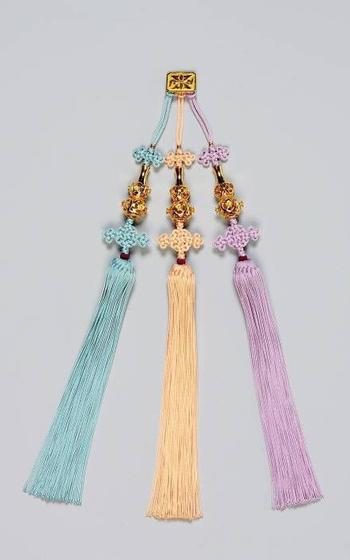
Maedeup is the structural backbone of the norigae (노리개), the tasseled ornamental pendant that hangs from the goreum coat string or chima skirt band of a hanbok. A norigae has four components: the ddidon hook, the paemul (the main jade, coral, amber, or gold ornament), the maedeup knots tied above and below the paemul, and the sul (술) tassels that catch the wearer's movement. Royal women wore samjak norigae, three-piece sets with three matching ornaments, while danjak (single-piece) versions suited daily life. The shape of the knot and the symbolism of the paemul, butterflies for marital harmony, bats for fortune, lotuses for purity, all worked together to wish the wearer longevity and good luck.
Beyond Norigae: Where Else Maedeup Lives
Maedeup has never been confined to women's accessories. During the Joseon dynasty (1392 to 1910) the royal court employed dozens of master cord and knot artisans, and the craft appeared everywhere. Men used jalkkeun (잘끈) knotted closures on their official robes and gat hat strings. Sword tassels hung from military officers' weapons, jumeoni (주머니) pouches closed with knotted drawstrings, and palanquins, royal seals, biers, Buddhist banners, fans, and even rosaries all carried maedeup. Larger maedeup gongye (매듭공예) wall hangings became their own art form, transforming a humble silk cord into woven sculpture. Today's makers extend the tradition into table runners, light fixtures, and contemporary textile installations.
An Intangible Cultural Property Since 1968
The Korean government designated maedeup as Important Intangible Cultural Property No. 22 in 1968 to protect a tradition that had nearly disappeared during the colonial and post-war years. Pioneer master Kim Hee-jin revived the lost techniques in 1966 and invented a special cord frame still used by artisans today. The living holders of the title, including renowned masters such as Choi Eun-soon and Kim Jung-sook, continue to teach apprentices in the four-stage process of dyeing silk thread, plaiting dahoe cord, tying the knot, and finishing the sul tassels. Their work has been collected by the National Folk Museum of Korea and the V&A Museum in London, and traveled in international exhibitions to Australia and the Philippines.
The Dong-Lim Knot Museum in Bukchon
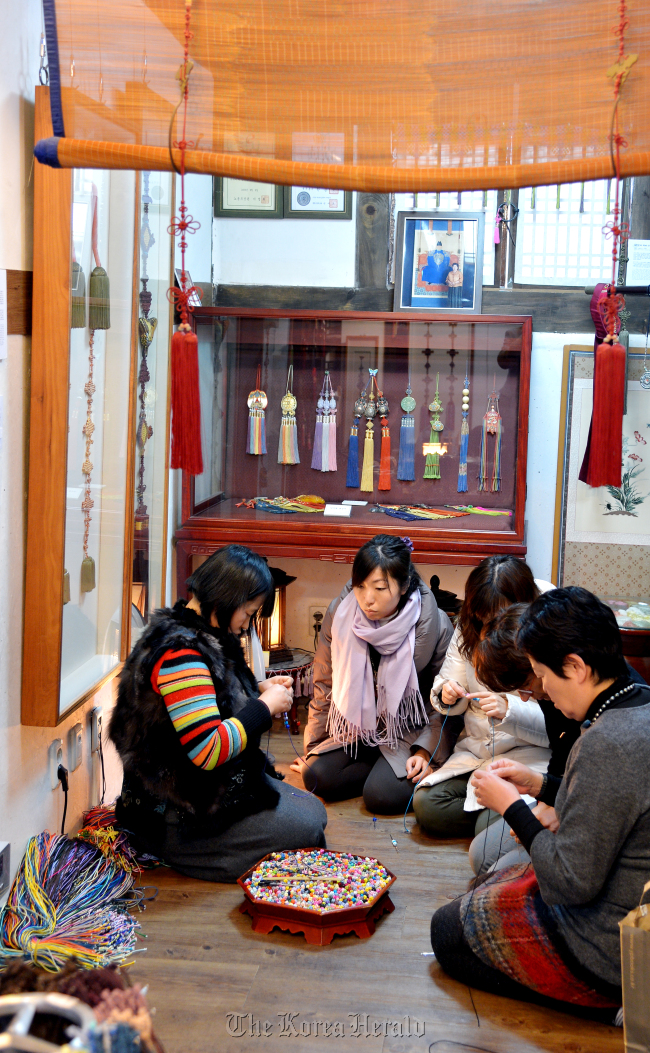
The spiritual home of maedeup in Seoul is the Dong-Lim Knot Museum (동림매듭박물관), tucked inside a quiet hanok at 10 Bukchon-ro 12-gil in Bukchon Hanok Village. Opened in April 2004 by master Shim Young-mi, who learned the craft from her father-in-law, who in turn learned from a great aunt serving as a palace knot technician, the museum is now a family workshop in its fourth generation. Inside, glass cases display historical norigae, belts, pouches, and contemporary art knots in vivid silks. Visitors can take a one-day class to tie a chrysanthemum bracelet, a dragonfly knot, or a mask strap for about 10,000 to 12,000 won. The Bukchon Traditional Culture Center nearby also offers maedeup classes alongside natural dyeing and jogakbo patchwork.
Maedeup in K-Drama Costume
Korean period dramas have given maedeup a global audience. The exquisite norigae and binyeo accessories in tvN's "Mr. Queen," Netflix's "Kingdom," and tvN's "Mr. Sunshine" were real handcrafted pieces sourced from heritage jewelers such as NASCHENKA, whose work has appeared in more than 70 historical dramas. When Queen Cheorin wears a phoenix binyeo or a hanging norigae sweeps across a silk hanbok, viewers are watching genuine cord work in motion. Even Netflix's animated hit "K-Pop Demon Hunters" featured authentic samjak norigae styled onto its idol heroines, embedding maedeup symbolism, longevity, fertility, prosperity, into K-pop fashion for a worldwide audience.
Modern Maedeup: From BTS Keychains to DIY Kits
Maedeup has quietly become one of Korea's most successful traditional crafts in the modern marketplace. BTS-themed maedeup keychains, bag charms, and earrings sold at airport shops have introduced the knots to Hallyu fans worldwide. Hanji-and-maedeup combination earrings, modern wedding decor accents, and minimalist three-knot pastel wall hangings now flood Etsy and Korean design fairs. DIY bracelet kits, including the one featured in the Daebak SULSUL Box, let makers anywhere try a chrysanthemum or dragonfly knot for themselves. For deeper learning, Bukchon Hanok Village workshops, Dong-Lim Museum classes, Korean Cultural Centers in London, New York, Sydney, and Tokyo, and a growing library of YouTube tutorials make maedeup more accessible than at any moment in its long history.
A Living Craft That Travels
From a silk filament in a Joseon palace to a bag charm dangling off a Seoul commuter's tote, maedeup has proved itself one of Korea's most resilient and exportable arts. It demands patience, geometric thinking, and a love of color, but the reward is a small object that holds centuries of meaning in a single symmetrical loop. Whether you tie one yourself in a Bukchon workshop or simply notice the knot above a norigae's jade pendant, you are watching a living tradition that refuses to fray.
Discover Korean Craft with SULSUL
Bring home a piece of Korea's living craft tradition with the SULSUL Box by Daebak, featuring handcrafted norigae, a dragonfly brooch, and a DIY knotted bracelet kit that celebrate traditional Korean artistry.


