


Table of Contents
Step outside a Seoul subway station after sundown and you may spot rows of glowing orange tents lining the sidewalk, with plastic stools spilling onto the curb and the smell of grilled fish cakes drifting through the steam. These are pojangmacha (포장마차), the late-night tent bars that have shaped Korean nightlife for more than half a century. Part street food stall, part neighborhood pub, they are where office workers, college students, and visiting K-drama fans share a bottle of soju long after the restaurants have closed.

What Is a Pojangmacha?
The word pojangmacha literally translates to "covered wagon," a nod to the wheeled carts that once trundled through Korean neighborhoods. Today the term covers any tarp-draped, open-air eatery that serves both food and drinks, usually wrapped in bright orange or red vinyl with plastic windows. The setup is informal by design: a small kitchen at the center, a counter or two, plastic tables, and a generator humming under the tent. Owners cook everything in front of you, ladling soup, grilling skewers, and slicing sashimi while you sip soju a meter away. According to The Korea Herald, that immediate, hands-on service is exactly what regulars say keeps pojangmacha alive even as Seoul modernizes around them.
A Post-War Origin Story
Most historians trace the pojangmacha back to the wheeled food carts that appeared in Seoul during the 1950s and 1960s, the years after the Korean War when work was scarce and capital was thin. Early vendors sold cheap shots of soju with simple munchies like roasted sparrow, dried squid, and boiled silkworm pupae. As Korea's economy boomed through the 1970s and 1980s, the tents grew larger and the menus expanded, cementing pojangmacha as a refuge where laborers and office workers could unwind on the way home. The Korea Herald describes them as a fixture of after-work Seoul, with stalls clustering behind office buildings near Namdaemun and along quiet alleys in Jongno.
What's on the Menu
Pojangmacha menus are not designed for a sit-down dinner, they are designed for anju, food meant to be eaten with drinks. The classics you will find at almost every tent include:
- Tteokbokki (떡볶이), chewy rice cakes simmered in a sweet, fiery gochujang sauce.
- Odeng or eomuk (오덩/어묵), fish cake skewers served in a hot anchovy broth that you sip from a paper cup between bites.
- Soondae (순대), Korean blood sausage stuffed with sweet potato noodles, served sliced with salt or stir-fried as sundae-bokkeum.
- Dakkochi (닭꼬치), grilled chicken skewers brushed with sweet-and-spicy sauce.
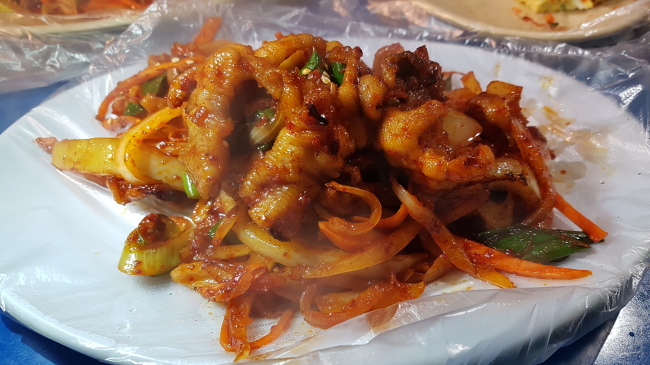
- Gopchang (곱창) and dakbal (닭발), grilled pork or beef intestines and fiery chicken feet for the more adventurous.
- Sannakji (산낙지), fresh-cut octopus that is still wriggling when it arrives at the table.
- Hwangtae-gui (황태구이), grilled dried pollack, a salty companion to a cold glass of beer.
The Korea Herald notes that many pojangmacha lean into the unusual stuff, dishes like spicy hagfish, stir-fried cartilage, and sea snail salad that you rarely see on a restaurant menu but that match perfectly with cold soju.
The Drinking Culture: Soju, Beer, and Somaek
A pojangmacha visit is never just about the food. Soju, Korea's clear distilled grain liquor, is the default order, usually poured shot by shot for the table. Beer is the next most common choice, and many regulars mix the two into somaek, a soju and beer cocktail that smooths out the soju's edge. The Korea Herald reports that the vendors typically open around 7 or 8 in the evening, with peak hours from 8 p.m. through midnight, and spring and autumn drawing the biggest crowds. Most Koreans treat the pojangmacha as a stop for i-cha, the "second round" of drinks after a proper restaurant meal, although solo visitors looking for a quick drink and a hot bowl of broth are just as welcome.
The K-Drama Pojangmacha Scene
If you have watched more than a handful of Korean dramas, you have seen this shot: the heartbroken protagonist hunched over a plastic table in an orange tent, soju glass in hand, while a friend or future love interest slides onto the stool across from them. Pojangmacha appear in everything from older classics like My Sassy Girl to recent hits like Itaewon Class, Crash Landing on You, and Reply 1988. The setting works because it telegraphs honesty in a single shot, a place where characters drop their formal manners and finally say what they mean. Director Lee Jang-ho's 1980 film A Fine, Windy Day was one of the earliest to put pojangmacha at the heart of a story, and the trope has only grown since.

Where to Find the Best Pojangmacha in Seoul
Pojangmacha can pop up in almost any neighborhood, but a handful of areas are famous for them.
- Jongno 3-ga Pojangmacha Street is the most iconic stretch in central Seoul. A 200-meter alley between exits 5 and 6 of Jongno 3-ga Station fills nightly with orange tents and outdoor tables, with both classic pojangmacha and indoor pocha establishments competing for the crowd.
- Jongmyo and Euljiro, just south of Jongno, host older alleys like the Nogari Alley where office workers gather for cheap beer and grilled snacks.
- Dongdaemun stays awake all night thanks to its wholesale fashion market, and Visit Korea recommends the area for late-night dak-kkochi, tteokbokki, and sundae-bokkeum from the surrounding stalls.
- Gwanghwamun and the streets behind Seoul City Hall draw business district crowds for after-work pojangmacha sessions.
- Chang-dong Pocha Street in northern Seoul, just outside Exit 1 of Chang-dong Station, is a long-standing alley of red tent bars that Visit Seoul highlights as one of the city's best preserved pocha rows.
The Modern Indoor Pojangmacha
While the classic roadside tent is still the soul of the experience, a newer generation of pocha takes the look indoors. Restaurants like Cheongdamdong Pojangmacha in Seoul recreate the menu and atmosphere inside a permanent space, with the orange lighting, plastic chairs, and 50-dish snack menu, but with proper plumbing, heating, and a card reader. Indoor pocha chains like Hanshin Pocha have expanded the format nationwide, offering the comfort of pojangmacha-style anju without the regulatory gray area of the original street tents. For travelers who want the vibe without the cold winter wind, modern indoor pocha are an easy entry point.

Etiquette for First-Timers
A pojangmacha is casual, but a few simple habits will make you blend in.
- Bring cash. Many tents are unregistered and do not accept credit cards.
- Order at least one drink. Pojangmacha rely on alcohol sales, so a bottle of soju or beer per person is the unspoken minimum.
- Pour for others, not for yourself. Korean drinking etiquette says you fill your companion's glass first, and they will fill yours in return.
- Use two hands. When receiving a drink from someone older, hold the glass with both hands as a sign of respect.
- Share the table. Tents get crowded after 9 p.m., and on busy nights strangers may join your table. Slide over and make room.
- Tip is not expected. Korean restaurants do not have a tipping culture, and pojangmacha are no exception.
Why Pojangmacha Still Matter
For all the gleaming new restaurants and franchise pochas, the real orange tents on the sidewalk still pull in crowds because they offer something hard to replicate: a slice of post-war Seoul, served with hot broth and cold soju, under a sheet of plastic that flaps in the wind. They are messy, unregulated, and sometimes a little expensive, but they remain one of the most honest ways to experience Korean food culture after dark. Whether you are a first-time visitor chasing a K-drama moment or a regular meeting old friends, a night under the orange tarp is one of the most memorable meals Seoul can serve.
Explore Korean Snacks with Daebak
Love Korean food? Get authentic Korean snacks and ramen delivered straight to your door with the SnackFever Box by Daebak.


