


Table of Contents
May 31, 2022. The White House press briefing room. Seven Korean men in matching black Bottega Veneta suits walk in to a livestream that pulled 310,000 simultaneous viewers, more than triple the Biden administration's typical press-briefing audience. Karine Jean-Pierre introduces them as "youth ambassadors." Then BTS takes turns at the lectern, in Korean, to address anti-Asian hate crimes during AANHPI Heritage Month. They did not perform. They did not sing a single bar of Butter or Dynamite. They addressed. For anyone tracking the Hallyu industry's trajectory the last decade, this was the moment K-pop crossed from entertainment-industry product into statesman territory.
Why BTS, and Why No Other K-pop Act Could Have Been Booked

The Biden communications office did not invite a K-pop group. They invited the only Asian pop act that the U.S. domestic audience would recognize on sight without a chyron. That distinction matters. BLACKPINK had Coachella and Born Pink to come, TWICE had their first U.S. arena run later that summer, Stray Kids were still in their American breakthrough cycle. None of them registered with the swing voter the White House actually wanted to reach: the AAPI suburbanite mom, the Asian American student, the second-generation Korean American who watched Butter on the iHeartRadio Music Awards. BTS was the only Asian act in 2022 with that kind of cross-demographic Western recognition. Inside HYBE, the calculus would have run something like this: an Oval Office meeting in the middle of Map of the Soul reactivation conversations would raise BTS's perceived institutional weight by a half decade. That is not 콘서트 promotion math. That is brand equity math.
The piece K-pop industry observers caught immediately, and Western press underplayed, was the suit choice. Bottega Veneta black. No flashy stagewear, no agency-coordinated concept reveal. The styling read like Davos, not a comeback teaser. Whoever signed off on the wardrobe inside HYBE understood that BTS needed to look like delegates, not idols. That single styling decision was a signal to U.S. policymakers that this group could carry institutional weight, and a signal to Korean fandoms that the visit was being treated with diplomatic gravity. The closest comparable was when Moon Jae-in's office sent BTS to the 76th UN General Assembly in 2021 in similarly understated tailoring. Same playbook, escalated.
The Press-Briefing Format Was the Statement, Not the Speeches
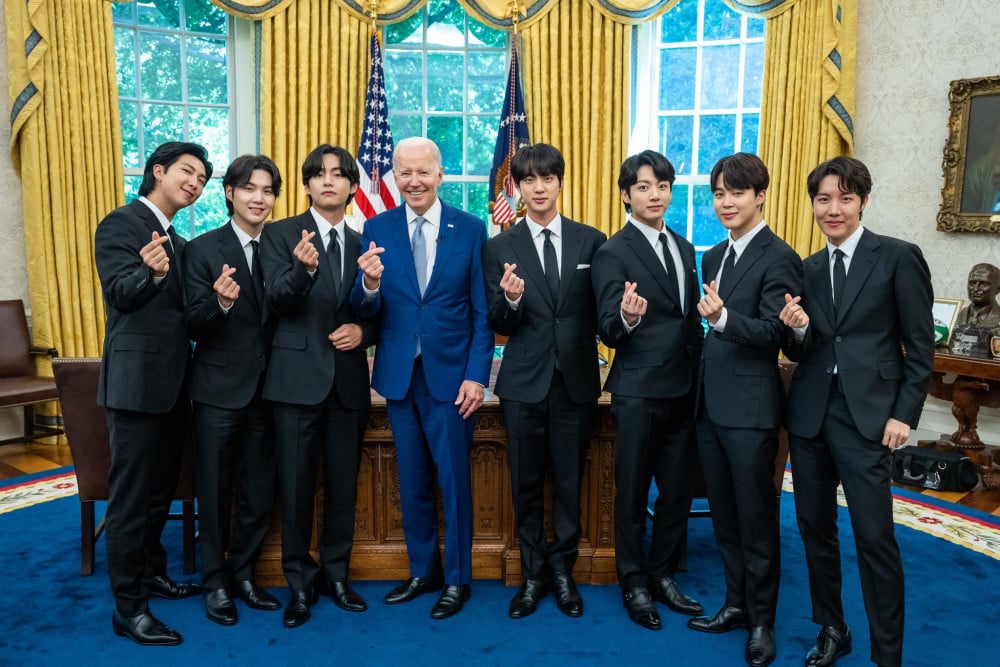
Read the briefing transcript again and the most important word is the venue. Not Oval Office, not Rose Garden, but the press briefing room. That room is where the White House addresses U.S. citizens through accredited press, and the format historically gets reserved for athletes who just won a championship, for victims of national tragedy, for civic figures. Pop stars do not typically get the briefing podium. Lady Gaga got it once in 2022 as co-chair of the President's Committee on the Arts. Olympic teams get it. BTS standing in that room, in that format, was a political statement disguised as protocol. The seven of them gave individual remarks in Korean, with Karine Jean-Pierre translating context and reading press queries. That is statesman framing.
What the press conference did mechanically: it placed the words 아시안 혐오 (Asian hate) on the official White House transcript record, in Korean. Jimin said in Korean, "We were shocked and devastated by the recent surge in hate crimes against Asians." Jungkook said music transcends language and culture. Suga said equality begins with embracing differences instead of treating them as right or wrong. Each member's remarks were translated, archived, indexed by Google, and quoted in every Korean-language press outlet from JoongAng Ilbo to Hankyoreh within 24 hours. That distribution effect, for the AAPI policy agenda, was worth more than any single press release Karine Jean-Pierre could have issued. BTS's reach is roughly 50 million streaming listeners monthly. The White House communications team is staffed to reach maybe a tenth of that in a given news cycle. The asymmetry is why this booking happened.
The HYBE Brand Math: This Did Not Require a Narrative Pivot

From inside the Hallyu industry, the most interesting part of the White House visit is the brand alignment. BTS's catalog since 2017 has been built explicitly on a mental-health-plus-identity message scaffolding. The Love Yourself trilogy (Her in 2017, Tear in 2018, Answer in 2018) was framed around self-acceptance and identity. The Map of the Soul series turned that into Jungian self-investigation. RM's UN General Assembly speech in 2018, the original "speak yourself" pivot, fused the artistic narrative with a soft-power youth-ambassador framing. When AAPI Heritage Month came up as a White House booking opportunity, no new narrative engineering was required. The story already aligned. That is rare in K-pop industry positioning.
Compare that to what would have happened if YG had been asked to send BLACKPINK. The group's brand is Tier-1 luxury fashion alignment, not civic discourse. Asking them to address AAPI hate would have required an awkward narrative bridge. Same applies to TXT, NewJeans, ENHYPEN. The reason BTS was the only viable booking is that their brand DNA was pre-loaded for civic discussion. That's a 10-year strategic decision by Bang Si-hyuk paying off in real time. Whoever inside HYBE saw the parallel in 2017 and decided to lean into Love Yourself as a brand foundation, instead of going pure swag/idol-bombast like other agencies, was effectively building the launchpad for this White House moment five years before anyone in Washington knew BTS existed.
The Atlanta Shootings Context: BTS Had Already Spoken
You cannot read the May 2022 White House visit cleanly without the March 2021 Atlanta context. On March 16, 2021, Robert Aaron Long killed eight people across three Atlanta-area spas. Six of the victims were Asian women. Four were 한인 디아스포라 (Korean diaspora) women: Hyun Jung Grant, Suncha Kim, Soon Chung Park, Yong Ae Yue. Korean Americans, more than any other Asian American group, organized in the immediate aftermath. The Korean American Coalition mobilized. KCS (Korean Community Services) ran direct outreach. KCRC (Korean Churches for Community Development) opened vigil spaces. The Atlanta shootings weren't just an AAPI hate-crime story. They were specifically a Korean American grief moment.
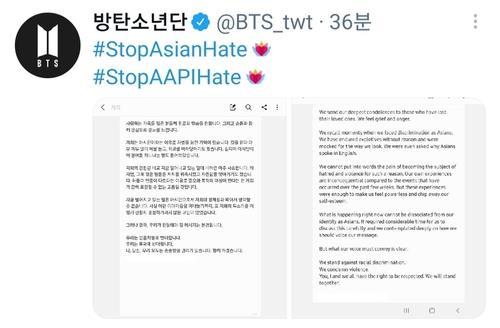
Two weeks later, on March 30, 2021, BTS posted their Stop Asian Hate 공식 성명 (official statement) on Twitter. They wrote in Korean and English. "We recall moments when we faced discrimination as Asians. We have endured expletives without reason and were mocked for the way we look. We were even asked why Asians spoke in English." That tweet got retweeted over a million times. Twitter later ranked it the most retweeted post of 2021 in that category. From a Korean entertainment-PR view, this was a non-trivial decision. BTS deliberately broke with the K-pop industry norm of staying apolitical on U.S. domestic affairs. Bang Si-hyuk reportedly cleared the language personally. Once that statement existed, the May 2022 White House invitation was the policy follow-through. The Biden team saw which K-pop act had already publicly aligned with the Stop Asian Hate movement, and the booking became obvious.
Why This Moment Legitimized K-pop as a Cultural-Political Force
Before May 2022, K-pop's institutional framing in Western media was Entertainment Industry. Fandom-driven streaming numbers, viral choreography, merch and album-sales economics. After May 2022, the framing shifted. K-pop was discussed in The Washington Post, NPR, and CNN as a soft-power tool with civic-discourse capacity. That is the same vocabulary applied to Japan's anime export industry, to British rock in the 1960s, to Korean film after Parasite. The Korean entertainment industry got admitted into the soft-power conversation that night. KOCCA (Korea Creative Content Agency) immediately repositioned BTS in its export-policy documents from a music-export case study to a cultural-diplomacy case study. That's not a cosmetic distinction. Government export funding gets allocated differently between those two categories.
The follow-on industry impact: K-pop labels that had previously been allergic to U.S. political alignment, including SM, YG, and JYP, began softening that posture through the rest of 2022. JYP's NMIXX got framed in early U.S. coverage as a "global youth voice" the way only BTS had been before. SM's leadership pivoted aespa's English-language press strategy to lean into Asian American audience cultivation, not just K-pop fandom cultivation. The agencies that had treated AAPI advocacy as too politically sensitive to brush against in U.S. press now had cover to engage. BTS legitimized the lane. That's the kind of industry-wide effect a single high-profile booking can trigger when the timing is right.
The Follow-Up Silence: Why BTS Did Not Repeat the Format
Here is where K-content industry insiders track a specific tactical decision. After May 31, BTS never repeated the White House format. They had a clear opportunity in 2023 to do a follow-up appearance around Lunar New Year or another AANHPI milestone. They did not. Within three weeks of the White House visit, the group announced what was framed in Western press as a hiatus but was understood inside HYBE as a strategic pivot to solo work. RM's Indigo released that December. Jin's The Astronaut dropped in October 2022. J-Hope's Jack in the Box came in July 2022. Jimin's Like Crazy hit number 1 on Billboard Hot 100 in April 2023. Suga's Agust D D-Day in April 2023. The solo runs effectively replaced the group activity cycle, and that pulled them out of the institutional-speech format.
The strategic logic: a second White House appearance would have diluted the moment. Doing a second one in 2023 would have looked transactional, a regular event rather than the historic singular booking. The K-pop industry rule, going back to G-Dragon's Lotto World Tour reasoning in 2017, is that legacy moments require scarcity. BTS made the White House appearance once. Karine Jean-Pierre's office knew not to ask again because HYBE communications had quietly signaled that the visit was a one-time statement. Members started doing UN-General-Assembly-adjacent appearances individually instead. The format moved from "BTS as a group as ambassadors" to "individual members as solo artists who carry the diplomatic franchise." That's a higher-resolution use of star power, and it preserved the May 2022 moment as the anchor in the BTS Hallyu-diplomacy timeline.
Explore More of Korea with Daebak
Want to bring a little piece of Korea into your life? The Daebak Box is packed with the best Korean snacks, ramen, and cultural goodies delivered monthly to your door.


