


Table of Contents
Korean calligraphy, called seoye (서예), is the centuries-old art of writing characters with brush and ink. Once the daily practice of Joseon-era scholars and the badge of an educated seonbi, it has been reborn in the past decade as a contemporary art form, a wellness ritual, and even a branding tool for soju bottles and K-drama posters. In January 2025, the Korea Heritage Service formally designated Hangeul calligraphy a National Intangible Cultural Heritage, sealing its place as one of Korea's defining living arts.

From Hanja Roots to Hangul: A Brief History of Seoye
For most of Korean history, calligraphy meant writing Chinese characters, or hanja. Court documents, poetry, and Buddhist sutras were all brushed in Sinographic scripts inherited from China. The turning point came in 1443, when King Sejong the Great commissioned the creation of Hunminjeongeum, the alphabet now known as Hangul. From the late Joseon period onward, calligraphers slowly began applying brush traditions to the new native script, producing handwritten copies of literary works and everyday letters that ranged from royal court documents to private correspondence. According to the Korea Heritage Service, Korean calligraphy has continued in unbroken transmission since Hangul's invention, evolving its own scripts and styles distinct from Chinese and Japanese traditions.
Chusa Kim Jeong-hui, Joseon's Calligraphic Genius
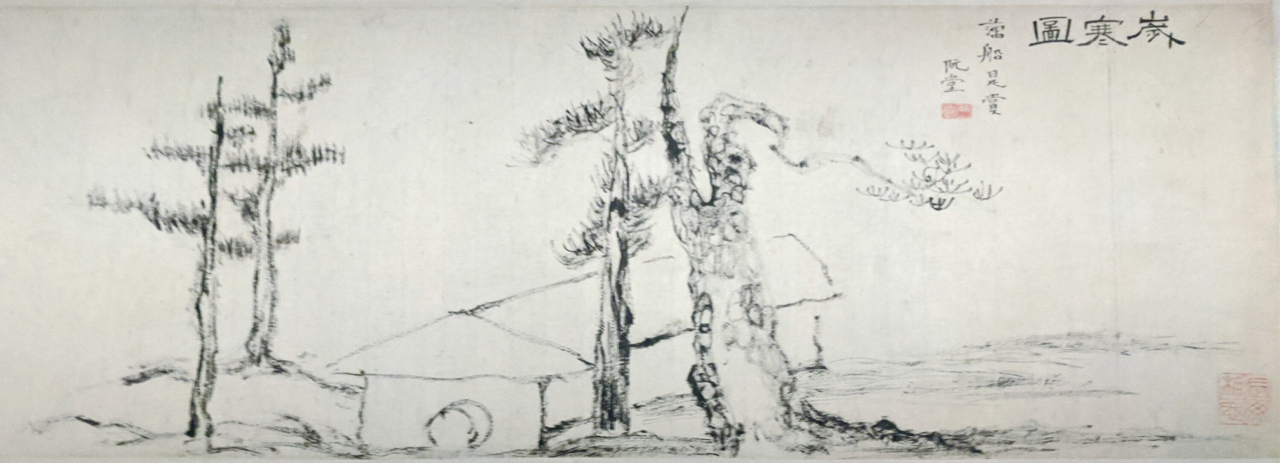
No discussion of seoye is complete without Kim Jeong-hui (1786 to 1856), known by his pen name Chusa (추사). A scholar born into the orbit of the royal family, Chusa studied epigraphy in Qing dynasty Beijing in his twenties and spent nearly nine years in exile on Jeju Island, where he refined the distinctive script that became known as Chusa-che. His best-known work, the 1844 painting Sehando, a National Treasure designated No. 180, was given to his disciple Yi Sang-jeok as thanks for smuggling rare Chinese books to Jeju. Chusa-che boldly reinterprets the shapes of hanja characters, allowing strokes to feel almost choreographic. Calligrapher Kang Byung-in, who has designed lettering for Chamisul soju and the drama Misaeng, credits Chusa as the spiritual ancestor of modern Korean calligraphic design.
Munbangsawoo: The Four Friends of the Study
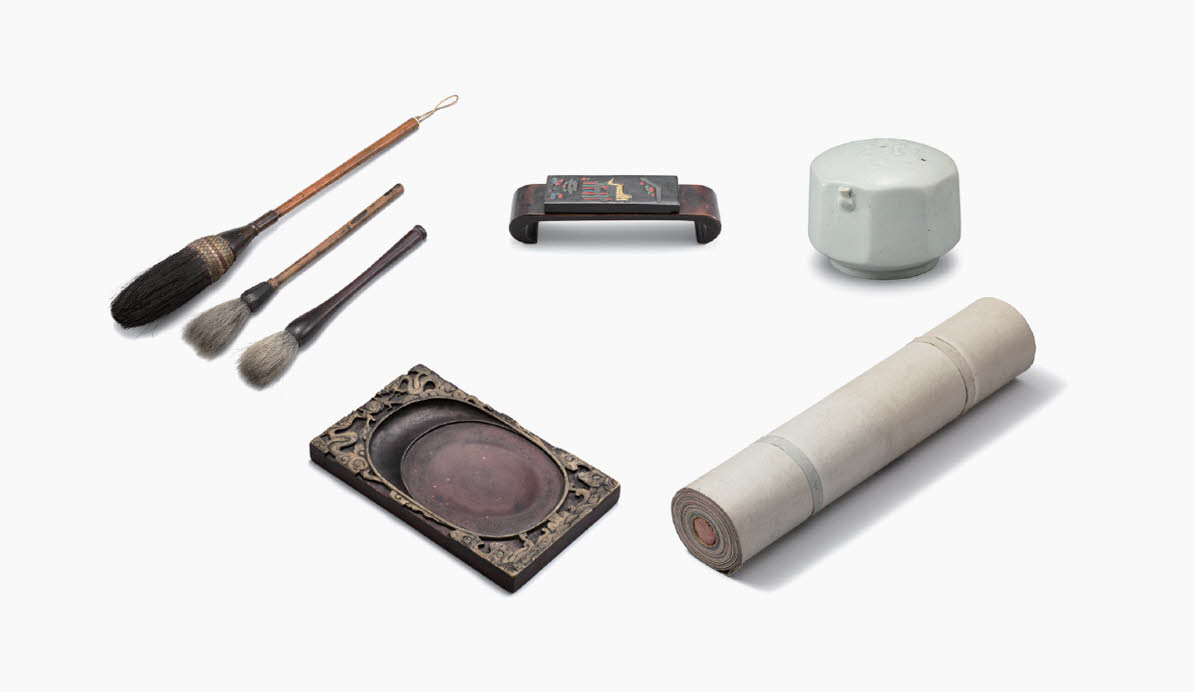
Korean calligraphers traditionally rely on a quartet of tools called munbangsawoo (문방사우), literally the four friends of the study. These are the brush (but, 붓) made from animal hair shaped to a sharp tip, the ink stick (meok, 먹) produced from soot and glue, the inkstone (byeoru, 벼루) where water and ink are ground together, and the paper (jongi, 종이), almost always traditional mulberry-bark hanji (한지) prized for absorbing ink without bleeding. The National Folk Museum of Korea notes that these objects were considered such intimate companions that a seonbi's desk, or seoan, with its munbangsawoo set, was carefully preserved and inherited across generations. The artist Lee Sang-hyun has recalled that he learned discipline as a child by grinding ink for hours before he was allowed to touch a brush.
Why Korean Hangul Calligraphy Feels Different
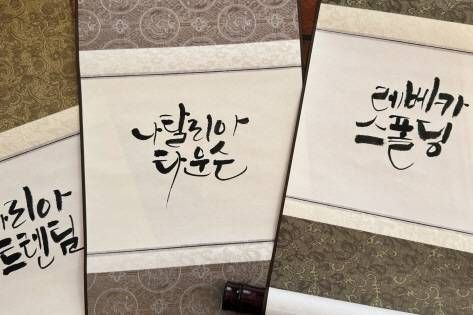
Hangul calligraphy looks visibly different from its Chinese cousin. Where hanja strokes tend toward angular, geometric precision, the round consonants and balanced vowels of Hangul produce a softer, more fluid line. Calligrapher Kang Byung-in has explained that Hangul's design follows a scientific logic: consonants are modeled on the shape of human speech organs while vowels reflect heaven, earth, and humanity, giving every syllable block a built-in dimensional structure when written with a brush. The result is a script that lends itself to playful, pictogram-like compositions. In his noncommercial work, Kang has written the Korean word for flower, kkot, so that the letters themselves bloom across the page.
Modern Masters Bringing the Brush to the Mainstream
The current calligraphy boom has clear ringleaders. Kang Byung-in, founder of the Sooltong calligraphy institute, designed the iconic Chamisul soju logo in 2006 and has lettered drama titles including Misaeng, The Great King Sejong and Jeong Do Jeon. Lee Sang-hyun, profiled by The Korea Herald in 2025, has worked on more than 10,000 projects across two decades, including posters for the film Tazza: The High Rollers, the drama The Moon Embracing the Sun, the Google Hangeul Day doodle, and album packaging for K-pop acts TVXQ and Girls' Generation. Other contemporary names include Kim Jong-won, whose Hangul work has been recognized by Japanese and Chinese calligraphy institutions, alongside a wave of younger artists treating seoye as a serious gallery practice rather than a museum relic.
Calligraphy as Wellness: The Post-COVID Boom
The pandemic accelerated what was already a quiet revival. Slow, focused brushwork dovetails with global interest in mindfulness, and Korean studios have reframed seoye as a meditative wellness practice on par with yoga or tea ceremony. Insadong in central Seoul is now lined with one-hour drop-in calligraphy classes where visitors choose a meaningful Korean word, learn its consonant-vowel structure, then brush it onto a hanji scroll or postcard to take home. Bukchon Hanok Village hosts longer workshops inside traditional hanok houses, including sessions with calligraphy artist Oh Jeong-mi where students write their names on hanji aged between 50 and 200 years old. The combination of slow ritual, traditional architecture, and a tangible keepsake has made these classes some of the most-booked cultural experiences in Seoul.
Where to See and Try Seoye in Seoul
For anyone visiting Korea, two stops anchor the calligraphy circuit. The Seoul Calligraphy Art Museum inside Seoul Arts Center in Seocho-gu opened in 1988 as the first museum in Korea dedicated to the art and houses more than 1,300 modern calligraphy works alongside classical pieces. Across town, the National Hangeul Museum near Yongsan tells the story of Korea's alphabet itself, with rotating special exhibitions that often spotlight calligraphic interpretations of Hangul. The biggest day on the calendar is Hangeul Day on October 9, when Gwanghwamun Square hosts a calligraphy competition that in 2025 drew about 500 entries and 80 international participants who wrote in traditional durumagi overcoats to evoke the atmosphere of Joseon civil service exams.
From Drama Posters to K-pop Albums
Seoye has quietly woven itself into the visual identity of contemporary Korean pop culture. K-drama title cards routinely commission calligraphers for their main artwork. Production designers on period dramas such as Mr. Sunshine and works set in the Silla or Joseon eras rely on brushwork for shop signs, scrolls, and royal documents that fill the screen. Soju brands, ramyeon labels, and even the Samsung wordmark have historical roots in calligraphic lettering. K-pop has joined the trend too, with members of BTS including V and J-Hope publicly sharing their interest in brushwork and traditional ink practice, helping push a once-stuffy art form to younger fans worldwide.
How to Start Your Own Practice
For beginners outside Korea, the entry point is straightforward. Pick a single Korean word that resonates, such as haengbok (행복, happiness) or saranghae (사랑해, I love you), and practice the shape of each consonant and vowel slowly. A starter munbangsawoo set with a mid-size brush, an ink stick, a small inkstone, and a roll of hanji is widely available from Korean stationery brands and specialty shops in Insadong such as Guhasanbang and Myungsindang. Most teachers will tell you the same thing the Korea Heritage Service emphasized in its 2025 designation: seoye is not just decoration but a form of recorded thought, and the discipline of repeated practice is the whole point.
Discover Korean Craft with SULSUL
Bring home a piece of Korea's living craft tradition with the SULSUL Box by Daebak, featuring handcrafted norigae, a dragonfly brooch, and a DIY knotted bracelet kit that celebrate traditional Korean artistry.


