


Table of Contents
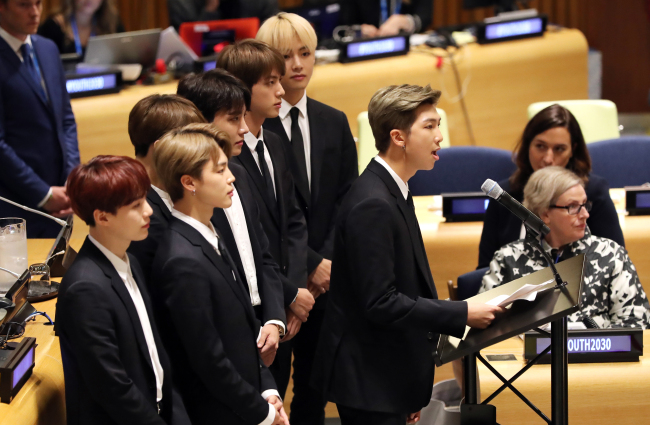
On September 24, 2018, a 24-year-old from Ilsan stood at the rostrum of the United Nations General Assembly in New York, looked out at heads of state, and opened a six-minute speech with a sentence that should have felt clumsy in English and somehow did not: "It is an incredible honor to be invited to an occasion with such significance for today's young generation." That was Kim Namjoon, better known as RM, leader of BTS. He was reading from a script he had drafted himself, and what he said next would end up reprinted in textbooks in South Korea, the United States, Singapore, and Vietnam within two years. This was not the first time a Korean act had brushed against the United Nations, Psy had performed at a UN event back in 2012, but it was the first time a K-pop group had been handed a speaking slot at the General Assembly itself. For anyone working in the K-content business in 2018, this was the moment the soft power conversation stopped being theoretical.
The Speech Did Not Happen By Accident
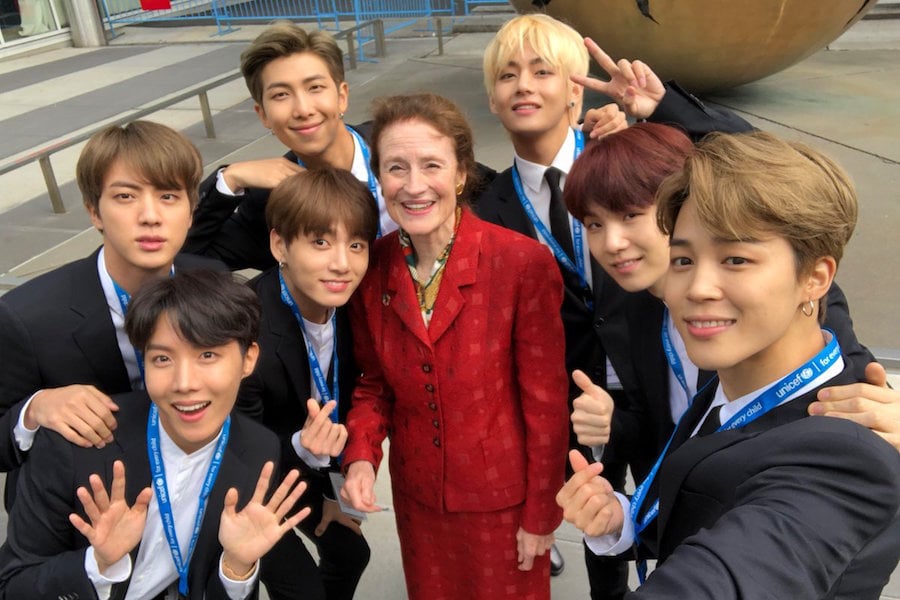
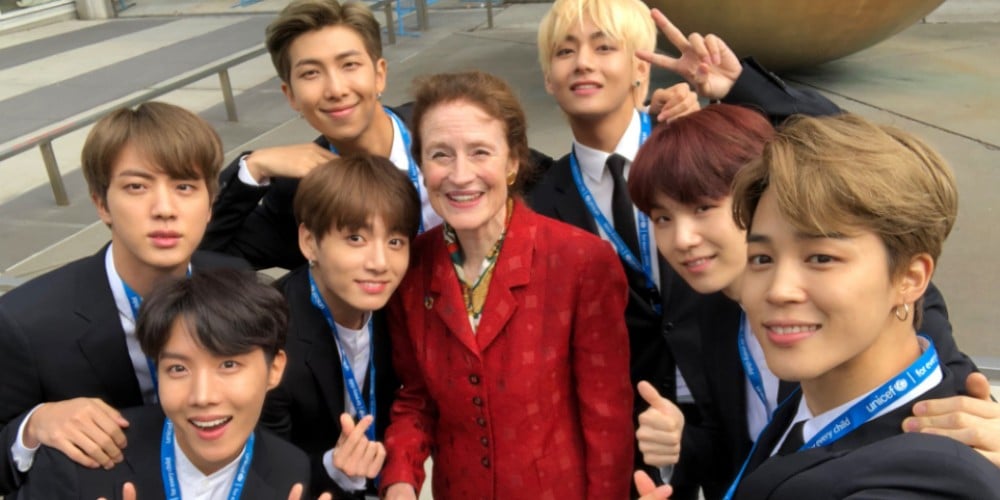
Here is the part most international coverage skipped at the time. BTS did not show up at the UN because the UN was excited about K-pop. They showed up because Big Hit Entertainment (now HYBE) and the Korean Committee for UNICEF had spent eleven months engineering a runway to that exact moment. The two organizations announced the LOVE MYSELF anti-violence partnership on November 1, 2017, complete with a 500 million won (about $447,400) seed commitment from Big Hit, plus 3% of all Love Yourself album sales and 100% of revenue from the campaign's official merchandise. That is not a casual charity gesture. That is a label building an institutional relationship with a UN agency, in writing, with audited revenue streams attached, almost a full year before the General Assembly invitation came through. By the time UNICEF's Executive Director Henrietta Fore introduced BTS at the Generation Unlimited launch, the relationship was already over $1 million deep.
Anyone who has worked on a brand-meets-NGO partnership knows the order this happens in. The NGO does not invite a pop act and then go looking for justifying activity. The activity is built first, then the activity earns the platform. Big Hit's strategic team, led at the time by founder Bang Si-hyuk, understood this with unusual clarity for a Korean label. The Love Yourself trilogy of albums, Her (2017), Tear (2018), Answer (2018), was already mapped to a self-acceptance narrative arc. UNICEF needed a Generation Unlimited launch voice that could speak to youth without sounding like a politician. The fit was not luck. It was the result of two teams choosing each other on purpose, eighteen months out.
Why RM, Specifically
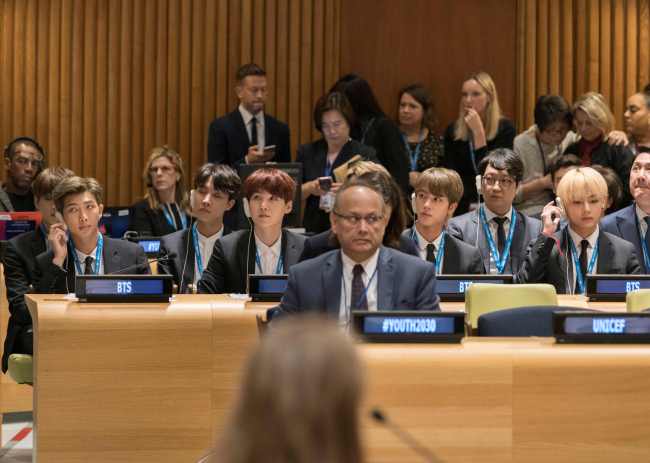
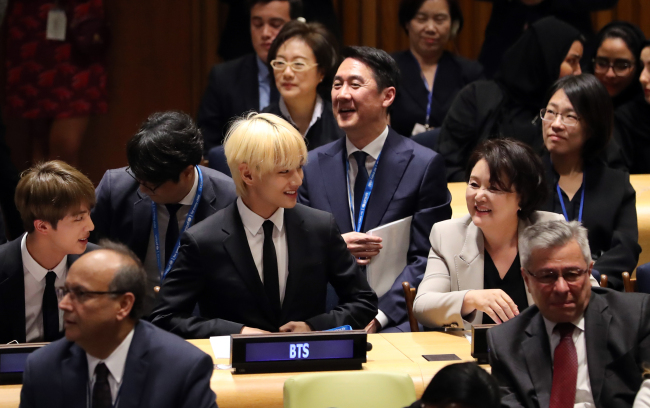
It has to be said because almost no Korean media at the time said it out loud: this was not seven members sharing the spotlight equally. BTS arrived at the UN as a group, sat with the South Korean first lady Kim Jung-sook during the ceremony, and stood behind RM as he delivered the address. But the speech itself was an RM solo, in English, and that was a deliberate Big Hit choice. RM is the only member who had grown up watching American sitcoms (his oft-repeated joke is that he learned English from Friends), the only one with the verbal confidence to deliver an extended, pre-written argument in front of an international audience without a teleprompter crutch. His IQ-as-marketing narrative (the 148 figure that Korean fan media loves to recycle) is partly meme, but the underlying point is real: he is a lyricist by training, the credited writer on the bulk of the group's Korean-language albums, and the member whose vocabulary in Korean already carried the kind of essay-style rhetoric the speech required.
The Love Yourself trilogy concept also mapped onto him more cleanly than onto any other member. Tear and Answer were both shaped around a personal-essay arc he had been writing into the group's discography since 2015's The Most Beautiful Moment in Life series. When UNICEF asked for a speech that would launch their global youth program, the team did not need to translate anyone else's lived experience into the format. RM was already speaking it on the records.

The Soft Power Apparatus Behind the Camera
국위선양 (gugwi-seonyang). The word translates roughly as "raising the prestige of the country," and it is one of those Korean concepts that carries actual administrative weight, not just sentiment. The Korean government has been formally tracking K-content's cultural-export value since the 1998 Kim Dae-jung administration's "Hallyu" white paper, and by 2018 the Ministry of Culture, Sports and Tourism was openly using BTS in its public diplomacy briefings. The first lady's attendance at the UN ceremony was not a casual show of support; it was a deliberate signal that the South Korean state considered the speech part of the country's diplomatic footprint. Within months of the address, the Order of Cultural Merit was awarded to the group, with President Moon Jae-in's office citing the UN appearance as part of the rationale.
This is the part Western pop journalism almost never gets right about K-pop. The export value of the industry is treated as a state-level metric in Seoul. The Korea Creative Content Agency publishes annual reports on Hallyu's economic spillover. When BTS spoke at the UN, the Bank of Korea's research department was already estimating that a single BTS album release generated roughly $4.6 million in cultural-product exports. The 2018 speech embedded the group inside that national-branding apparatus in a way no Korean act had been embedded before. By 2021, the same logic would lead President Moon to formally appoint all seven members as Special Presidential Envoys for Future Generations and Culture, giving them diplomatic passports for the General Assembly trip. That is not a fan honor. That is the Republic of Korea writing a pop group into its foreign service playbook.
What RM Actually Said, and Why It Worked
The 소프트 파워 (soft power) reading of the speech tends to flatten what was a surprisingly personal piece of writing. RM did not deliver a feel-good empowerment pep talk. He opened with a confession, that as a child in Ilsan he had stopped recognizing his own voice. "I tried to jam myself into the molds that other people made. Soon, I began to shut out my own voice and listen to the voices of others. No one called out my name and neither did I. My heart stopped and my eyes closed shut. Like this, I, we, all lost our names. We became like ghosts." Quoted on its own that paragraph sounds dramatic, but in context it was the structural setup for an argument: that he had used music as a sanctuary, that joining BTS gave him a community, and that the Love Myself campaign was the natural outward expression of an inward practice.
He closed with the line that ended up on lecture-hall slides for the next four years: "No matter who you are, where you're from, your skin color, your gender identity, just speak yourself. Find your name and find your voice by speaking yourself." The reason that closing landed harder than the usual UN-platform rhetoric is that it explicitly named gender identity, in 2018, from a Korean pop act. Inside Korean entertainment that was genuinely transgressive. The K-pop industry, at every label level, was famously cautious about LGBTQ-adjacent messaging in 2018. Tiffany of Girls' Generation had only that June published her Billboard open letter thanking the LGBTQ community, and it had been treated as unusually bold. RM said it at the UN, on the record, with the South Korean first lady in the audience. That was not an accident of phrasing. It was a calculated decision about what kind of speech BTS wanted on the historical record.
The Multi-Year Platform Big Hit Built From One Invitation
What looks in hindsight like a single 2018 moment was actually the opening move of a three-act UN engagement. In September 2020, BTS returned via pre-recorded video to address the 75th General Assembly during the COVID-19 high-level event, this time with all seven members speaking in turn from a Seoul stage dressed as the UN podium, in front of a backdrop that mimicked the General Assembly hall. The 2020 message was about pandemic isolation; RM opened with "Two years ago here, I asked your name. I urged you to let me hear your voice." That direct callback to 2018 was the tell, the speech was written to build narrative continuity, not as a standalone press hit.
Then in September 2021, BTS returned in person to the 76th General Assembly as the Republic of Korea's Special Presidential Envoys, performed Permission to Dance in a music video shot inside the UN building, and addressed the SDG Moment event. The continuity is the point. Most pop acts that get a UN moment get one moment. BTS turned a single 2018 invitation into a three-year platform, then into a permanent association in the global public's mind between K-pop and the United Nations. That kind of durability is rare. Lady Gaga, Pharrell, and Shakira have all had UN moments. Few of them have been invited back twice.

The Industry Lesson Other Labels Took Away
Inside the Korean entertainment business the 2018 speech reset what was considered possible. Within eighteen months SM Entertainment had announced a UNESCO partnership for SuperM, JYP was actively pursuing UN agency relationships for TWICE's campaigns, and even mid-tier labels started building NGO-partnership decks into their album rollout plans. The internal logic at HYBE-adjacent labels was clear: a credible humanitarian platform multiplies the perceived ceiling of an act. The act becomes harder to dismiss as a confection, the music gets covered by news desks, not just culture desks, and the act's longevity insurance goes up considerably.
The other lesson was about authorial voice. RM's speech worked because he wrote it. He was not handed a UNICEF communications draft and asked to deliver it. The Korean Committee for UNICEF later confirmed that the speech text was developed in collaboration with the group's own writing, which is industry shorthand for "the artist drafted it and the agency edited for length." That mattered. The speech had RM's actual lyrical fingerprints on it, the recurrent self-questioning, the structural use of his own back catalog as reference points, the Ilsan-childhood specificity. Generic celebrity UN speeches do not get printed in textbooks. The ones that read as personal essays do.
한류 외교, and What the Speech Foreshadowed
한류 외교 (hallyu-oegyo, "Korean wave diplomacy") was a term Korean policy circles had been using since the mid-2010s, mostly in academic settings, to describe how K-content was beginning to function as a form of unofficial state outreach. The BTS UN speech is the moment that concept moved from policy paper to lived practice. The Korean Ministry of Foreign Affairs began including K-pop briefings in its overseas posts within two years. Korean missions to the UN started referencing BTS in their public statements. By the time the group performed inside the UN building in 2021, the line between K-pop diplomacy and Korean state diplomacy had blurred to the point where it no longer made sense to draw it.
What makes this story specifically Korean, and worth taking seriously as cultural history, is that it could only have happened with a state that had decided, twenty years earlier, that cultural exports were a national strategic asset. The 1998 Hallyu policy framework, the Korea Creative Content Agency's funding mechanisms, the Ministry of Culture's content export incentives, all of that infrastructure was sitting there in 2018, waiting for an act that could deliver. BTS delivered. RM, in six minutes of English at a podium in New York, became the public face of a soft-power doctrine the Republic of Korea had been quietly building for half a generation. The speech was the moment, but the apparatus around it was the real story.
Bring Korea Closer with Daebak
Want to bring a little piece of Korea into your life? The Daebak Box is packed with the best Korean snacks, ramen, and cultural goodies delivered monthly to your door.


