


Table of Contents
The first time I sat in a Seoul cafe owned by an idol's brother and watched the manager politely shut down a fan asking for autographs, I understood that the 연예인 카페 (celebrity cafe) business in Korea is not the vanity project Western outlets describe it as. It's a category of small-and-medium F&B that runs on a very specific set of assumptions about how Korean fan economies, real estate, and brand extension actually work, and I've spent more than a decade watching K-pop labels and agencies build around it.
Celebrities owning restaurants is a global phenomenon, but Korea pulls it harder than almost anywhere else. The combination of dense urban geography, a fan culture built around physical pilgrimage, and Korean tax-advantageous treatment of restaurant 사업가 (small-business owner) income makes the math line up in ways it never quite does in Los Angeles or London. Here's the list I send friends visiting Seoul who want to actually understand what they're walking into, not just chase a selfie wall.

Why Korean Celebrities Open Restaurants in the First Place
Start with the actual industry mechanic, because the "celebrities love food" framing misses the load-bearing reason. Korean idol contracts are 7 to 10 years long with profit splits that often back-load earnings, and most actors don't see equity-grade money until their late thirties. Restaurants are how the smart ones diversify out of one-stream entertainment income before their visibility window closes. A cafe in Garosu-gil or a 갈비집 in Gangnam is a real-estate-anchored asset that throws off cash and appreciates with the neighborhood. It's also a Korean-tax-code-friendly small-business structure that absorbs personal staff and family employment in ways an entertainment LLC can't.
The second mechanic, and this is the part that's specifically Korean: the agency or label doesn't usually own the restaurant. A 가족 family member does. The idol or actor is the silent stakeholder and the public face, but the operating entity is usually a brother, a parent, or a 매니저 (manager) who left the agency. That structure lets the artist stay clean of Fair Trade Commission scrutiny over endorsement self-dealing while still benefiting from the foot traffic. It also lets the family inherit a working business if the artist's career stalls. You can read every venue on this list as that pattern in action.
Ossu Seiromushi: BTS' Jin (and his brother Kim Seok Joong)
BTS' worldwide handsome opened 오쓰세이로무시 with his older brother Kim Seok Joong in July 2018, near Seokchon Lake in Songpa-gu and later a second branch near Yeouido. The restaurant specializes in 세이로무시, the Japanese technique of steaming sliced beef and pork over a wooden cypress 蒸籠 lattice with a tower of seasonal vegetables. The cypress is not decoration. It's what keeps the meat juices from going acidic during the steam, and it imparts a faint forest-floor aroma that survives the dipping ponzu. This is technical Japanese cuisine, not a fan trap.
Here's the appeal point that ARMYs sometimes underrate: Jin actively talked food on Eat Jin and his cooking V-Lives long before idol food content was a category. When Bang Si-hyuk himself sent a congratulatory wreath to the opening, that wasn't marketing kabuki. It was a HYBE founder backing one of his artists' family pivot into hospitality. The restaurant has weathered the early ARMY-pilgrimage spike, then the COVID downturn, and is still operating with reservation walls during normal periods. That survival rate, for a celebrity F&B, is rare.
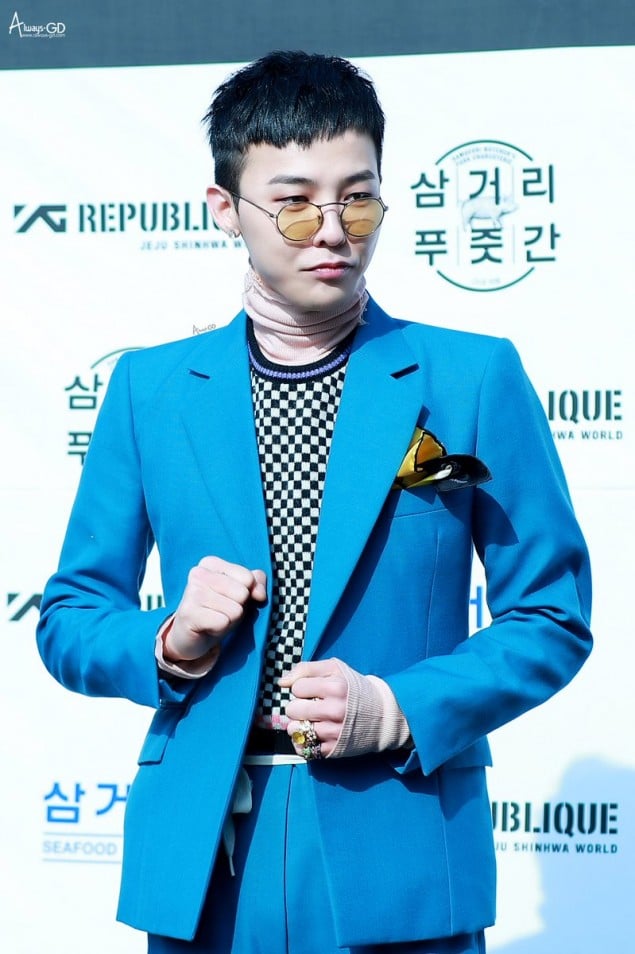
Untitled, 2017: G-Dragon at Jeju Shinhwa World
The reason GD's Jeju cafe was a calculated bet, not a flex, comes down to the venue. Untitled, 2017 sits inside YG Republique, the resort-zone YG Entertainment built into the Shinhwa World integrated resort on Jeju. G-Dragon was the brand ambassador for the entire resort, and the cafe was the architectural anchor: from above, the building reads as the letters G and D overlapping, designed off a sliced and reconstructed music disc. Inside, breathing 'flower' sculptures by Choi Jeong-hwa expand and contract in reference to GD's farewell message before military service ("we'll meet again when the flowers bloom").
The economics: at peak, YG's representatives revealed the cafe was clearing 15 million KRW per day, roughly $13,900 USD, which puts it in the top tier of single-location Korean cafe revenue, well past what a normal Jeju tourist cafe would gross. The cafe has since closed in 2020, which is the other lesson here. Celebrity cafes have a roughly 2 to 3 year half-life as pilgrimage destinations before traffic normalizes. Untitled, 2017 was always a marketing asset for the resort more than a permanent venue, and the YG-side return on construction got recouped fast. Hospitality unit economics still apply: once the novelty wave breaks, you need repeat locals, and Jeju Shinhwa World's location is wrong for that.
Mouse Rabbit: Super Junior's Yesung
If Untitled, 2017 is the case study in "celebrity venue as resort marketing," 마우스래빗 is the case study in "celebrity cafe done patient and right." Yesung and his older brother Kim Jong-jin opened Mouse Rabbit near Konkuk University in 2012, and 14 years later it's still operating, which in the Korean cafe industry is genuinely impressive. The 99 percent of Seoul cafes do not survive a decade. Konkuk Univ. Station foot traffic is the secret: students, K-CON visitors at the nearby KINTEX corridor, and Hallyu tourists overlap on that subway line in a way Gangnam doesn't.
The name is the small detail that gives away the brothers' personal involvement: Mouse Rabbit comes from their birth-year zodiac animals, 쥐 (mouse, 1984 for Yesung's brother) and 토끼 (rabbit, 1987 for Yesung). The basement, branded "rabbit hole," runs as a darker lounge for ELF fans who want photo-op moments; the ground floor is a working cafe for non-fan locals. That dual-tier physical separation is how Mouse Rabbit gets to keep both audiences without alienating either. Yesung later opened a second venue, Cafe Armoire, applying the same playbook in 서촌 Seochon. Notice the geographic spread, not concentration. That's a business operator's instinct, not a fan's.
Studio Concrete: Yoo Ah-in's Hannam-dong Gallery Cafe

Yoo Ah-in's Studio Concrete is the case study for "celebrity venue as creative platform" rather than F&B-first. Opened in 2014 in 한남동 Hannam-dong, the building is a remodeled vintage house with a first-floor gallery and coffee shop, a second-floor workshop and terrace, and a rooftop that frames a clean Namsan view. The collective includes photographer Kim Jae-hoon and artists Kwon Cheol-hwa and Kwon Ba-da, all born in the 1980s, and the space hosts monthly exhibitions of emerging Korean and international artists, many of them never shown commercially before.
What makes this Korean-specifically interesting: Hannam-dong is the neighborhood where Korea's wealth, art-collector, and celebrity-resident demographics overlap most tightly, and Studio Concrete planted itself as the un-glossy node in that map. The first-anniversary exhibition pulled photos from Song Hye-kyo and Song Joong-ki, and the gallery has historically backed Korean Childhood Leukemia Foundation projects. It's the rare celebrity-adjacent venue where the artistic programming would still be worth visiting even if you didn't know who Yoo Ah-in was, which is exactly how a creative space outlasts the celebrity hype cycle.
Cafe Far Ben: RM's Younger Sister Kim Kyung-min in Seongsu
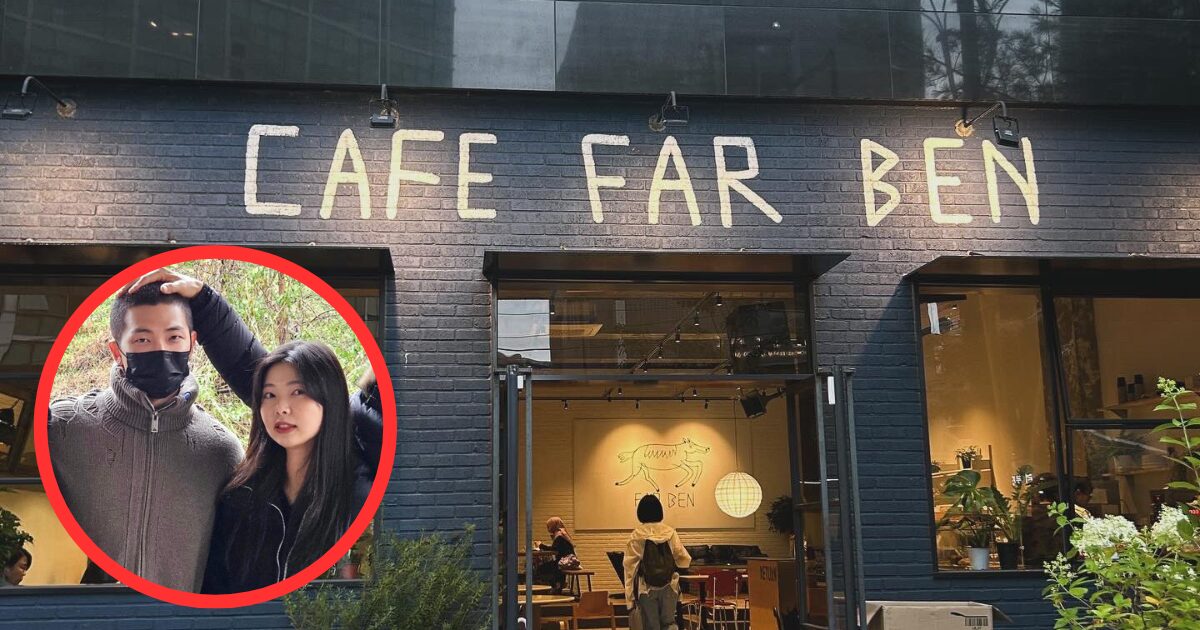
Far Ben is the newest entry on this list and the cleanest example of how the family-first ownership structure I described earlier actually executes. RM's younger sister Kim Kyung-min opened the cafe July 1, 2024 in 성수동 Seongsu-dong, the post-industrial Seongdong-gu neighborhood that has become Seoul's hottest cafe and concept-shop district over the past five years. The location is one block from 1MILLION Dance Studio, which means the customer base is not only ARMY pilgrims but also K-pop trainees, choreographers, and the creative-industry workforce that lives within walking distance.
RM sent a congratulatory flower wreath and the photo of it went viral on Korean Twitter the day the cafe opened. Jimin's father, who runs a separate cafe in Busan, sent his own wreath as a gesture across BTS families. This is the part outsiders miss: the Korean entertainment industry runs on these family-to-family social ties, not on agency-level press releases. The signature menu, the Far Ben Chio (a sweet coffee topped with savory peanuts), is a recognizable Korean-cafe move (sweet plus savory plus textural top note), and it tells you Kim Kyung-min is operating the cafe with a real menu strategy, not just outsourcing the food program. Seongsu real estate is brutally expensive; her staying power will be the test of whether Far Ben joins Mouse Rabbit in the multi-year survivor category.
Mokran: Chef Lee Yeon-bok's Yeonhui-dong Chinese Restaurant
I'm including 목란 even though Lee Yeon-bok is a chef, not an idol or actor, because he is functionally one of the most televised celebrities in Korea and his restaurant operates on the same celebrity-cafe logic at the highest level. Lee is the chef who appeared on JTBC's 냉장고를 부탁해 (Please Take Care of My Refrigerator) and turned 멘보샤 menbosha, a Hong Kong-origin deep-fried shrimp toast, into a Korean household dish. Mokran sits in 연희동, the residential Seodaemun-gu pocket that's quietly become the most prestigious Korean-Chinese fine-dining cluster in Seoul.
The booking dynamics tell you everything about the celebrity-restaurant scarcity premium. Mokran takes reservations by phone only, with no online booking, and Korean food bloggers report having to redial 20 to 30 times to connect. That's not infrastructure failure. It's deliberate exclusivity, the same mechanic Tokyo's Jiro-class sushi counters use. When BTS' Suga walked into Mokran in 2018, Lee Yeon-bok dropped his work and ran upstairs to get an autograph. He's a fan too, which is part of what makes him relatable to Korean audiences. The lesson: in Korea, the line between celebrity-as-customer and celebrity-as-owner blurs, because the same TV ecosystem produced both.
How to Read a Korean Celebrity Cafe Before You Walk In
If you're planning a Hallyu Seoul itinerary and want to use this list well, here's the heuristic I use. First, check ownership structure. If the venue is run by a family member rather than the artist directly, it's almost always more sustainable, because the family operator has to make rent without idol income subsidizing losses. Second, check the year of opening; anything past the 2-year mark has cleared the ARMY-pilgrimage wave and is operating on real F&B fundamentals, which usually means the food is actually good. Third, check the surrounding neighborhood. A celebrity cafe in Garosu-gil or Hannam-dong sits in real-estate-anchored districts where the menu has to compete with strong neighbors. A cafe in a remote resort or a tourist-only zone almost never makes it past three years.
The other thing to know: the idol or actor will almost never be there. The fan etiquette in Korea is that you visit the venue, you don't ask for a sighting, and you absolutely don't ask for photographs or autographs of the owner if they're present. Korean fan culture is highly self-regulating about this, and Western fans who break the rule are usually reminded by Korean fans first. Treat it as a working cafe with a famous shareholder, not a fan meeting venue, and you'll walk away with the real experience these places were built to offer.
Explore Korean Snacks with Daebak
Love Korean food? Get authentic Korean snacks and ramen delivered straight to your door with the SnackFever Box by Daebak.


