


Table of Contents
K-Beauty is not a vibe anymore. It is a $14 billion industry. Korea's 화장품 (cosmetics) sector cleared roughly 14 trillion won in 2024 and pushed about $10 billion in cosmetics exports offshore, with the US taking the top spot at over $2 billion. That is a shift most Western beauty press still under-covers. What started as an "OMG snail mucin" TikTok obsession has quietly become a top-five global cosmetics export category, sitting alongside French luxury houses and Japanese giants. This piece is the industry breakdown, from a K뷰티 industry perspective, on the brands that actually built the playbook: Innisfree, Etude House, Laneige, Cosrx, Sulwhasoo. What worked, what stopped working, and what the next five years look like from inside the 아모레퍼시픽 orbit.
Why K-Beauty exports quietly became a $10 billion category
Start with the numbers, because most coverage skips them. Korean cosmetics exports hit roughly $10.2 billion in 2024, up from about $7 billion in 2023, and Korea overtook the US as the world's No. 2 cosmetics exporter behind France. The US alone accounted for $2.2 billion of that, up 15 percent year-over-year, which is the moment Korean beauty stopped being a niche category on r/AsianBeauty and became a fixture at Sephora, Ulta, Target, and Amazon Prime Day. Amazon Prime Day 2024 had Cosrx's Advanced Snail 96 Mucin Power Essence at No. 1 in beauty and personal care, full stop. That is not marketing spin. That is a Korean 스킨케어 SKU beating out established Western brands on the biggest US retail day of the year.
Two companies still dominate this ecosystem inside Korea: Amorepacific and LG Household and Health Care, which together account for roughly 65 percent of Korean cosmetics revenue. The other 35 percent is where things get interesting, because that is the indie founder-led corner where Cosrx (2013), Beauty of Joseon, Anua, Numbuzin, and Skin1004 built product-first, D2C-heavy businesses that skipped the traditional duty-free retail model entirely. When people say "K-beauty is having a moment," what they usually mean is "these indie founder brands are eating into a market that used to belong to duty-free tourists from China." The real industry mechanic behind it is that when Chinese tourism collapsed in 2018 to 2020, Korean cosmetics companies had to build a US and global e-commerce muscle almost from scratch. The pandemic-era Chinese retreat forced a US-first pivot that arguably would have taken another five years without the crisis. That is the story most Western beauty editors miss.
Innisfree (2000): the Jeju natural playbook every K-beauty brand copied
Innisfree launched under Amorepacific in 2000 with a very specific positioning bet. Natural ingredients sourced from Jeju Island. Green tea from Amorepacific's own Jeju tea garden (which had been running since the 1970s, not incidental to the brand story), volcanic clay, camellia oil, tangerine, orchid. The name "Innisfree" comes from a W.B. Yeats poem about a peaceful island, and yes, the naming choice was intentional even in 2000 when nobody in Korea was thinking about global K-beauty exports. Nine years in, Innisfree rebranded around "Natural Benefit from Jeju" (2010) and became the OG K-beauty export template. By 2018, it had roughly 1,790 stores globally, and every other Korean brand from Nature Republic to The Face Shop was chasing the same Jeju-natural aesthetic.
Then the model broke. Innisfree's annual Korean sales dropped from 552 billion won in 2019 to 225 billion won last year. Domestic offline stores fell from 1,600 in 2018 to 147 in 2025. The 2023 rebrand cut the product line from 1,400 items to about 300 and killed a lot of legacy bestsellers. What actually happened is that the Jeju natural story got saturated (Innisfree lost differentiation as competitors copied it), Chinese tourist traffic evaporated, and Korean Gen Z shifted to ingredient-first thinking. They want to know it has PDRN or ceramides, not that it came from a specific island. Amorepacific pulled Innisfree from North America in 2021, then quietly rebooted it via Amazon and Ulta in 2023 with a repositioned "sensitive-skin natural" story. The Innisfree lesson is that heritage stories age fast in K-beauty. A brand narrative that carried you for 15 years might need a total rebuild by year 20. That is the Amorepacific balance sheet talking.
Laneige BB Cushion (2008): the most-copied K-beauty invention ever
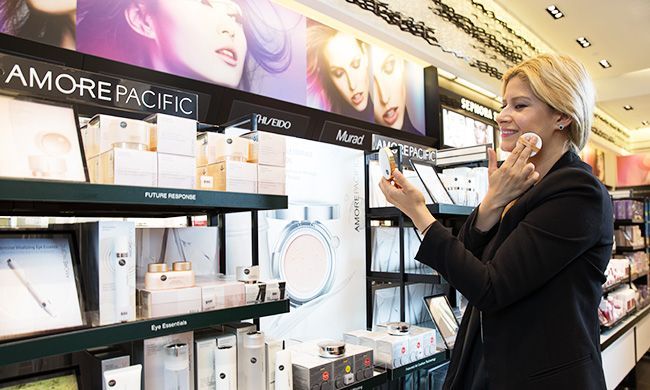
Ask anyone in cosmetics R&D what the most influential Korean beauty product of the last 20 years is. The answer is the cushion compact. It launched under Amorepacific's IOPE brand in 2008 (the very first was IOPE Air Cushion), moved to Laneige as the Laneige BB Cushion in 2012, and by mid-2014 the Laneige Snow BB Soothing Cushion had sold so many units that stacked, the tower would have been 13 times the height of Mt. Everest. Not hyperbole. That is Amorepacific's own accounting. In 2016, Amorepacific reported that total cushion compact sales across its 15 brands had crossed 100 million units, with one unit sold globally every second.
Why did this specific format matter? Because it solved a real product problem. How to deliver liquid foundation with SPF and skincare active ingredients in a portable, one-swipe application. Before the cushion, women were carrying separate foundation bottles, sunscreens, and sponges. The cushion collapsed all of it into one pump-and-pat compact with a polyurethane foam sponge that stayed saturated for months. Fenty, MAC, Chanel, Lancome, and Bobbi Brown all launched cushion products by 2018, all effectively riffing on the format Amorepacific invented. Amorepacific holds 26 registered patents on cushion technology and has filed for 177 more. The industry mechanic here is under-appreciated. This is one of the few times a Korean beauty company invented a product format that Western luxury houses had to chase, rather than the reverse. Laneige BB Cushion sits on the same tier as Estee Lauder inventing "night cream" in the 1960s, in terms of category creation.
Cosrx (2013): the Amazon-first indie brand that skipped duty-free
Cosrx is the case study Western beauty press finally caught up with in 2023 to 2024. Founded in 2013 by Jun Sang-hun (who reportedly built the brand because he could not find products for his own sensitive skin), Cosrx skipped the entire duty-free plus department store dance that Amorepacific brands relied on for two decades. Instead: Amazon-first, minimal packaging, low SKU count, and a marketing strategy built entirely around specific active ingredients rather than heritage stories. The Advanced Snail 96 Mucin Power Essence is 96.3 percent snail secretion filtrate. That is it. No hero founder story, no Jeju vibe, no BLACKPINK ambassador for the first ten years. Just the ingredient and the price ($19 for 100ml, unheard of in K-beauty at that quality tier).
By 2021, Cosrx had won Korea's $70 million export award and was doing over 80 percent of sales internationally. In 2024, Kolmar BNH acquired Cosrx for roughly 1.85 trillion won, one of the biggest K-beauty M&A deals ever, and the Snail 96 Essence topped Amazon Prime Day beauty. What the Cosrx story shows industry-wise is that the old K-beauty distribution model (duty-free plus Chinese tourist buying blocks plus store network) was actually a distribution constraint, not a moat. When indie founders skipped it and went straight to Amazon plus TikTok plus Sephora US, they broke through faster than Amorepacific and LG H&H did with their in-house challenger brands. That is why every K-beauty company under the sun is now rebuilding around D2C. Watch Beauty of Joseon (2016), Anua (2018), and Skin1004 (2016) follow the same playbook over the next three years. All three are already climbing the Amazon best-seller lists and none of them are attached to a chaebol.

Etude House and Sulwhasoo: the MZ trap and the heritage revival
Two brands sit on opposite ends of the Amorepacific portfolio and both tell you something important about the K-beauty industry. Etude House launched in 1997, opened its first road-shop store in 2005, and by 2016 had 525 stores in Korea and 232 abroad. It was the pink-pastel princess brand that owned early K-beauty's MZ세대 imagination. Then it hit a demographic wall. As those Etude customers aged out of pastel-cute packaging and into ingredient-driven skincare in their late 20s and 30s, Etude House did not follow them. Etude sales dropped from around 300 billion won in 2016 to under 100 billion won by 2020, and the brand hit capital impairment in 2021 (the only Amorepacific subsidiary to do so). It was the most public example of "cute packaging plus low-price offline distribution" failing when Gen Z showed up with different priorities.
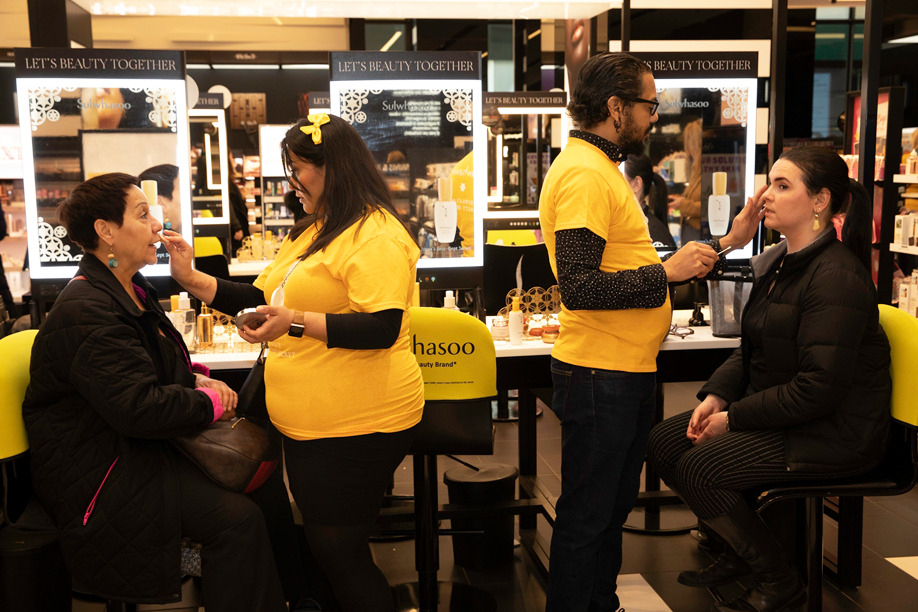
Sulwhasoo is the opposite bet. Founded in 1966 under Amorepacific (the original Amorepacific founder started ginseng cosmetic experiments in 1954), Sulwhasoo is the premium "hanbang" (한방, traditional Korean medicine) heritage play. Ginseng, pine, plum blossom, camellia. First Care Activating Serum (윤조에센스) is the flagship, with roughly 1.6 million bottles sold in peak years. What is interesting is Amorepacific's 2022 to 2023 reboot. It dropped the Chinese hanja logo for an English one, hired BLACKPINK's Rose (later Yoona from Girls' Generation) as global ambassador, and opened Sulwhasoo counters at Macy's Flushing, Santa Anita, and South Coast Plaza in 2025. Sulwhasoo's US revenue has grown roughly 20 percent annually for the last three years. The takeaway: premium heritage K-beauty (Sulwhasoo, Sum37, The History of Whoo) is quietly winning the US market by borrowing luxury Western strategies (K-pop ambassadors, Sephora and Macy's placement, story-first packaging) while keeping the actual 한방 formulation heritage intact. That is a much harder trick to pull off than most Western brand editors realize, and it is why the Rose Sulwhasoo campaign moved the needle in a way generic influencer marketing never would have.

What K-Beauty looks like in 2027 and 2028
Industry insider take from watching this space for over a decade. Three shifts are already locked in. First, Amorepacific and LG H&H's collective 65 percent share will keep drifting downward toward 50 to 55 percent as indie founder brands scale. That is not a crisis, it is just structural. Kolmar Korea and Kolmar BNH (the ODM side) are actually the quiet winners here, because indie brands need contract manufacturing at scale, and Kolmar plus Cosmecca produce for both incumbents and challengers. Second, the "K-beauty as ingredient story" era is only just beginning. Snail mucin was the on-ramp product. PDRN, exosomes, cica plus centella, tranexamic acid, Yunjac's "Fitting Glue" biopolymer, and Ginsenomics from Amorepacific's Johns Hopkins collaboration are the next wave. Expect Korean brands to file 30 percent more cosmetic ingredient patents in 2027 than in 2023 (they already lead the world on this metric). Third, the US will keep being the growth engine. Chinese sales are structurally down and Amorepacific has been public about "reducing dependence." Watch for K-beauty exports to the US to cross $3 billion in 2027, roughly 27 percent of total K-beauty exports.
The reason all of this matters, beyond the numbers, is that K-Beauty pulled off something rare. A national cosmetics industry that innovated a new product format (the cushion compact), a new ingredient story (Jeju natural, then snail mucin, then PDRN), and a new distribution model (Amazon-first D2C) all within 25 years. France took a hundred and fifty years to build LVMH-tier beauty. Korea did it in one generation, and the industry is now moving fast enough that Sephora US is regularly beating Sephora France to the newest Korean launches. That is the industry story worth watching.
Explore Korean Beauty with Daebak
Discover the best of Korean skincare and beauty with the K-Beauty Box by Daebak, handpicked from Seoul and delivered to your door.


