

Table of Contents
Here is the honest read from someone who has watched Korea's convenience-store food business grow up in real time: 편의점 (pyeonuijeom) stopped being a snack pit stop somewhere around 2015 and turned into the country's most efficient meal delivery system. CU, GS25, 7-Eleven, and Emart24 now run 55,000+ stores across the peninsula, and the convenience-store retail category cleared roughly ₩26 trillion in 2023 domestic sales, with prepared food the fastest-growing line inside that number. A student can walk into any GS25 at 2 a.m. and build a hot, layered, actually satisfying meal for under ₩8,000. That is not a stunt. That is the operating baseline.
Why 편의점 food is a real ecosystem, not a snack stop
Skip the tourist framing that treats CU and GS25 as novelty photo ops. The industry mechanic that matters: Korea's Big Three convenience chains (CU under BGF Retail, GS25 under GS Retail, and 7-Eleven under Lotte) fight for market share by turning every store into a mini-kitchen. Each chain runs proprietary 도시락 (dosirak) lines with celebrity chef collaborations, exclusive 컵라면 flavors you cannot get in a supermarket, and hot food counters selling 오뎅 broth by the ladle. GS25's Kim Hye-ja dosirak, the ₩3,900 lunchbox launched in 2010 and reformulated for 2020s health trends, still hits 100,000 units sold per week on peak days. That is not a snack line. That is Korea's largest ready-meal channel, running on operator margins tighter than any restaurant kitchen.
Where this becomes appeal for the international reader: everything is engineered for hot, immediate combining. Every store has a microwave, hot water dispenser for cup ramyeon, plastic scissors, chopsticks, and a standing counter with a view of Seoul, Busan, or Jeju out the window. Koreans do not eat this food in embarrassment. This is where after-hakwon high schoolers refuel, where salarymen do a quick 소주 after a client meeting, where K-drama script writers plot the next crash-out scene. Post-2015 the whole category leveled up when 정용진 pushed Shinsegae's premium 편의점 concept, GS25 opened the Ttang cuisine event in Gangnam, and CU launched the 라면 라이브러리 at Hongdae with 200+ instant-noodle SKUs on one wall. If you want to understand modern Korean food culture without booking a K-food tour, walk into any 편의점 and start combining.
Combo 1: 삼각김밥 (samgak-gimbap) plus 컵라면 (cup ramyeon), the base layer everyone starts with
This is the entry combo, the reason most Koreans have muscle memory for peeling back the numbered plastic wrap on a 삼각김밥. The mechanic: a triangular rice packet with a filling in the center (참치마요, 스팸구이, 전주비빔, 김치, 진짜 too many to list) engineered by a Japanese design filed in the 1980s so the seaweed 김 stays sealed away from the rice in two thin plastic sheets. You pull tab 1 to release the seal, tabs 2 and 3 to remove the side wrappers, and the 김 wraps itself around the rice in a single motion. Crisp, warm rice, ₩1,200. Pair it with a cup 컵라면 (Shin Ramyun cup for the go-to, Yukgaejang cup for the peppery beef broth, Nongshim's Kimchi cup for the fermented tang) heated in the same 3 minutes of hot water. Total meal cost: ₩3,500. Time from door to first bite: 4 minutes.

The appeal point that gets lost when foreigners try this at home: it is not the individual items, it is the ritual of building the plate at the standing counter. You unwrap the triangle, crack the cup ramyeon lid, pour hot water, set your phone timer for 3 minutes, unwrap the second triangle (nobody eats just one), and then you have a working meal without having sat down. The Korean high school kid on the way to 학원, the tour bus driver on a shift break, the tourist who missed their reservation, they all end up eating the same thing. That flattening is part of the appeal. It is one of the few remaining truly egalitarian spaces in Seoul food.
Combo 2: Cheese on 신라면, the ₩1,500 upgrade that saves a bad night
Every 편의점 sells sliced processed cheese in the refrigerated case near the sausage. Buy a Shin Ramyun cup, add hot water, wait 2 minutes, tear open a slice of cheese, drop it on top, stir until it half-melts into the broth, done. The salt of the cheese mellows Shin Ramyun's aggressive gochujang heat, the fat coats the noodles, and the whole thing tastes like a Korean-Italian fusion dish that cost ₩3,200 total. Add a boiled egg from the counter for ₩1,000 and now you have protein. Add a slice of Spam from the small can for ₩2,500 and you have basically built a personal 부대찌개 in a paper cup.
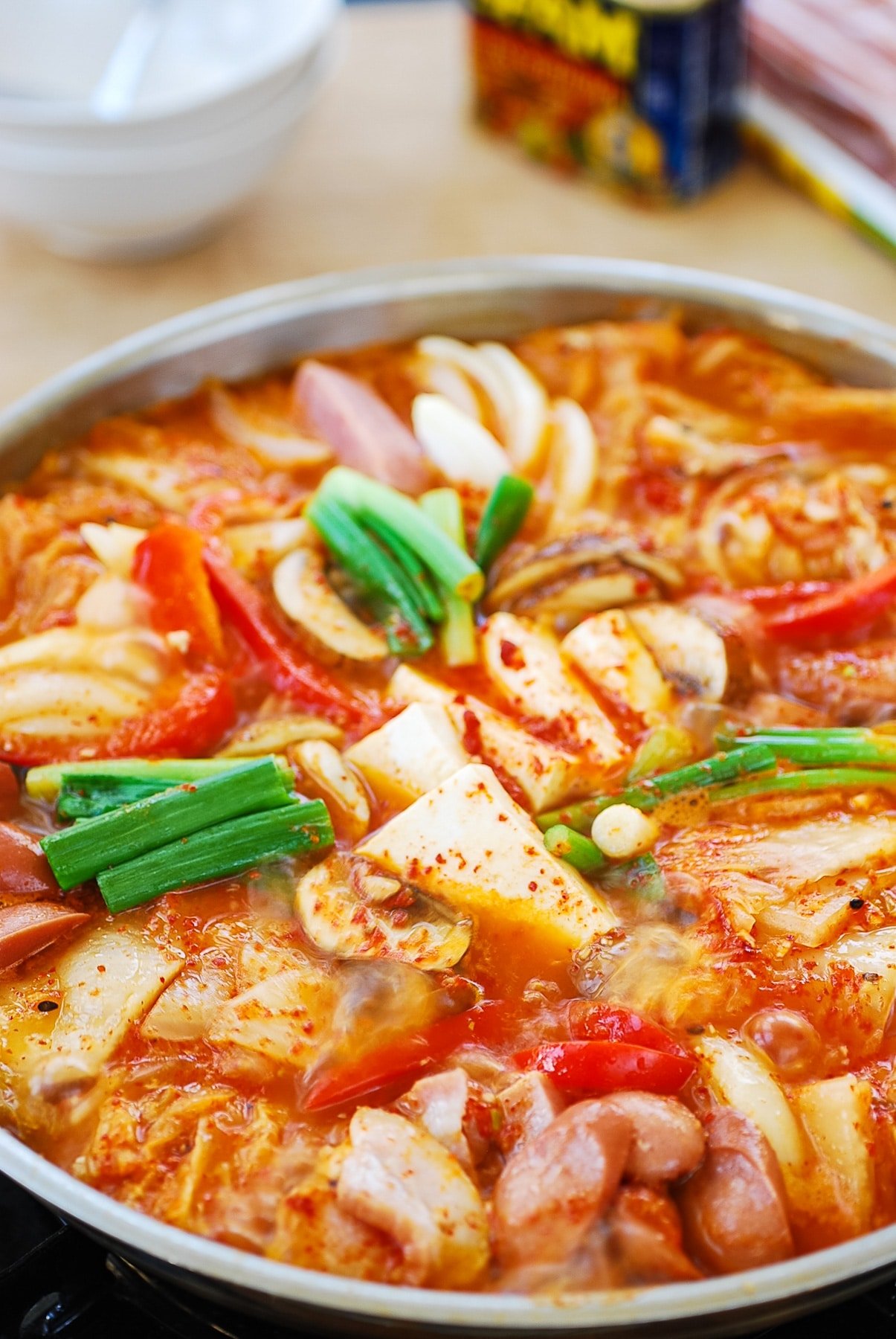
The lineage matters. 부대찌개, the Uijeongbu army-stew tradition of stretching surplus Spam and hot dogs with kimchi and ramen noodles that emerged after 1953, is the direct ancestor of this convenience-store shortcut. When Koreans drop a slice of cheese into a Shin Ramyun cup at 1 a.m., they are running a compressed home version of a dish their grandparents built in cast-iron pots. What makes it specifically Korean is that nobody pretends otherwise. The convenience-store version is honest about its lineage. Contrast with American ramen hacks, where cheese-on-noodles gets treated as a joke; here it is a legitimate technique with 70 years of history behind it.
Combo 3: 도시락 fixed with 참기름 (sesame oil) and 김 (nori), the microwave rescue
The chain 도시락 lines (GS25 Kim Hye-ja, CU HEYROO, 7-Eleven's Yoo Jae-suk lunchbox) run at a price point (₩3,900 to ₩5,900) that requires the manufacturer to skip flavor-expensive ingredients like fresh 참기름 (sesame oil) and 조미김 (seasoned seaweed). Here is what fixes it: buy the dosirak, buy a small ₩1,500 bottle of 참기름 from the cooking-oil aisle or grab a single-serve packet from the seaweed section, buy a stack of 김자반 or 조미김. Microwave the dosirak for 2 minutes 30 seconds, open the lid, drizzle a teaspoon of 참기름 across the rice and the 반찬 (side dishes), sprinkle 김자반 across the whole surface, close, wait 30 seconds so the aromatics bloom in the residual heat, then eat.

Why this hack works better than it should: 참기름 has a low smoke point but a huge aroma payoff at just-warm temperatures. Adding it to microwave-hot rice is basically the trick every Korean grandmother uses in a 비빔밥 stone bowl, compressed into 15 seconds. The 김자반 (crumbled seasoned nori mixed with sesame seeds and a little sugar) adds a savory-sweet umami crunch that no factory-sealed dosirak can hold on to for 24 hours. Total spend to upgrade a ₩4,900 lunchbox to something that tastes homemade: about ₩2,000 in condiments that will last you a week of visits. This is the trick that Korean office workers pass down like inside knowledge.
Combo 4: 편의점 오뎅 (eomuk) with soju, the cold-weather standing-counter meal
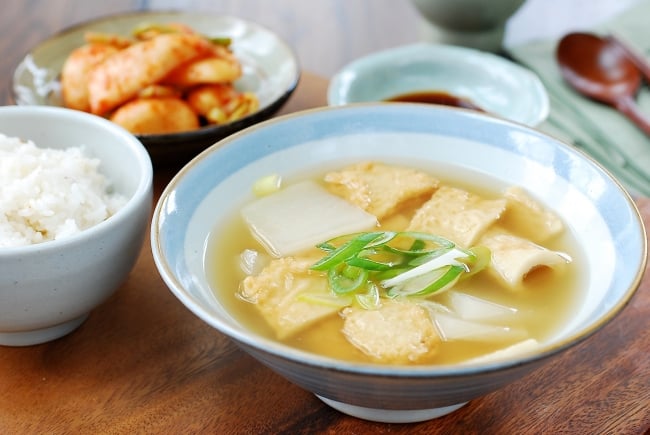
Winter in Seoul between November and February, walk into any GS25 or CU after 8 p.m. and there is a hot bain-marie at the counter with skewered 오뎅 (fish cake) simmering in a light dashi-anchovy broth. Pull a stick, dip it in the soy-mustard sauce on the counter, ladle broth into a paper cup, drink the broth between bites. The 오뎅 is Busan-style processed fish paste on a wooden skewer, ₩1,000 to ₩1,500 per stick. Pair with a small green-bottle 소주 (roughly ₩2,000 at the register) and you have built the world's most efficient winter drinking snack for under ₩5,000. This is what your Korean coworker means when they text at 9 p.m. saying 편의점에서 한잔 할까.
The specifically Korean part: it is a legitimized public drinking format. Nowhere in Tokyo can you crack a beer at a Family Mart standing counter without looks. In Seoul it is normal, it is priced for it (2,000 won soju, glass provided), and the store often has a heater under the counter in winter. This is the appeal point that always gets lost in international coverage of K-food: it is not just about the dishes, it is about the low-friction access to a shared social ritual. A ₩5,000 오뎅-and-소주 pit stop replaces a ₩50,000 pojangmacha tent, and both are considered valid.
Combo 5: 편의점 커피 plus 훈제 계란 (smoked egg), the breakfast that runs on 5,000 won
Every 편의점 has a bean-to-cup machine (GS25's Cafe25 is the most reliable) pouring 1,500 to 2,000 won lattes and Americanos. The counter fridge has vacuum-sealed 훈제 계란 (smoked eggs, roughly ₩1,000 each), sometimes labeled as 반숙 훈제 계란 for the soft-boiled variety. Combine one Americano, two smoked eggs, one 바나나맛 우유 for the sweet chaser. Total: ₩5,000. The protein-to-caffeine ratio hits harder than any hotel breakfast for a fifth of the price, and the smoky flavor on those eggs (they are actually smoked, not just brown-dyed like you might assume) plays surprisingly well against black coffee.
The Cafe25 machine, incidentally, brews with beans that GS Retail sources from Ethiopia and Guatemala. The chain sold 300 million cups in 2023 alone, which puts it ahead of Ediya and gaining on Starbucks Korea in raw volume. That is not a novelty side counter, that is a top-five coffee player hidden inside a convenience-store chain. Post-COVID, when office workers stopped grabbing ₩5,000 to ₩6,000 chain cafe drinks on the way in, convenience-store coffee absorbed the demand, and it has not given it back. This is one of those quiet retail shifts that gets covered in the 컨슈머 pages of Korean business papers but rarely surfaces in the K-food international coverage.
The Kdrama moment that seeded all of this internationally
Non-Korean interest in 편의점 food really moved from curiosity to obsession after "My Love from the Star" in 2013 to 2014, when Jun Ji-hyun's Cheon Song-i character kept eating fried chicken and 삼각김밥 combos on screen. The specific triangle-gimbap scene at a Seoul convenience store went viral across Chinese and Southeast Asian fandom sites in early 2014, and Korean travel authorities noticed export spikes in 삼각김밥 packaging materials shortly after. Since then, every K-drama with a convenience-store scene, from "Backstreet Rookie" to "Extraordinary Attorney Woo" to "Twenty-Five Twenty-One," has functioned as unpaid marketing for the CU and GS25 supply chain. The Kdrama placement is not accidental. CU maintains a formal product-placement team that negotiates directly with production companies for on-screen dosirak and cup ramyeon shots.
My honest read from the industry side: the reason Korean 편의점 gourmet has become an actual global category rather than a novelty is that Korean brands nailed the packaging design a decade before Western retail caught up. The two-sheet 삼각김밥 wrap, the vented dosirak container that microwave-steams without sogging, the paper-cup broth format that survives a 15-minute walk home, this is engineering-level product design applied to ₩3,000 meals. Everyone else is playing catch-up. If you visit Seoul in 2026, spend an afternoon systematically working through a CU or a GS25 the way you would a food hall. It is one of the most efficient education-per-won experiences available in Korean food culture right now.
Explore More of Korea with Daebak
Want to bring a little piece of Korea into your life? SnackFever is packed with the best Korean snacks delivered monthly to your door.


