


Table of Contents
The Korean fast food market is one of the more interesting case studies in global QSR (quick service restaurant) strategy, and I have spent about a decade watching it from a Hallyu industry seat, tracking how the burger scene tracks the country's broader consumer mood. If you show up in Seoul assuming Korean fast food means the same three US chains you get everywhere else, you are missing the whole story. The domestic chains are bigger, weirder, and more strategically aggressive than most visitors realize, and the international players spend real R&D money on Korea-only menus that then get exported to other markets. The Korean 패스트푸드 (paseuteupudeu, fast food) category cleared roughly $3 billion in annual sales as of 2025, per Euromonitor data reported by the Korea Herald, and it is one of the few restaurant categories that actually grew coming out of the pandemic instead of consolidating.

Lotteria, the OG 롯데리아 That Refused to Die
Lotteria (롯데리아) is where any honest tour of Korean fast food has to start. Opened in Seoul in 1979 under Lotte Group's food arm, it is the domestic incumbent that everyone else measures themselves against. The signature product is the 불고기버거 (bulgogi beoger, bulgogi burger), a sweet-savory soy-and-garlic marinated beef patty that Lotteria essentially invented as a category in 1992. That single menu item is the reason Lotteria survived when McDonald's and Burger King came in and vaporized most of the other Asian burger chains through the 1990s. Lotteria did not try to out-American McDonald's. It built a menu that tasted like Korean home cooking wrapped in a bun, and Korean consumers rewarded it with about 1,300 stores at peak, a number that puts it in league with the biggest Western chains in the country.
Here is the industry mechanic most guidebooks skip. Lotteria went through a genuinely rough patch between 2018 and 2022, with revenue at parent Lotte GRS dropping from over 1 trillion won in 2017 to 675.7 billion won in 2021 during COVID. The 2018 to 2020 slide was not really about food. It was about brand perception. Lotteria's image had aged into "the burger you eat because you had no other choice at the highway rest stop." The comeback since 2023 is a case study in Korean corporate rebranding: new "Taste the Fun" slogan, redesigned stores, chef collaborations, and menu drops that treat the burger as a canvas for Korean regional flavors. The Jeonju bibimbap rice burger sold 800,000 units in its first month. The squid alive burger sold 700,000 units in 11 days. These are not accidents. Lotte GRS is running its menu R&D like a K-drama writers' room, engineering hits with clear appeal-point hooks.
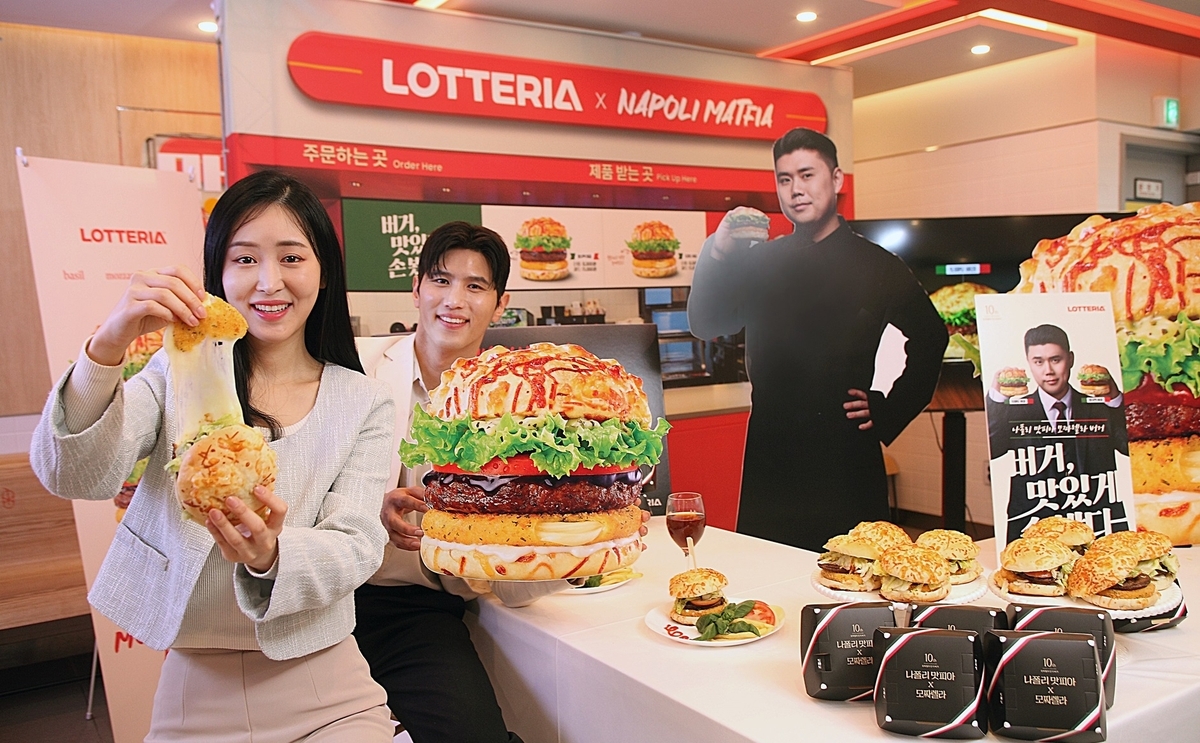
The appeal point Western fans miss about Lotteria: it is not competing with McDonald's on price or speed. It is competing on emotional familiarity. When a middle-aged Korean uncle walks into a Lotteria at 11 p.m. after work, he is not there for novelty. He is there because the 새우버거 (saeu beoger, shrimp burger) tastes exactly like it did in 1998. That kind of taste-memory economics is what let Lotteria expand into Vietnam, Cambodia, Myanmar, Laos, and Mongolia with roughly 320 overseas stores as of 2025, and finally debut a US drive-through in Fullerton, California in August 2025. The Fullerton opening had customers queuing at 5 a.m., which is the kind of buzz most K-pop label debut showcases would kill for.
맘스터치 (Mom's Touch), the Volume-Tier Disruptor
Mom's Touch is the chain that quietly beat Lotteria at its own game between 2019 and 2022. Founded in 2004, the brand built its entire pitch around one insight: Korean consumers prefer 닭다리 (dakdari, chicken thigh) to breast meat, and no other burger chain was giving them a bone-in-worth thigh in a bun. The 싸이버거 (Ssai beoger, Thigh Burger) uses a full spicy-fried chicken thigh as the patty, which is enough meat that the bun basically holds on for the ride. Priced around 4,000 won, it hit the sweet spot for high-school and university students, and Mom's Touch became the fastest-growing burger franchise in Korea through the late 2010s. By January 2025 the chain had 1,450 domestic stores, edging past Lotteria's roughly 1,300 store count and making it the largest burger franchise in Korea by unit count.

The strategic move that put Mom's Touch on the global map was Shibuya. The chain opened a Tokyo store in April 2024, and it pulled over 700,000 visitors and generated more than 5 billion won in first-year sales, per Korea Herald reporting. That is a genuinely bonkers number for a single fast-food unit, and it worked because Mom's Touch cracked the same code that BTS and BLACKPINK cracked in the Japanese market: do not water down for local taste, lean harder into the Korean-ness. The Thigh Burger in Shibuya is spicier than the Korean base version, not milder. That is the opposite of how McDonald's usually enters a new country, and it is the deeper reason Mom's Touch is now planning a Harajuku flagship in September 2025 as their global largest outlet. The brand read the Japanese K-culture consumer correctly: they want the authentic thing, not the softened export version.
노브랜드버거 (No Brand Burger), Shinsegae's Value Bomb
No Brand Burger is the disruptor that scared both Lotteria and Mom's Touch when it launched in August 2019. The brand sits under Shinsegae Food, itself part of the Shinsegae Group that also runs E-Mart, and it is essentially the burger extension of the No Brand private-label strategy E-Mart used to compete with Costco. The pitch: a burger for around 2,800 to 3,500 won, roughly 40 to 50 percent below what McDonald's and Lotteria charge for a comparable set, with quality that does not embarrass itself. In an inflation-anxious Korean market where 최저가 (choejeoga, lowest price) sensitivity is a real consumer force, that math worked. No Brand Burger hit around 250 domestic locations by 2024, and it kept expanding even during periods when the broader QSR category was flat.
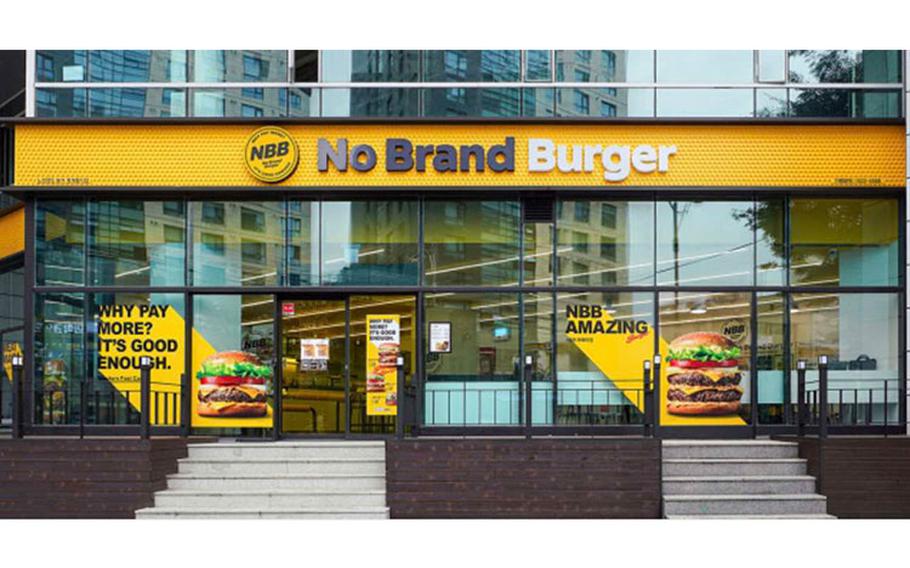
Here is what makes No Brand's positioning genuinely interesting for anyone watching food retail. Shinsegae Food is not treating burgers as its main event. It is using the chain as a distribution channel for E-Mart's private-label supply chain: house-brand cheese, house-brand buns, house-brand patties, all leveraging the same procurement infrastructure that gives E-Mart's regular No Brand groceries their price advantage. The Amazing Bulgogi burger launched at 2,500 won in early 2026 is the sharpest expression of that vertical integration, and it is a direct challenge to Mom's Touch's volume-tier grip. What foreign fans should notice is that this is not fast food fighting fast food. It is a retail chaebol using its supply-chain scale to squeeze the burger category from underneath, and it is working.
Kraze Burger, and Why Premium Fast Food Died in Korea
Kraze Burger is the cautionary tale that every Korean QSR strategy team studies. Founded in 1998, Kraze positioned itself as Korea's answer to Johnny Rockets, a premium sit-down burger experience with table service, milkshakes, and 8,000 to 12,000 won prices at a time when Lotteria was charging 3,000 won for a bulgogi burger. At peak in the early 2010s, Kraze ran roughly 100 stores across Korea and had a genuinely fashionable brand attached to Gangnam and Apgujeong-dong retail addresses. Then it collapsed. Overseas expansion into the US failed. Competition from Shake Shack (which opened in Gangnam in 2016) and homegrown premium burger operators ate the top of the market. Liquidity dried up by 2016, and LF Food picked over the corporate carcass in October 2017 for about 1 billion won, mostly for the trademark. By 2020 the domestic Kraze footprint was essentially gone.
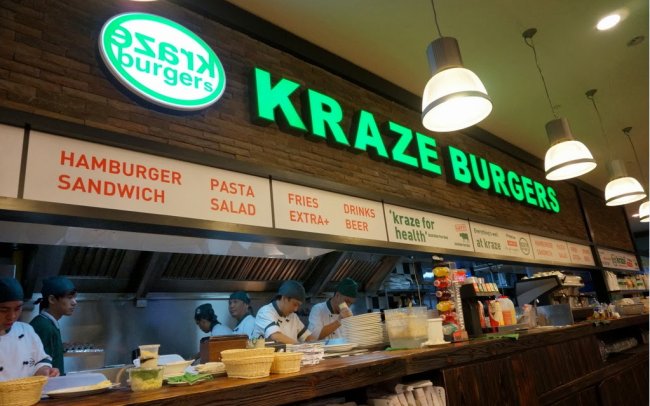
The lesson Kraze taught the industry: Korean fast food does not sustain a premium tier the way the US market does. Korean consumers who want premium burgers will pay 15,000 won for Shake Shack or 20,000 won for an indie craft-burger spot in Itaewon, but they will not pay 10,000 won for a chain-brand table-service burger. The middle price bracket is empty, and it stays empty. Every player who has tried to occupy it since 2017 (including LF Food's attempted Kraze revival) has lost money. The Korean burger category structure is now barbell shaped: volume tier (Mom's Touch, Lotteria, McDonald's, Burger King around 5,000 to 7,000 won), value tier (No Brand Burger around 2,800 won), and premium tier (Shake Shack, boutique operators above 12,000 won). The middle got squeezed out by consumer math, and no strategy team has cracked it since.
How McDonald's, Burger King, and KFC Rebuilt Themselves for Korea
The global chains in Korea are not the same brands you know from the US or Europe, and this is the part most travel writers get wrong. McDonald's Korea returned to profitability in 2024 with 11.7 billion won in operating profit on record 1.25 trillion won revenue, mostly on the strength of its Taste of Korea program launched in 2021. The Jindo green onion cream croquette burger, the Boseong green tea pork burger, the Jinju pepper cream cheese burger, and the Iksan sweet potato mozzarella burger are all real menu items, not gimmicks, and the Iksan sweet potato variant sold over one million units in its first nine days per Korea Herald. McDonald's Korea is now considering exporting Taste of Korea across Asia, which flips the traditional franchise flow: Korea is now the R&D center for global localization, not the recipient.
Burger King Korea followed a similar pattern. The Quattro Cheese Whopper was developed in Korea in 2013 and has since been introduced to seven other markets including the US, China, and Japan. BKR (which operates Burger King and Tim Hortons in Korea) posted 384 billion won in operating profit in 2024, up 60.4 percent, on the back of localized menu innovation and the kind of provocative marketing (including a Whopper discontinuation stunt) that Korean consumers rewarded rather than punished. KFC Korea's play has been the bulgogi twister and gochujang-glazed variants, positioning against the domestic KFC (Korean Fried Chicken) chains like Kyochon and BBQ by leaning into the sauce-forward Korean palate rather than fighting it. All three global chains figured out the same thing: in Korea you do not sell American food. You sell American brand identity wrapped around Korean flavor logic.
Reply 1988 and the K-Drama Lotteria Effect
One thing that does not get enough industry credit: the K-drama placement pipeline. Reply 1988 (응답하라 1988), the 2015 tvN retrospective drama, was set in a Ssangmun-dong Seoul neighborhood in the late 1980s, and it featured multiple Lotteria scenes as social hubs for the teenage cast. Those scenes did more for Lotteria's global brand than any ad campaign, because Reply 1988 became one of the most globally rewatched Korean dramas of the 2010s and pulled the "Korean kids hanging out at Lotteria" tableau into permanent K-culture iconography. For Southeast Asian and Latin American fans who first encountered Korean youth culture through K-dramas, Lotteria became visually equivalent to what a 1950s diner is in American pop culture nostalgia. That is not something Lotte GRS could have bought. It is a soft-power dividend that keeps paying off, and it is one of the reasons the Fullerton opening buzz was as loud as it was.
What the $3 Billion Category Actually Looks Like Now
Zoom out and Korea's fast food story in 2026 is this: a volume tier (Lotteria, Mom's Touch, McDonald's, Burger King) fighting over roughly 70 percent of the pie with tightly localized menus and K-drama-adjacent brand equity, a value tier (No Brand Burger, and the discount-focused submenus at the volume chains) exploiting a genuinely price-sensitive middle-income consumer segment, a dead premium middle that nobody has successfully re-entered, and a global-export vector where Korean chains are moving into Southeast Asia, Japan, and now the US on the back of Hallyu tailwinds. The strategic bet Lotte GRS and Mom's Touch are both making is that K-culture goodwill translates into K-burger dollars overseas. The early Fullerton and Shibuya data says yes. The next five years will show whether that scales, or whether the K-burger travels less well than K-pop and K-drama do.
Bring the Korean Snack Aisle Home
While you are waiting for a Lotteria to open near you, the closest thing to actually being in a Korean convenience store aisle is the SnackFever Box. Every box is curated with authentic Korean snacks, chips, biscuits, and drinks pulled straight from the shelves of CU, GS25, and 7-Eleven Korea, so you get the same cheat-meal energy that powers a late-night Lotteria run without needing a plane ticket. It is the easiest way to build your own Korean fast food ritual at home.


