


Table of Contents
Ask any Korean office worker why a table of coworkers who barely know each other suddenly starts chanting numbers and counting on their fingers three shots into a Friday 회식 (hoesik, company dinner), and the honest answer is that nobody wants to drink alone with their boss watching. Korean drinking games are not just party fillers. They are the social technology that makes a 소주 (soju) bottle safer to share across the strict senior-junior hierarchy that defines Korean corporate life. In the K-drama scenes that got Western viewers curious about all this in the first place, the games are what fills the awkward silence between the first pour and the second.

Why 회식 needs a game (and why Korean drinking games are actually workplace tech)
Here is the piece foreign coverage of Korean nightlife almost always misses. Most Korean drinking games are not designed for house parties. They are designed for 회식, the semi-mandatory company dinner where a 30-year-old junior 사원 sits across from a 55-year-old 부장 (bujang, department head) and has to figure out how to drink together without accidentally violating a hierarchy rule. Direct refusal of a shot from a senior is culturally rough. Direct challenge to the same senior is worse. What the games do is take the decision out of the room and hand it to a set of arbitrary rules that everyone agrees on before the first bottle is opened.
You do not "make" your boss drink in Korea. You lose 눈치게임, and then the rules make your boss drink. That distinction is the entire point. Sociologist Yun Myung-hui of Sogang University has called Korea a "connection-based society" where alcohol is the medium that lets people bypass their day-job formality, but the medium only works if the drinking itself feels like a shared ritual rather than an order from the top. The games are the ritual layer. They depersonalize the shot. They are also, incidentally, why Koreans are usually less impressed by American beer-pong-style games: those are about winning, and Korean drinking games are about giving everyone plausible deniability while they get lightly hammered together.
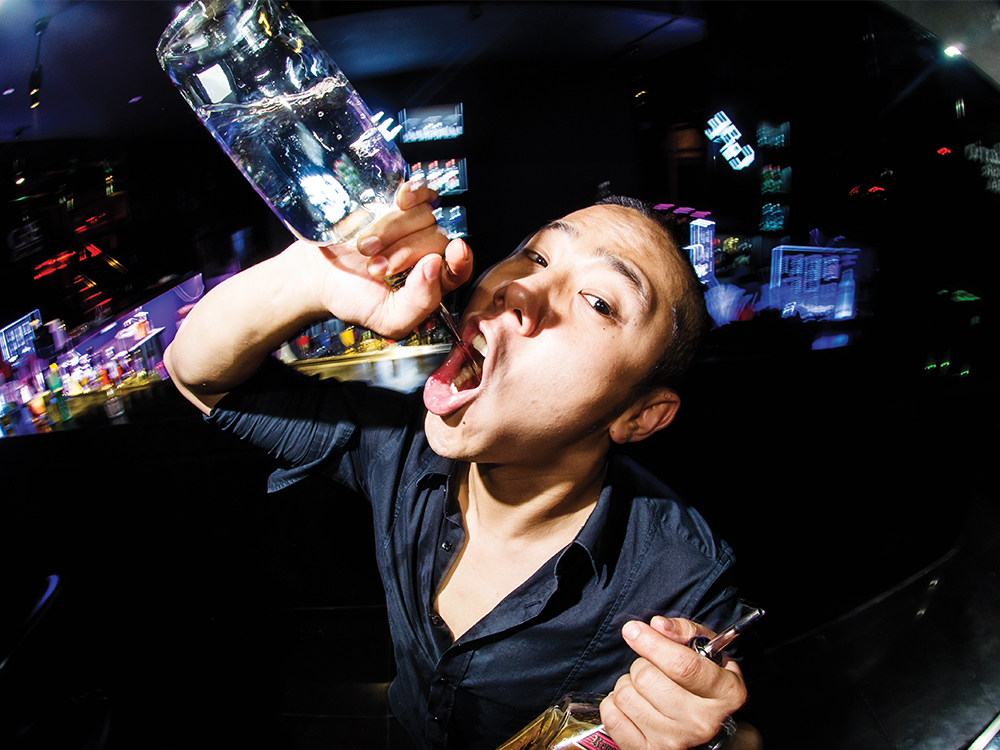
눈치게임 (Nunchi Game): the peer-pressure amplifier disguised as counting
눈치 (nunchi) is one of those Korean concepts that translates badly. The dictionary says "the ability to read the room," but in practice it is closer to the split-second social calculus you run when a senior at the table has just made an ambiguous face. 눈치게임 turns that skill into a numbers exercise. Players count out loud from 1 to whatever the table size is, no fixed order, no turns. If two people call the same number at the same time, both drink. If someone waits too long to call the last number, they drink. If nobody wants to be the last one, nobody wants to be the first one either, and the whole table freezes into a stare-off.
What makes it work as a drinking mechanic is that timing pressure amplifies whatever awkwardness is already in the room. A department that has been quietly annoyed at each other all week will fumble the game inside the first minute, and suddenly three people are drinking at the same time, laughing, and the tension is broken. That is the actual industry insight: 눈치게임 is deceptively effective as an icebreaker for teams that are stuck in polite mode. Korean HR consultants have been quietly recommending it to foreign firms setting up Seoul offices for exactly that reason. It reads the tension in the room and forces it out.
Titanic and somaek: the loaded bomb inside a beer glass
Titanic is the game K-drama scriptwriters reach for whenever they want a table scene to escalate fast. Here is the mechanic: fill a beer glass halfway with 맥주 (maekju, beer), then very carefully float an empty 소주 shot glass on top of the beer. One by one, each player pours a small amount of soju into the floating shot glass. The person whose pour causes the shot glass to sink downs the entire glass of 소맥 (somaek, soju-beer mix) they just built together. The physics is unforgiving and everyone at the table can see the shot glass dipping lower.
The reason this game hits differently from Western drinking games is that somaek is genuinely dangerous in a way beer alone is not. A standard 소맥 hits roughly 10 percent ABV depending on the pour ratio, so a full beer glass of it is basically three drinks in one. The trend of somaek itself traces back to displaced journalists during the 1980 Chun Doo-hwan era who started mixing soju and beer as an ironic protest gesture, and it went mainstream after the 1997 Asian financial crisis when cheaper drinking replaced expensive Western whiskey. Titanic weaponizes that history: it forces the last pourer to drink the accumulated evidence of everyone else's cowardice. Nobody at a 회식 table wants to be the one who sinks the ship.
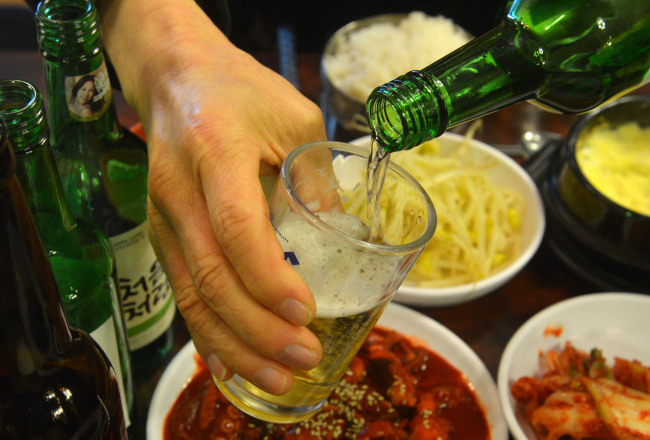
3-6-9 (삼육구): cognitive stress meets soju, which never ends well
The 3-6-9 game (삼육구 게임) is the one that translates the cleanest to a foreign audience because the rules are cartoonishly simple and the failure mode is instant. Players count out loud in order: one, two, three (but instead of saying "three" you clap once), four, five, six (clap), seven, eight, nine (clap), ten, eleven, twelve, thirteen (clap, because it contains 3), and so on. Every number containing a 3, 6, or 9 becomes a clap. Compound numbers (like 33 or 36) get two claps. Anyone who says the number by mistake, claps at the wrong time, or misses their turn drinks a shot.
What makes 3-6-9 lethal at a 회식 is that it demands working memory at exactly the moment when soju is stripping working memory away. It also scales with the group: at a table of eight, the count is bouncing around the table fast enough that you have to track both what number is coming and whether you can convert it to claps in the half second before it hits you. When Korean comedians want to signal that a variety-show cast has been drinking on set, they cut to a 3-6-9 sequence and let the natural chaos do the work. It is the game that most reliably produces the K-drama shot of a female idol laughing so hard she has to hide behind her palm.

이미지 게임 (Image Game): the hierarchy game disguised as flirty fun
이미지 게임 is the game that got Korean 회식 culture in trouble with the younger generation. The leader poses a category ("who at this table is most likely to have a secret drinking problem," "who would look best in a wedding dress," "who is most likely to date a coworker") and everyone silently points at whoever they think fits. Whoever gets pointed at the most drinks. The mechanic is fun in a college MT (membership training) context. It is politically loaded in a workplace one.
The appeal is honest: 이미지 게임 lets people say things about each other that Korean workplace decorum would otherwise forbid, under the cover of a game. That is also its risk. A category like "who works the hardest" can end up singling out the youngest 신입 (new hire) and making them drink a bunch of shots as a "compliment." A category like "who is the biggest lightweight" can land on the one team member who genuinely cannot handle alcohol for medical reasons. Post-2020, Korean corporate HR has been quietly pulling this game out of the standard 회식 rotation, and Gen Z drinkers, per Korea Herald reporting, actively avoid it. But it remains a K-drama staple because it lets a scene reveal what characters actually think of each other in 20 seconds of screen time.
Flick the Cap and High/Low: the two-part 소주 bottle game
This is the pair of games that require the physical 소주 bottle itself, which is why they only work in Korea. When you first open a Chamisul or Chum Churum bottle, the metal cap has a small dangling tail (a little coil of metal left over from the seal). Everyone at the table takes turns flicking the coil with a fingernail. Whoever finally snaps it off has to drink. The loser then becomes the moderator of round two: High/Low. Inside every soju bottle cap, a small number from 1 to 100 is printed on the underside. The moderator sees the number, tells the group only that it falls somewhere between two range endpoints, and everyone takes turns guessing higher or lower. Whoever guesses the exact number and the moderator make the rest of the table drink.
Nothing about these two games is complicated. The reason they matter is that the whole ritual takes maybe six minutes and gets you through the opening awkwardness of a new bottle with almost no talking required. That is a huge amount of social utility for a game that costs nothing. It is also why the 소주 bottle itself, with its dangling cap and its hidden number, is a piece of physical design that a lot of foreign visitors quietly notice without realizing it was engineered for exactly this ritual. Jinro and Lotte both keep the coil and the cap number in place decades after they stopped mattering technically, because messing with the ritual would be commercially suicidal.
Why global viewers finally caught on (Netflix, K-drama coding, and Rose's APT)
For most of the 2010s, Korean drinking games were something foreign viewers noticed in K-dramas without quite parsing why they existed. Every idol variety show had a 눈치게임 or a Titanic bit. Every 회식 scene in a workplace drama had a table doing 3-6-9. Netflix's global algorithm delivered those scenes to millions of viewers who had no cultural context for them, and the games ended up doing quiet cultural export work while nobody was tracking it. The appeal, decoded: the games gave Western viewers a glimpse of a social ritual their own drinking cultures do not really have, which is a structured, group-oriented way to lower the stakes of drinking with strangers.
The tipping point was Rose of BLACKPINK's October 2024 "APT." with Bruno Mars. The song is literally built around another Korean drinking game (the 아파트 game, where players stack their hands into a "building" and count floors), and Rose's TikTok tutorial for how to play it racked up hundreds of millions of views inside a month. Korea Herald quotes 20-somethings back home who now find the games a bit passe. Meanwhile in the US and Europe, foreign fans were teaching themselves the 아파트 chant in their college dorms. That inversion is very Hallyu: what young Koreans consider slightly out of date becomes the fresh cultural import for global audiences. The industry read is that Korean drinking games have effectively already gone global, whether or not the average Seoul 20-something wants to keep playing them.
Bring the ritual home
If Titanic, 3-6-9, and Rose's APT chant made you want to try a proper 소주 night with friends, the Daebak Box is the easiest on-ramp to the surrounding culture. Each box ships hand-picked Korean snacks, 안주-style munchies, and pop culture goods straight from Seoul every month, so you can set the table right, pull up a Netflix K-drama 회식 scene, and settle in for the kind of night the games were actually designed for.


