


Table of Contents
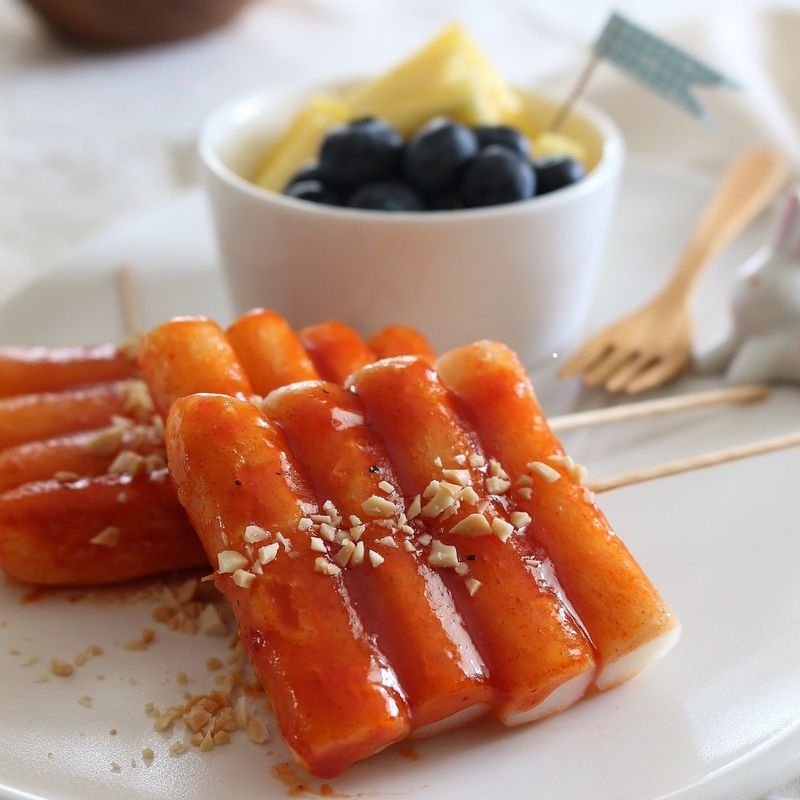
Ask any Korean adult over 30 to name the snack they blew their pocket money on between the last school bell and the walk home, and roughly nine out of ten will say 떡꼬치 (tteokkochi). Rice cake, four segments to a stick, deep-fried until the surface goes slightly crackly, brushed with a sweet-spicy gochujang glaze that stains your fingers red. Cost in 1995: 500 won. Cost in 2026 at the same 분식집 (bunsikjib, snack shop) storefronts: 1,000 to 1,500 won. Adjusted for the price of everything else in Korea, that is close to inflation-negative, which tells you exactly how load-bearing this snack is for the 학교 앞 (school-front) street food economy.
What Tteokkochi Actually Is, and Why the Format Matters
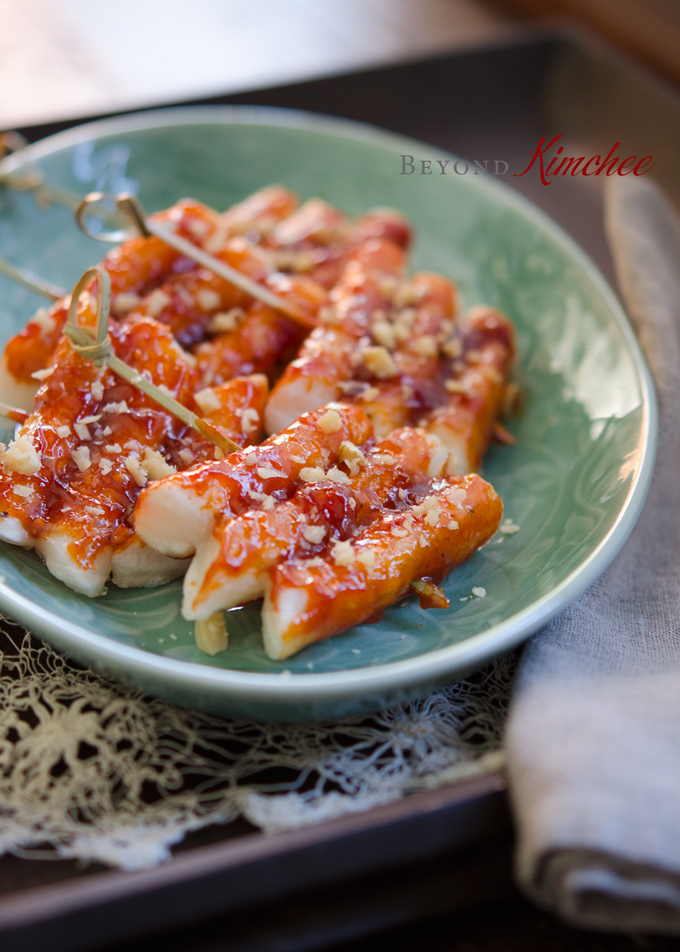
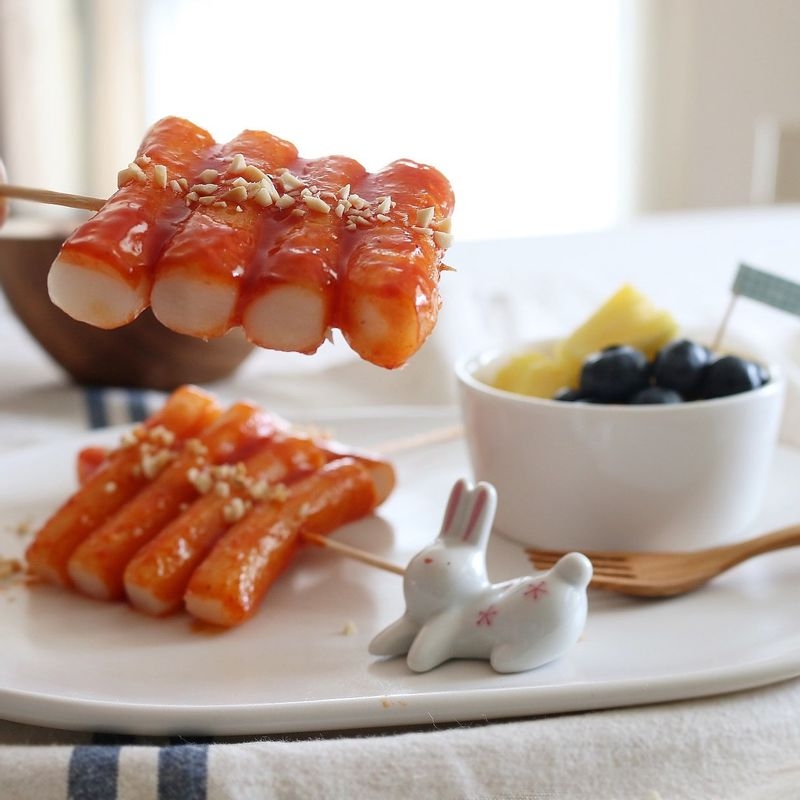
The construction is deliberately dumb, in the best sense. You take 가래떡 (garaetteok), the same unsweetened cylindrical rice cake used for tteokbokki and tteokguk, cut it into segments about three centimeters long, thread four segments onto a bamboo skewer, and fry the whole thing. The glaze is a gochujang base with ketchup, honey or corn syrup, minced garlic, and sometimes strawberry jam if the vendor is old-school Busan. The finished skewer has the texture Korean snacks specialize in: crisp shell, chewy interior, the specific 쫄깃 (jjolgit) bite that no potato-based Western snack can replicate.
The appeal point most non-Korean food writers miss is that 떡꼬치 is not really about flavor. Gochujang glazes are on a hundred other Korean dishes. The whole draw is the format itself: four handheld bites on a stick, priced to be affordable to a 5th grader with 1,000 won of coin change, ready to eat in the 90 seconds between order and the school bus. That is a UX problem the Korean street food economy has been solving since the late 1980s, and 떡꼬치 is the local-optimum answer.
The 학교 앞 Economics Nobody Writes About
Korean street food is not a monolith. There is Myeongdong tourist-facing street food (Korean corn dogs, tornado potatoes, egg bread), Gwangjang Market grandma food (bindaetteok, mayak gimbap, live sannakji), and then there is 학교 앞 street food, the entire ecosystem that exists specifically to feed elementary and middle school students in the twenty-minute window after school lets out. 떡꼬치 sits at the center of that third category, alongside dalgona, hotteok in winter, and 분식집 tteokbokki cups.
What makes this segment weird is the pricing physics. A skewer that costs 1,000 won cannot use imported ingredients, cannot support high staff cost, and cannot lose more than a few won per unit to spoilage. Vendors survive on volume (a good spot near a middle school does 200 to 400 skewers a day), and on batch prep: fry 30 skewers at once, glaze on the fly, serve in small paper cups. The margin per skewer is thin, but the format is engineered to move product fast during the 3 to 5 PM peak. That is why you cannot really scale it into a restaurant business. The moment rent goes above 학교 앞 street-vendor levels, the unit economics collapse.
The Cheese-Tteokkochi Pivot That Broke the Original Format
The most consequential experimental variant of the last decade is 치즈떡꼬치 (cheese-tteokkochi), which really means: alternate segments of garaetteok and mozzarella string cheese on the same skewer, grilled with butter, drizzled with sweetened condensed milk. It looks nothing like the original. It is not spicy. It is not brushed with gochujang. You will not find it at any traditional 분식집 in Suwon or Cheongju.
What you will find it doing is winning on Instagram. Myeongdong vendors pivoted to it around 2017 to 2018 because the pull was tourist-driven: a cheese-pull shot works in a 4-second Reel, and the condensed-milk drizzle looks decadent on video. Maangchi's version, which she developed after tasting the Myeongdong original, uses low-to-medium heat with mozzarella specifically because cheddar burns too fast and gets salty. The industry lesson buried in this variant, and the reason I keep flagging it as a case study, is that Korean street food adapts to whichever camera is pointed at it. In 2005 that camera was Naver blog food photography, which favored top-down warm-toned shots, hence the ketchup-heavy glaze. From 2020 onward the camera is short-form vertical video, which rewards dramatic pulls, drizzles, and color contrast. Cheese-tteokkochi is what the format looks like when it optimizes for the second regime.

Curry, Jjajang, Honey Butter: The Experimental Sauce Playbook
Beyond cheese, the experimental 떡꼬치 lineup that has actually held up in the market breaks down into four categories, in rough order of commercial staying power. Curry-glazed 떡꼬치 was the first big pivot in the mid-2010s, riding the same Japanese-style curry powder wave that pushed curry ramyeon and curry tteokbokki. The appeal is that curry powder gives a savory depth pure gochujang cannot, and it plates better in yellow than red for the food-video crowd. It has not overtaken the original in 분식집, but is a common secondary menu item at university-front carts.
Jjajang-glazed (짜장 소스) is a Chuncheon-region trend that borrows from jajangmyeon's black bean sauce. Honey butter is the Haitai Confectionery carryover from the 2014 honey-butter chip explosion that spilled into every snack category Korea had, including street skewers. The last variant, which most experimental 분식집 have quietly retired, is the fire-noodle-glazed (불닭 소스) 떡꼬치. It sold hard from 2020 to 2022 riding Samyang's global 불닭볶음면 momentum, but the spice level was punishing for the actual elementary school demographic, and vendors backed off. The commercial lesson buried in that arc is that experimental variants live or die based on whether the school-age customer can finish the whole skewer, not whether it goes viral once.
The Traditional Cousin: 떡산적, Court Cuisine's Answer to the Street Version
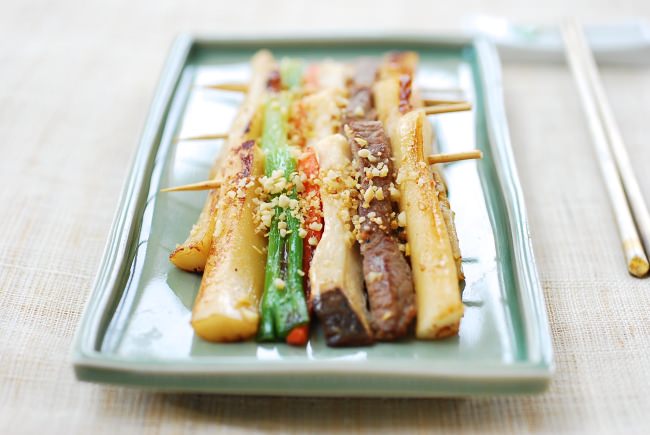
Before 떡꼬치 was 분식집 street food, there was 떡산적 (tteok sanjeok), a Joseon-era ceremonial dish where garaetteok is skewered with marinated beef, king trumpet mushrooms, scallions, and carrot, then pan-grilled. It shows up on 설날 (Lunar New Year) and 추석 (Chuseok) tables in older or more traditionally observant families, and it is one of the specific dishes people mean when they loosely invoke 궁중요리 (gungjung yori, royal court cuisine). Same rice cake, same skewer format, completely different world.
The reason the parallel matters industry-wise is that Korean food has always used skewering as a portioning trick for both elite and street contexts, and 떡꼬치 basically inherited a court-cuisine plating idea and stripped it down to what a 10-year-old could afford after school. Same construction, one hundred times cheaper. That translation from court to street is one of the more understudied moves in modern Korean food history, and it maps almost exactly onto how 떡볶이 went from royal 궁중떡볶이 (sweet soy-glazed, meat and vegetables, non-spicy) to the fluorescent-red street version that took over Korean snack shops in the 1970s.
Why 떡꼬치 Does Not Ship Overseas the Way Tteokbokki Did
Here is the part of the story food-media coverage almost never gets right. Tteokbokki went global. Frozen tteokbokki kits are in every H Mart in the US, Bibigo sells microwavable tteokbokki cups in Costco, and CJ CheilJedang's export volume on the category has grown roughly 30 to 40 percent year-over-year since 2020. 떡꼬치, sitting right next to it on the 분식집 menu board, has not made that jump. In 2026 it still does not have a serious retail presence outside Korea.
The reason is boringly logistical, and it is the kind of thing you only see once you have watched a few Korean food-export deals get structured. Tteokbokki is a sauce-based bowl dish that survives freezing and microwave reheating reasonably well. Rice cakes hold texture in sauce because the sauce keeps them hydrated. 떡꼬치 is a fried, dry-glazed, single-serve stick. The moment you freeze it, the glaze loses its shellac and the rice cake goes rubbery, and no amount of air-fryer instruction on the back of a package will convince a Western consumer that the result matches what they saw on a Seoul travel Reel. Bibigo actually tried, launching a mini-tteokkochi frozen SKU in the US in 2023 on a limited-market test. The category has moved slowly since. 떡꼬치 is one of those Korean foods that only really works fresh, made in front of you, priced under a dollar, and that is not a shape global retail wants to buy.
The Domestic Rice Cake Market Reality Behind the Skewer
The Korean 떡 (tteok, rice cake) manufacturing market runs roughly one trillion won a year, or about 750 million to one billion USD depending on the exchange rate. Most of that is bulk garaetteok and tteokbokki-cut rice cake, sold B2B into 분식집 chains, school cafeterias, and Costco-tier retail SKUs. 떡꼬치-specific product lines are what analysts inside CJ and Pulmuone call seasonal inventory absorbers: when a factory over-produces garaetteok for the Lunar New Year 떡국 rush, the surplus gets re-cut, portioned into 30-piece frozen bags, and sold at 3,000 won as home-fry 떡꼬치 packs at E-Mart and Homeplus.
That is the operational reason 떡꼬치 stays alive as a retail category even though the street version dominates the emotional real estate. It is the safety valve for the domestic rice cake supply chain, absorbing production overage into a low-price, frequent-repurchase home SKU. If you have ever wondered why the 매콤달콤 (mae-kom-dal-kom, spicy-sweet) home tteokkochi kit is always in stock even in a bad harvest year, that is why. Not glamorous, but that is how the industry actually works, and it is why the format survives every generation of experimental sauce, every viral cheese-pull Reel, every attempt at export.
Explore Korean Snacks with Daebak
Love Korean food? Get authentic Korean snacks and ramen delivered straight to your door with the SnackFever Box by Daebak.


