


Table of Contents
When Kim Woo-bin (김우빈) walked onto the Jeju set of tvN's Our Blues (우리들의 블루스) in late 2021, he was doing something the Korean drama industry does not really have a clean playbook for. Five years earlier, in May 2017, at twenty-seven years old and coming off the Uncontrollably Fond era that had made him one of Korea's most in-demand male leads, he was diagnosed with nasopharyngeal cancer. He disappeared from the screen almost overnight. And unlike a Hollywood career, where a five-year hiatus is a manageable pause, the K-drama pipeline moves so fast that five years is basically a generation. New faces come up, agencies pivot, IPs get shopped to whoever is trending that quarter. So the Our Blues casting was not just a return. It was a specific bet on which kind of return format would work best for an actor whose body had been through the wringer and whose star equity, while intact, had been dormant. Noh Hee-kyung (노희경), the writer, understood that instinctively. What she offered him was not a 24-episode romantic lead assignment. It was an ensemble slot in an omnibus drama with fifteen other named actors carrying their own arcs, and that structural choice is the reason the comeback landed as cleanly as it did.

The Hiatus: What Nasopharyngeal Cancer at Twenty-Seven Actually Meant for a Working Male Lead
To understand why the Our Blues casting worked, you have to understand the shape of the five-year hole in his filmography. Kim Woo-bin's diagnosis came in the middle of what agencies internally call the peak commercial window for a male lead, roughly ages 25 to 32, when brand endorsement deals stack and the leading-role offers come in bunches. He had already anchored The Heirs (상속자들) in 2013 opposite Lee Min-ho and Park Shin-hye, then leveraged that visibility into Uncontrollably Fond (함부로 애틋하게) in 2016 with Bae Suzy. Both were the kind of glossy, high-emotion romantic lead vehicles that read as low-risk casting to Korean broadcasters. He was, by any industry measure, a bankable name. Then nasopharyngeal cancer arrived, and nasopharyngeal is a particularly awkward cancer for a working actor because radiation therapy in that region affects the voice, salivary function, jaw range, and stamina in ways that do not fully resolve for years. The 2019 recovery announcement was public, the actual physical rebuild was longer, and the reason he took another two-plus years after that before returning was almost certainly a mix of stamina management and waiting for the right first project to say yes to. In Korean industry logic, your comeback role sets your next five years of positioning. You cannot afford to pick wrong.
The 2019 Alhambra Palace cameo (알함브라 궁전의 추억, tvN, Hyun Bin lead) is worth flagging here as a kind of soft-launch test balloon. It was a small role, one narratively significant appearance, and it let him check whether his on-camera presence still landed after two years of treatment. The fact that fans and Korean media reacted warmly to that brief scene rather than treating it as a sad former-star cameo told his agency AM Entertainment that the equity was still there. From that data point, the Our Blues offer in 2021 was calibrated as the real return, and choosing an omnibus written by a top-tier writer rather than a straight-up commercial romantic vehicle was the tell that the strategy was long-game.
Why the Noh Hee-kyung Omnibus Format Was the Right Landing Spot
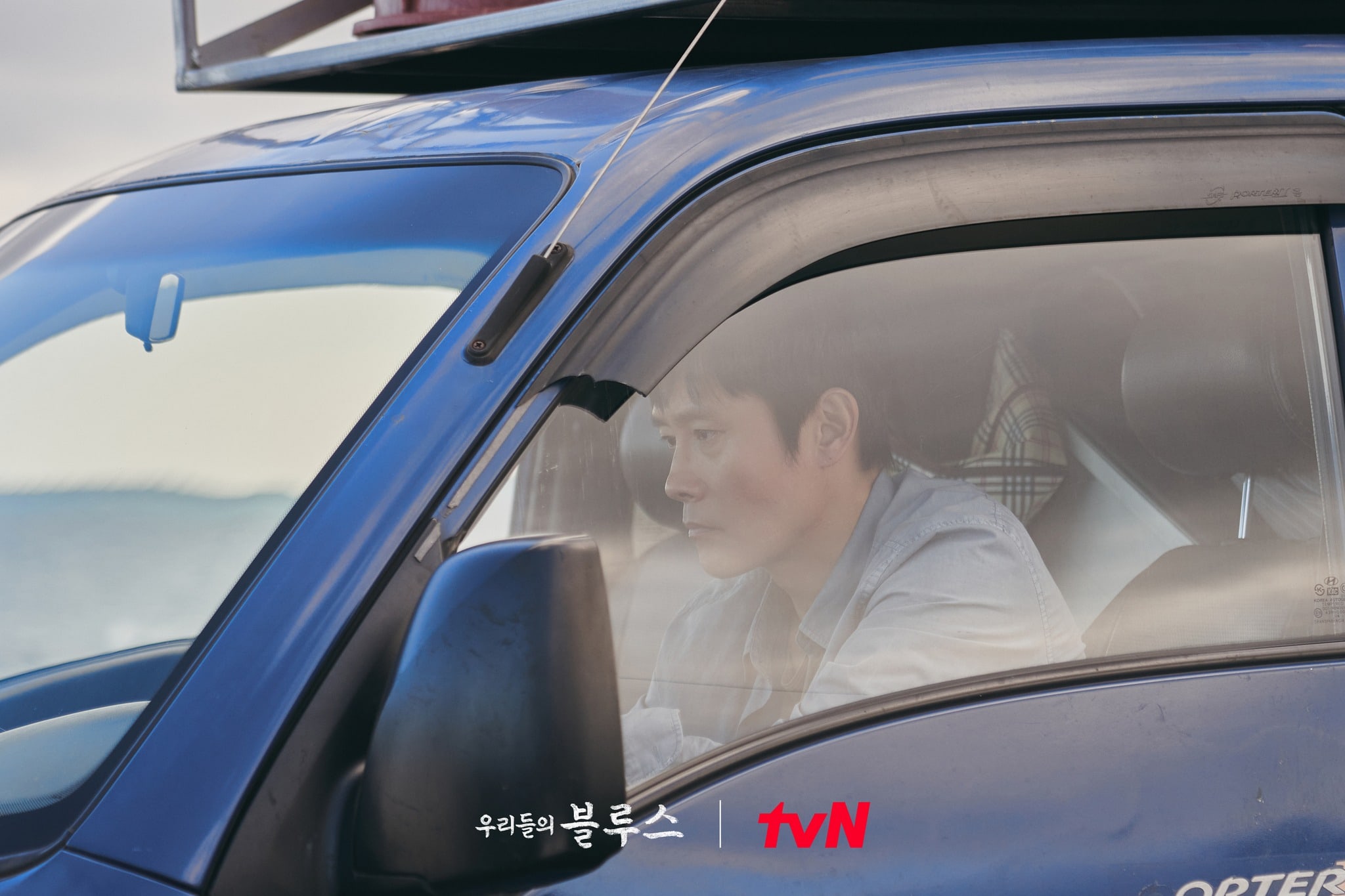
Noh Hee-kyung has been writing prestige K-drama since 1996. Her track record includes Worlds Within, That Winter the Wind Blows, It's Okay That's Love, Dear My Friends, and Live, and she works with director Kim Kyu-tae (김규태) on most of them. What she does structurally, and what almost no other Korean prime-time writer does with her consistency, is thread multiple character arcs through a single geography without collapsing them into a hierarchy. Our Blues took that instinct to its logical extreme. Twenty named characters, six intersecting protagonist pairings, an omnibus format that let each arc run three to four episodes and then hand off to the next. The setting was Jeju Island (제주도), specifically the village of Pooreung, with more than 80 percent of shooting done on location. For the industry, this format is a rare thing, financially it works only when you can cast a stacked A-tier ensemble willing to accept limited screen time, and Noh Hee-kyung is one of the few writers whose script alone can pull that group together.
The cast tells you exactly what her name is worth. Lee Byung-hun (이병헌), coming straight off Squid Game global fame, playing a traveling truck-salesman. Shin Min-a (신민아), also a top-tier lead, playing a woman with a difficult backstory who lands in Jeju. Cha Seung-won (차승원), a comedic and dramatic veteran, playing a returning-home city man. Han Ji-min (한지민) as a rookie haenyeo (해녀, the female sea divers who have worked the Jeju coast for centuries). Lee Jung-eun (이정은), fresh off Parasite's Oscar sweep, playing a fish shop owner. Uhm Jung-hwa (엄정화), a pop legend from the late nineties turned respected actress. Kim Hye-ja (김혜자) and Go Doo-shim (고두심), both Baeksang-crowned veterans playing haenyeo elders. That is roughly ₩50 million per episode in ensemble talent before you count Kim Woo-bin. The reason each of them said yes is Noh Hee-kyung's script and the ensemble structure, which means no single actor has to bear the full 12-episode load. For Kim Woo-bin, coming back from five years of medical recovery, that structural weight distribution was the whole point.
The character Noh Hee-kyung wrote for him, Park Jung-jun (박정준), was also a deliberately unshowy landing spot. Park Jung-jun is a Jeju-born ship captain who stayed on the island while his generation moved to Seoul, gives boat rides to the haenyeo, sells fish at the auction market, and lives in a repurposed bus by the beach. He is not the tortured romantic lead. He is not the alpha corporate heir. He is a quietly warm, patient man who falls in love with a rookie haenyeo (Han Ji-min's character Lee Young-ok) and stays present through her complicated backstory. That is a very different acting register from The Heirs or Uncontrollably Fond, and it let Kim Woo-bin recalibrate his onscreen presence at forty percent of the intensity his earlier roles demanded. He even physically committed. The farmer's tan was real, done deliberately to sell the outdoor fisherman look, and that small detail is the kind of committed craft signal Korean audiences read as the actor taking the character seriously rather than coasting on comeback goodwill.
The Ratings Read: Why 10 to 15 Percent Is a Win for a Noh Hee-kyung Drama

Our Blues aired on tvN weekends from April 9 through June 12, 2022, and averaged around 12 percent in the Nielsen Korea nationwide rating. That number looks small if you are comparing it to Sky Castle at its 23 percent peak, or Crash Landing on You at 21 percent. But comparing prestige-slot ratings to commercial-peak ratings is a category error. Noh Hee-kyung dramas historically land in the 10 to 15 percent zone because they are writer-driven, slow-burn, and lean adult rather than teenage-fan-service, and tvN's prestige slot audience is comfortable with that pace. The financial calculus for tvN with a Noh Hee-kyung project is that critical prestige plus international streaming value (Netflix Asia carriage on this one) more than makes up for a rating that would be considered underperforming in a Studio Dragon commercial vehicle. The 2022 Baeksang Arts Awards nominated Our Blues for Best Drama and Best Screenplay, and Lee Jung-eun won Best Supporting Actress. Those nomination signals plus the Netflix Asia carriage are what a prestige-slot 12 percent rating looks like when the numbers land right.
For Kim Woo-bin specifically, that positioning was actually more valuable than a mainstream ratings hit would have been. A rating of 21 percent on a fluffy romantic melodrama re-anchors an actor to a genre category. A 12 percent on a prestige omnibus repositions the actor as someone whom Kim Kyu-tae, Noh Hee-kyung, and by extension the rest of the Korean director-writer prestige tier are willing to work with. That casting-credit-signal is what unlocks the Netflix money that came next. Which, if you have been following his post-Our Blues run, is exactly what happened.
The Shin Min-a Layer: A Real-Life Couple Sharing the Call Sheet Without Sharing the Storyline
Almost every Korean entertainment outlet covering the Our Blues casting had to write the Shin Min-a angle. She has been Kim Woo-bin's actual real-world partner since 2015, one of the longest publicly acknowledged K-industry relationships still going, and they married in April 2024 after roughly nine years together. Casting them into the same drama could have gone one of two obvious ways. Noh Hee-kyung's cleverer move was to cast them into Our Blues with separate love interests. Shin Min-a's Min Sun-a is paired with Lee Byung-hun's Lee Dong-suk. Kim Woo-bin's Park Jung-jun is paired with Han Ji-min's Lee Young-ok. They never share the romantic arc onscreen. Noh Hee-kyung told Korean press she had suspected they would refuse if she tried to write them as the drama's central couple, so she offered separate love lines instead, and they both said yes. That is a very Korean-industry-nuance solution. It respects the actors' private life while capturing both names on the same call sheet, and it gives the ensemble a real-world publicity story without commodifying the relationship itself.
For fans, the effect was that Our Blues became must-watch specifically because a real couple sharing the call sheet is a rare artifact in Korean drama, and the meta-textual layer of watching each of them fall onscreen for a different person read as playful rather than transactional. That parasocial energy converted into press cycles and international coverage that pushed Netflix Asia carriage numbers higher. The industry mechanic underneath this: relationship publicity is scarce in K-drama because agencies aggressively suppress romantic rumors during peak career windows, so when a confirmed couple actually shows up on the same production, it becomes free promotion the marketing budget could not have bought. Noh Hee-kyung understood that and used it without exploiting it.
What Came Next: The Post-Our Blues Trajectory

The Our Blues booking unlocked the rest of the comeback slate. Alienoid (외계+인 1부, 2022) had actually wrapped earlier during his recovery period, so it released just after Our Blues finished airing. Choi Dong-hoon (최동훈) directed, and Kim Woo-bin played the Taoist master Muruk in a two-timeline sci-fi ensemble. The film underperformed commercially in Korean theaters relative to its budget, but its second part (외계+인 2부, 2024) course-corrected and the two-film set landed as a respectable event-film sci-fi bet. In terms of positioning, Alienoid did for Kim Woo-bin what Our Blues did on TV. It signaled that top-tier Korean auteurs were willing to build tentpole vehicles around him, not just cast him in supporting slots. Then Netflix moved in.
Black Knight (택배기사, 2023) was the Netflix K-drama that made his post-cancer physical range visible. He plays a delivery-driver-slash-mercenary in a dystopian near-future Seoul where air pollution has forced humans into oxygen-managed enclaves. The show involved sustained action sequences, hand-to-hand combat choreography, and the kind of physical presence work that would have been unthinkable in 2018. That he could do it in 2023 was the industry read on how thoroughly he had rebuilt. Black Knight was not a critical darling (mixed reviews, some pacing complaints), but Netflix does not need critical unanimity. They needed the pan-Asian streaming numbers, and Black Knight delivered on that. Wall to Wall (84제곱미터, 2025) followed on Netflix as a Korean apartment-life psychological thriller, again exploiting the physicality and range he had earned back. The trajectory since Our Blues has been steadily upward, and the through line is that the low-pressure ensemble return in 2022 gave him the runway to take on more demanding roles from 2023 onward without the industry treating them as risk-management assignments.
The Larger Read: Why This Casting Deserves to Be Studied

There is a lesson in the Our Blues casting for anyone paying attention to Korean industry mechanics. Comeback roles after long medical hiatuses in K-drama are usually one of two mistakes. Either the actor takes an aggressive commercial lead vehicle too early, gets brutalized by the shooting schedule (Korean K-drama shoots run 60 to 80 hour weeks routinely), and ends up either delaying the second recovery arc or turning in a rusty performance that damages the equity they were trying to protect. Or they take a role that is too small, gets read as a career-loss admission by press, and the momentum stalls out. What Kim Woo-bin, his agency AM Entertainment, and Noh Hee-kyung engineered together was a third path: a role of appropriate importance in a prestige-slot omnibus that let him carry roughly one-sixth of the emotional load rather than the whole thing, in a character register (quietly warm, unshowy) that his post-treatment body could deliver comfortably, working with a writer-director pairing whose downstream credit unlocks the next tier of casting offers.
The Korean industry appeal-point that most Western coverage misses about this era of K-drama is that Korean audiences read casting choices as character signals about the actor. Choosing to work with Noh Hee-kyung is a public statement about what kind of career you are building. Choosing an ensemble omnibus over a commercial romantic lead is a statement that you value craft over ratings. Fans who followed his cancer journey read the Our Blues casting as him coming back on his own terms, not as a desperate re-entry. That reading translated into the parasocial loyalty that drove the Netflix Asia streaming numbers for Black Knight and Wall to Wall two years later. The industry mechanic and the fan mechanic reinforced each other, and Noh Hee-kyung's script was the fulcrum. For anyone who has watched Korean drama long enough to know that comebacks are usually messy, Our Blues remains the reference case for how to do one right.
Bring the K-Drama Culture Home
If following Kim Woo-bin's Our Blues comeback got you back into the tvN prestige-slot rabbit hole, the Daebak Box is our monthly curation of Korean snacks, culture goods, and K-drama-adjacent lifestyle items shipped from Seoul. Every box is a small window into the same Korean pop-culture ecosystem this article sits inside.


