


Table of Contents
Here is something most foreign travel guides get wrong about Korean cherry blossom season. They treat 벚꽃 (beotkkot) like Japanese hanami. Pack a picnic, find one tree, sit under it for an afternoon, done. That framing misses the entire mechanic. In Korea, cherry blossom viewing is a multi-day, multi-site rotation that includes a dedicated night format, and the 야벚꽃 (ya-beotkkot, night cherry blossom) industry behind it is closer to a public art installation than a passive park visit. After a decade watching Korean tourism patterns evolve alongside the Hallyu boom, I think this is the single most underexplained piece of Korean spring culture.

야벚꽃: the night format Japan does not really have at this scale
If you have done hanami in Tokyo or Kyoto, you might assume Korean cherry blossom season is the same thing with kimchi. It is not. The structural difference is lighting infrastructure. Korean municipal governments have spent the last fifteen years investing in dedicated illumination systems for cherry blossom corridors, treating bloom season as a tourism asset on par with K-pop concerts or food festivals. Songpa-gu wires up Seokchon Lake. Yeongdeungpo-gu lights Yeouiseo-ro. Changwon City installs heart-shaped LED arches along Yeojwacheon Stream in Jinhae. Daegu's Dalseo-gu turns E-World into a cherry blossom theme park where the night pass exists as its own ticket category.
That investment shapes how Koreans experience the season. Hanami in Japan is daytime-anchored. 야벚꽃 in Korea is its own format with its own crowd, its own photography style, its own pricing tier. When Koreans say "벚꽃 보러 가자" (let's go see cherry blossoms), they often mean after work, after dinner, around 8 or 9 p.m. when the trees are uplit and the air has cooled. That timing is not incidental. It is engineered.
Why Korean cherry blossom is a multi-day rotation, not a one-day picnic
Here is the appeal point Western travel writers miss. Korean MZ세대 (the millennial-Gen Z generation that drives most domestic tourism behavior) does not pick one cherry blossom spot. They sequence three or four across a single weekend. A typical Seoul-based itinerary looks like this: Yeouido on Saturday morning for the 1.7km tunnel and the picnic atmosphere, Seokchon Lake on Saturday night for the Lotte World Tower reflection shot, then Children's Grand Park or the Gyeongui Line Forest Path on Sunday afternoon for a slower walk with less crowd. Each location has a different visual signature. The rotation is the point.
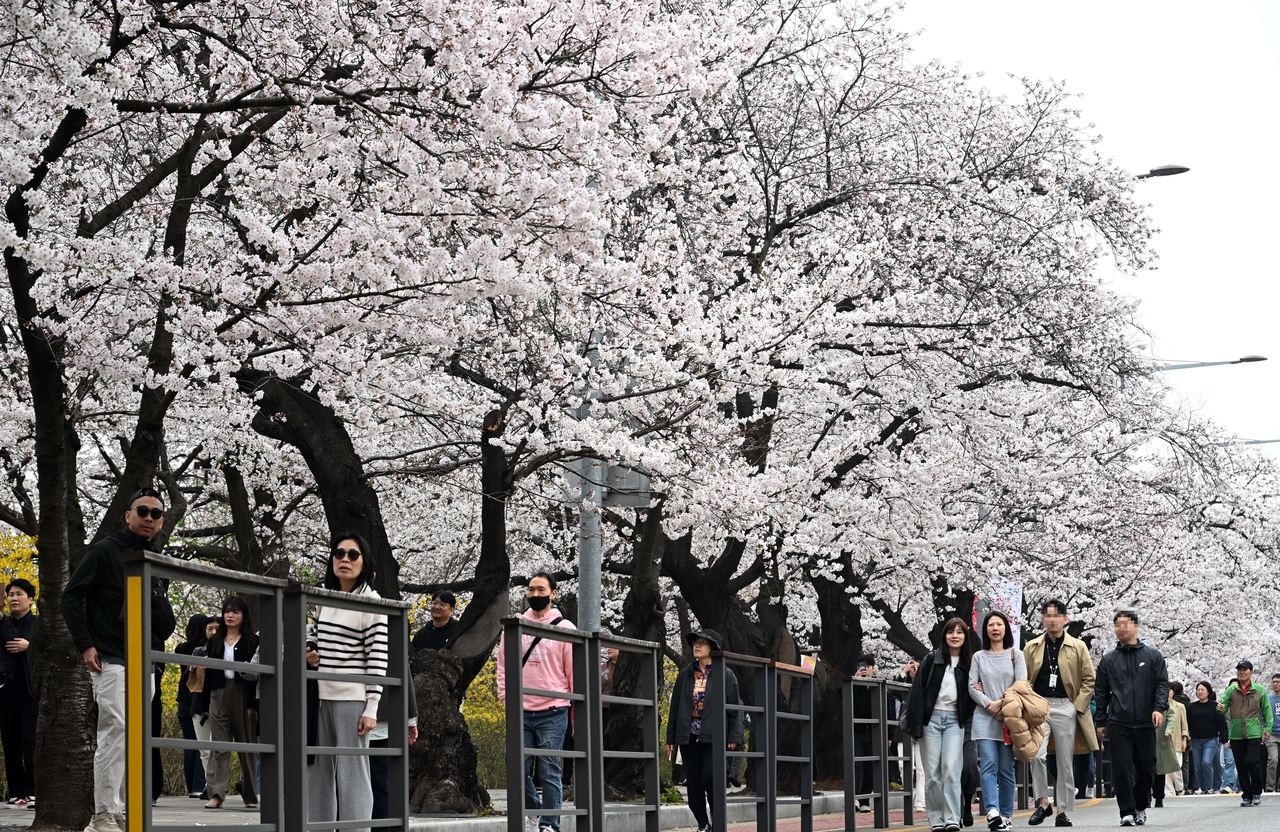
The economics behind it are interesting. Yeouido is free. Seokchon Lake is free. The Gyeongui Line Forest Path is free. So the cost of a multi-spot weekend is essentially transit and snacks. The Korean cherry blossom season is one of the few mass-scale seasonal experiences in the world that costs almost nothing at the entry level, which is why search data shows accommodation searches in Seoul jumped 225 percent above average during the Yeongdeungpo Yeouido Spring Flower Festival window, per Korea Herald reporting. The trees are free. Everything around the trees is priced.
The Seokchon Lake play: free public viewing as a Lotte World halo
Seokchon Lake is the example I use when people ask me how Korean tourism strategy actually works. The 2.5km lake circuit sits directly next to Lotte World, Lotte World Tower, and the Lotte World Mall. The cherry trees ring the water. The tower glows behind them. It photographs unreasonably well at night, and that is not an accident. Songpa-gu and Lotte built that ecosystem together. Lotte gets the foot traffic, Songpa gets the tourism numbers, and visitors get a free festival with paid attractions one elevator ride away.
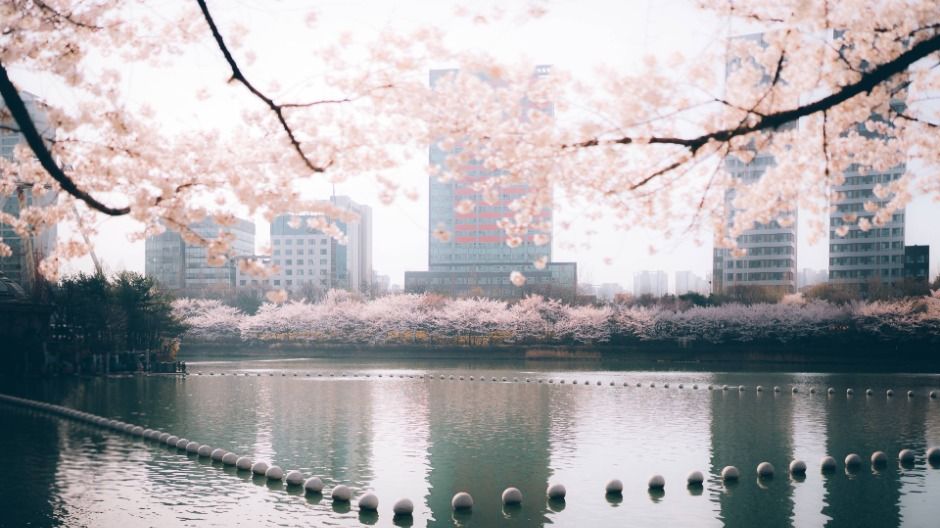
The 2026 Seokchon Lake Cherry Blossom Festival runs from late March into early April, with the official Korea Tourism Organization listing and the Songpa-gu Office both promoting illumination from sunset through midnight. The key compositional move is standing at the southern end of East Lake (동호) around 8 p.m., when the tower is fully lit, the petals catch the ambient light, and the still water doubles the entire scene. Phone cameras handle it cleanly. Korean food creators and travel influencers know this, which is why your feed during the first week of April becomes wall-to-wall Seokchon shots. The lake is a content factory.
Han River 따릉이 cycling: the new cherry blossom format
The fastest-growing way to do cherry blossom season in Seoul right now is by bike. Specifically, 따릉이 (Ttareungi), the Seoul Metropolitan Government's public bike share system. Han River cherry blossom cycling routes have effectively exploded as a category since 2022, when the city expanded foreigner-friendly pricing tiers and added more docking stations along Yeouido and Banpo Hangang Park. The Seoul Metropolitan Government's official bike tour route guide now lists Han River spring cycling as a top recommendation.
The math works. Ttareungi runs about 1,000 won per hour through the foreigner pass. Private rental kiosks near Yeouinaru Station start at 3,000 won for the first hour and 500 won per fifteen minutes after that. Guided morning bike tours from local operators run roughly 12km over 2.5 hours including stops. That puts a half-day cherry blossom bike experience in the 40 to 60 dollar range with a guide, or essentially free with Ttareungi if you DIY. Compare that to the equivalent in Tokyo or Paris and it is not close. Seoul has built one of the world's most accessible urban cycling networks, and cherry blossom season is when that infrastructure pays off most visibly.
Jinhae Gunhangje: the night cherry blossom megafestival
If Seoul is where Koreans do the rotation, Jinhae is where the entire country goes for the single biggest cherry blossom event of the year. The Jinhae Gunhangje Festival runs ten days each spring across the Jinhae District of Changwon, South Gyeongsang Province, with approximately 360,000 cherry trees blooming simultaneously. That number is not a typo. The 2026 edition opened March 27 and ran through April 5.

The night format here is the Yeojwacheon Starlight Festival. The 1.5km stream stretch glows with cherry petals reflected in water and heart-shaped LED arches strung above the walking path, with the Romance Bridge (로망스다리) serving as the K-drama backdrop that has driven the festival's social media reach. Gyeonghwa Station, the disused railway with cherry trees forming a kilometer-long tunnel over the tracks, hits the same algorithm. Korean production crews routinely book these spots from 6 a.m. to 9 a.m. for K-drama and music video filming before public access opens, which is part of why these locations look so cinematic. They are filmed first, walked second.
The K-drama production pipeline behind cherry blossom spots
This is the industry insight that almost never makes it into travel coverage. Korean drama production schedules treat cherry blossom season as a tight two-week shooting window that locks down the visual identity of any spring-set show. Yeouiseo-ro, Seokchon Lake, the Gyeongui Line Forest Path, Jinhae's Romance Bridge: all of these locations have permit calendars that get fought over by tier-one production companies (Studio Dragon, SLL, CJ ENM-affiliated productions) every January. Shooting blocks typically run 5:30 a.m. to 9 a.m. before crowds arrive, and the rental fees go to district offices and the Seoul Film Commission.
That is why a cherry blossom scene in a popular K-drama almost always looks identical to what you see when you visit. You are walking through a film set that opens to the public after 9 a.m. The infrastructure (paved paths, illumination wiring, sight-line clearances) is partly maintained for production-grade footage. The 한류 (Hallyu) export industry is, in a real sense, a co-investor in Korean cherry blossom tourism, and once you notice this, you cannot unsee it.
Daegu E-World: the ticketed night format that proves the model
If you want to understand how seriously Korea takes night cherry blossom viewing, look at E-World in Daegu. This is an amusement park in Dalseo-gu that has built its entire spring identity around the Blossom Picnic festival. E-World claims three times more cherry blossom trees than Yeouido's Yunjung-ro and markets itself as the largest nighttime cherry blossom site in Korea. The 83 Tower observation deck overlooks the entire park, and the festival sells a dedicated 야간권 (night pass) at about 35,000 won for adults, separate from the all-day pass at 49,000 won.
The pricing structure tells you everything. A standalone night ticket only exists because there is enough dedicated demand for night cherry blossom viewing to support it as a product line. That demand did not appear by accident. It was cultivated through fifteen years of consistent investment in lighting, photo zones (red double-decker bus installation, merry-go-round, sky deck), and Instagram-ready installations that make the experience visually distinct from anything else in the country.
How to build your own multi-day cherry blossom itinerary
Here is a workable template if you are visiting Korea during bloom season. Start in Seoul. Day one morning, Yeouido for the daytime tunnel walk and Han River picnic. Day one evening, Seokchon Lake for the tower reflection night shot. Day two morning, rent a 따릉이 and ride the Han River cycling path from Yeouinaru to Banpo and back. Day two afternoon, slower walk along the Gyeongui Line Forest Path through Yeonnam-dong cafes. Day three, take the KTX down to Busan or Jinhae (about 2.5 hours) and spend the evening at Yeojwacheon Stream under the LED arches. The whole rotation costs surprisingly little in admission since most of these venues are free, and it gives you the full range of Korean cherry blossom formats: park festival, lake reflection, urban cycling, hidden corridor, and southern megafestival.

The thing to remember is that 봄 나들이 (bom nadeuri, spring outing) culture in Korea has always been about movement. You do not sit. You walk, you cycle, you ride the subway between spots, you rotate. The cherry blossoms are an excuse to be outside for as many hours as the weather allows, day and night, across as many sites as you can fit. That is why one-day cherry blossom tours from outside Korea always feel incomplete. The format itself is built around accumulation.
The bigger picture: cherry blossom season as Korean cultural export
Cherry blossom imagery is one of the most reliable triggers for international interest in Korean travel, second only to K-pop and K-drama. The Korea Tourism Organization's spring campaigns lean on bloom forecasts as headline content. K-content production timing aligns with bloom calendars so that the visual signature of Korean spring shows up in dramas viewers will rewatch for years. Buldak ramyeon and K-beauty brands run cherry blossom limited editions. The 벚꽃 emoji shows up across Korean brand marketing from mid-March through mid-April with a consistency that is genuinely industry-coordinated.
So when you are walking through Yeouiseo-ro at 8 p.m. with a 따릉이 parked next to a convenience store cherry blossom soft serve, you are inside a fully assembled Korean cultural export machine. The flowers are real. Everything around the flowers is strategy. That gap between the genuine seasonal beauty and the engineered infrastructure underneath it is, I think, the most interesting thing about Korean cherry blossom culture and the reason you should give it more than a single afternoon.
Bring Korean Spring Home with Daebak
Cannot make it to Korea this spring? Get a taste of Korean seasonal culture delivered straight to your door with the Daebak Box, featuring authentic Korean snacks, beauty, and lifestyle picks curated by our team.


