

Table of Contents
Ask any 연세대 alum where they ate through undergrad and you get the same twenty-restaurant answer, give or take. That is not a lack of imagination. It is because Sinchon (신촌), the neighborhood wrapped around Yonsei, Ewha Womans, and Sogang, was engineered for one specific job: feeding roughly forty thousand hungry, broke, sleep-deprived students in a two-kilometer radius. The result is a food scene that has run on tight margins and cult favorites since the 1980s, and one that is quietly getting hollowed out right now.
The Sinchon-Ewha-Sogang Triangle: A Food Ecosystem Built for Broke Students
Three universities inside a 15-minute walk. That is the setup that turned Sinchon into a food-industry hothouse. Yonsei brings the pre-med and international-studies crowd, Ewha brings the humanities and design students, Sogang adds the smaller Jesuit-founded liberal-arts contingent. Total campus enrollment across the three sits around forty thousand, and every one of those students needs to eat between classes for something under 8,000 won. That price ceiling is not a suggestion. Push past it and the table sits empty.
What foreigners often miss is how tightly the neighborhood is zoned by unspoken cultural rules. The alleys behind the main gate of Yonsei are cheap eats: sundubu jjigae joints, kimbap counters, dakgalbi houses where two servers work eight tables. Head one block toward Ewha and you hit the "girls' cafe belt," where the aesthetic (pastel signage, chiffon cake in glass domes) is calibrated for the Ewha demographic. Cross Sinchon Rotary toward Sogang and prices creep up because the crowd skews older, more grad-student, more willing to sit on a bottle of soju for three hours. It is not one neighborhood. It is three overlapping economies stitched together by one subway station.
The Street: Yeonsero and Sinchon's Golden Age
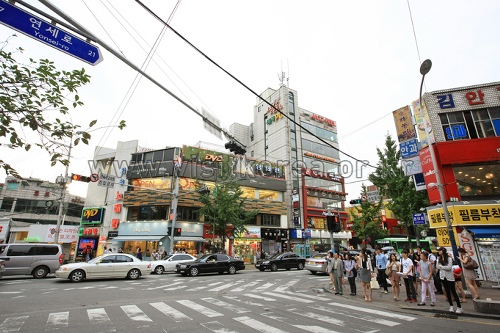
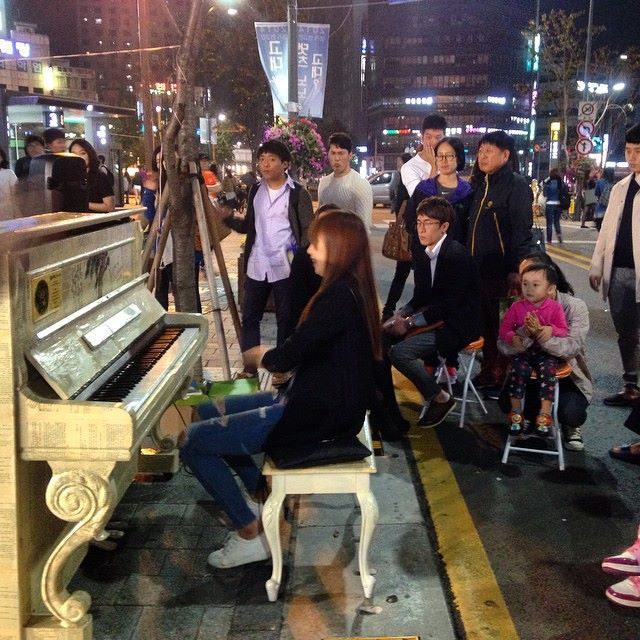
Yeonsero (연세로), the pedestrian avenue that runs from Sinchon Subway Station straight to the Yonsei main gate, was officially designated in 1999 as "The Road One Wants to Walk," and then made fully pedestrian-friendly in 2014. If you walked it in the late '90s and early 2000s, you were walking through the peak of what Koreans call 대학가 (daehakga, the college town). Buskers with acoustic guitars every 20 meters. Photo booths (스티커사진) around the corner from tteokbokki carts. Bars where a pitcher of Cass ran 4,000 won because the operator counted on you buying four.
The industry mechanic that made this work was simple: rent on Yeonsero-adjacent alleys was cheap enough that a family-run kimbap joint could survive on 3,000-won gimbap rolls, and cheap enough that a first-time restaurateur could open a bunsik shop with under 30 million won of setup capital. Compare that to trying to open the same thing in Gangnam today (three-times the deposit, higher wage floor) and you understand why Sinchon was the training ground for a generation of Korean F&B operators. Half the guys who now run Michelin-listed spots in Hannam or Seongsu cut their teeth on a Sinchon lease.
The Iconic Staples: 회오리감자, 홍콩반점, and 신촌설렁탕
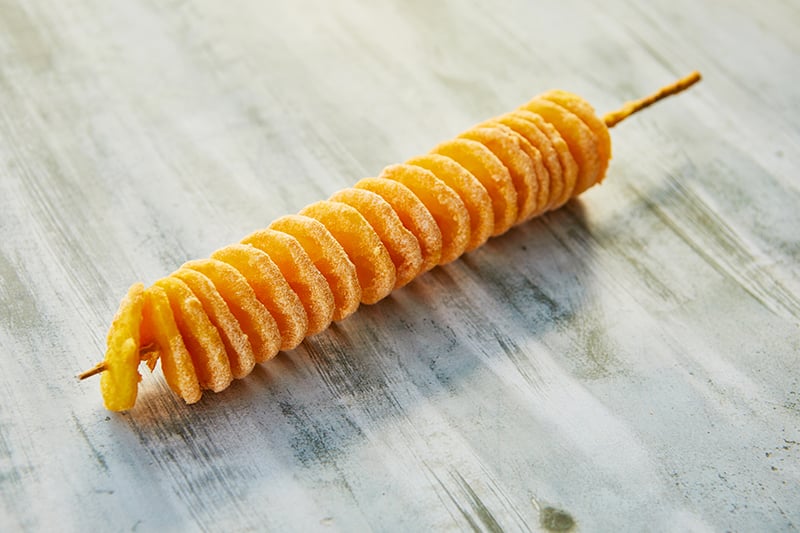
Every Sinchon food memory eventually collapses onto three items. First, 회오리감자 (hoeorigamja), the tornado potato: a whole spud spiral-cut on a skewer, deep-fried, then dusted with sour cream and onion powder or cheese seasoning. It hit Korean streets around 2005 and Sinchon was its unofficial testing ground, sold from tin-roof carts outside the Yonsei main gate for 3,000 won. The appeal is not the potato itself. It is the ratio: crunchy outside, fluffy inside, seasoning that hits the salty-tangy note Korean palates love in bar snacks. Foreign tourists posted it to Instagram before Korean food influencers had figured out the format, which is why the tornado potato reached Berlin street festivals before it reached most Korean provincial cities.
Second, 홍콩반점 (Hongkong Banjeom), the Baekjong-won-owned "Hong Kong Restaurant" chain that basically colonized Sinchon in the 2010s with a 4,500-won 짬뽕 (jjamppong, spicy seafood noodle soup). The play was volume: standardized recipe, central commissary, high-turnover seating. A Sinchon Hongkong Banjeom will turn 200 covers on a Friday lunch, which is roughly triple what a comparable Gangnam Chinese restaurant does. The dish itself is honestly not the best jjamppong in Seoul. That is not the point. The point is that it exists in the exact spot, at the exact price, where a Yonsei junior with 10,000 won in her pocket can eat, pay, and get back to the library in 25 minutes.
Third, 신촌설렁탕 (Sinchon Seolleongtang), the ox-bone soup house that has been running near Sinchon Rotary since 1979. Setleongtang is the ur-Seoul comfort food, a milky broth simmered with beef bones for a full day, served with rice and a pot of kimchi you self-season with salt and scallion. What made Sinchon Seolleongtang a landmark is not the recipe (dozens of joints do it well). It is the ritual: the way Yonsei professors would grade papers in the back booth at 7 a.m., the way study groups would show up at midnight after all-night sessions in the university library. That is 정 (jeong, the deep-affection bond) built into a restaurant's DNA over four decades. Very hard to replicate. Very easy to lose when the rent spikes.
The Business Model Behind Sinchon's Cheap Eats: 3x Table Turnover
Here is the industry piece that nobody writes about. Sinchon restaurants have historically run a three-times-per-shift table turnover model, which is triple what a standard Seoul dining district manages. That is the entire reason a bowl of jjamppong can be 4,500 won and still make the operator money. If you sit down at Hongkong Banjeom or Sinchon Daegu Samgyeopsal at peak lunch, you will notice the server does not chat, does not wait for you to linger over coffee, and starts wiping your table before you have finished paying. That is not rude. That is the margin math working.
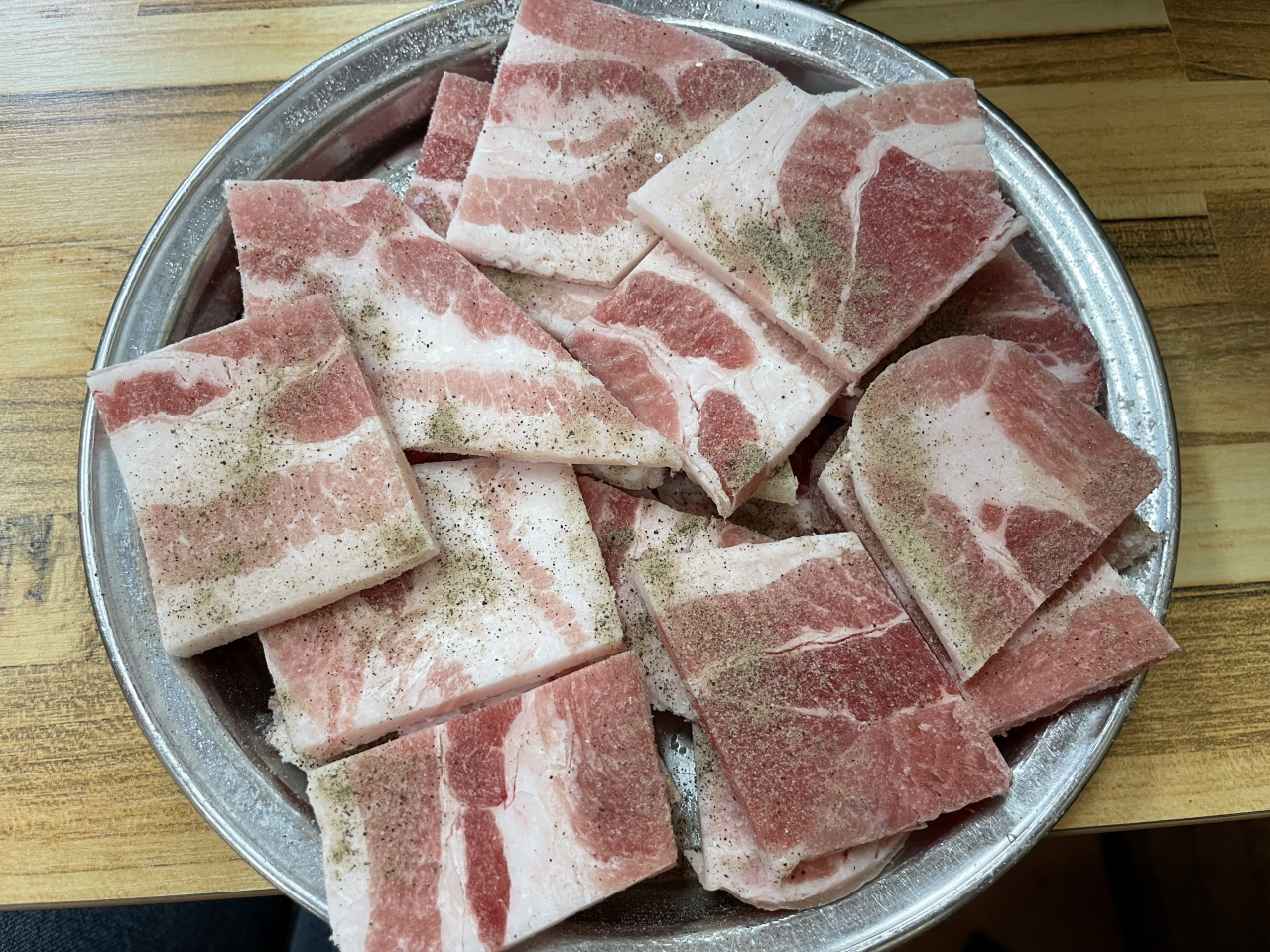
Look at Sinchon Daegu Samgyeopsal, profiled by The Korea Herald as one of the neighborhood's all-time favorite campus foods. One menu (frozen pork belly). Fixed side dishes. A server who comes at the end to fry your leftover kimchi and rice on the same pan you just used for pork. That single-item design is not a lack of ambition. It is a production-line decision. You cut the menu, you cut the prep labor, you cut the ticket time, and you free up seats to feed the next four students walking in from Yeonsero. Multiply that by 40 years and you get a Sinchon institution that outlasted the trends around it.
The 3x-turnover model has a shadow side. It works only when foot traffic stays dense. The second the university crowd thins out (COVID lockdowns, hybrid classes, Ewha demographics shrinking as fewer women's-only university applicants come in), the model collapses. That is exactly what has been happening to mid-range Sinchon operators since 2020.
Why Sinchon Lost the Cool Kids to Hongdae and Ikseon-dong
If you visited Sinchon in 2010 versus visiting it now, the change is stark. The music venues moved to Hongdae by the mid-2000s. The trendy cafes migrated to Yeonnam-dong (still walkable from Sinchon Station) and then further to Seongsu and Ikseon-dong. Real-estate data explains most of it: commercial rents on the main Yeonsero corridor jumped roughly 40 percent between 2012 and 2019, pushing out exactly the mid-range operators (sit-down cafes, indie live-music bars, hybrid restaurant-lounges) that used to define the neighborhood's cool factor. What survived were the very cheap (bunsik carts, kimbap counters) and the very expensive (K-BBQ chains with corporate backing). The middle got hollowed out.
The demographic shift matters too. In the '90s, dating for a Yonsei student meant meeting your Ewha girlfriend at a Sinchon coffee shop and walking to a movie. That dating geography got disrupted around 2013 when Hongdae (one subway stop away) turned into the definitive Seoul night-out district for anyone under 30. Ikseon-dong followed around 2016 as the aesthetic-first date destination, all restored hanok alleys and slow-brew cafes. Sinchon became, in Korean parlance, a "지나가는 동네" (a neighborhood you pass through) rather than a destination. For food operators, that is fatal.
What this means for the food scene: the survivors are the 40-year veterans (Sinchon Daegu, Hongkong Banjeom, Sinchon Seolleongtang, the Ewha-side Ttalgigol Bunsik that has fed Ewha students for four decades) plus the new-wave chains willing to eat thin margins for the branding value of a Sinchon flagship. The independent middle, the exact stuff that gave Sinchon its identity, is largely gone.
The K-Drama and Movie Pilgrimage Layer
Foreign visitors keep coming to Sinchon for one specific reason: cultural memory built by Korean film and TV over 25 years. My Sassy Girl (엽기적인 그녀, 2001), the Cha Tae-hyun and Jun Ji-hyun rom-com that basically defined Korean romantic comedy for a decade, was largely set in the Yonsei-Sinchon area. Reply 1994 (응답하라 1994), the tvN drama that romanticized '90s Yonsei-era college life, sent an entire wave of Korean and international viewers walking down Yeonsero looking for the show's fictional boarding house. Yonsei's Underwood Hall, the classic collegiate-Gothic building at the top of the campus rise, has appeared in enough K-drama frames that Chinese and Southeast Asian tourists photograph it as often as they do Gyeongbokgung.
That pilgrimage traffic props up parts of the Sinchon food scene that would otherwise have died. Sinchon Seolleongtang gets a steady flow of Chinese and Japanese food-tourism traffic because Korean food-Instagram accounts have named it as an "authentic old-Seoul" spot for over a decade. The Ewha alley cafes get international students who came specifically because Ewha's front-gate street was in K-drama montages. It is not enough to reverse the neighborhood's decline. It is enough to keep the anchors open.
How to Actually Eat Sinchon Right Now
If you have one day: start at Sinchon Daegu Samgyeopsal for the frozen pork-belly-into-kimchi-fried-rice combo. Walk Yeonsero to the Yonsei main gate. Underwood Hall photos, quick loop through the campus. Back down the hill, tornado potato from a cart, then coffee at any of the Ewha-side cafes on Ewha-yeodae 5-gil. Dinner at Sinchon Seolleongtang if you want the old-Seoul comfort-food register, or Hongkong Banjeom if you want the volume-play jjamppong that feeds 200 covers a night. Drinks afterward at a Damotori-style makgeolli bar (Damotori has been the Sinchon pregame bar since 1987, older than most current Yonsei students).
What you are eating in Sinchon in 2026 is not the peak Sinchon. Peak was 2010. What you are eating is the version that survived the rent spikes, the demographic shift, and the migration of the cool kids to Hongdae. That is still worth eating. The 40-year veterans got 40 years old for a reason.
Get Korean Snacks Delivered
Craving Korean street food and college-town flavors from home? Get authentic Korean snacks and ramen delivered straight to your door with the SnackFever Box by Daebak.


