


Table of Contents
Every March, Korea's cherry blossom obsession funnels into one city: 진해 (Jinhae), the naval port town in Changwon that hosts 군항제 (Gunhangje). Ten days, roughly 360,000 King cherry trees, and more than two million visitors converge on what is, by every reliable measure, Korea's largest cherry blossom festival. If you have followed the Hallyu content boom for even a few years, you have seen those iconic 여좌천 shots. This is the story of how they got that way, and what a decade covering Korean spring tourism has taught me about actually attending.
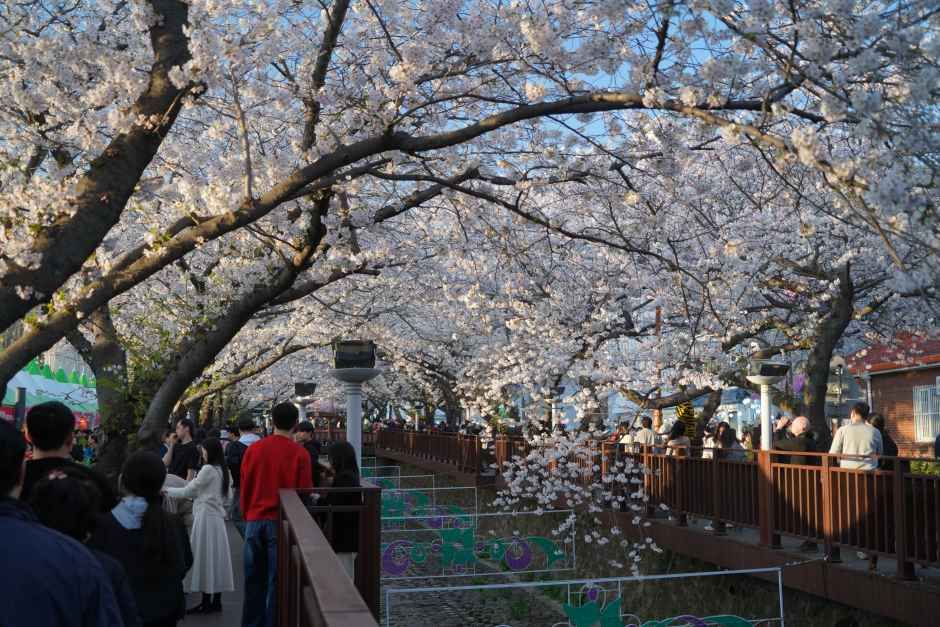
From a 1952 Memorial to Korea's #1 Cherry Blossom Festival
군항제 did not begin as a flower festival. It launched in 1952 as a memorial rite for Admiral Yi Sun-sin (이순신 장군), the Joseon-era naval commander who bested Japanese fleets during the Imjin War. Choosing Jinhae was deliberate: the city hosts Korea's Naval Academy and sits at the country's spiritual naval crossroads. The event formalised into a full-scale spring festival in 1963, and by the time Hallyu tourism took off in the mid-2010s, Gunhangje had become the anchor event of Korea's spring travel calendar.
Here is the part most guides skip. King cherry trees (왕벚나무) in Jinhae bloom roughly 7 to 10 days later than the Jeju and Busan first flush, which places peak bloom right when international travellers can align long-weekend trips. That timing accident is the single biggest reason Gunhangje pulls 2M+ visitors a year while other similar-scale festivals plateau at 500K. Korea Tourism Organization data has flagged this pattern for years, but the industry did not price it in until Instagram made 진해 벚꽃 명소 a recurring hashtag around 2017.
Why 여좌천 Owns Every Cherry Blossom Feed You Have Ever Seen
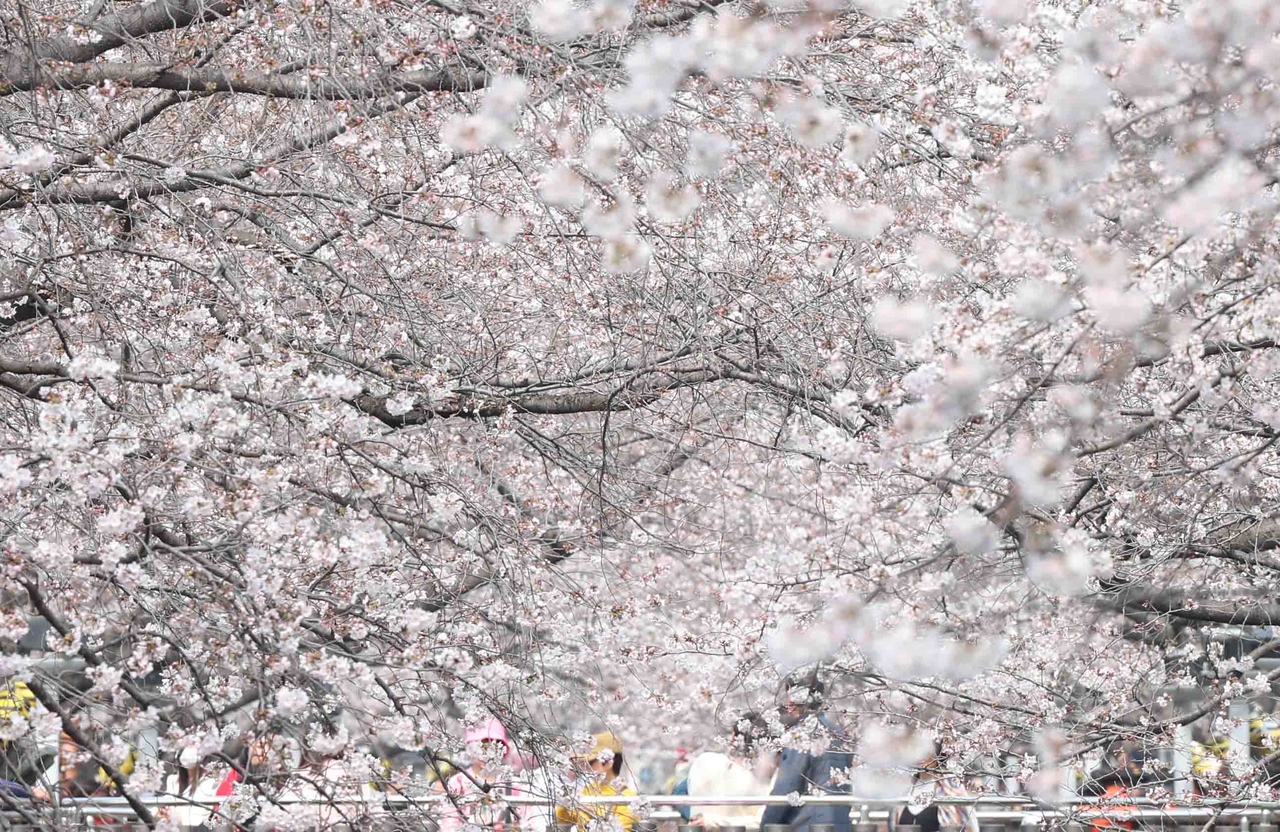
여좌천 (Yeojwacheon Stream) is not the widest cherry blossom road in Korea, and it is not the oldest. What it has is geometry. The stream runs a 1.5 km corridor with King cherry trees planted in parallel rows on both banks, and the trees lean inward at almost exactly the angle a smartphone camera at eye level needs to compose a perfect 1:1 Instagram square. Locals figured that out around 2015. The algorithm figured it out around 2018. Since then, 여좌천 has been Korea's single most posted cherry blossom location, ahead of even Seoul's Yeouido.
The wooden bridge in the middle, 로망스다리 (Romance Bridge), earned its nickname from the 2002 MBC drama Romance and doubles as a K-drama pilgrimage stop. At night, the city strings heart-shaped lanterns and pink light chains through the trees for the Yeojwacheon Light Festival. Daytime crowds skew Korean family and couple; night crowds skew international Hallyu fans who timed their trip around the illumination. Both crowds are, to be blunt, dense. There is no version of this location that is not busy during peak bloom.
경화역: The Railroad Shot That Put Jinhae on the Global Map
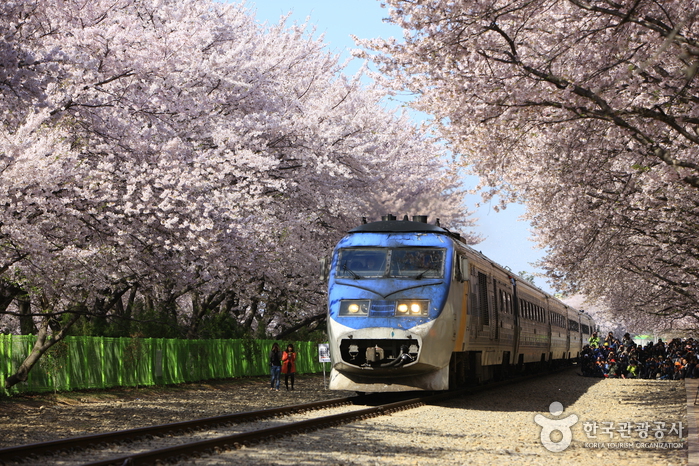
경화역 (Gyeonghwa Station) is technically an abandoned rail stop. The Jinhae Line stopped running passenger service in 2015, but the tracks, the platform sign, and a retro locomotive display are all preserved as a photo tourism asset. Cherry trees line an 800-meter stretch of the disused tracks; during festival week the city runs a themed shuttle train that briefly appears in the tunnel of blossoms, and photographers stack three-deep along the platform to time the shot.
CNN Travel included 경화역 on its list of Korea's most beautiful places, and if you dig into why, the answer is composition. Perfectly straight rail lines draw the eye into a soft pink haze, with a low horizon that flattens depth-of-field on any phone camera. If you have ever wondered why Korean spring content feels instantly recognizable versus Japan's sakura content, this frame is a big part of it. The Japanese sakura equivalent (parks, temples, riversides) rarely offers this kind of linear industrial contrast. That contrast is why 경화역 travels internationally the way it does.
The Naval Base Access No Other Cherry Blossom Festival Offers

Here is the piece that separates Gunhangje from every other Korean flower festival. During the 10-day window, the Republic of Korea Naval Academy and the Jinhae Naval Base Command open to the public. The rest of the year, both are hard-restricted military zones you cannot get near. That access, combined with the memorial rites for Admiral Yi Sun-sin, the Victory Parade re-enactment, the Military Band and Honor Guard Festival on Friday nights and weekends, and the Republic of Korea Air Force Black Eagles aerobatic display, gives Gunhangje a civic-ceremonial layer no other cherry blossom festival in Asia matches.
If you have covered K-content marketing for even a few years, you know the insight buried in this. The ceremonial layer is what keeps Gunhangje out of the "just another Instagram festival" bucket that other flower events sink into after a few viral seasons. It is Korea's closest civilian equivalent to a national ceremony, and that authenticity is precisely what international Hallyu fans read as "real Korea." You cannot fake a naval band. You cannot fake a working aircraft carrier moored to the pier while cherry petals drift onto it. That is the appeal point Korean tourism officials have been quietly building around since 2016.
The Booking Reality Nobody Warns You About

Now the operational side. Jinhae is a small city (population under 200,000) that swells to over 300,000 people on peak festival Saturdays. Local hotel and pension ADR (average daily rate) runs 8 to 12 times normal during festival week, and most of the well-located inventory sells out within 48 hours of Korea Tourism Organization confirming the bloom forecast, which usually lands in late January. If you are reading this in December, you are already borderline late for peak-weekend accommodation.
The alternative most seasoned travellers use is basing yourself in Busan or Changwon proper and shuttling into Jinhae. Trazy and other Korean tour operators run Seoul-to-Jinhae and Busan-to-Jinhae day tours with KTX combinations that price out cheaper than trying to stay in Jinhae itself. The KTX plus local bus route from Seoul takes roughly four hours one way, which turns Gunhangje into a workable, if long, day trip if you leave before 6 AM. Anyone selling you a "Seoul Gunhangje half-day tour" is not being honest about the drive.
When to Go, What to Eat, What to Skip
Peak bloom historically lands around March 30 to April 5, but climate change has pushed forecasts progressively earlier over the last decade. The festival runs a fixed 10-day window regardless. If you time your visit outside peak weekend, you trade some crowd pressure for slightly less dense blossom coverage, which most photographers agree is worth it. Weekday early-morning visits (before 8 AM) are the pro move for anyone serious about shooting.
Food-wise, the festival street market leans traditional 축제 fare: hotteok, dakgangjeong, tornado potato, sotteok-sotteok, sweet rice cake with cherry blossom motifs (벚꽃 인절미), and cherry blossom bread shaped like a petal. Jinhae's local specialty pastry, 준암 오리빵 (Joonam duck bread), is worth queuing for. Skip the makgeolli tents unless you have a designated shuttle-taker; Jinhae's bus system is not built for peak-crowd conditions and Uber does not operate here.
Avoid: any package tour promising "Gunhangje plus DMZ same day" (physically impossible), any hotel listing under $50 per night on peak Saturday (almost certainly a scam or a mislisted date), and the temptation to lug full camera gear beyond one body plus one lens. Crowds are dense enough that mobility matters more than glass. The photo you actually want, the 여좌천 tunnel shot at sunset, does not need anything more than a phone camera and patience.
Explore More of Korea with Daebak
Want to bring a little piece of Korea into your life? The Daebak Box is packed with the best Korean snacks, ramen, and cultural goodies delivered monthly to your door.


