


Table of Contents
If you have spent any time in the Korean travel space, you have watched the same pitch play out over and over: fly into Incheon, three nights in Seoul, KTX down to Busan for the beach, done. Daegu (대구), Korea's fourth-largest city, gets skipped almost by default. That is the industry's loss, not yours. After more than a decade watching KTO campaigns and K-content tourism plays land or flop abroad, I can tell you Daegu is the city Koreans themselves quietly rank as the best "second stop" outside Seoul, and once you understand its three anchors, textiles, herbal medicine, and a spice tolerance that even other Koreans find intense, the pitch writes itself.
Daegu is not trying to out-Seoul Seoul. It has a distinct 정체성 (jeongcheseong, identity) built around 서문시장 (Seomun Market) as Korea's largest Joseon-era textile hub, 약령시 (Yakryeongsi) as the country's 400-year herbal medicine capital, and a food scene where 매운맛 (maeunmat, spicy heat) is not a garnish but the whole point. Add the annual Chimac Festival pulling one million visitors a year and Palgongsan Mountain wrapping the city in a Buddhist backdrop, and the case for a two-night Daegu detour writes itself.

Seomun Market (서문시장): Where Korea Actually Learned to Trade
If Namdaemun is where Seoul tourists take pictures and Gwangjang is where Netflix crews shoot mung bean pancakes, Seomun is where Korean traders have been moving actual volume since the 17th century. In the Joseon dynasty this was one of the country's three great markets, sitting alongside Pyeongyang Market up north and Ganggyeong Market in Chungcheong. It relocated to its current site in the 1920s after the Cheonhwangdangji Reservoir was reclaimed, and the alleys still carry the old signage: Hongdukkae Pancake Alley, Chicken Pancake Alley, names that tell you what merchants were pushing three centuries ago.
The reason Seomun still matters is textiles. Daegu has been Korea's fabric city since the late Joseon period, and Seomun is where the country's silk, hanbok fabric, bedding cotton, and factory-run polyester have been wholesaled for generations. Walk the six districts and you will pass over 4,000 shops selling dried seafood, kitchenware, cutlery, dishes, and every conceivable weight of cloth. This is not a "market experience" designed for camera phones. It is functioning wholesale infrastructure that happens to let tourists in.
The real appeal point (and where the Korean government has been quietly pushing tourism) is the 야시장 (yasijang, night market) that opened here in 2016. It runs 80 food stalls along the central aisle Friday through Sunday nights, and this year Seomun was named one of Korea's 11 "must-see" traditional markets for the global spotlight by the Ministry of Culture. Order the 납작만두 (napjak mandu, flat dumplings) unique to Daegu, the 씨앗호떡 (ssiat hotteok, seed-filled sweet pancake), and 칼국수 (kalguksu, hand-cut noodle soup). Bring cash; not every stall takes card.

Yakryeongsi (약령시): The 400-Year Reason Daegu Is Korea's Medicine Capital
Most travel bloggers who cover Daegu mention Yakryeongsi in a single sentence and move on. That is a mistake, because this is the reason Daegu exists at the scale it does. Established in 1658 along a 700-meter stretch of Namseong-ro in Jung-gu, Daegu Yangnyeongsi (also spelled Yakryeongsi) was the market where the Gyeongsang-do governor supplied 한약재 (hanyakjae, medicinal herbs) to the central government and sold the rest to commoners. Until 1910, Daegu was the operational center of Korean 한방 (hanbang, traditional Korean medicine), moving herbs to Japan, China, Russia, and Manchuria.
The industry mechanic behind this is that Korean 한의학 (hanuihak, traditional medicine) is not just Chinese medicine imported. It is a distinct system rooted in 동의보감 (Donguibogam), the UNESCO-designated 17th-century medical encyclopedia compiled by Heo Jun, and the 사상체질 (sasang chejil, four-body-type constitutional medicine) framework systematized by Lee Je-ma. Where Chinese herbal medicine tends toward strong, symptom-focused decoctions, Korean 한약 is calibrated to individual constitution (Taeyang, Taeeum, Soyang, Soeum). Daegu was where those pharmacological traditions got commercialized at scale.
The reason this matters right now, in 2026, is that Korean traditional medicine has quietly turned into a wellness tourism magnet. Foreign patients spent a record 26 billion won at 한의원 (hanuiwon) clinics in 2025, chasing 추나 (Chuna) chiropractic therapy, acupuncture, and weight-management herbs. Daegu's Yangnyeongsi Oriental Medicine Cultural Museum offers hands-on programs (herbal foot baths, body-type diagnosis, medicinal cooking classes) that give visitors a legitimate window into what has been the city's economic identity for four centuries. The annual Herbal Medicine Festival every May turns Namseong-ro into an open-air pharmacy that even skeptics find charming, in the way that 정 (jeong, deep-set warm affection) tends to sneak up on you.

Why Daegu Food Is Uniquely Spicy (Even Koreans Notice)
Koreans have a running joke: Seoulites think tteokbokki is spicy, Jeollanam-do treats spice as background music, and Daegu just cranks the gochugaru and dares you. It is not a stereotype, it is measurable. Daegu's signature dishes lean harder on chili than almost anywhere else in the country, and the reason is a mix of geography, industrial history, and a Chinese-Korean immigrant influence that shaped the city's palate.
Start with 찜갈비 (jjimgalbi). Daegu's version is not the sweet, soy-braised short rib you get in Seoul. It is beef ribs stewed in a dented nickel-silver bowl (chosen because it conducts heat faster and keeps the sauce bubbling at the table), then hit with sliced garlic and a small mountain of hot red pepper. The dish was born in Dongin-dong in the 1970s when noodle shop laborers started bringing meat to the counter for added protein, and the cooks improvised with the Korean pantry staples they had (gochu, garlic, sesame oil). Bongsan claims to be the original, and the block around it is now officially called 동인동 찜갈비 골목 (Dongin-dong Jjimgalbi Alley). The appeal point is texture: because it braises rather than grills, the meat pulls apart with chopsticks, and you eat it over rice while the residual chili oil pools at the bottom.
Then there is 막창 (makchang), Daegu's grilled pork abomasum. Every other Korean city treats offal as a hangover food. Daegu treats it as a Friday-night event, grilled tableside, dipped in a doenjang-based sauce, chased with soju. The city is also the historical epicenter of 매운 갈비찜 (spicy braised chicken), and Nammun Market's Naganghwan-style spicy noodle scene deserves its own trip. Add in 뭉티기 (mungtigi), raw beef sliced into thick chunks and served with a fiery dipping sauce, and you have a food identity that punches well above the city's tourism budget.
The Chimac Festival: Korea's Answer to Oktoberfest
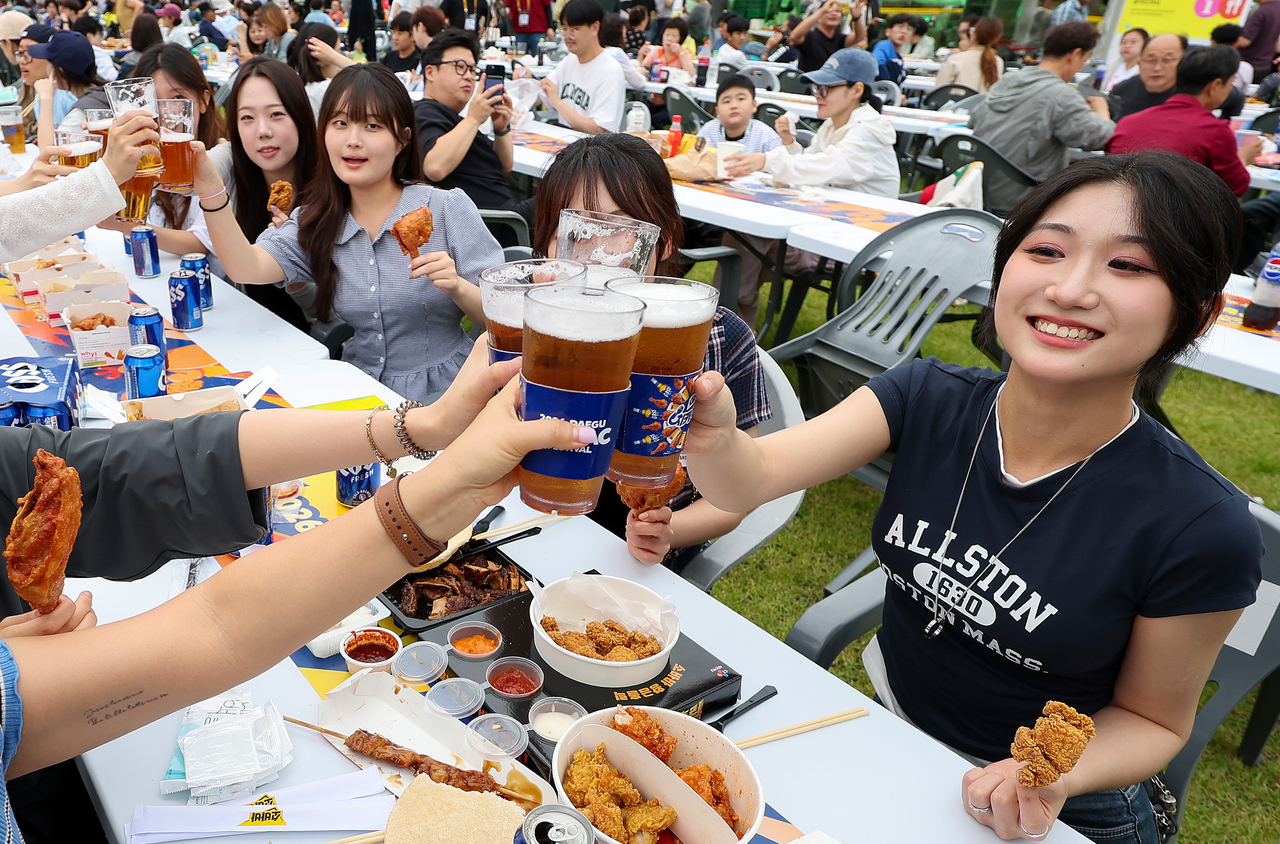
If Munich has beer tents and Seoul has cherry blossoms, Daegu owns 치맥 (chimaek, chicken plus 맥주 maekju beer). The Daegu Chimac Festival launched in 2013 and now pulls one million visitors every summer, running five days at 2·28 Freedom Plaza inside Duryu Park under a rotating theme (this year's was "Chimac 26: Departure"). The Ministry of Culture nominated it for Korea's Local 100 and Cultural Tourism Festival lists this year, which is the government's soft-power way of saying they want Chimac to become the Korean Oktoberfest for global travelers.
The reason Daegu owns this event is not marketing spin. Daegu is the historical mecca of Korean fried chicken. Food columnist Hwang Young-cheol points out that Daegu's old name Dalgubeol shortens to Dalgu, which literally means chicken in old regional dialect. By 1903 the city already had a major poultry market, and in the 1960s Daegu's flatlands hosted 70 to 80 percent of Korea's poultry production. In 1978 the country's first fried chicken restaurant, later franchised as Mexican Chicken, opened in Daegu's Hyomok Market. Mexicana, Cheogajip, Hosigi, and Daegu-born Kyochon all trace their DNA to this city.
The appeal point for foreign visitors is the format. Nightly K-pop and indie performances (this year FT Island, N.Flying, 10cm), water-themed EDM parties in "Daefrica Waterpia" zones (a nod to Daegu's nickname combining the city name with Africa because of the summer heat), and stalls run by nearly 100 chicken manufacturers pouring cold Cass and Kyochon-branded beer. The 2023 edition sparked 29.6 billion won in economic activity for the city. If you time a Daegu trip for early July, this is the single event that will convert your friends into believers.
Palgongsan and Donghwasa: The Mountain Backdrop That Anchors the City
Every Daegu resident I have spoken with says the same thing about the city skyline: look north from anywhere and you will see the 팔공산 (Palgongsan) ridgeline. The name commemorates eight generals who died defending the peaks over a thousand years ago, and today the ridge holds dozens of temples and hermitages, including one of the most historically important Buddhist complexes in the country. Palgongsan sits about 20 kilometers northeast of downtown Daegu at the confluence of the Nakdong and Geumho rivers, with three main peaks: Birobong at 1,192 meters flanked by Dongbong and Seobong on either side.
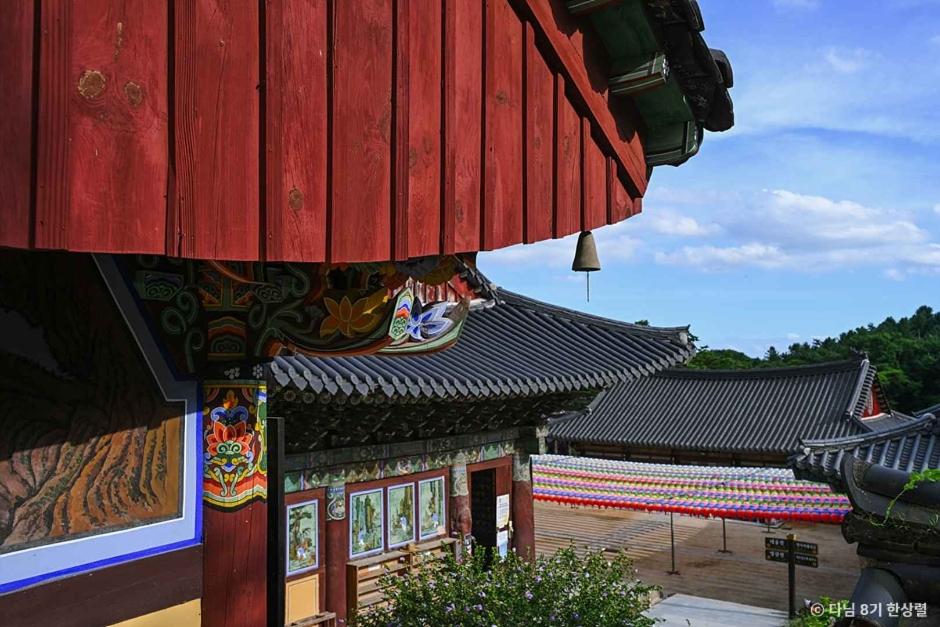
The anchor here is 동화사 (Donghwasa Temple), built by the monk Geukdal in AD 493 during the Silla dynasty. Its name means "temple of the paulownia blossom," referring to the trees that were said to bloom around it even in winter. The current buildings mostly date to 1723 to 1732 (Joseon-era reconstructions), and the 33-meter Tongil Daebul (Great Unification Buddha) built in 1992 stands as one of the tallest stone Buddha statues on earth. Foreign visitors are welcome for the temple's overnight 템플스테이 (templestay) program, which includes 발우공양 (balwoo gongyang, monastic bowl meals), 108 full bows, dawn 참선 (chamseon) meditation, and a green tea ceremony.
The industry point I usually make: the templestay program at Donghwasa is one of the more genuinely accessible ones because Daegu has kept translation infrastructure alive for over 20 years, and the volunteer program actually briefs foreign guests in real English rather than the awkward pamphlets you get at some Seoul temples. If you cannot commit to the overnight stay, the Palgongsan Cable Car (adult round trip 13,000 won) runs from the Donghwasa side up to a summit station with the Wish Rock viewpoint. On a clear day you can see the northern reaches of Daegu proper, which is when you finally understand why Koreans call Palgongsan the city's spiritual anchor.
How to Get to Daegu (and the Rest of the Itinerary)
KTX from Seoul Station drops you at Dongdaegu (East Daegu) Station in just under two hours, and this is the option almost every Korean local will recommend. Slow trains take about three and a half hours if you want scenery. Buses from Seoul Express Bus Terminal run 3 to 4 hours depending on traffic. If you are flying, Daegu International Airport (TAE) handles regional and select international routes.
Once you are in the city, Daegu Metro's three subway lines will get you to every anchor on this guide. Seomun Market Station on Line 3 for the market and night market. Banwoldang Station on Lines 1 and 2 for Dongseong-ro, the downtown shopping and cafe area. Head to Jung-gu for Yangnyeongsi and the Modern Culture Alley walking route (a real recommendation, this is where Daegu's Christian and industrial history sits). Line 1 up to Ayanggyo, then Bus 401 or 팔공1 for Donghwasa. E-World and 83 Tower sit near Duryu Station on Line 2 for the seasonal cherry blossoms and the observatory deck that gives you the full Daegu skyline.
A practical note on when to visit: Daegu earns its "Daefrica" nickname in July and August, when temperatures regularly hit 36 to 38 degrees Celsius. That said, Chimac Festival is worth the sweat. For softer weather, April cherry blossoms at E-World or October foliage on Palgongsan are the classic locals' picks. Skip mid-August unless you specifically want the heat as part of the experience.
Daegu will not out-shine Seoul or out-beach Busan. That is not what the city is for. It is a place with a distinct textile-and-medicine identity that predates most of Korea's modern tourism circuit, a food culture spicy enough to reset your palate, and the kind of Palgongsan-anchored calm that Seoul cannot offer even on its best day. If you are booking your third or fourth Korea trip and want the itinerary Koreans themselves would give you, this is it.
Explore More of Korea with Daebak
Want to bring a little piece of Korea into your life? The Daebak Box is packed with the best Korean snacks, ramen, and cultural goodies delivered monthly to your door.


