


Table of Contents
I've spent the better part of a decade watching how K-content licenses cross oceans, and one truth keeps landing: the snack aisle predicts the fandom. Before a kid in São Paulo knows a NewJeans title track, she probably knows Pepero. Before a fan in Berlin can name the CEO of HYBE, he's already sipped Binggrae 바나나맛우유. Korean 편의점 shelves are the true onboarding ramp, and the ramp starts at the school gate.
Korean high schoolers move through a snacking day most Western parents would find alarming: morning 등하교 gum on the bus, a midmorning 초코바 during hallway pass, a hot 매점 cup after 4th period, and a GS25 or CU sweep during 하교 rush before hitting a 학원. It is a real economy. Industry estimates put Korean HS students at roughly ₩3 to 5 trillion in annual snack and beverage spending, most of it concentrated across three giants (Lotte Wellfood, Orion, Haitai) and captured through convenience-store dominance. What ends up in the backpack is, quietly, a barometer of Korean pop taste itself.
Pepero: the student-native pretzel that captured Times Square
If you had to pick a single stick of pretzel to represent the entire Korean HS canon, it is Pepero. Lotte Wellfood did not invent Pepero Day. Teenage girls in North Gyeongsang Province started it in the mid-1990s, and Lotte simply noticed the sales spike and moved. That origin story matters, because it explains why Pepero doesn't feel corporate on a Korean campus. It reads as student-native, the way certain TikTok memes feel student-native even when brands try to co-opt them. About 65 percent of annual Pepero sales still cluster around November 11 (per Korea Times reporting), and Lotte is now beaming NewJeans Pepero ads onto Times Square LED walls in New York. That is a ceiling most Western snacks never touch.

Choco Pie: the boomer that still moves 4 billion units
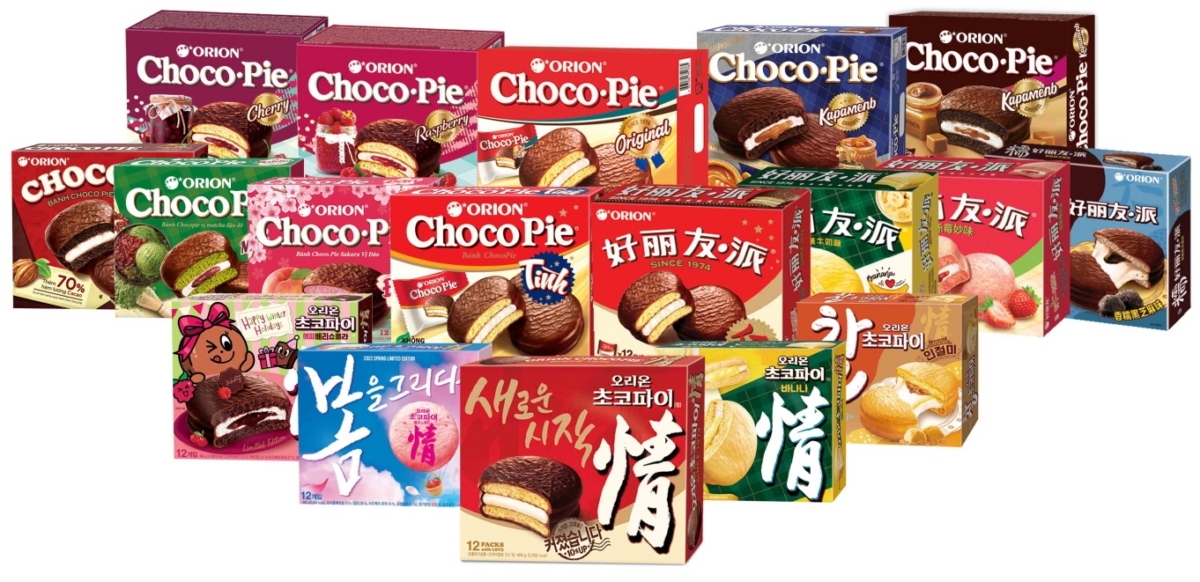
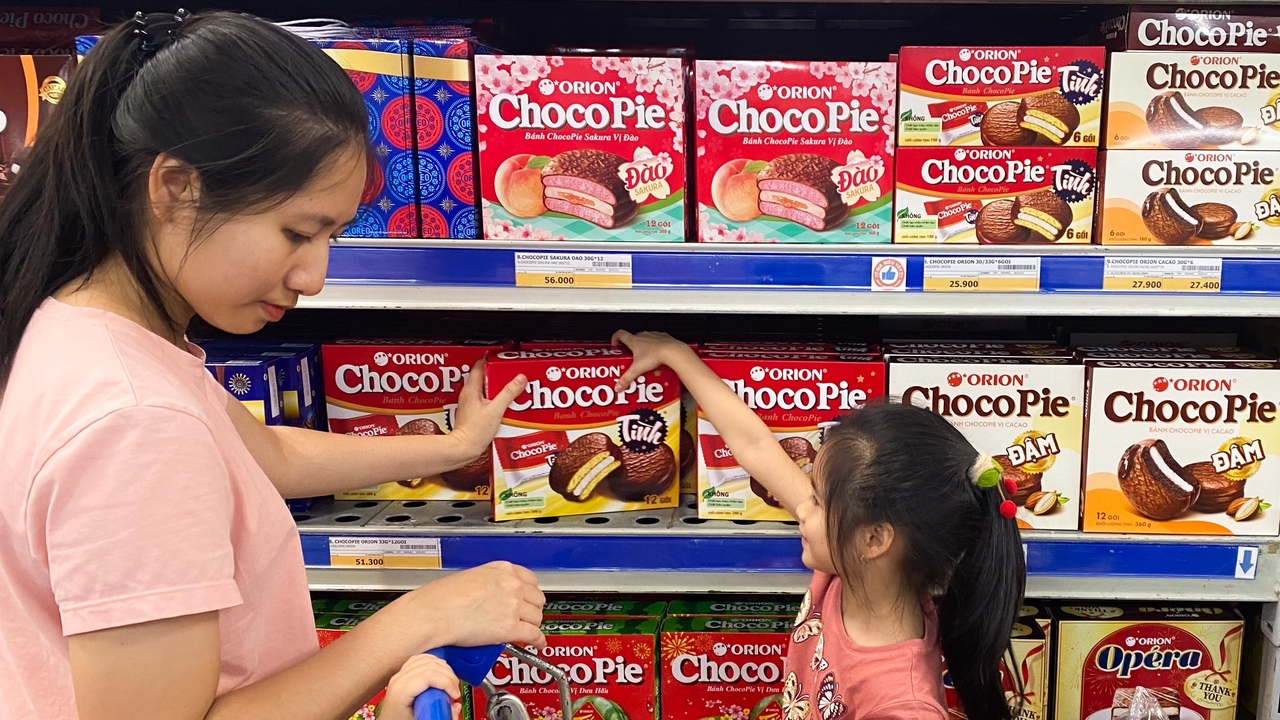
Orion's Choco Pie is the oldest snack on this list and somehow still the strongest. The 1974 launch cleared ₩1 billion in year one, and last year alone Orion moved 4 billion units, pushing cumulative revenue past ₩8 trillion (about $6 billion) since inception (Korea Herald, 2025). Two things sustain it. First, the Chinese character 정 (jeong, that stubbornly untranslatable Korean word for the warmth of shared feeling) is literally printed on every box. That positions the snack as something you give, not just something you eat. Second, Orion aggressively localized: matcha and red bean in China, coconut in Vietnam, berry jam in Russia. Textbook confectionery playbook, and it is why 67 percent of Choco Pie revenue now comes from overseas.
Sangeobap and shrimp crackers: the ₩800 bag that never dies
Sangeobap (literally "sea creature rice") is the seafood-shaped puffed snack that older HS kids buy semi-ironically. It is crisp, faintly sweet, faintly briny, cheap enough that a ₩800 bag fills a hallway break without denting a week's allowance. Alongside it lives the entire Nongshim shrimp cracker family, one of the oldest Korean snack SKUs still in daily rotation. The appeal is not flavor complexity. It is texture: a light, airy crunch (바삭) that shatters cleanly instead of the greasy chew of a Western potato chip. Korean brands optimized around that mouthfeel decades ago, which is why these bags travel from Seoul convenience stores to Bay Area H-Mart aisles without reformulation.
Tteokbokki chips: the 매점 as A/B testing floor for hallyu
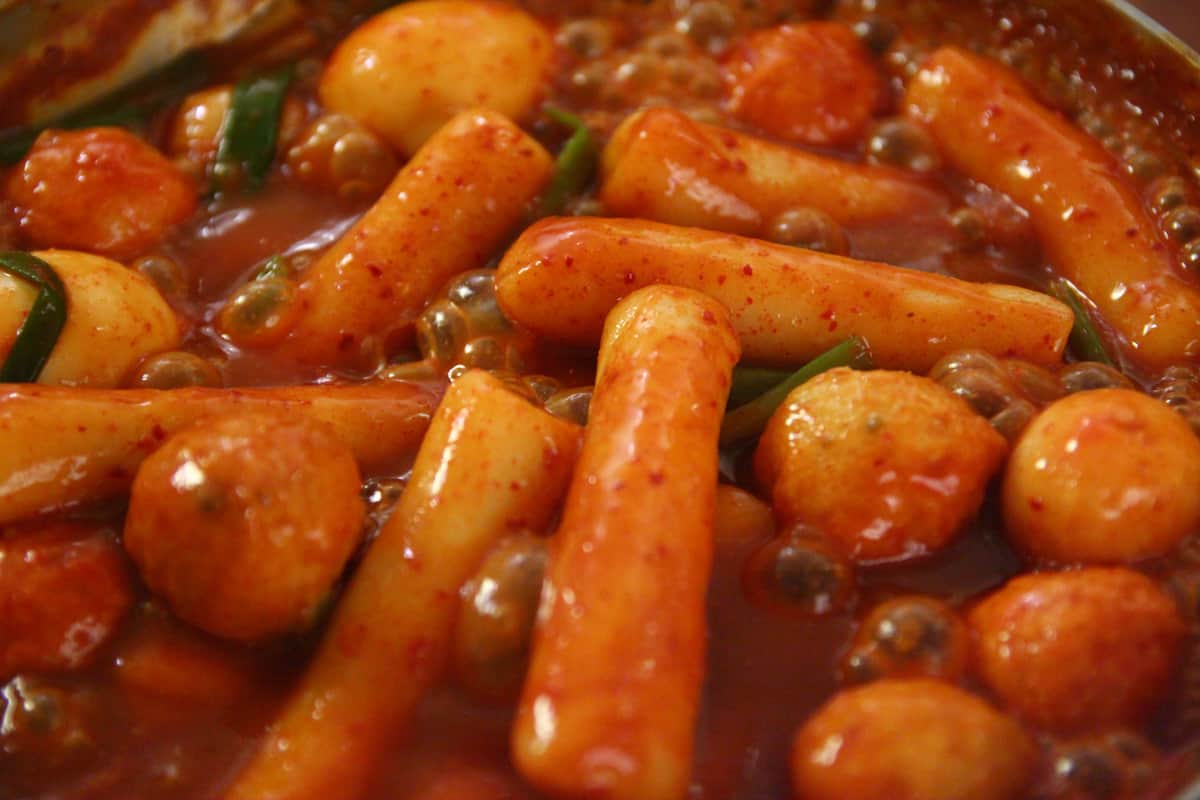
The "tteokbokki flavor everything" trend was validated inside Korea years before Squid Game gave the world its dalgona moment. The Shindangdong Tteokbokki chip line, Haitai's spicy rice cake snack, countless GS25 and CU limited editions: all bank on the same insight. HS students crave the sweet-spicy 고추장 profile even when they can't afford or don't have time for actual street tteokbokki. This is a real hallyu commerce mechanic. Netflix hits (Squid Game, Extraordinary Attorney Woo) put international eyes on Korean street food, and CU or GS25 buyers answer within weeks with limited SKUs. The 매점 becomes a live A/B testing floor for the K-content universe.
Banana milk, Milkis and the drink shelf that funds the whole ecosystem
Ask any Korean HS student to name a drink and Binggrae 바나나맛우유 is either first or second out of the mouth. The chubby jar bottle is not nostalgic packaging by accident. Binggrae designed it in 1974 to evoke traditional Korean pottery, and the shape became so iconic that Jungkook has been photographed sipping it and IU has fronted the campaigns. Roughly 800,000 bottles sell per day in Korea alone, over 6 billion since launch (Bokksu Market). Then there is Milkis, the Lotte carbonated milk soda that reads bizarre on paper but tastes like a drinkable cream soda. Both drinks share the trait Korean HS students prize: they land sweet without turning cloying, and they price cheap enough for a ₩1,500 grab-and-go.

Why this backpack matters
The Korean HS backpack is not a random assortment. It is a curated shelf that Lotte, Orion, Haitai, Binggrae and the CU / GS25 buyers all fight to control. When a limited-edition Pepero drops the same week as a NewJeans comeback, that timing is not accidental. It is how Korean snack conglomerates ride the hallyu wave in real time. If you want to understand why K-pop, K-drama and Korean street food travel together as one cultural bundle, follow the snacks. They are the earliest, cheapest, most repeat-purchased touchpoint fans have with Korea. The idols come and go. Pepero, Choco Pie and 바나나맛우유 stay in the bag.
Want to skip the trip to the airport 편의점? SnackFever Box is the shortcut. Every month it curates the exact hits Korean HS students are buying right now, and drops them at your door.


