


Table of Contents
Sangeobap (상어밥) is the shark-shaped kid brother in Orion's sea-creature snack lineup, the same puffed and baked biscuit family that gave Korea Korepab (코레팝) and the flagship Goraebap (고래밥). If you grew up in Korea in the late 80s or 90s, you know the drill: rip the top, tip the whole bag into a bowl, and let your friends fight over the sharks, whales, and starfish inside. I've been tracking Korean snack aisles for a decade, and Sangeobap is a textbook case of why the retro-nostalgic snack economy still moves so much shelf space.
What Sangeobap Actually Is
Sangeobap is a puffed wheat-flour biscuit shaped like a cartoon shark, seasoned with the same salty seaweed and BBQ-tinged coating Orion uses across its Marine Boy line. The parent SKU, Goraebap (literally "whale food"), launched back in 1984, and Orion built the recipe around six thin baked layers rather than a deep fry, which is where the light, crunchy, hollow texture comes from. Sangeobap is essentially a spin, same mouthfeel, same seasoning, just a bag of only sharks so kids can pretend they are eating the top of the food chain. That is a genuinely Korean product logic: shape variation as its own marketing category, not a gimmick.

Korepab, 코레팝, and Orion's Ocean-Life Playbook
Korepab is the fish-cracker cousin, same wheat-based, baked, seasoned family, different silhouette (a stubbier fish, sometimes marketed abroad as "Korebap"). Together with Sangeobap and Goraebap, it makes up what Korean snack buyers privately call Orion's 바다 라인 (ocean line), a small but weirdly durable SKU cluster that anchors the "cute animal-shape snack" shelf next to Nongshim's Ojingeojip (오징어집, cuttlefish). The industry logic is simple. A parent stops in the aisle because the packaging is bright and the price sits around 1,500 won, and the child recognises the character before they can read the label. Orion still holds roughly 24 percent of Korea's snack market share (Nongshim is right behind at 23.6 percent), and this mid-tier retro cluster is a big reason why.
Why 새우깡 Set the Rules First
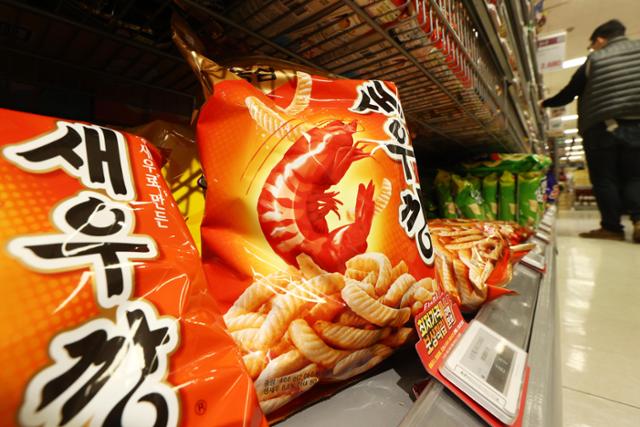
You cannot talk about Sangeobap without walking upstream to Saeukkang (새우깡), the Nongshim shrimp cracker that launched in 1971 and basically invented the Korean packaged-snack category. Nongshim has moved more than 7.7 billion bags of it, and in the first half of 2025 it posted 57.8 billion won in retail sales, still the country's number-one snack. Then KPop Demon Hunters happened. Netflix's animated hit put a bag of what any Korean instantly clocks as Saeukkang on screen, and Nongshim rolled out a limited-edition run with Rumi, Mira, and Zoey artwork that sold out in minutes. Sangeobap and Korepab live in Saeukkang's slipstream, inheriting the same "buy it because you already trust it" muscle memory.

The 응답하라 Series Rebooted the 옛날 과자 Economy
The reason Sangeobap and its Orion siblings keep pulling shelf space, when honey-butter chips and Buldak collabs are the "trending" story, is 응답하라 (Reply). tvN's Reply 1988, Reply 1994, and Reply 1997 turned the 80s and 90s snack pantry into a supporting cast of characters, and the retro wave has not slowed. Newer dramas like Typhoon Family and A Hundred Memories keep dressing every set with the same 옛날 과자 (old-school snacks) props, and cassette-tape culture is now something Gen Z watches with genuine longing. That is why Sangeobap still gets a facing at CU and GS25 right next to K-pop-branded Pepero. The retro-snack tier holds an estimated 15 to 20 percent of the Korean aisle, and 40-something parents are the most reliable repeat buyers.
Post-Squid Game K-Snack Exports
The other quietly interesting part of the Sangeobap story is what happens outside Korea. After Squid Game and now KPop Demon Hunters, Korean snack exports have become a real soft-power line item, and Orion has been aggressive about pushing the Marine Boy pack (its export name for the Goraebap and Sangeobap family) into Chinese hypermarkets, Southeast Asian convenience stores, and Korean-owned grocers across the US. What actually sells the shark abroad is not the seasoning, it is the shape variety and the memory of Reply-era Seoul, packaged into a bag your kid can open in a Jakarta 7-Eleven or a Queens H Mart. That is the K-content flywheel doing its actual job, one biscuit at a time.

Explore Korean Snacks with Daebak
Love Korean food? Get authentic Korean snacks and ramen delivered straight to your door with the SnackFever Box by Daebak.


