


Table of Contents
I have been working in and around Korean content for more than a decade, and the moment that crystallized "Korea owns the zombie genre now" for me wasn't Train to Busan in 2016. It was September 2020, when a 5 million dollar Korean apartment movie called #Alive (#살아있다) hit Netflix during a real lockdown and lapped Hollywood at its own table, becoming the first Korean film to top the platform's global Top Movies chart. The story of how that happened is the story of how Korean genre cinema actually works, and #Alive is one of the cleanest case studies I have.
If you only know zombies through The Walking Dead and World War Z, the Korean approach will feel structurally off in a good way. Western zombie cinema is combat: protagonists hunt, fortify, and shoot. Korean zombie cinema, from Yeon Sang-ho's Train to Busan to Kim Eun-hee's Kingdom to Cho Il-hyung's #Alive, is a social stress test, where the question is not whether you can kill the horde but whether the people sharing your KTX car, your palace, your apartment stairwell will hand you over to save themselves. That is a very Korean argument, and once you see it you cannot unsee it.

The Korean Zombie Lineage: How a Single Genre Got Built in Six Years
Train to Busan (2016) is the genre's Big Bang. Yeon Sang-ho took a KTX train, packed it with class signifiers (a fund manager, a baseball team, a working-class father-to-be, a homeless 아저씨), and let the infection sort them. Domestically it pulled 11.5 million admissions, which is monster territory in a country of 51 million people. Critically it traveled to Cannes Midnight, and it gave overseas distributors the proof point they needed: Korean horror could scale. From there the lineage runs Kingdom on Netflix in 2019 (Joseon-era zombies, with director Kim Seong-hun and writer Kim Eun-hee turning the zombie outbreak into a metaphor for famine and feudal indifference), then both #Alive and Peninsula in summer 2020, then All of Us Are Dead in 2022, then My Daughter is a Zombie in 2025 and the upcoming Colony with Jun Ji-hyun.
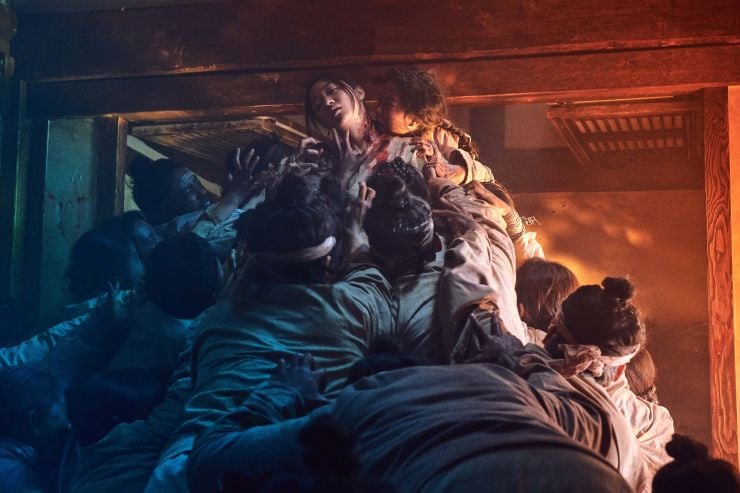
Here is the appeal point that Western critics keep missing: the Korean zombie isn't really the antagonist. The 좀비 is a forcing function. The actual drama is what the uninfected survivors do to each other under that pressure. In Train to Busan, the truly monstrous character is a living human (Yong-suk, the COO, who throws people to the horde to buy himself time). In Kingdom, it's the Queen Consort plotting succession. In #Alive, it's the masked stranger in the apartment opposite who is keeping his bitten wife alive in a closet. The infection just removes the social safety net so the real characters can show up.
Why #Alive Was a Bet Worth Making in 2020
The production math on #Alive is worth understanding because it shows what mid-budget Korean genre cinema actually looks like under the hood. Cho Il-hyung adapted a 2019 American spec script called Alone by Matt Naylor, kept the single-apartment chamber-piece structure, and shifted the location to a real Seoul apartment complex. The budget came in around 5 to 6 million USD, which is roughly a tenth of what a US studio horror in this slot would spend, and ZIP Cinema produced with Perspective Pictures co-producing on the American side. Lotte Entertainment distributed domestically. The script-to-screen window was tight, on the order of nine to twelve months by industry accounts, because Korean genre productions run on a 8 to 10 month shooting calendar by default.
The constraint is the feature, not the bug. When you have 5 million dollars and one location, you cannot fall back on set pieces. You have to make the apartment do narrative work, and Cho's choice to keep Joon-woo's father's whiskey, his ham radio, his sister's apartment key, and his old Korean rope rescue gear all working as Chekhov's guns inside that single space is exactly the kind of writing discipline that Hollywood lost when budgets ballooned. The film moves because it has nowhere else to go. That's a feature of how Korea trains its genre directors: tight calendars and tight budgets force you to write your way out instead of shoot your way out.

The Smartphone Twist: Why This Movie Is Specifically a 2020 Movie
The hook in #Alive that most foreign reviews underrate is the technology layer. Joon-woo is a game live-streamer (스트리머), the kind of full-time Twitch/AfreecaTV figure that Korea has produced at scale since the late 2010s. His apartment is wired with three monitors, a ring light, and a webcam, and his first instinct when the outbreak hits is not to grab a weapon but to check Naver and his livestream chat. That is a deeply Korean character beat. Korea's smartphone-and-streaming saturation is the highest in the OECD, and during the actual COVID lockdowns the country was running on Coupang same-day delivery and KakaoTalk group chats. Cho Il-hyung wrote a survival story where the survival skill is your phone battery percentage. Twenty-seven percent, twelve percent, three percent. Those numbers do as much narrative work as any zombie kill.
That is also why the film resonated the way it did during the global Netflix release on September 8, 2020. Viewers in Madrid and Sao Paulo and Atlanta who had been doom-scrolling Instagram from their own confined apartments for six months recognized the texture of the panic. The film wasn't pretending to be about a real pandemic. It was simply the only film in 2020 whose claustrophobic premise had been written and shot before COVID and then accidentally landed at the most resonant possible moment. Cho started writing well before the outbreak, but the cultural timing turned the movie into a real-time metaphor. That is the kind of luck Korean genre cinema sometimes gets, and Korean producers know how to spend it.
Yoo Ah-in and Park Shin-hye: The Casting Logic
The casting of Yoo Ah-in and Park Shin-hye is one of the smarter pieces of producing on this film. Yoo Ah-in had built his reputation on serious adult cinema, Six Flying Dragons on SBS, Lee Chang-dong's Burning at Cannes 2018, and his profile in Korea was prestige-actor with a slightly difficult-genius reputation. Park Shin-hye, by contrast, was K-drama royalty, You're Beautiful, The Heirs, Doctors, Memories of the Alhambra, with a Hallyu fanbase that ran from Manila to Sao Paulo. Putting these two together is not the obvious move. Their fanbases barely overlapped in 2019.
That is exactly why it worked. Yoo gives the film festival-critic credibility and the introspective half of the apartment-isolation scenes (the dad's whiskey monologue, the failed suicide attempt). Park brings the Hallyu base and a smart, lateral-thinking survivor character whose 한국형 사고력 (old-school resourcefulness with rope, knives, and basic chemistry) plays against Yoo's tech-dependent helplessness. In a conventional Western zombie movie, you would not give your female lead the more competent survival kit. The decision to do so here is part of why Park's character clicked with non-Korean audiences and why she has been able to translate that role into Sisyphus and Doctor Slump since. Yoo went on to praise her unwillingness to be argued out of her own choices on set in his June 2020 press interviews, which is essentially him saying she was the better actor on this picture.
The Netflix Deal That Mattered: 50 Million Households in One Month
Here is the industry insight that gets lost in the consumer coverage. Netflix did not commission #Alive. Lotte Entertainment opened it in Korean cinemas first on June 24, 2020, where it pulled roughly 1.9 million admissions despite COVID-thinned theater capacity, the highest first-day moviegoer count of any film in Korea since the country's pandemic threat alert went severe in February. Netflix then bought the international streaming rights and released globally on September 8, 2020.
Within 48 hours, #Alive hit number one on FlixPatrol's worldwide Netflix movies chart, the first Korean film to ever do so. It topped the chart in 35 countries including the US, France, Spain, Sweden, Russia, and Australia. By the end of its first month, internal Netflix estimates put viewership at well above 50 million member households globally. That is a number Korea had never put up on a movie before Squid Game broke every record a year later in 2021.
Why this matters strategically: it proved that Korean horror could export without IP recognition baseline. Netflix had already bet on Kingdom in 2019, but Kingdom had period-drama appeal and the safety net of a serialized Netflix Original budget. #Alive was a finished theatrical product with no marketing run-up in any non-Korean market. The fact that it still broke through, on word-of-mouth and the algorithmic push of an aligned tonal moment, is what convinced Netflix to multiply its Korean content slate from 80 million USD in 2019 to over 500 million USD by 2022. Park Shin-hye and Yoo Ah-in's apartment movie is one of the load-bearing data points behind that capital allocation.
The Korean Horror Production Pipeline That Made This Possible
If you want to understand why Korea now reliably outputs one genre-defining horror or thriller per year (Train to Busan, The Wailing, Kingdom, #Alive, Hellbound, All of Us Are Dead, Parasyte: The Grey, Concrete Utopia, Exhuma), look at the production stack. Korean mid-budget genre films sit in a 5 to 15 million USD sweet spot that effectively does not exist in Hollywood anymore. The major Korean studios (CJ ENM, Lotte Cultureworks, Showbox, Megabox Plus M) all keep slates of these films, and they greenlight on director-and-script logic, not on franchise IP. ZIP Cinema, the production house behind #Alive, also produced The Witch and several Park Hoon-jung pictures, building the kind of repertory crew that knows how to deliver a tight schedule under genre constraints.
Cast economics help too. Korea's top-tier actors take work in these mid-budget genre films because the cultural prestige of a 정통 장르영화 (serious genre piece) sits adjacent to drama prestige in a way it doesn't in the US, where action and horror are seen as separate prestige ladders. Yoo Ah-in stepping into his first genre film is treated as a curiosity, not a step down. Park Shin-hye returning to the big screen as a survivalist character is seen as a range expansion. The financial gap between top-tier idol-drama paychecks and feature-film fees is also smaller in Korea than in Hollywood, which lowers the friction of casting at this budget level.

How #Alive Fits Into the Korean Zombie Family Tree
Side by side with its siblings, #Alive's specific contribution to the lineage is the chamber-piece reduction. Train to Busan is a moving-train ensemble (about 12 named characters in a closed but mobile space). Kingdom is a sprawling palace-and-province epic. Peninsula is a Mad Max-style road movie in the post-outbreak ruins. All of Us Are Dead is a high school. #Alive shrinks the form down to two people across a courtyard. That formal restriction is the kind of choice you get from a director who has watched the genre's first wave and wants to do the version that can't be done with money alone. It's the Korean version of Locke or Buried, but with K-content's specific obsession with isolation, family obligation (가족), and digital alienation built in.
It's also why the film travels. The Western viewer in a lockdown apartment in 2020 didn't need Korean cultural fluency to read Joon-woo's three-monitor setup or Yoo-bin's hiking-gear improvisation. Those reads were already there. What Korean cinema added was the tonal restraint, the willingness to sit in silence for long stretches, and the very Korean reluctance to give the protagonists a tidy heroic ending. #Alive ends with rescue, but the closing statistics roll over a city that has been gutted. The mood is closer to Korean drama's 한 (lingering ache) than to a Hollywood disaster movie's redemption arc. That tonal grain is what global viewers, by 2020, were finally ready to read.
What to Watch If #Alive Worked for You
The natural ladder, in order of how I would recommend them to a friend who liked #Alive: start with Train to Busan if you somehow missed it, because everything in the genre is built on top of it. Then Kingdom seasons 1 and 2 on Netflix for the political-thriller-with-zombies layer (and the Kingdom: Ashin of the North special for the period-piece origin story). Then Sweet Home on Netflix for the apartment-building-as-character idea pushed in a different direction. Then Hellbound and Parasyte: The Grey for the same creative team working in adjacent metaphysical territory. Yeon Sang-ho's own follow-ups, Peninsula and Hellbound and Revelations, are flawed but interesting in how they extend his world-building. Skip Peninsula if you only want one zombie movie a year. It's the weakest of the Train to Busan family.
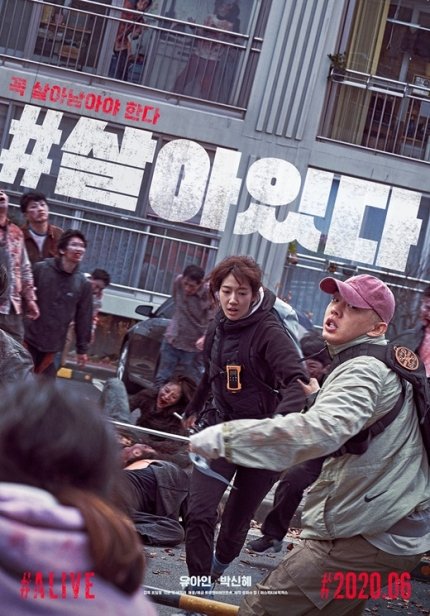
The thing to take from #Alive, if you are reading it as a piece of Korean culture and not just as a zombie movie, is that Korean genre cinema is doing what Hollywood used to do in the 1970s: making mid-budget, director-driven, idea-first films that take risks because nobody is leaving 200 million dollars on the table for a sequel they need to protect. Cho Il-hyung made one feature, his debut, in his early forties, and Lotte and Netflix between them got it in front of more than 50 million households worldwide. That math is the math Korean content has been quietly running for years now. #Alive is one of the cleanest examples of it landing exactly on time.
Explore More of Korea with Daebak
Want to bring a little piece of Korea into your life? The Daebak Box is packed with the best Korean snacks, ramen, and cultural goodies delivered monthly to your door.


