


Table of Contents
Ask any Korean grandmother what to do the second the mercury drops below 10°C in November, and the answer is not "put on a coat," it is "boil something." Korean winter cooking runs on a single premise that shows up in every dialect and every family: 국물 (gukmul, hot broth) is medicine, and the pot on the stove is the room's actual heater. Foreign coverage of K-food loves to write about 이열치열 (iyeol-chiyeol, fight heat with heat) as a summer thing, when 삼계탕 is served boiling in July. What almost nobody outside Korea explains is that the same logic runs in the opposite direction in 겨울 (gyeoul, winter). A single spoon of scalding kimchi 국물 does more for a cold day than any amount of central heating, and Korean home cooks have five workhorse dishes engineered to deliver exactly that jolt with maybe 15 minutes of active work.
Why Korean winter cooking beats every meal kit in your pantry
Here is the industry stat that decides the whole category. Korea's home meal replacement (HMR) market is now worth roughly $5 billion by CJ CheilJedang's own tracking, and the winter jjigae sub-segment is the one that spikes hardest, with January HMR frozen-stew sales climbing over 40 percent versus the November baseline every year since 2022. CJ Bibigo, Ottogi, and Pulmuone all launched retort-pouch 김치찌개 and 부대찌개 lines specifically to catch that curve, and they still get outsold in Korean 이마트 by fresh ingredients because home cooks know the truth: a real Korean winter stew is one pot, five ingredients, and 15 minutes. That is the appeal point Western food media keeps missing. K-food is not aspirational chef territory. It is the fastest weeknight dinner on Earth once you have gochugaru and a jar of kimchi in the fridge.
The other reason these five dishes travel so well is ingredient overlap. Kimchi covers three of them. Gochugaru or gochujang covers four. A single package of Korean rice cakes stretches across 떡국 and hot pot leftovers all season. That is the design brief the Korean home cook is optimizing for and the reason a Bibigo box of instant 김치찌개 in a Berlin supermarket sells like it does. The dishes are portable because the pantry is compact.
부대찌개 (Budae Jjigae): the Korean War hangover that became a national comfort food
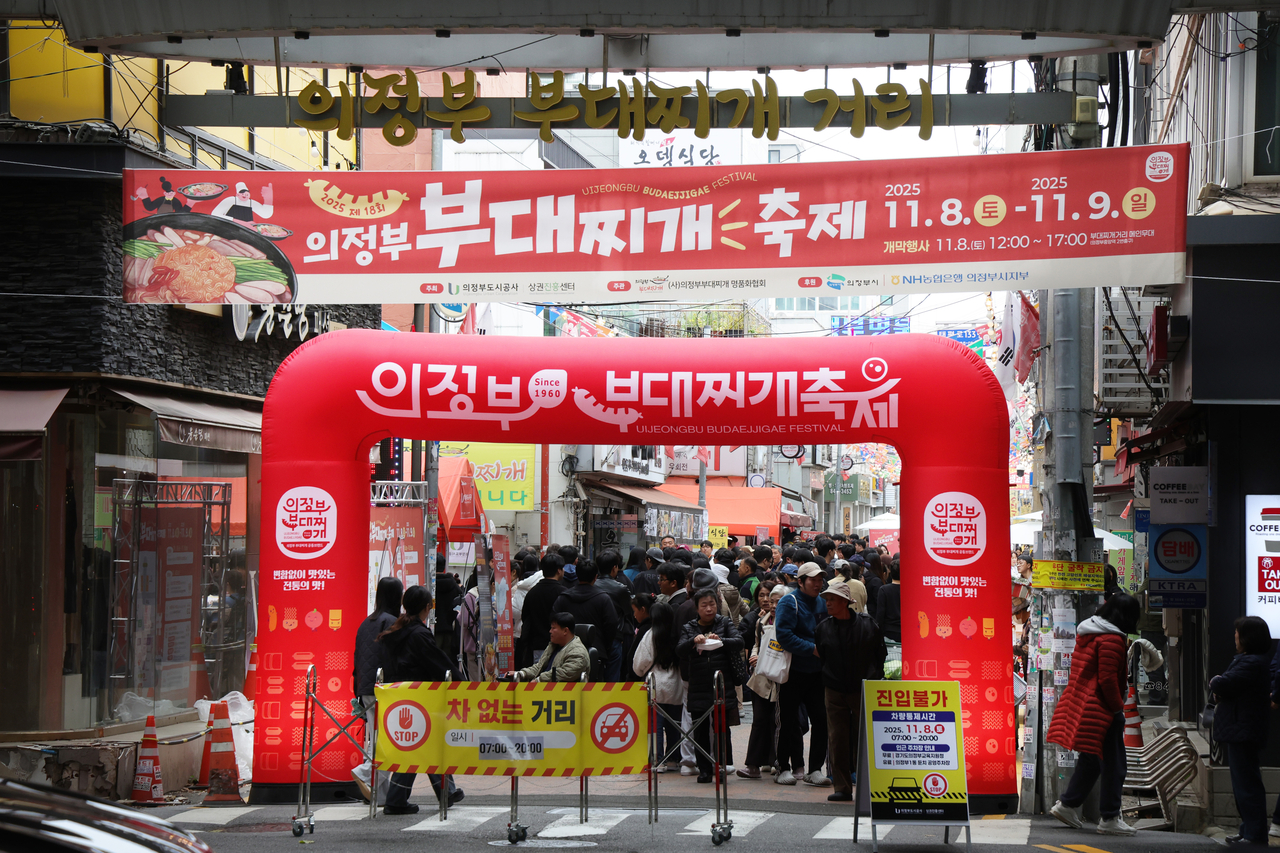
Every foreign explainer of 부대찌개 sticks the 1953 origin story on the front of the article and calls it a day. The interesting part is what happened after. Uijeongbu, the city an hour north of Seoul that hosted the biggest US Army base on the peninsula, is still the ground zero for 부대찌개, and its annual November festival (the one in the cover photo) is now in its 18th year with municipal budget backing. The dish went from post-war scrap survival food to a legitimate industry: Uijeongbu Budae Jjigae Street runs about 30 restaurants and pulls in an estimated 1.5 million visitors a year, and the frozen retail category (spam plus baked beans plus ramyeon plus kimchi in a pouch) hit around 200 billion KRW in domestic sales last year.
The reason it works as a home dish is that it is basically stunt cooking with no downside. Throw kimchi, spam, hot dogs, baked beans, tofu, one packet of instant ramyeon noodles, a spoon of gochujang, and 2 cups of anchovy broth or plain water into a shallow pot. Boil ten minutes. Add American cheese on top for the last two minutes if you want the Instagram shot. That is the recipe. What Western food writers keep calling "fusion" is not fusion, it is compression: a whole meal of protein, carbs, spice, and fat cooked in a single pot in the time it takes to check your phone. The reason it caught on outside Korea is not novelty. It is that Gen Z home cooks recognize a maximum-flavor-per-effort dish when they see one, and a 김치찌개 with spam floating in it clears that bar.
김치찌개 (Kimchi Jjigae): the ugly kimchi rescue mission that runs Korean weeknights
Ask a Korean home cook when they make 김치찌개 and the honest answer is "when the kimchi in the fridge starts getting weird." This is the appeal point almost no English recipe blog states plainly: 김치찌개 exists specifically because Korean households ferment kimchi in bulk, and the kimchi that is past its crispy prime, the sour, deep-red, aggressively fermented stuff at the bottom of the jar (묵은지, mugeunji), is exactly what makes the best stew. Fresh kimchi produces a thin, one-note 김치찌개. Six-week-old kimchi produces the kind of layered, funky, alive broth that Koreans schedule their week around. That is why every Korean apartment building smells faintly of it around February.
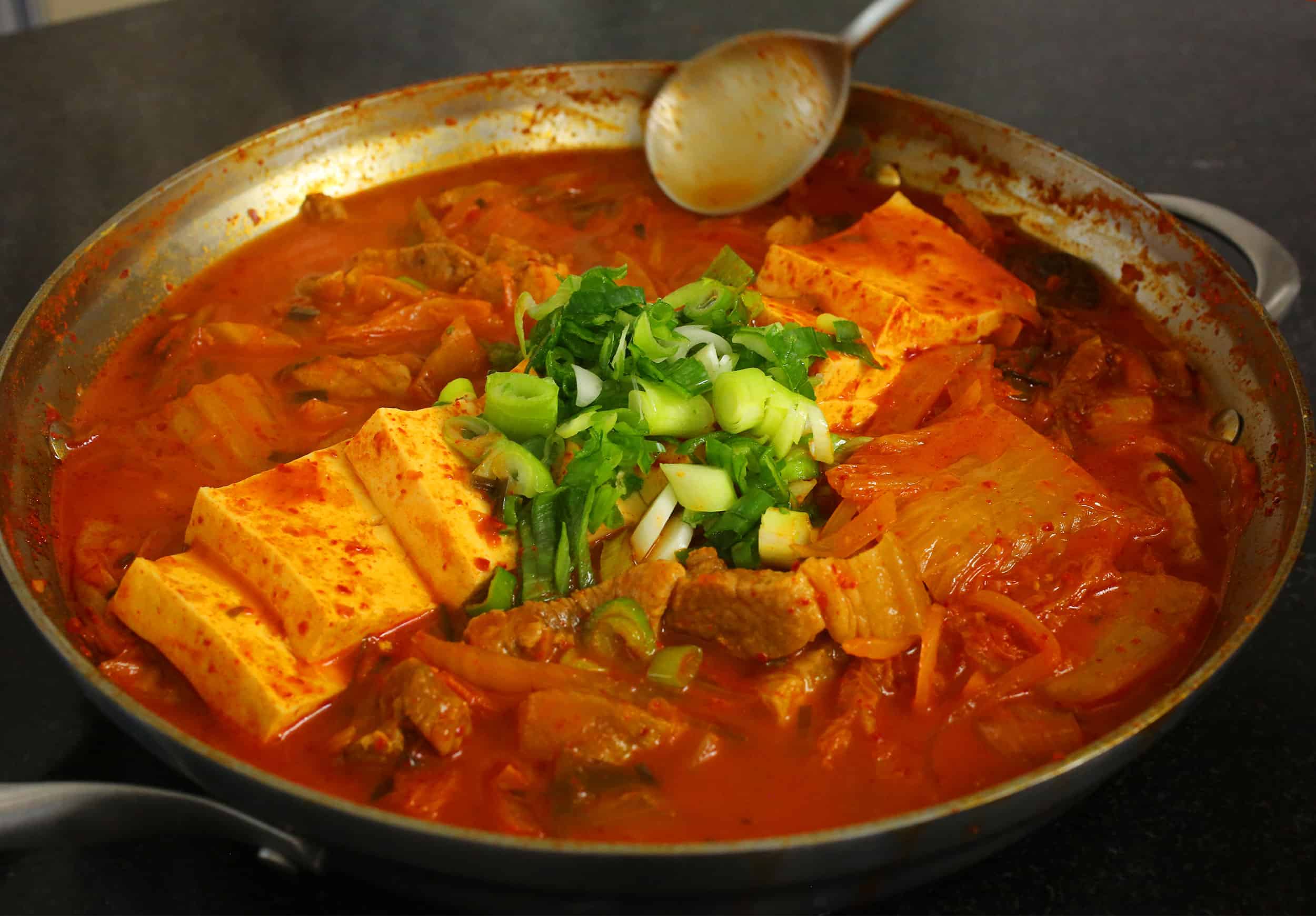
The 15-minute weeknight version at home is simple to the point of embarrassing. Cut a pound of well-fermented kimchi into bite pieces, dump it in a shallow pot with a splash of the brine, add half a pound of pork belly (or a can of tuna if you go 참치김치찌개 mode), throw in sliced onion, one tablespoon of gochujang, two teaspoons of gochugaru, a teaspoon of sesame oil, and enough water or anchovy stock to cover. Boil hard for 10 minutes, drop soft tofu slabs on top, boil another 8. Green onion at the end. Served bubbling with a bowl of white rice, that is the meal that runs 40 percent of Korean weeknight dinners in winter, no exaggeration. The industry insider read: this dish is what makes home-fermented kimchi worth the two-day process. Once you commit to the kimchi, the stew is just the tax return on your investment.
떡국 (Tteokguk): the Lunar New Year soup Korean families use to add a year to your age
떡국 is culturally the biggest of the five because Koreans traditionally do not count age at your birthday, they count it on Lunar New Year (설날, Seollal), and the moment a bowl of 떡국 hits your table on New Year's morning is the moment you officially age up. Miss the 떡국, and grandmothers will insist you did not turn a year older. The dish is a clear beef brisket broth with disc-cut 가래떡 (garaetteok, cylindrical white rice cake) sliced into ovals, garnished with shredded beef, egg strips (지단, jidan), and roasted seaweed. The oval shape of the rice cake is not decorative, it is meant to look like an old Joseon-era coin, which is where the "eat this and get rich" symbolism comes from. Korean cookbook copy tends to note the symbolism politely and move on. The point worth surfacing is that most Korean families eat 떡국 not once but easily 4 to 5 times across the Seollal week, which is why every Korean supermarket stocks 20 different brands of rice cake logs in January.
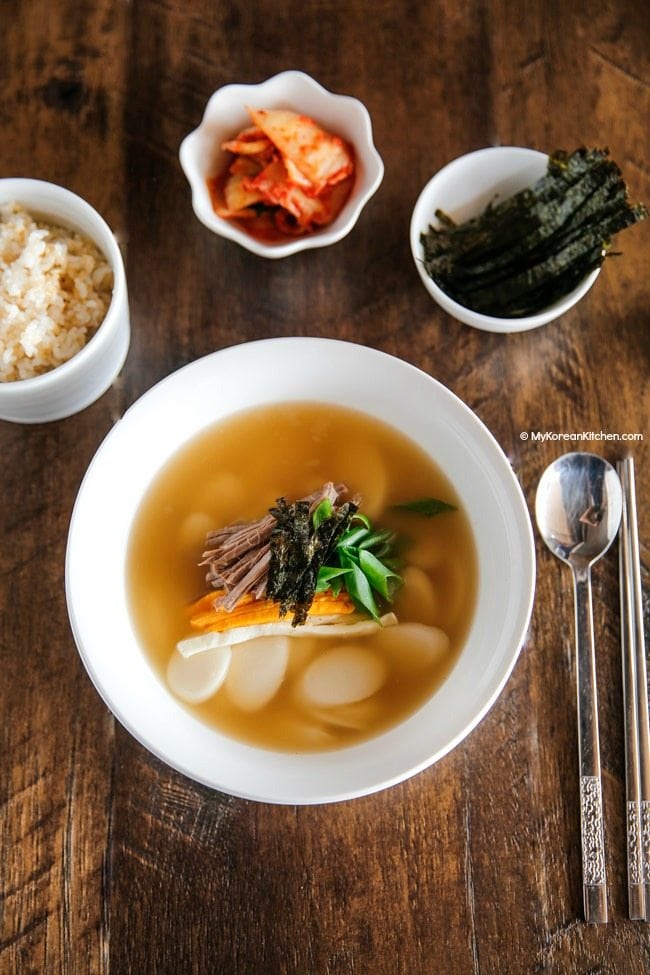
Home cooks who want the traditional version simmer beef brisket for an hour to get a clean stock, but the honest Korean shortcut every 20-something in Seoul uses is anchovy-kelp dashi from a tea bag (다시팩) as the broth base. It gets you 80 percent of the flavor at 15 percent of the effort. Slice a soaked 가래떡 log into 400g of ovals, drop them into simmering seasoned broth with a teaspoon of soy-sauce-for-soup (국간장), boil three minutes until they float and turn tender, top with egg strips and beef and torn seaweed. That is Sue at My Korean Kitchen's method and it is the version most young Koreans actually make. The appeal point for a Western home cook: this is the rare Korean dish that is subtle, clean, and comforting rather than spicy, which makes it the gateway soup for anyone who thinks all Korean food is chili-red.
만두국 (Manduguk): the North Korean New Year dish that quietly won the freezer aisle
만두국 is what happens when North Korean kitchen culture met the South Korean freezer economy. Because rice was historically harder to grow in the northern provinces, families there made dumplings (만두, mandu) for Seollal instead of rice cake soup, and after the 1950-1953 war split millions of families, the North Korean 만두국 tradition traveled south and stayed. The version most Seoul kitchens make today is a hybrid, either straight 만두국 with just dumplings in beef or anchovy broth, or 떡만두국 (tteok-manduguk) with both rice cakes and dumplings, which is the crowd-pleaser at multi-generational family tables.
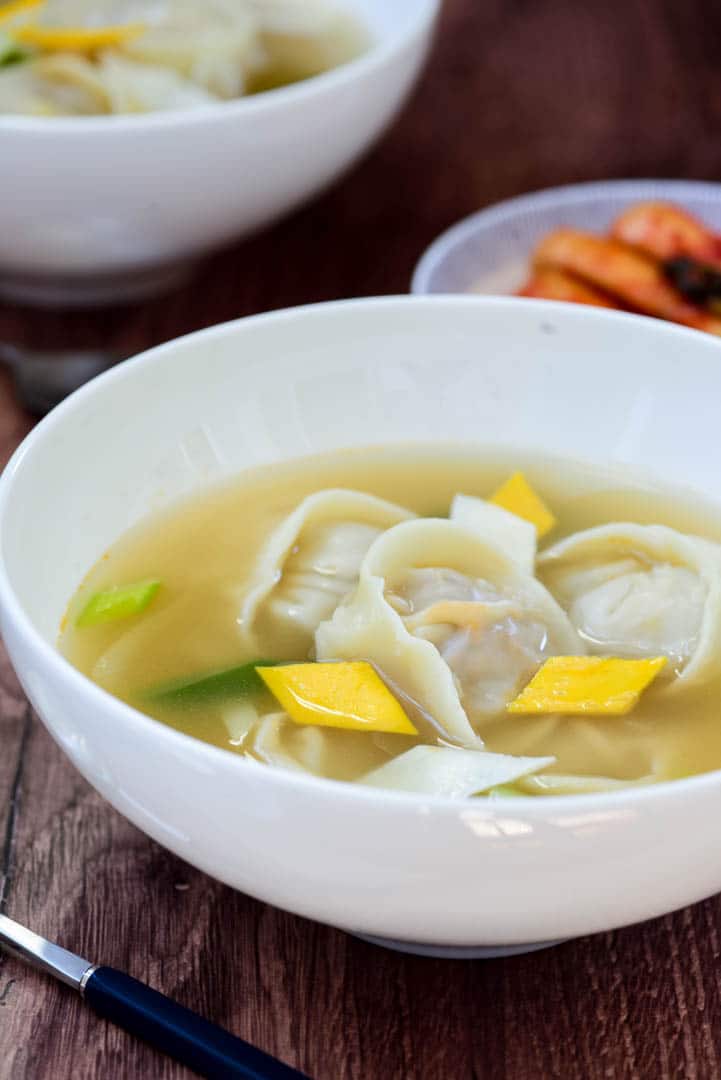
Here is where Korean home cooking gets ruthless: nobody in Seoul is making 만두 from scratch on a Tuesday. The freezer aisle at 이마트 or Home Plus is stacked with Bibigo, CJ, and Pulmuone mandu (kimchi, pork, or shrimp) that are engineered for exactly this dish. Bibigo's Kimchi Mandu is arguably CJ's most successful frozen product globally, hitting over $1 billion in annual sales across the US, Japan, and China combined by 2024, and the reason is that a 30-second sear plus a 5-minute simmer in seasoned broth gives you a full meal. Boil chicken or anchovy broth, add minced garlic and a splash of 국간장, drop in 10 frozen 만두, cook until they all float, garnish with egg strips and seaweed. That is a Tuesday-night dinner in nine minutes flat. The industry insider point: Bibigo's frozen mandu category was quietly the biggest test of whether Korean weeknight food could scale globally, and it passed, which is why every Whole Foods in the US now stocks it.
어묵탕 (Eomuk-tang): the Korean street cart classic you can build at home from a 편의점 run
어묵탕 (also called 오뎅탕, oden-tang, because Korean street food history borrowed the Japanese name in the early 20th century) is the winter dish that lived on 포장마차 street carts for decades before Korean home cooks realized they could make a nearly identical version with 20 minutes of effort. On the cart, a huge steel pot bubbles all day with anchovy-kelp broth (다시), skewered fish cake sheets fanning out like laundry on a line, and a shot glass of the hot broth is what actually sells the whole experience: 500 won for a cup that warms your hands for the entire walk to the subway. That broth-in-a-shot ritual is the single most-loved winter street snack move in Korea, full stop.
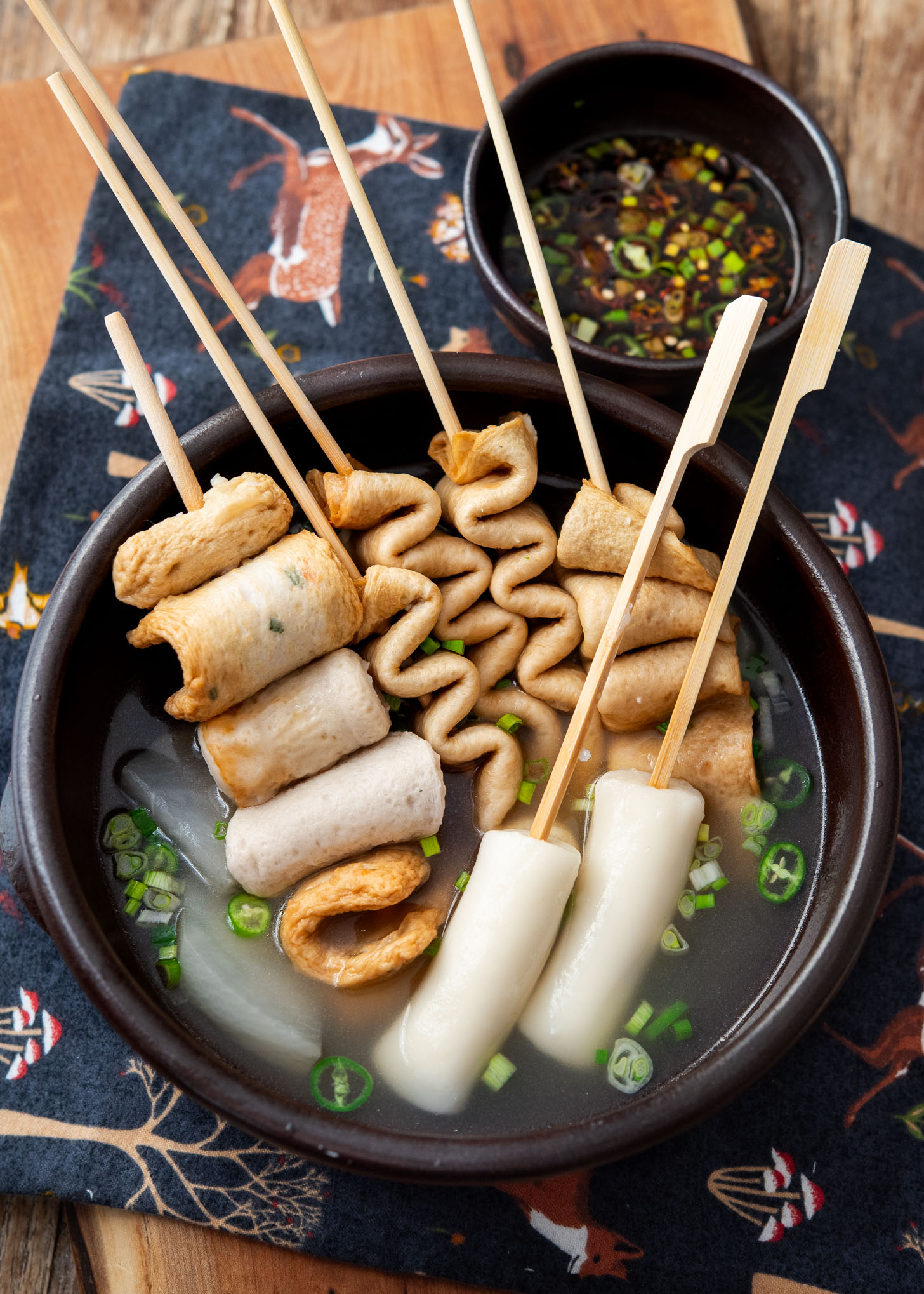
The home version is genuinely a 편의점 (convenience store) meal. Grab a packet of frozen 어묵 (Samjin Amook and Busan Eomuk are the two brands to look for), a 다시팩 (dashi bag), one Korean radish (무), and a green onion. Simmer the dashi bag with sliced radish and green onion in 7 cups water for 10 minutes. Pull the bag, season with 1 tablespoon of 국간장 and half a tablespoon of Korean tuna sauce or tsuyu, drop the fish cake skewers in, simmer until they puff. Ladle broth over anything sticking out. Add a fresh chili slice if you want the street-cart heat. Served with a soy-vinegar-gochugaru dipping sauce, this is the dish that most convincingly transports a New York or London kitchen to a snowy Myeongdong alley at 11 PM. The appeal point: 어묵탕 is the softest entry into Korean winter food for anyone spice-averse, because the broth is clean and savory rather than fiery, and the fish cakes taste like a savory Korean cousin of dashi-poached fish balls the whole family will eat.
The one-pot minimum viable Korean pantry
If you took nothing else from this list, here is the shopping run that unlocks all five dishes: one jar of properly fermented kimchi (or a bag if you buy from H Mart), one bag of gochugaru (Korean chili flakes), one tub of gochujang, one bottle of 국간장 (soup soy sauce, not regular soy sauce, this is the load-bearing ingredient), one packet of anchovy-kelp dashi bags, one bag of frozen mandu, one pack of 가래떡 rice cake logs, and one pack of frozen 어묵. That is under $50 at any decent Asian grocery. With that pantry, a Korean winter runs itself: 부대찌개 on Monday, 김치찌개 on Wednesday, 만두국 on Friday, and 어묵탕 whenever it snows. 떡국 is your Lunar New Year Sunday. That is the reason Korean home cooking has quietly become the most globally exportable weeknight cuisine of the last decade, and it has almost nothing to do with K-drama food porn. It has everything to do with the fact that Korean grandmothers designed these dishes to be defensible on the tiredest day of the week.
Explore Korean Snacks with Daebak
Love Korean food? Get authentic Korean snacks and ramen delivered straight to your door with the SnackFever Box by Daebak.


