


Table of Contents
Walk into Ovener (오브너) on any weekday afternoon and you will find the same tableau: three people ordering, six people angling their phones over a slice of 딸기 tart, and the front counter racing to plate the next order before the fruit warms up. That combination, actual craft plus repeatable Instagram frame, is the whole business model of Korea's new dessert cafe class. Ovener didn't invent it, but the cafe pulled the format tight enough that competitors have been quietly copying it for years.
The Post-Instagram Bakery Playbook
Boutique 디저트 카페 like Ovener don't operate the way a Paris Baguette or Tous Les Jours does. There is no 40-SKU display case, no bread wall, no seasonal LTO calendar built around holidays. Instead you get one hero product, in Ovener's case the 과일 타르트, executed in a color palette that Instagram's algorithm loves: cream base, high-contrast fruit red or green, a matte plate, natural light through the window. That is the entire storefront.
I've watched this format harden across Korean boutique dessert for the better part of a decade, and the reason it works is not aesthetic. It is operational. A single hero product means you buy fewer ingredients, hire fewer bakers, waste less inventory, and, most importantly, your customer already knows what they are ordering before they walk through the door. The Instagram post is the menu. That collapses the sales funnel to almost nothing.

딸기, 청포도, 복숭아: Reading Ovener's Fruit Calendar
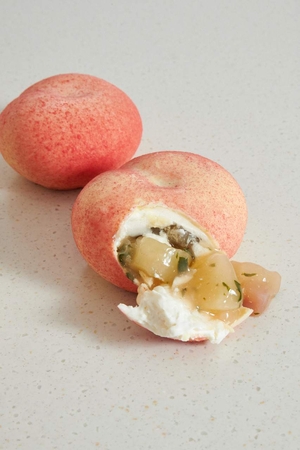
If you actually track Ovener's Instagram grid over 12 months, the product rotation reads like a farming almanac. Late fall through early spring is 딸기 season, when Korean Seolhyang and Kingsberry strawberries are at peak sugar and Instagram is flooded with red-cream cross-sections. Spring shifts to 청포도, the shine muscat grape that Korea learned to grow at boutique quality about eight years ago and has been photograph-obsessed with ever since. Summer belongs to 복숭아, the flat white peaches from Gyeongsang region that basically melt.
Why does this seasonal cycle matter? Because it engineers scarcity into a product that would otherwise be perpetually available. When 청포도 season ends, that cake ends. Customers understand this and behave the way they would around a limited concert ticket. The line at Ovener during peak Seolhyang weeks is not customer service failure. It is the strategy working as designed.
Single Hero, Gradient Palette, Repeat
The visual formula that defines this whole cohort of Seoul dessert cafes is what I call the single hero, gradient palette approach. One product carries the brand's identity, and the entire visual world is tuned to one dominant color family. Look at Doré Doré and its rainbow layer cake, still probably Seoul's most-photographed dessert of the past decade. Look at Cafe Bora out in Insa-dong, where the entire menu is a violet gradient built around Jeju purple sweet potato. Look at Ovener, where the palette shifts with whatever fruit is on the tart that month.
That is not accidental prettiness. It is a shareability engineering decision. A tightly held color palette means every user-generated photo, no matter how amateur, still fits the brand grid. Free marketing at industrial scale. This is the piece most Western food-and-beverage operators still don't fully appreciate about the Korean model, they think it is aesthetics. It is actually distribution.
The AOV Math Nobody Talks About
Here is the piece that never makes it into travel guides. Korean boutique dessert cafes with a seasonal fruit hero item routinely post average order values 200 to 400 percent higher than a standard neighborhood coffee cafe in the same neighborhood. A regular cafe sells you a 4,500 won iced Americano. Ovener and its peer group sell you a 12,000 won 과일 타르트 slice plus a 6,500 won drink, and you brought a friend, so double the check. Do the math per square meter of retail floor. It is a very different business.
Combine that with the fact that these cafes typically operate out of 30 to 60 pyeong spaces (roughly 100 to 200 square meters) with 4 to 8 staff, and you understand why the format keeps replicating even when it looks visually saturated. The unit economics are genuinely good, provided the operator understands that their real product is not the tart, it is the photograph that leaves with the customer.
The Copycat Wave and Post-Squid Game Dessert Tourism
Since the mid-2010s, this playbook has spread through Seoul in visible cohorts. First came the rainbow cake wave, of which Doré Doré is still the flagship. Then the purple wave, led by Cafe Bora and a dozen imitators in Ikseon-dong. Then the fresh fruit wave, where Ovener sits alongside newer entrants like Rafre Fruit in Seongsu and Boyeonhui in Yeonhui-dong. Each cohort follows the same script: single hero item, gradient palette, seasonal drop calendar.
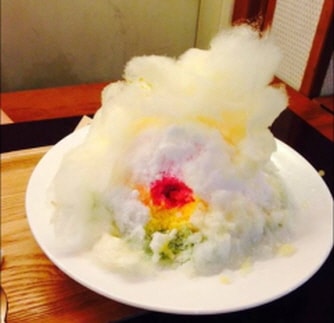
Post-Squid Game, and now post-second Hallyu wave with Culinary Class Wars pushing Korean food discovery even further, the dessert cafe circuit has become an actual tourism itinerary. Foreign visitors arrive in Seoul with a checklist: Doré Doré for the rainbow, Ovener for the fruit tart, Cafe Onion for the pandoro pastry against the hanok wall. The Korean word for it is 인생샷, the "photo of your life," and the whole circuit exists to deliver that shot.
What makes Ovener durable in that circuit is that the cafe never chased trends into their peak Instagram moment and then died with it. The fruit tart has been the hero product since day one. The palette has stayed disciplined. When the copycats moved on to the next visual gimmick, Ovener kept making the tart. That is the answer to why some of these cafes last five years and some die after eighteen months.
Explore Korean Snacks with Daebak
Love Korean food? Get authentic Korean snacks and ramen delivered straight to your door with the SnackFever Box by Daebak.


