


Table of Contents
Walk into any Korean subway station in Seoul and the first franchise you clock is almost never a coffee chain. It's a bakery. Paris Baguette, Tous Les Jours, or one of the newer Seongsu-dong artisan spots. I've spent over a decade working with Korean food brands and food-service consultants, and here is the piece that surprises most outsiders: the Korean bakery is not an imported Western format at all. What Koreans call 빵집 (ppang-jip, literally "bread house") is its own hybrid category, built around sweet-savory hybrids that Western bakeries almost never attempt. Soft brioche stuffed with sausage and ketchup. Buttery streusel bread with peanut-flavored crumble. Cream cheese and garlic loaded into the same pull-apart bun. If that sounds like a category error, that is exactly the point.
The industry backbone is a duopoly. Paris Baguette (owned by SPC Group) crossed 3,700 domestic stores plus 200-plus in the US by end of 2024, and Tous Les Jours (CJ Foodville) sits behind it as the No. 2. Together they define what an "average" Korean bakery looks like: bright lighting, tong-and-tray self-serve, hourly bake schedule, and a menu that leans about 60 percent sweet, 40 percent savory. Post-2020, though, the pressure came from the other direction. Seongsu-dong artisans like Ilhoje (started by the Anthracite Coffee owners), Bread Blue, and a wave of single-origin flour specialists have pushed a ₩3,000 to ₩8,000 per-pastry tier that the chains cannot match on craft. That tension is the whole story of Korean baking in 2026.
Below are five bakery staples that anyone visiting a 빵집 (ppang-jip) for the first time should try in order. Two sweet, two savory, one hybrid that broke the internet a few years back.

Soboro-ppang (소보로빵): The Streusel Bun Every Korean Kid Grew Up With
Soboro-ppang, sometimes called 곰보빵 (gombo-ppang, "pockmarked bread") in more formal Korean, is the single most nostalgic item on any 빵집 shelf. It is a soft, slightly sweet round bun with a crackled, peanut-butter-and-sugar streusel crust baked on top. The name "soboro" is actually a loanword from Japanese, originally referring to a minced-fish or minced-meat topping, and the visual similarity to that crumbled surface is where the naming logic came from. Korean bakers took the Japanese format, dropped the fish, dialed the sweetness way back, and locked in what became a Korean elementary-school after-school classic.
What makes soboro genuinely Korean is not the recipe, it is the pairing culture. Nobody eats soboro alone. It goes with a cheap paper cup of Maxim instant coffee at a 다방 (dabang) or, in the modern version, an iced Americano from a corner cafe. There is a specific reason: the streusel is almost gritty in texture, and the coffee's bitterness cleans the palate between bites. That contrast, 쫄깃 (jjolgit, chewy-soft) bread against a crunchy sandy crust, is a template Korean bakeries use over and over across the entire menu. Once you notice it, you see it everywhere.
Industry note worth flagging: Paris Baguette sells its 3-pack of soboro at roughly ₩3,900 nationwide, and it is consistently in the chain's top-5 SKUs by volume. When a mass-market bakery cannot phase out an item that has been on the menu since the 1980s, you know it has crossed from product into cultural infrastructure.
Danpat-ppang (단팥빵): The Red Bean Bun with Postcolonial Baggage
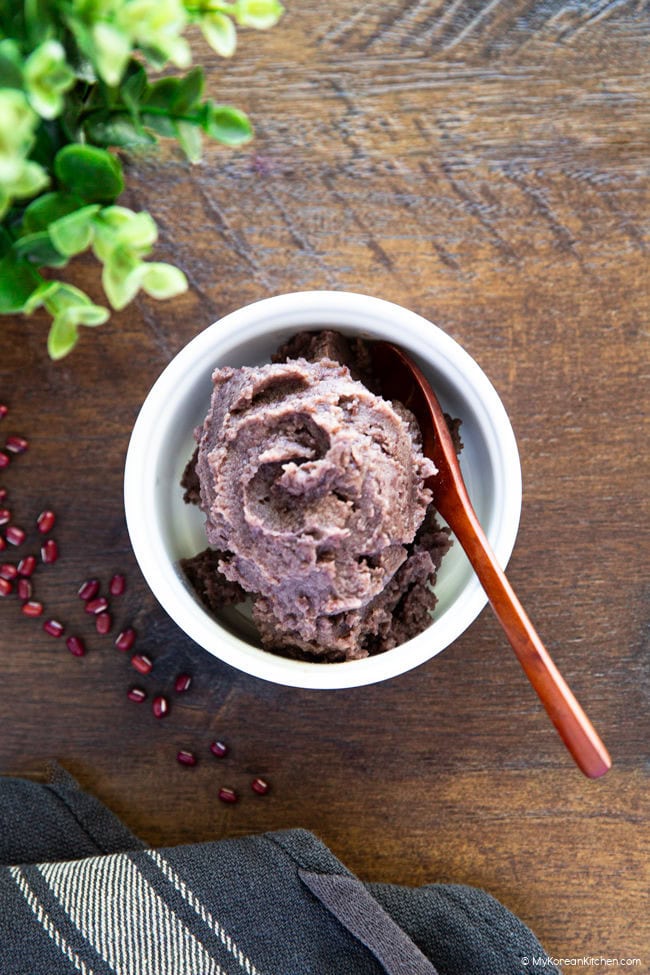
Danpat-ppang (literally "sweet red bean bread") is Korea's version of the Japanese anpan, and its history is more layered than most menu boards let on. Yasubei Kimura invented anpan in 1875 in Tokyo, filling a Western-style yeasted roll with the traditional wagashi red bean paste. During the Japanese occupation of Korea (1910 to 1945), the format crossed the strait, and by the postwar era Korean bakeries had localized it: less sugar in the dough, more filling by weight, and a slightly denser bun that could survive a bus commute in a paper bag. If you compare a Kimuraya anpan in Ginza to a Paris Baguette danpat-ppang in Gwanghwamun today, the Korean version is heavier, less delicate, and the paste is often blended smoother.
The appeal for Koreans is not really the sweetness. It is the filling ratio. A well-made danpat-ppang is closer to 50-50 paste-to-bread than the Japanese equivalent, and the paste itself, pat-anggeum (팥앙금), is often made with a splash of Korean rice syrup (조청) rather than pure sugar, which gives it a caramel-forward depth Japanese anko does not have. That is the actual appeal point Western reviewers miss: it is engineered to feel like a snack that fills you up, not a delicate confection. This is bread evolved for the working-class snacking habits of postwar Korea, and it still reads that way.
Watch for the sesame seeds sprinkled on top. That is a direct visual holdover from Kimura's original 1875 recipe, which was topped with either white sesame or a salt-pickled cherry blossom for the Emperor Meiji edition. Korean bakers kept the sesame and dropped everything else. Small detail, but it tells you the whole trans-Pacific journey the bun made.
Cream-ppang (크림빵) and Deli Manjoo: The Custard Family

Cream-ppang covers the whole custard-cream and whipped-cream category, and it is best understood as a family rather than a single item. At the bakery-chain level, you get an oval soft bun split down the middle and piped full of vanilla pastry cream, sometimes with a thin layer of jam. At the convenience store level, Samlip's 정통크림빵 (jeongtong cream-ppang) has been on 7-Eleven shelves in essentially the same wrapper since 1964, and it is still one of the biggest-selling packaged breads in the country. At the specialty end, Deli Manjoo (pictured above) turns the same custard filling into a corn-shaped sponge cake baked to order in subway stations, which as of 2024 sells for roughly ₩500 per piece and gets more foot traffic than a lot of actual bakeries.
Here is the industry mechanic behind why cream-ppang is a bigger deal than it looks. Korean adults tend to skew less sweet-toothed than Western consumers, so bakeries had to engineer the custard to be lighter, less eggy, and only mildly sugared. Compare a Korean bakery custard to a French crème pâtissière and the Korean version is looser, whiter, and more milk-forward. That is a deliberate calibration for domestic palate, not a shortcut. Kids get the sugar hit, and adults can eat one after lunch without feeling like they broke their diet. It is dessert engineered as an everyday item, which is exactly why it survives.
The other reason it matters: cream-ppang is the gateway item that gets Korean kids into bakery loyalty. Ask a 30-year-old Korean what their first Paris Baguette memory was and there is a very good chance the answer is a cream bread they got after piano lessons in 2003. That kind of childhood association is worth more than any ad budget.
Maneul-ppang (마늘빵): The Cream-Cheese-Garlic Format That Broke Instagram
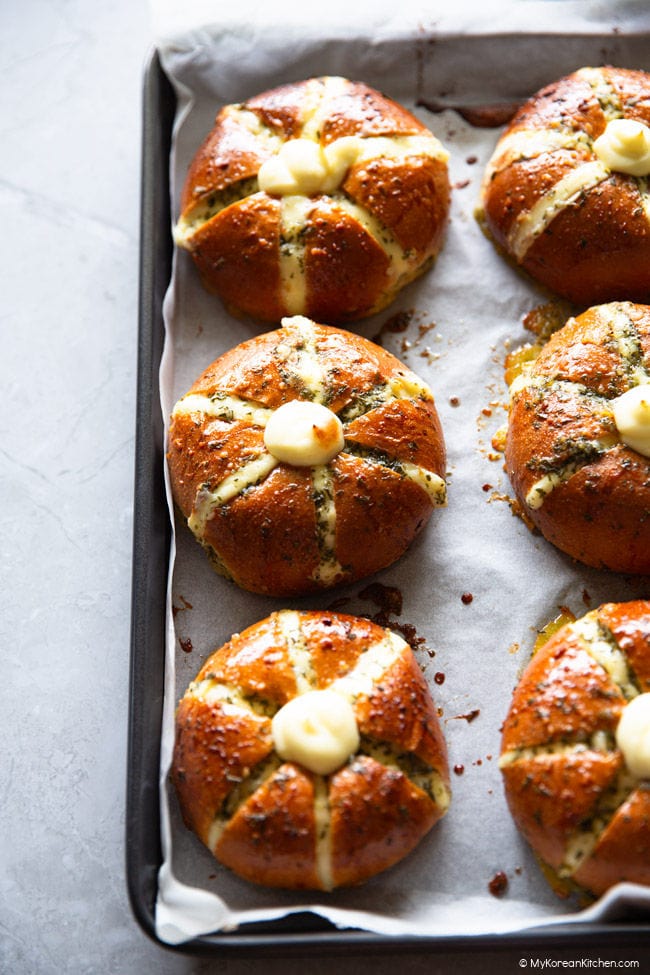
If you were on Korean food Instagram between 2019 and 2021, you saw this exact bread. 육쪽 마늘빵 (Yukjjok maneul-ppang, "six-cut garlic bread") is the format Korea invented from a Danish origin story, and it is now the most-copied bakery item in the country. The base is a soft brioche bun cut into a six-slice grid without cutting through the bottom, piped full of sweetened cream cheese, dipped whole into a garlic-butter-egg custard, and baked. Every one of the six slices gets soaked. Every bite hits sweet, salty, garlicky, tangy, and buttery in the same second.
The origin story is a small Danish bakery in Copenhagen called Bread Story, but Korean bakers rewrote the recipe entirely. The original Danish version uses less sugar and no cream cheese, closer to a savory garlic-parsley loaf. The Korean adaptation doubled the sugar, added the cream cheese filling, and made it a pull-apart. That is the version that went viral in 2019 at Yeon Nam-dong's original Ikseondong-style artisan bakery, spawned queues of two hours, and then propagated through every neighborhood bakery in Seoul within eighteen months.
The appeal point everybody talks about is the flavor combo, but the real innovation is structural. Traditional garlic bread has one flat surface, so the garlic-butter has to be spread thin. The six-cut design multiplies the surface area by roughly seven, so you get maximum garlic-butter absorption without the loaf getting soggy. Every bite is engineered. That is the kind of small mechanical redesign Korean food producers have been quietly winning at for two decades, and it is why maneul-ppang has now shown up on menus in New York, LA, and Sydney at bakeries that have zero Korean staff.
Sausage-ppang (소시지빵): The Savory Bread that Runs on Ketchup and Mayo

Sausage-ppang is the savory workhorse of the Korean bakery, and it is the item that most confuses first-time visitors. Imagine a soft round bun with a whole hot dog partly embedded on top, splashed with a zigzag of mayonnaise, then a zigzag of ketchup, then a scatter of chopped canned corn and shredded mozzarella. Baked. Some versions add sliced green onion, some add a light dust of dried parsley. If you have ever eaten a Korean-style pizza with corn on it, you already understand the flavor lane.
Here is why it exists in that form. Korean bakery product development in the 1990s was constrained by two things: Korean home ovens were still uncommon, so bakery bread had to feel like a full snack you could eat on the subway, and Korean palates historically wanted savory-and-sweet in the same bite (think of how Korean fried chicken uses a sweet-spicy sauce). Sausage-ppang solves both. The ketchup adds sweetness, the mayo adds fat, the corn adds crunch, the sausage adds protein, and you can eat it one-handed on the way to work. Convenience store chains like CU and GS25 sell packaged versions for roughly ₩1,500 to ₩2,000, and they consistently rank in the top 20 grab-and-go items.
The appeal point that Western food writers usually miss: this is not "junk food" bread in the Korean imagination, it is a legitimate breakfast or lunch category. Watch a Seoul office worker at 8:45 a.m. and there is a decent chance they are eating a sausage-ppang and drinking a can of Let's Be coffee at their desk. The bakery designed the product for that exact scene. It is fast, filling, and it hits the salt-fat-carb triangle that keeps the industry moving 4 million-plus units of the format monthly across the top three chains.
Where the Category Is Going
The five items above are the classics, but the interesting story of 2024 to 2026 is what the artisan wave is doing to them. Ilhoje in Seongsu-dong sells a ₩6,500 soboro made with organic French flour and Korean peanuts. Bread Blue in Yeonnam-dong runs a cream-ppang with hokkaido-cream-adjacent custard and a mochi-textured bun. The chains are watching, and Paris Baguette in particular has quietly upgraded its premium line to hit that ₩4,500 to ₩6,000 tier that used to belong only to the specialty spots. This is a healthy fight for consumers. The category is genuinely improving.
What has not changed is the fundamental Korean bakery instinct: soft dough, aggressive fillings, sweet and savory in the same case, and a rotation schedule that has fresh bread coming out of the oven every hour. That is the muscle memory of a country that only started baking bread commercially in the 1970s and had to invent its own answer to what a bakery should be. The answer, it turns out, was a category the rest of the world is now trying to copy.
Bring the Korean Bakery Home
If you want to taste your way through this category without booking a flight to Seoul, the SnackFever Box by Daebak ships a curated rotation of Korean bakery-adjacent snacks, cream-filled cakes, and sweet-savory hybrids to your door every month. It is the closest thing to a monthly walk through a Seoul 빵집 shelf.


