


Table of Contents
As the weather turns cooler, the leaves start to redden, and our cozy sweaters come out of the closet, autumn brings plenty to look forward to: fewer mosquitos, pumpkin spice everything, bonfire season, an approaching Halloween, and most importantly, warm and scrumptious snacks we have craved all summer long. Korea understands the joy of seasonal snacking, and as soon as the leaves begin to fall, street vendors switch up their menus to deliver the beloved bites that warm hands and hearts alike. Here are six autumn Korean street snacks you absolutely must try at some point.

Bungeo-ppang
Bungeo-ppang is one of the most famous Korean snacks and one of the best street foods out there. It might be shaped like a fish, but do not be fooled, there is no fishy flavor in this snack at all. The batter sits somewhere between a Western waffle and an Eastern dumpling, while the filling is sweet red bean paste, originally brought over from Japan. Together they form these instantly recognizable little pastries that are loved everywhere they appear.
In fact, walk through almost any market or food district in Japan and you will probably spot bungeo-ppang too, since the snack became a hit in the neighboring country. The traditional filling is red bean paste, and it remains the favorite in South Korea. Other fillings have evolved depending on local tastes: Japan popularized a creamy custard version, while in the United States vendors often experiment with Nutella and strawberry jam.
Closely related is gukhwa-ppang, which translates to chrysanthemum bread. The pastry is shaped like a flower with many petals and is stuffed with the same comforting red bean paste, perfect for a chilly afternoon stroll.
Goguma
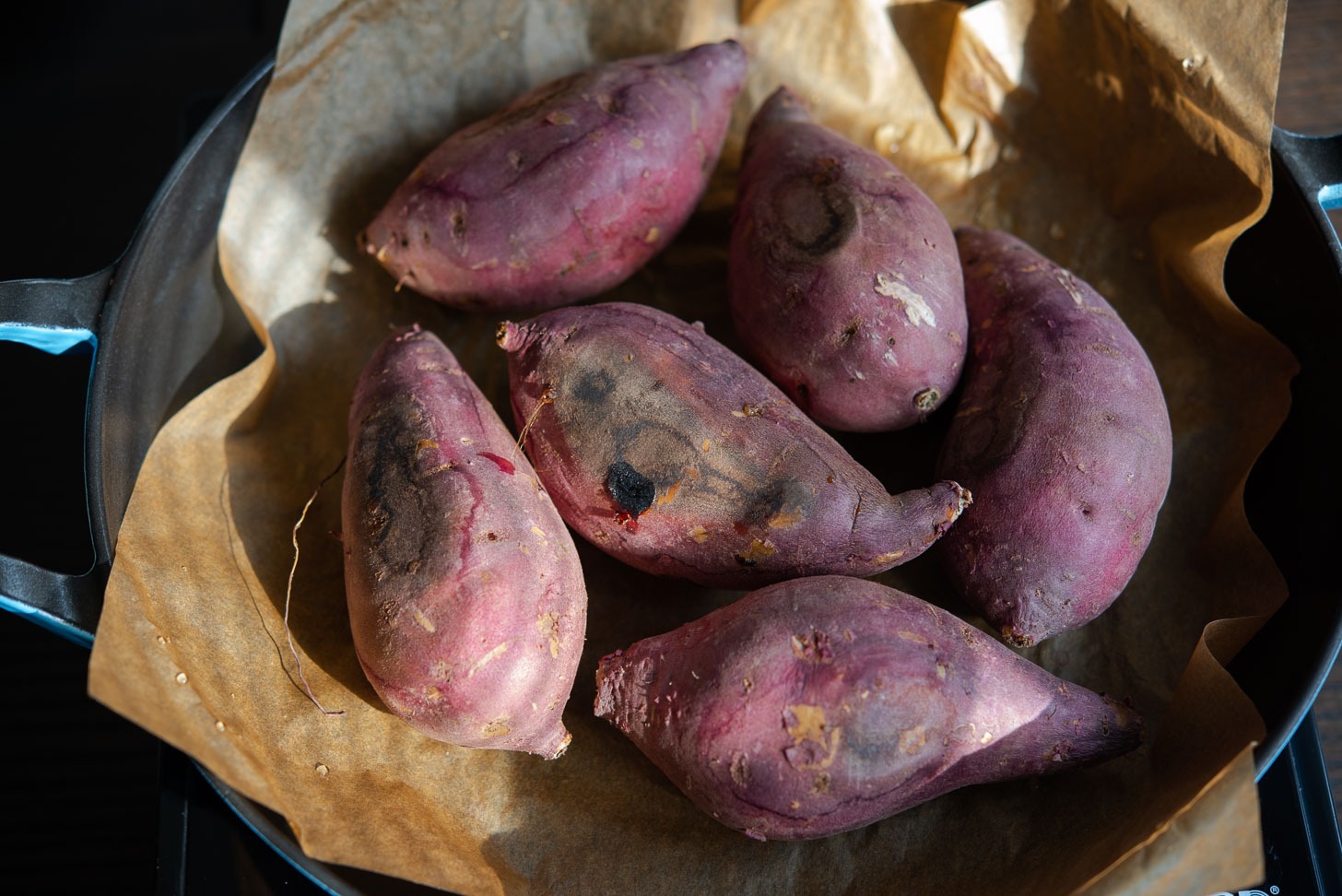
Roasted sweet potatoes are wildly popular as the weather cools, and Koreans absolutely adore them. What makes this snack even better? It is genuinely healthy and super cheap because it is, quite literally, just a roasted sweet potato. The vendors who roast them often wear a thick fur ushanka, which has become a signature look for goguma sellers. Spot an ushanka and you have yourself a warm snack waiting nearby. Sometimes you will see big drum cans on the sidewalk being used to roast the potatoes slowly, producing the smoky version known as gun-goguma.
Some vendors dry the roasted sweet potatoes so they last longer, creating chewy slices of gun-goguma-mallaengi. When the weather is still warm at the start of autumn, the roasted sweet potatoes are frozen instead, producing the easiest ice-lolly ever: ice-gun-goguma.
Dak-kkochi

If you love Japanese food culture, you have probably heard of yakitori. But did you know Koreans have their own version that is just as mouth-watering? Dak-kkochi is a chicken skewer grilled right in front of you. The chicken is usually marinated in a sweet and salty sauce, or a spicy sauce depending on your preference, and at the end you can finish it with extra spicy BBQ sauce, mayo, or mustard. It is easy to eat one-handed, very well priced, and absolutely heavenly. A perfect autumn evening snack.
Beondegi
This snack is probably the least popular outside of Asia, and one where you really need to get past the fact that you are eating bugs. Beondegi is boiled and seasoned silkworm pupae, and a beloved cup-snack sold on the streets of Korea. It is not uncommon to see large cauldrons of boiling silkworm pupae steaming away in markets or street food alleys across the country. The strong, earthy odor that wafts out of those pots can be off-putting for first-timers.
The little pupae have a pungent and slightly bitter taste, and when you bite into them they pop in your mouth, almost like bubble tea. If you are not used to eating insects, you will probably have to acquire the taste, but once you get over the unusual texture you may find yourself craving it. The pros are pretty compelling: a cupful only costs around a dollar, it is loaded with protein and nutrients, and it is environmentally friendly because raising silkworms takes far fewer resources than animal protein or even soybeans.
Gyeran-ppang

Egg bread is not uncommon across many different cultures. There is challah, a Jewish bread that uses eggs for a soft, almost cake-like texture. There is South American pan de huevo, which gives bread a sweet, yellow twist. There is French toast, where day-old bread is soaked in an eggy mix and pan-fried. Koreans have their own recipe for egg bread too, and it is called gyeran-ppang.
It is essentially a sweet and savory pancake batter filling up half of a cupcake mold, with an egg yolk and a touch of egg white carefully placed on top, then baked until puffed and golden. You could call it the pied piper of Korean street food, because the fragrance alone is good enough to lure tourists and locals straight to the food cart.
Hotteok

Hotteok is a Korean pancake, traditionally stuffed with an amazing filling of sugar, honey, peanuts, and cinnamon. Perfect for cold weather, this snack will warm your heart up any day because it is both piping hot and soothingly delicious. Newer fillings include green tea, bokbunja (Korean blackberry), pizza, and much more, so there is genuinely something for every preference. The snack even features in a famous Korean expression, "the hotteok store is burning," which refers to noisy chaotic situations. With how popular this snack is, you might even think of the saying while you are standing in line waiting for yours.
That wraps up our list of amazing Korean street snacks for autumn. Food trucks are increasingly popular in Western countries now, but they do not yet compare to the food truck culture in Asia. Hygienic, delicious, and cheap, it is a whole different experience to wander through a street food area like Gwangjang or Myeongdong in Seoul, bungeo-ppang in one hand, dak-kkochi in the other.
What snacks have you tried? Which one are you most excited to try? Have you been to a Korean street food market before? Let us know in the comments below.
Want to try Korean snacks without flying to Seoul? SnackFever Box delivers a handpicked selection of authentic Korean snacks straight to your door every month, so you can taste a piece of Seoul wherever you are.


