


Table of Contents
The Buyeo Seodong Lotus Festival (부여서동연꽃축제) is the kind of Korean summer festival that gets skipped over in most English-language travel guides, which is a mistake if you actually understand how the Hallyu tourism economy has been shifting since 2022. It runs every July at 궁남지 (Gungnamji), Korea's oldest man-made pond, in a small county in South Chungcheong Province that used to be a Baekje capital city and now pulls in around half a million visitors during festival week. I have been tracking Korean regional festivals inside the K-content and travel marketing space for over a decade, and this one keeps showing up on the Ministry of Culture, Sports, and Tourism's short list of Excellent Festivals for a reason. It is not a lotus-viewing event dressed up in Baekje costumes. It is a 634 AD royal garden that never fully stopped being a royal garden, running a legit provincial-scale tourism operation on top of a story that Korean writers have been retelling since the Samguk Sagi.

궁남지 (Gungnamji) and why Korea's oldest man-made pond still matters
Gungnamji is not just an old pond. It is the oldest artificial garden pond in Korea, dug in 634 AD during the 35th year of King Mu's reign, and specifically recorded in the Samguk Sagi with the line that reads, in condensed form, "a pond was dug to the south of the palace, water was brought in from about 20 li away through an 8 km waterway, willow and cherry trees were planted around it, and an island was built in the middle symbolizing Bangjangseonsan (方丈仙山)." That last detail is what most visitors miss. The little island in the middle of Gungnamji is a Taoist longevity symbol, one of the three mythical mountains where immortals were said to live, and Baekje's court architects were essentially engineering a wish for the king's long life into the shape of the water itself. This is the reason Gungnamji Pond carries National Historic Site No. 135 designation (as of June 10, 1964), and this is the reason Baekje's palace gardener Nojagong (노자공) was later dispatched to Japan to transfer Baekje's garden landscaping techniques. If you have ever walked a Kyoto stroll garden and wondered where the ancestor techniques came from, a real portion of the answer is Buyeo.
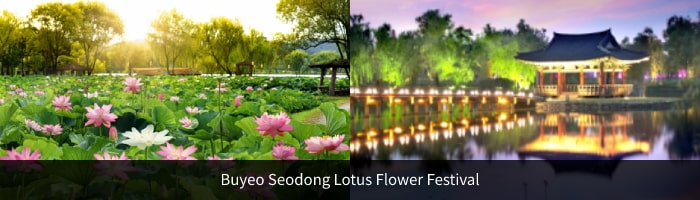
The present-day pond you see was restored in 1965 and 1967, and Poryongjeong (포룡정) pavilion, sitting in the middle of the water at the end of a slightly curved wooden bridge, is the piece that photographs cleanest at dawn. If you are staying overnight in Buyeo during festival week, the actual insider move is to skip the crowded noon hours and shoot Poryongjeong at 5:30 to 6:15 AM. The lotus opens with the light, the tour buses have not arrived yet, and you get the reflection layer the tripadvisor guides never actually manage to show you.
The 서동 and Seonhwa legend, and why Korean drama keeps circling back to it
The festival's name comes from Seodong (서동, "yam child"), the childhood name of Baekje's 30th king, King Mu (r. 600 to 641), who married Princess Seonhwa (선화) of rival Silla in one of the earliest cross-kingdom love stories in the Korean historical canon. The Samguk Yusa version reads more like a romance novel than court history. Seodong, born a commoner outside the palace, disguises himself as a yam seller, sneaks into Silla's capital Seorabeol (present-day Gyeongju), teaches Seorabeol's children a rumor-song called "Seodongyo" (서동요) about Princess Seonhwa secretly visiting him at night, the song spreads through every alley in the kingdom via kid-mouth, King Jinpyeong misreads it as scandal, exiles his own daughter, Seodong intercepts her on the road, and they ride back to Baekje together. He later becomes King Mu and reportedly founds Mireuksa Temple with her. It is, structurally, a K-drama plot with a viral marketing subplot baked in a thousand years before TikTok existed.
This is why the SBS drama "Ballad of Seodong" (서동요, 2005 to 2006) starring Jo Hyun-jae and Lee Bo-young was not a random period-piece pick. Buyeo tourism officials treat that drama as the modern anchor. When Lee Bo-young was later brought back by KTO as a face for the Discover Buyeo course, she publicly named 서동요 as the shoot that made her fall for the city. The provincial tourism math here is straightforward. You cannot manufacture a founding myth. You already have one. Lean on it every summer, cross-promote with a still-airing sageuk when possible, and let the drama fanbase provide organic traffic. Most Chinese and Southeast Asian visitors to Buyeo I have talked to came in through the 서동요 or a similar historical romance first, then discovered the lotus festival was a real event they could time a July trip around.
Ten million lotus, 3,000 varieties, and the Extraordinary Attorney Woo effect
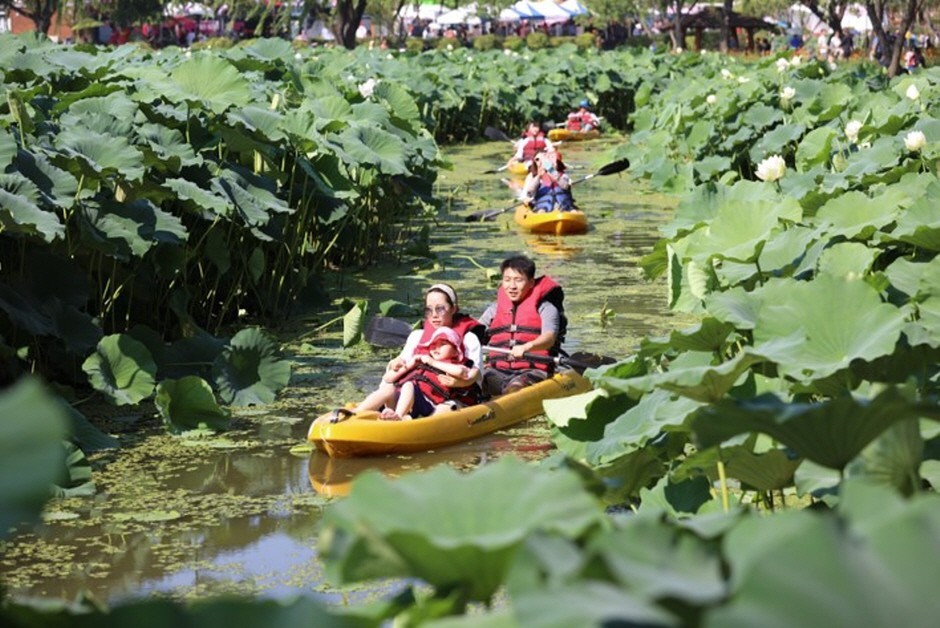
The scale here matters. Gungnamji and the surrounding lotus paddies hold something in the range of 10 million blossoms across more than 3,000 lotus and water lily varieties, and the festival splits the varieties into themed viewing zones so you are not walking past the same pink 연꽃 for two hours. Red lotus, white lotus, water lilies (수련), Victoria amazonica, and the smaller cultivars each get their own labeled section. That kind of botanical inventory is rare inside a single Korean festival grounds, and it is one of the specific reasons the Ministry of Culture, Sports, and Tourism keeps naming this event to its Excellent Festival tier (four years running from 2015 to 2018 alone).
Post-2022, there is a Hallyu tailwind almost nobody outside the domestic tourism office is naming out loud. When "Extraordinary Attorney Woo" (이상한 변호사 우영우) landed on Netflix in June 2022, it did not just launch Park Eun-bin globally. The show's opening title sequence, its color palette, and the recurring imagery of the whale and floating flowers turned "the lotus and the peaceful pond" into a K-drama-adjacent aesthetic that a generation of new international viewers actively started associating with Korean summer. Woo Young-woo's name literally reads "Young (flower) Woo (rain)," a palindrome that folds a flower metaphor into her identity. I am not saying "Attorney Woo" directly drove Buyeo bookings. I am saying if you look at how Korean summer flower content performs on Instagram and TikTok since 2022, the lotus is in a different visibility tier than it was in 2019, and Gungnamji is one of the two or three photo backdrops that gets tagged when a Korean creator wants to signal "traditional-but-quietly-hip." That is a real shift in demand-side attention, and Buyeo happens to sit exactly in the frame that shift is looking at.

Chungcheongnam-do's provincial festival play and how the money actually works
Buyeo Seodong Lotus Festival is organized by the Buyeo Culture Center and hosted by Buyeo-gun, which means the funding stack is provincial (Chungcheongnam-do) plus county-level (Buyeo-gun) tourism budget, sitting on top of central-government Excellent Festival branding support from MCST. Admission is free, and it has been free for the entire 20-plus-year history of the festival. That is not accidental. Free admission is the province's opening play to pull day-trippers off the Seoul-to-Gwangju KTX line and into the county for a full 24 to 48 hours of tourism spend, which then flows through the actual local revenue channels: hanok stay bookings, lotus-based food and tea rooms, the 백제향 (Baekjehyang) cafe on Sabi-ro serving lotus tea and lotus bread, the small crafts market at 123 Sabi Craft Village, and the Baekje Cultural Land theme park down the road.
This is a template a lot of foreign-content strategists misread. When a Korean provincial festival makes headlines internationally, the first assumption is often that gate revenue is the point. It is almost never the point. The gate is the loss leader that gives the province a legit reason to expand hotel capacity, subsidize local restaurants around the venue, and put together an English-language tour package with the Korea Tourism Organization. Buyeo has been running this playbook since 2003 (the festival's first year), and by 2015 it had graduated to Excellent Festival tier. The lotus is the bait. The sustained development budget for the county is the actual win.
The Baekje UNESCO cluster and why Buyeo is a smart 2027 trip
Here is the piece that makes the lotus festival worth flying in for versus just Seoul-hopping. Buyeo was 사비 (Sabi), the last capital of Baekje from 538 to 660 AD, and eight of its sites are part of the Baekje Historic Areas UNESCO World Heritage inscription (added 2015). Within a 15-minute taxi ride of Gungnamji, you have Busosanseong Fortress, the Gwanbuk-ri archaeological site, the Jeongnimsa Temple ruins with its five-story stone pagoda that survived the Silla conquest, the royal tombs at Neungsan-ri, the Naseong city wall, and the Buyeo National Museum's newly opened three-story wing dedicated entirely to the Baekje Gilt-Bronze Incense Burner (백제금동대향로), a National Treasure. That is a UNESCO-heavy cluster you do not normally get outside of Gyeongju.
The travel angle most foreign-facing guides underrate is that Buyeo is small enough to do properly in a weekend, without the Gyeongju-style tourist saturation. You fly into Incheon or Gimpo, take the KTX or the express bus (about 3 hours from Seoul), and by early evening you are eating lotus-leaf-wrapped rice and lotus tea at Baekjehyang while a Baekje-era wooden bridge is being lit up for the night parade. In 2027, once KTO's premium gastronomic-tourism tier scales further and the Baekje-Sabi visitor track gets a fresh promotional push, Buyeo is going to lose the "quiet" adjective it currently gets in English guides. The window for going before the crowd catches up to it is now.
Have you been to the Buyeo Seodong Lotus Festival?
If you are planning a first Buyeo trip, target the second week of July, book a hanok stay near Gungnamji, and give yourself a proper 48 hours. If you have already been, drop a comment with what you shot and which section of the pond gave you the best light. And if you have watched "Ballad of Seodong" or noticed the lotus imagery in "Extraordinary Attorney Woo," tell us whether you clocked the connection to the actual Baekje capital before or after you saw it.
Explore Korea with Daebak
Bring a little of Korea into your home every month with the Daebak Box, hand-picked K-culture snacks, K-pop merch, and lifestyle finds delivered straight from Seoul to your door.


