


Table of Contents
Every Hallyu food writer eventually files a story about H Mart (한아름 마트, Han Ah Reum Mart), and there is a reason the story keeps getting written. H Mart is the single largest cultural pipeline moving Korean food into North American home kitchens, roughly $3.28 billion in 2022 sales across about 120 stores in the US, Canada, and the UK, and the growth curve since 2020 has been steeper than anyone inside the Korean grocery industry predicted. I have watched Korean-American entrepreneurs at HanaFood and Assi Plaza try to run the same playbook for twenty years without matching H Mart's density. The interesting part, and the reason a Michelle Zauner memoir became a New York Times bestseller by setting its opening scene in a Korean supermarket, is that H Mart is not really operating as a grocery chain anymore. It is operating as a cultural embassy with a checkout counter, and the sales figures are downstream of that positioning.
The Han Ah Reum Origin: One Corner Store in Woodside, Queens, 1982
The company was founded in 1982 by Il Yeon Kwon, a Korean immigrant in Woodside, Queens, as a single corner grocery called Han Ah Reum (한아름), which most Korean speakers translate as "an armful" but which carries a warmer nuance closer to "an embrace-full." The Woodside store still operates under the original 한아름 branding today, which is a small detail most H Mart shoppers miss. Every other location branded H Mart in 1990s-era rebrand for English-speaking clarity, but the founding store kept the Korean nameplate because Il Yeon Kwon wanted a physical marker of where this started. That kind of specific decision, keep the Korean name on the mother store, put the anglicized initial on the growth stores, is the tell for how H Mart thinks about its own brand. The Korean root stays visible for the Korean-American community that built the customer base. The H Mart shorthand handles the rest.
The Queens location matters because 1980s Woodside was one of the two Korean immigrant hubs in New York, alongside Flushing, and the store's early success came from a very specific insight the Kwon family had that mainstream American grocery buyers missed. Korean home cooking in the diaspora needs a wall of 반찬 (banchan, side dishes), not just kimchi. It needs 순두부 (sundubu, silken tofu) fresh enough to eat within two days. It needs 도시락 (dosirak, packed lunch boxes) that a Korean office worker in Manhattan can grab at 11:30 am without a language barrier. Whole Foods can do premium organics. Trader Joe's can do a curated snack aisle. Neither can do a 40-foot refrigerated banchan wall run by Korean grandmothers who taste-check the seasoning. That is the specific competitive edge H Mart had in 1982 and still has in 2026, and it is worth understanding as an operational advantage rather than a cultural nicety.
The Michelle Zauner Effect: How a Memoir Turned H Mart Into a Cultural Landmark

Michelle Zauner's 2021 memoir "Crying in H Mart" debuted at No. 2 on the New York Times nonfiction bestseller list and stayed on the list for over 60 weeks. The opening scene, a biracial Korean-American woman standing in the H Mart banchan aisle in tears after her mother's death from pancreatic cancer, did something for H Mart that no ad campaign could have engineered. It reframed the store from ethnic grocery to sacred cultural space. Zauner told The Korea Herald in a 2022 interview that finding a can of 팥 (pat, red bean) at H Mart triggered a full visceral memory of her mother making 팥빙수 (patbingsu, red bean shaved ice), and that this specifically physical, aisle-anchored memory was the reason she kept going back. Her thesis is that H Mart functions as cultural infrastructure for diaspora Koreans who are losing pieces of their language and food knowledge. It stops the erosion. That is a heavy load for a grocery chain to carry, and the fact that Zauner's readers accepted the framing without pushback tells you how the Korean-American community itself already saw the store.
What is easy to miss from outside the Korean-American reader base is that Zauner's memoir landed exactly when the K-content wave was crossing over. "Crying in H Mart" published April 2021, six months after "Parasite" won Best Picture, four months after BTS's "Dynamite" hit Billboard No. 1, seven months before "Squid Game" broke Netflix records. Non-Korean readers who might have skipped a Korean-American memoir in 2015 walked into 2021 already primed by K-drama, K-pop, and K-cinema. H Mart's non-Korean customer share, roughly 15% pre-2020 by industry estimates, has by internal reads pushed past 40% in the four years since. Orion Pictures optioning the memoir for a film, with Zauner naming veteran Korean actor Kim Su-mi as her top casting pick, will extend that halo further. The store is now part of the Hallyu apparatus even though it started as a purely functional Korean-immigrant service.
The Hot Food Court: Where the Economics Actually Live
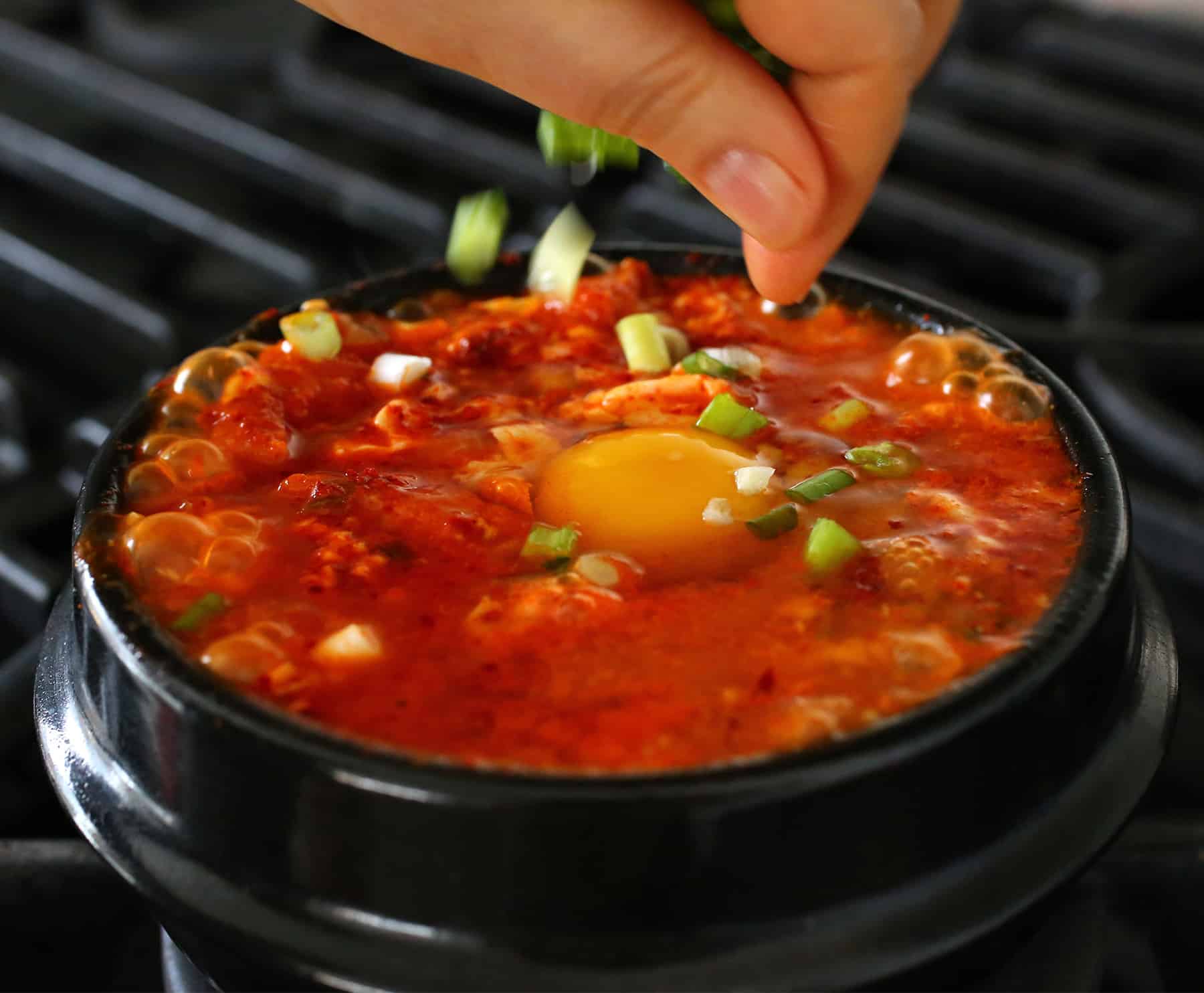
Here is the part most Western coverage of H Mart flattens. The grocery aisles do the volume, but the hot food court, prepared banchan station, and adjacent food halls do the margin. A Korean 도시락 lunch box at the H Mart hot bar in Manhattan's Koreatown 32nd Street location runs $8 to $12, with three protein-and-banchan combinations rotated daily. A 순두부찌개 (sundubu-jjigae, soft tofu stew) at the food court runs $6 to $10 and is served in a stone 뚝배기 (ttukbaegi) that gets bussed back to the kitchen. Prepared banchan sold by weight at the deli counter runs $6 to $9 per pound. Every one of these items has a margin profile closer to a restaurant than a grocery item, and H Mart is running restaurant-scale food volume through a grocery-scale rent and staffing base. That is the specific economic mechanic behind why H Mart beats Whole Foods on revenue per square foot for the Korean-American demographic segment, and it is why the newer stores (Yonkers NY 2022, Katy TX 2023, Marietta GA 2023) have oversized food halls attached to the grocery footprint rather than the small snack corners of the 1990s and 2000s stores.
The food court is also the H Mart onboarding funnel for non-Korean customers. Someone who watches "Squid Game" and wants to try 달고나 (dalgona) at home does not walk in on their first visit knowing which brand of 쌀 (rice) to buy or how 고추장 (gochujang) is graded. But they can walk up to the hot bar and order 김밥 (kimbap) or 비빔밥 (bibimbap) and eat it at the food court seating for under $15. That first experience is the acquisition moment. The grocery basket build happens on visit two and three, after the customer has enough vocabulary to navigate the aisle. Every H Mart operator I have talked to inside the Korean-American retail circuit is explicit about this: the food court is the top of the funnel, and the grocery is the retention layer. Whole Foods cannot run this playbook because their food service is built as an accessory to grocery. H Mart flipped the relationship, and it is the specific structural reason their per-square-foot revenue is higher.
The Banchan Wall: 반찬 as Competitive Moat
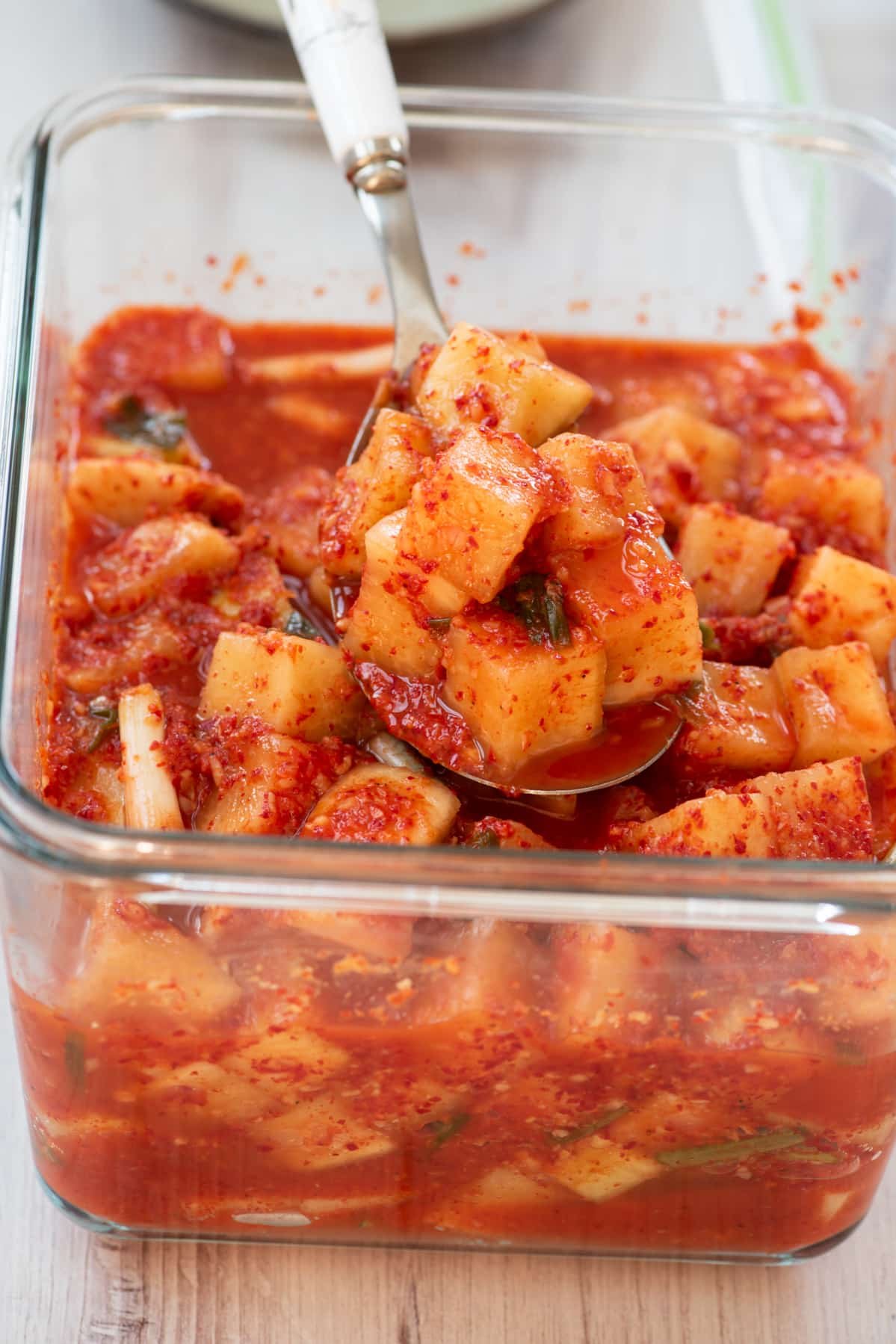
The 반찬 wall is where H Mart's operational discipline actually shows up. A typical mid-size H Mart runs 30 to 45 rotating banchan SKUs on any given day, sourced from a combination of in-store production, Korean-American commissary suppliers (H Mart owns Nara Foods, which is the New Jersey commissary supplier that stocks about half the northeast stores), and specific New Jersey and California Korean farms growing napa cabbage, mu (Korean radish), aster (참취), and perilla for the fermentation program. The 김치 (kimchi) selection alone runs eight to twelve varieties, from the standard 배추김치 (baechu kimchi, napa cabbage) to seasonal 열무김치 (yeolmu, young radish) and 파김치 (pa, scallion). Whole Foods stocks two kimchi SKUs on a good day. Trader Joe's stocks one. Costco has recently pushed a Bibigo kimchi tub that moves volume but only in one flavor profile. H Mart's wall is not just deeper. It rotates on fermentation age, which is the specifically Korean detail a mainstream chain cannot replicate without dedicated staffing.
The vertical integration is the moat. Nara Foods, the H Mart-owned commissary, supplies not just H Mart but also many independent Korean restaurants along the New York-New Jersey corridor. That gives H Mart procurement leverage on scale that no independent Korean grocer can match, and it is the same reason the 2022 opening of a 45,000-square-foot Yonkers flagship (H Mart's largest at the time) was possible. Yonkers now anchors a Korean food supply chain that flows down through Fort Lee, into Palisades Park, through 32nd Street Koreatown Manhattan, and out to the Long Island stores. That corridor did not exist as a coherent supply chain in 2000. H Mart built it.
The Regional Flagships: How H Mart Colonizes a Metro
The H Mart expansion playbook has a specific pattern worth naming, because it repeats reliably across metros. First store: a modest 15,000 to 20,000 square foot location in the metro's Korean-American enclave (Ktown LA, Duluth GA, Aurora CO, Palisades Park NJ, Fort Lee NJ). Second store, opened 18 to 36 months later: a suburban flagship of 30,000 to 45,000 square feet with a full food hall, deep prepared foods program, and adjacent Korean bakery (usually Paris Baguette or Tous Les Jours) plus a Korean skincare corner (usually a leased Nature Republic or Innisfree footprint). Third and fourth stores follow in secondary suburban rings where Korean-American families have moved out from the original enclave. The Katy TX flagship that opened in 2023 is the model of this playbook running clean. Katy is a Houston western suburb with a growing Korean-American demographic that historically drove 45 minutes to the Bellaire Boulevard 99 Ranch Market or the older Houston H Mart. Now they do not have to. The playbook is legible enough that Korean-American demographers use H Mart's expansion announcements as a proxy indicator for where the Korean-American middle class is actually settling in the US.
Look at the specific regional flagships and their positioning. The Yonkers NY store (opened 2022) is the northeast fulfillment anchor, close to the Nara Foods commissary and positioned to serve the Westchester and southern Connecticut Korean-American demographic that was underserved for two decades. The Ktown LA location (built out multiple times, currently anchored at the Koreatown Plaza and Koreatown Galleria) is the West Coast flagship and the historic center of Korean-American food culture in the US. Duluth GA (in the Duluth-Gwinnett corridor northeast of Atlanta) is the Southeast flagship, and it is worth noting that the Duluth Korean-American community grew large enough during the 2000s and 2010s that H Mart's Atlanta expansion has been more aggressive than in most other secondary markets. Aurora CO handles the Denver and Rocky Mountain region, which historically had almost no Korean grocery infrastructure. Each flagship was placed after H Mart's real estate team ran demographic analysis on Korean-American population density, projected Korean-adjacent Asian-American demographics, and non-Korean K-content consumer interest based on postal zone data. That is a level of retail analytics most independent grocers cannot afford, and it is the reason H Mart keeps hitting expansion targets while competitors miss.
The Post-2020 Non-Korean Customer Surge: What Actually Happened
Something important happened to H Mart's customer mix between 2020 and 2024, and it deserves its own read. Pre-2020, H Mart's non-Korean customer share sat at roughly 15%, mostly other Asian-American shoppers (Chinese-American, Filipino-American, Vietnamese-American) and adventurous foodies. Post-2020, industry estimates put non-Korean customers at 40% or higher at flagship stores, with some newer suburban locations reporting closer to 50%. The specific drivers are worth naming. First, the K-content halo: "Parasite" (2019), "Squid Game" (2021), "The Glory" (2022), "Extraordinary Attorney Woo" (2022), plus the BTS-BLACKPINK-NewJeans K-pop chart dominance, primed a huge segment of non-Korean US consumers to want to try Korean food. Second, pandemic-era home cooking: the 2020-2021 lockdowns pushed people toward at-home meal preparation, and Korean cooking (kimchi jjigae, bibimbap, dakdoritang, japchae) delivered restaurant-quality flavor for grocery-cost effort. Maangchi's YouTube channel gained roughly 500,000 subscribers in that window, most of them non-Korean, and every one of those learners eventually needed to find a Korean grocery for gochugaru, myeolchi, sesame oil, and doenjang. Third, TikTok-driven snack culture: Buldak ramen, honey butter chips, and 삼각김밥 (samgak gimbap) triangle rice balls all trended, and H Mart was the physical destination that could actually stock the SKU.
The interesting appeal-point for non-Korean H Mart shoppers is that the store does not condescend to them. There is no "Korean 101" endcap, no watered-down explainer signage, no "beginner kimchi" positioning. The store treats a non-Korean shopper the same way it treats a Korean grandmother, which sounds like a small thing but is actually the specific tonal choice that keeps K-content-primed customers coming back. If you have watched a K-drama and you want to eat what the characters eat, you do not want a mall-food-court version. You want the real thing, and you want to figure it out yourself. H Mart lets you do that. The 정 (jeong, deep-affection warmth Korean culture prioritizes over transactional efficiency) that the store extends to Korean elders extends to first-time non-Korean shoppers by default, and that is the emotional retention lever no marketing budget can buy.
Why H Mart Wins: Sourcing, Language, and the 정 Layer
The three specific reasons H Mart wins that most operators cannot replicate. First, local Korean-American farm sourcing. H Mart has been quietly building relationships with New Jersey (Cumberland County), California (Ventura and Riverside Counties), and Georgia (Gwinnett County) Korean-American farmers since the late 1990s. These farms grow napa cabbage, Korean mu radish, perilla leaves (깻잎), aster (참취), Korean chili peppers (풋고추, 청양고추), and Chinese chives (부추) specifically for H Mart procurement, and the shorter supply chain shows up as fresher produce than what independent Korean grocers can buy from cold-chain distributors. Second, the language layer. H Mart stores are staffed with Korean-speaking managers and cashiers at nearly every counter, which sounds obvious but is the specific reason older Korean immigrants who never fully acquired English still shop there rather than at Kroger or Publix. Third, and most under-discussed, the 정 layer. H Mart cashiers ask about your family. The 반찬 counter workers taste-test in front of you. The manager remembers your kimchi preference. These are labor-cost decisions H Mart makes and Whole Foods does not, and they compound into loyalty that is very hard to attack with lower prices alone.
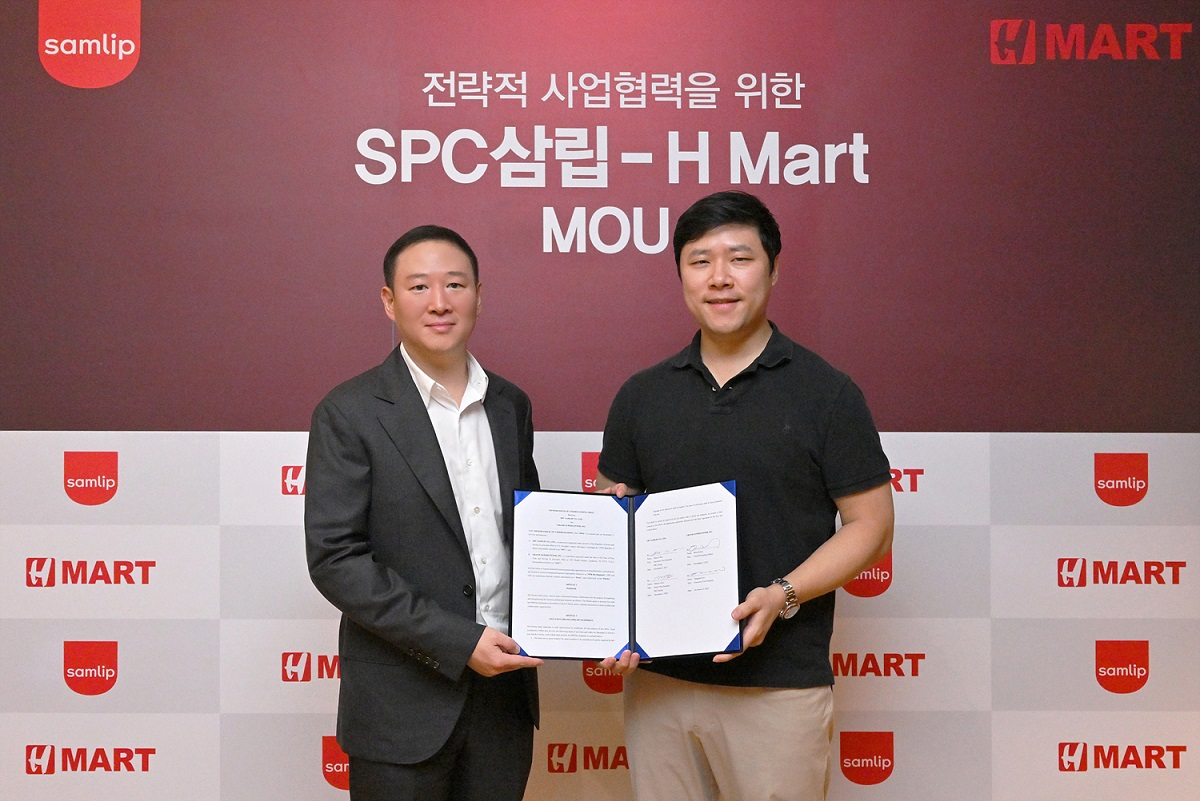
The larger read for the Hallyu industry is that H Mart is now the most important physical retail node for Korean food culture in North America, and its influence goes well beyond grocery. When SPC Samlip signed its 2023 partnership to expand yakgwa and hoppang distribution through H Mart, that was Korean confectionery companies acknowledging that H Mart's shelf space in the US now shapes what Korean products get developed at Seoul headquarters. When Nongshim, Ottogi, and Samyang schedule their US-market launch calendars, they schedule around H Mart's promotional windows. When a Korean food startup wants to enter the US market, the H Mart buyer meeting is the first pitch that matters. The Woodside 한아름 store that opened in 1982 as one immigrant family's corner grocery has become the specifically Korean retail power that pulls Seoul's food industry toward the US market, and that is the specific reason the Michelle Zauner memoir framing (H Mart as sacred cultural space) resonates rather than reading as sentimental. The store has actually done the work of holding the Korean-American food culture together through four decades of demographic change, and the store is now doing the harder second job of making that culture legible to a non-Korean US customer base that showed up because of K-drama and stayed because of the 반찬 wall.
Bring the Korean-Snack Aisle Home
Whether you have a nearby H Mart or you are in a US city that H Mart has not reached yet, the SnackFever Box ships the same Korean snack SKUs (Buldak, honey butter chips, Choco Pie, Pepero, seasonal 편의점 hits) that H Mart runs on its snack aisles. Every box is a monthly bridge from Seoul convenience-store shelves and H Mart flagship food halls to your front door.


