


Table of Contents
Here is the thing about Korean snack culture that Western food writers keep missing when they cover the K-food export boom: none of this scales without 정 (jeong). Not the ramyeon numbers, not the Choco Pie office pantry rotation, not the roughly $500M+ global subscription snack box category. Ten years in the Hallyu space and I can tell you the export data does not explain the appeal, because the appeal is not really about the snack. It is about what happens when you hand someone the snack. 정 is the untranslatable Korean emotional bond built through small, repeated acts of care, and 나눔 (sharing) is the vehicle. The 간식 (snack) is just the currency the exchange runs on.

Why every Korean office pantry runs on 정
Every Korean office pantry I have worked in operates on the same unspoken protocol. Someone comes back from a business trip and drops a box of 초코파이 on the shared desk. Someone else stops at GS25 on the way in and leaves a case of Binggrae 바나나맛 우유 in the fridge with a sticky note saying 다들 드세요 (help yourselves, everyone). Nobody counts. Nobody logs it in Slack. The 간식 rotation just runs, and if you stop contributing to it you feel the social temperature drop before anyone says a word. That is 정 quietly building the relational floor of a workplace, and it is why Korean colleagues who transfer overseas often tell me the thing they miss most is not the specific snack. It is the informal snack economy of a Korean office.
Kimjang is the archetype every K-food business copied
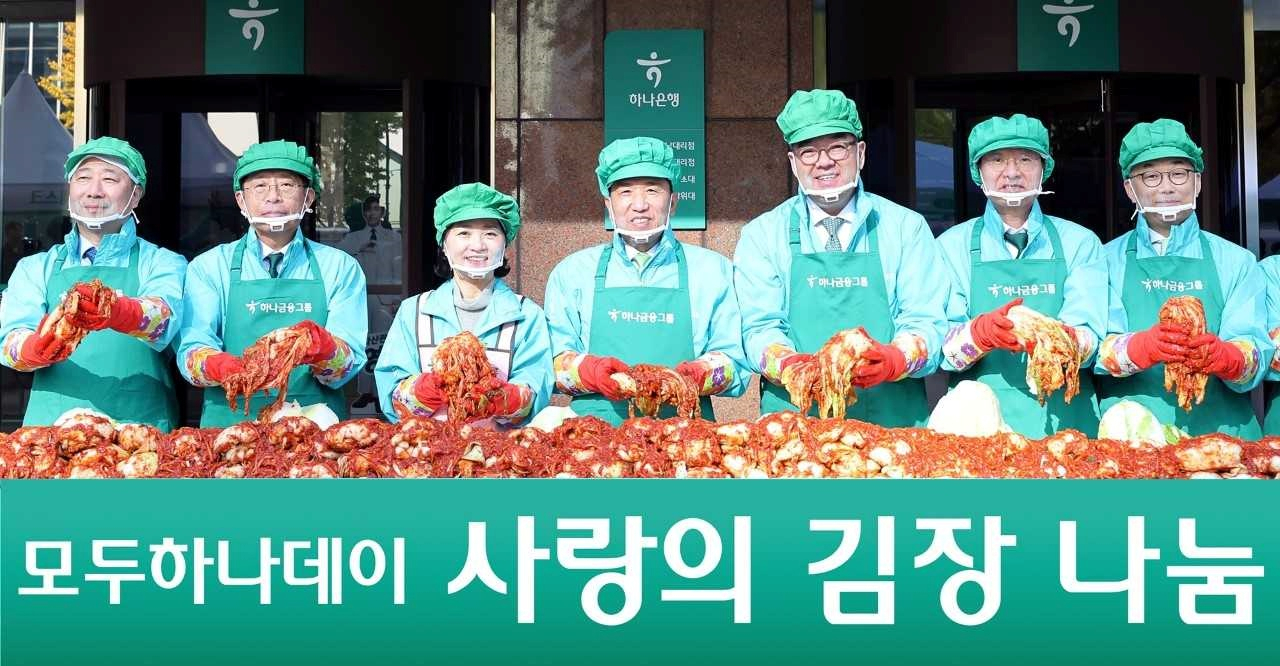
Kimjang, the November tradition of communities gathering to make and share hundreds of heads of kimchi for winter, is the archetype. UNESCO inscribed it as Intangible Cultural Heritage in 2013, and the reason matters: the inscription is not for the kimchi. It is for the collective 나눔 act. That is why Korean conglomerates still run corporate kimjang every autumn as CSR. When Hana Financial did theirs in November 2024, roughly 300 executives and staff hand-made 11,111 heads to donate. To a Western observer this reads as a photo op. To a Korean audience it reads as the company signaling it understands the culture it operates in. Kimjang is the proof of concept that Koreans will organize entire logistics operations around the pleasure of sharing food.
Now zoom out to the K-food subscription box category the West is finally paying attention to. SnackFever launched in 2015 with a simple insight founder Chris Kang worked out early: overseas K-content fans did not want generic "Asian snacks" boxes. They wanted the specific 간식 their bias groups mentioned on VLIVE and later Weverse. Daebak Box, my employer (full disclosure), built on the same read. Across the wave that includes Daebak, SnackFever, Bokksu, Munch Addict, KoreaCrate, and Seoulbox, the global category has cleared roughly $500M in annual GMV, and it is almost entirely K-food driven. The category exists because 나눔 travels.
The Weverse-era snack-sharing loop, decoded
Here is the mechanic Western brands still underestimate. When BLACKPINK's Jennie mentioned 바나나킥 (Banana Kick) on The Jennifer Hudson Show in March 2025, Nongshim's export orders spiked within weeks. When Zoey in Netflix's KPop Demon Hunters (2025) was animated munching a bag of 새우깡, Nongshim's Saeukkang landed on Amazon bestseller lists across six countries inside a month. Stray Kids as Pepero brand ambassadors sold out limited-edition eight-member packs on Weverse Shop in under an hour. This is not Beyonce-Pepsi celebrity endorsement. It is peer-to-peer snack sharing scaled by a fandom that treats copying the idol's snack pick as an act of 정 with the artist.

Fans then repeat the act laterally. On DC Inside gallery threads and Weverse fan communities, unboxing a Korean snack shipment and posting which ones you liked is a standard content format. On the r/kpop and r/KoreanFood subreddits, "what should I try in my Daebak Box" gets long comment threads from strangers telling each other what pairs with 소주, which flavor tastes like their Korean grandmother's kitchen, which one to save for a bad day. That is 문화 교류 (cultural exchange) doing its work in real time between people who have never met. The snack is the excuse. The exchange is the point.
Diaspora as the quiet cultural bridge
The more interesting movement post-2020 is happening on North American and European college campuses and office break rooms. Korean-Americans and second-gen kids started bringing Korean snacks to work and school to share with non-Korean friends, and something shifted. A single 초코파이 handed to a coworker becomes a two-minute conversation about growing up in a Korean household. A Ppushu Ppushu bag crushed and shared at a dorm study session becomes the first Korean food a Boston freshman ever tries. These are not big cultural moments. They are what Korean marketers call 잔잔한 문화 교류, quiet cultural exchange, and cumulatively they built the demand pipeline that let K-food exports hit a record $13.6 billion in 2025.
What Western analysts covering the K-food boom keep missing is that the snack subscription box category did not invent this. It packaged an existing behavior. Koreans have been shipping 간식 to overseas relatives through 택배 gift boxes for 40+ years. My grandmother sent boxes of dried squid, 유과, and 홍삼 candy to my cousins in Chicago every Chuseok in the 1990s. What Daebak, SnackFever, and the 2020-2024 startup wave figured out was that the same relational logic scales to a fan in São Paulo who has never met a Korean but follows aespa and wants to eat what Giselle mentioned on First We Feast. The infrastructure is identical. Only the recipient changed.
My honest read after a decade watching this space: the snack subscription category is not really about food discovery. It is about giving diaspora Koreans and international Hallyu fans a monthly, low-friction way to participate in the 나눔 ritual that anchors Korean social life. The box arrives, you crack it open with a friend or on a livestream, you post the unboxing to Weverse, you tag a mutual, you save the Homerun Ball for later. That entire loop is 정 running on export infrastructure. Every box that ships is a small piece of Korea's relational culture getting rebuilt somewhere else, one 간식 at a time.
Want to plug into the 나눔 loop yourself? SnackFever Box ships a curated set of Korean snacks every month, straight from Seoul, so you can host your own peer-to-peer 정 exchange with the people around you (or with your Weverse mutuals across three continents).


