


Table of Contents
Here is the honest read from someone who has spent over a decade watching K-food scale up outside Korea: Bonchon (본촌) is the most consistently underestimated Korean fried chicken brand in Western press. English-language coverage keeps calling it "the Korean KFC," which is technically fine and completely misses the appeal point. Bonchon was never designed to be a Korean equivalent of an American fast-food giant. It was engineered from day one as a Korean-American diaspora export project: a very specific Busan frying method, wrapped inside a master-franchise model built to travel. The 2002 Busan origin, the 2006 Manhattan opening, the 2018 private-equity handoff, and the roughly $1.5 million average annual revenue per US store (per Bonchon International head Bryan Shin, speaking to The Korea Times in 2026) are not disconnected data points. They are one continuous thesis. It is worth pulling apart for anyone who eats 치킨 with cold beer and wants to know what the sauce is actually paying for.
What the 2002 Busan launch was actually solving for
Founder Seo Jin-duk (서진덕) opened the first Bonchon in Busan in 2002, and the industry read at the time was that this was a strange move. Korea's fried chicken market was already saturated. Kyochon had been running since 1991 and had locked up the premium tier with its soy garlic glaze and single-brand storefronts. BB.Q Chicken had launched in 1995 and was already deep into aggressive nationwide franchising. Nene, Pelicana, and dozens of regional 후라이드 shops had the mid-market covered. Anyone opening a new chicken brand in Busan in 2002 was walking into a knife fight with no differentiation on paper. The move that made Bonchon interesting, and the reason the name (which translates roughly to "my hometown") was chosen with intent, was that Seo was never really targeting the Korean market. He was building a Korean-American export product from the first store. The Busan origin was, in industry terms, a test kitchen for a formula designed to ship.
Why the 2006 Manhattan opening was the real founding moment
Four years after Busan, Bonchon opened its first franchised location outside Korea in Manhattan in 2006, followed by a directly managed Manhattan store in 2010. Bryan Shin, now head of Bonchon International, has said publicly that the Manhattan store "hit the jackpot" so hard that New York police had to manage the queues. That line reads as boosterish, but the timing was real. The 2006 window was the exact moment when Korean fried chicken was starting to filter into US food media as a curiosity distinct from Chinatown wings and American Southern fried chicken. Bonchon's founder-level decision to open in Fort Lee, New Jersey (a heavy Korean-American population) and Manhattan simultaneously gave the brand two feedback loops at once: a diaspora audience that knew what proper double-fried 후라이드 was supposed to taste like, and a New York foodie audience that had never had thin-crust Korean chicken before. The diaspora ratified the product. The foodies gave it viral distribution. That two-audience validation is the mechanism most Korean F&B brands trying to enter the US still get wrong.
The double-fry plus 마늘간장 glaze: why the technique is the product
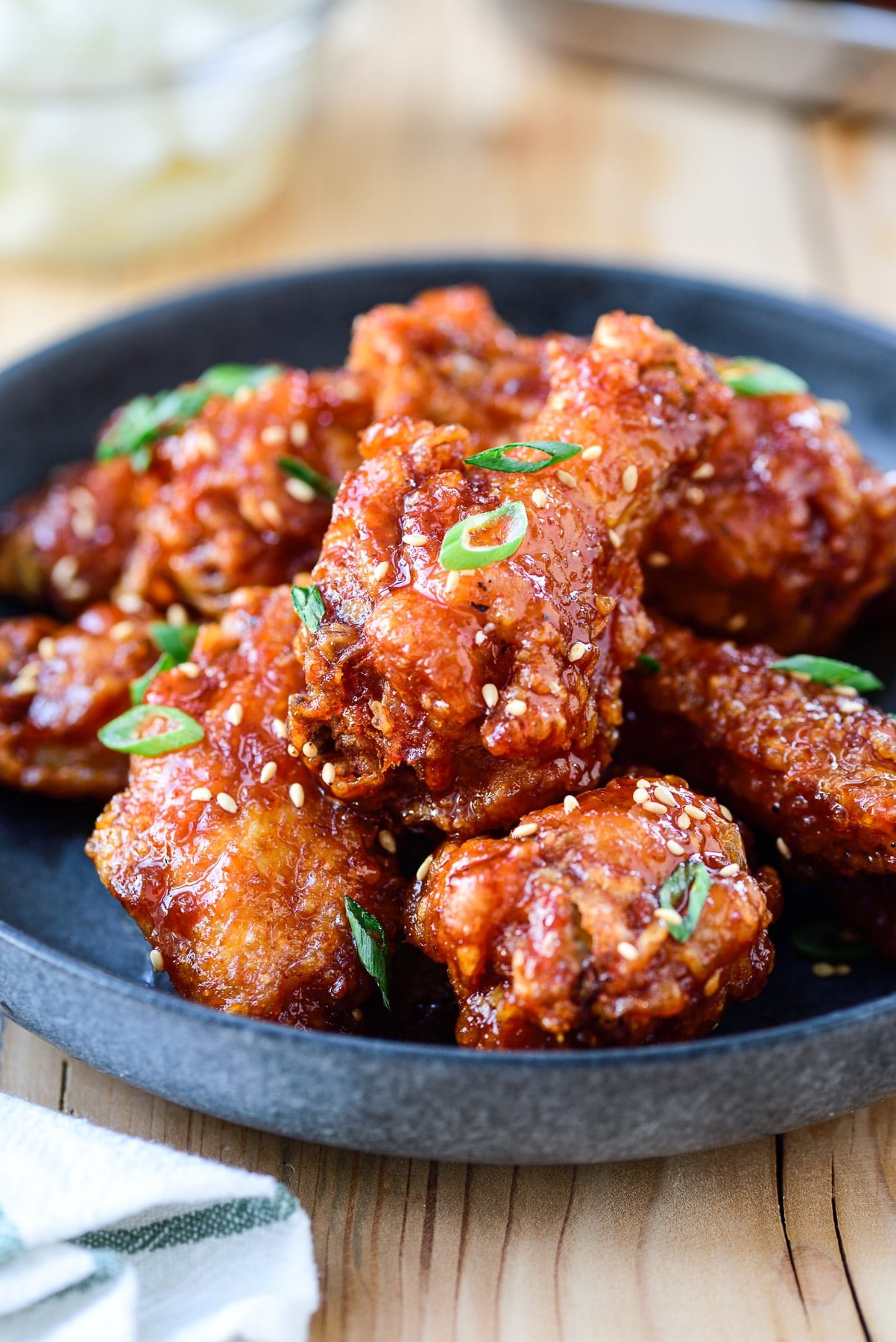
Every English-language article about Korean fried chicken repeats the phrase "double fried." Very few explain why that matters commercially. The Korean method (fry once at 320 to 330 degrees Fahrenheit to cook the meat, rest for a few minutes so residual moisture escapes, then fry again at 350 to 360 to crisp the exterior) produces a shatteringly thin crust with almost no oil retention. That crust holds its crunch under sauce for hours. American-style fried chicken with a thick, well-seasoned crust cannot do this. The moment you glaze it, the crust goes soggy in minutes. That is why Bonchon can hand-brush its 마늘간장 (soy garlic) or spicy gochujang sauce onto each piece at the store and still deliver crunch to a delivery order 30 minutes later. Korean Bapsang's Hyosun and Maangchi have both written about this technique in home-cook terms, and the underlying appeal point is the same at Bonchon's scale: this is a category weapon that Popeyes and KFC structurally cannot copy without rebuilding their entire fry line. Bonchon's Bryan Shin has said the brand makes its batter deliberately watery and its coating thin. That is not a chef flourish. That is category defense.
The unit economics: what a $1.5 million Bonchon store actually is
Bryan Shin told The Korea Times in April 2026 that each Bonchon restaurant in the US, its top-performing market on a per-store basis, generates about $1.5 million in annual revenue on average. That number is worth sitting with. A typical American casual-dining chicken concept averages closer to $1 million per unit at the mature-store level. Bonchon is running about 50 percent above that benchmark on a smaller footprint. The reason is a franchise-economics point that gets buried in food coverage: Bonchon's overseas franchisees only get one thing shipped from Korea, and that is the sauce, manufactured at a plant in Busan. Everything else is sourced locally under head-office inspection. That means the cost of goods scales cleanly, sauce margin stays in Bonchon International's pocket, and the brand's flavor consistency is enforced at the choke point that matters. Franchise investment in the US typically runs in the $500,000 to $1 million range per store depending on real estate, which puts payback timelines inside the range that keeps franchisees renewing. This is the invisible reason Bonchon has scaled where a lot of Korean F&B exports have plateaued.

The VIG Partners handoff: what PE actually did for Bonchon
In November 2018, Seoul-based private equity firm VIG Partners signed a deal to take a 55 percent majority stake in Bonchon International (reported by The Korea Herald's Investor desk). At the time of the deal, Bonchon had more than 325 stores in eight countries, including 85 in the US alone. Revenue had almost doubled to 25 billion won ($22.12 million at the time) over the prior three years, and EBITDA had roughly tripled to 11 billion won. Park Byung-moo of VIG Partners framed the thesis as "K-fashion and K-beauty precedent," meaning Bonchon was being positioned as the next category of Korean cultural export scaling on Hallyu tailwinds. What PE actually delivered, in the years that followed, was disciplined market-analyst infrastructure, quarterly in-country mystery-shopping of every overseas franchisee, and systematic entry into Taiwan, Laos, and Paris (2023). The Paris store hit 4.4 out of 5 on Google Reviews inside its first year, which is the kind of number that quiets internal debates about whether European palates can accept 마늘간장 as a mainstream flavor. They can.
BB.Q, Kyochon, and the actual rival dynamics
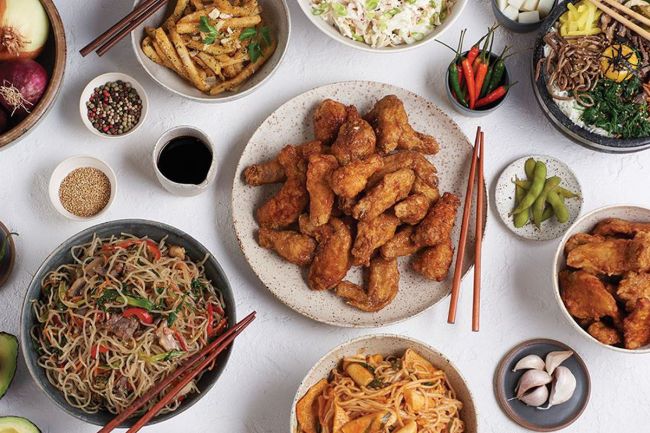
Non-Korean coverage tends to lump Bonchon with BB.Q Chicken and Kyochon as "the three Korean fried chicken chains in the US," which flattens what is actually a three-lane race. Kyochon plays the premium single-brand game. Every store looks like a Kyochon store, the menu is tight, and the price point sits high. It is the closest thing Korean chicken has to a heritage-brand play. BB.Q Chicken, which is Korea-based, has aggressively franchised its way to more than 500 US stores by 2024 and runs a broader menu with heavy TV marketing spend, including its post-2020 BTS partnership that pushed the brand into K-pop-adjacent visibility. Bonchon is neither. Bonchon's positioning is casual-dining Korean-American, US-headquartered (Dallas), with a menu that stretches beyond chicken into japchae, bulgogi, and popcorn shrimp with spicy sriracha mayo. Roughly 30 percent of each store's menu is non-chicken. That is a deliberate strategic choice. Bonchon is competing for the "we go here for dinner" occasion, not just the "we order wings for the game" occasion. In marketing-strategy terms, Bonchon is fighting on a different battlefield than BB.Q, which is why both can grow at the same time.

Kimchi coleslaw as strategy: why the menu localization is smart
The move that gets treated as a footnote in most Bonchon coverage is actually one of the most instructive parts of the playbook: Bonchon localizes its menu without breaking its core. Kimchi coleslaw in the US. Seasoned fries with Korean spice blends. Popcorn shrimp with sriracha mayo. Soy-marinated salmon in Thailand. Bulgogi bowls and japchae as full-size entrees everywhere. Bonchon's American bibimbap was adjusted to include quinoa and to drop the pickled yellow radish and raw egg, which are non-negotiable in Korea and immediately alienating for the first-time American diner. Purists on both sides complain about this. The strategic read is that this is exactly how a Korean-American brand survives the first-visit hurdle. The core (double-fried 치킨 with signature 마늘간장 or spicy glaze) never moves. The perimeter (sides, non-chicken entrees, dessert) adapts by market. This is the same pattern Yoshinoya used in the US in the 1970s, and it is the reason Bonchon can open in Manila, Bangkok, Phnom Penh, Dubai, and Paris without needing five separate brand identities. The core is portable. The perimeter is negotiable.
The 치맥 tailwind: how Netflix and BTS moved the category
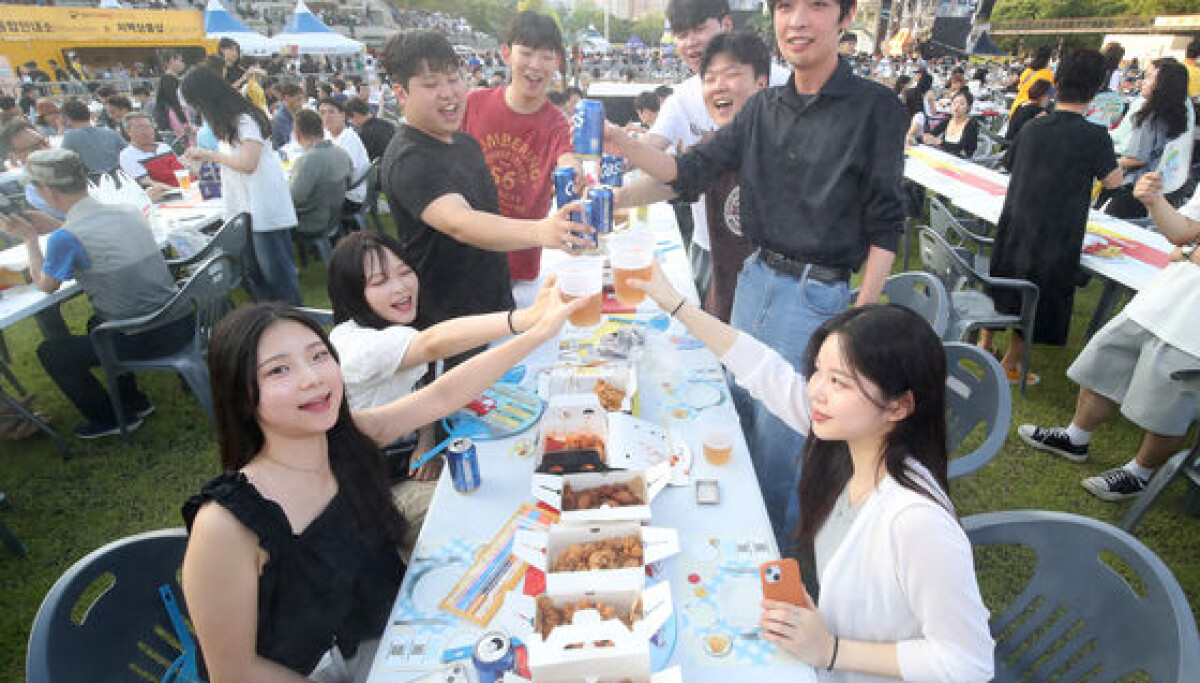
Anyone who tracks Korean cultural export knows the post-2020 window was when Korean fried chicken stopped being a niche category in the US and became a mainstream one. The specific catalysts were extremely legible. The Netflix hit rate of Korean dramas (Crash Landing on You, Itaewon Class, and later Squid Game) meant that scenes of characters eating fried chicken with beer on screen, using the term 치맥 (chimaek, chicken plus 맥주 beer), traveled globally in a way no advertising budget could match. Product placement was not necessary. The visual language of a lacquered box of Korean chicken and two cold beers on a low table became shorthand for Korean cozy-life aesthetic. Bonchon's competitor BB.Q Chicken cashed the cheque directly with its BTS ambassador deal in 2020. Bonchon did not need to. The category tailwind lifted every serious operator, and Bonchon's advantage was that it already had the US infrastructure to absorb the demand. Mark Zuckerberg's viral 2024 Bonchon visit at a California location, which Bryan Shin cited to The Korea Times, was the kind of moment that would have required a seven-figure marketing spend to manufacture. It happened for free.
Why Bonchon's next move is Korea itself
The genuinely surprising line in Bryan Shin's April 2026 Korea Times interview was that Bonchon plans to return to Korea in "two years or more" as a mid- to long-term goal. Bonchon has not operated in Korea for years. Bonchon International currently runs exclusively outside Korea, with approximately 500 restaurants across nine countries and nearly $400 million in overall sales in 2025. Coming back to Korea is a reversal of the original 2002 thesis. The read from anyone who works in Korean F&B is that this only makes sense if Bonchon believes it can position itself as a returning-hero brand: the Korean chicken chain that conquered the world and is now bringing back the flavor Americans and Filipinos and Thais fell in love with. That framing has worked before in Korean beauty (Sulwhasoo's globalization then re-emphasis at home) and in K-pop (groups touring globally first, then re-establishing dominance in Seoul). It has never really been tried in K-food fried chicken. If Bonchon pulls it off, the Busan-to-Manhattan-to-Seoul arc becomes the case study every K-food consultant will reference for the next decade.
The Daebak read: why Bonchon still matters to the Hallyu food story
Bonchon is not the biggest Korean chicken chain (BB.Q holds that on unit count) and it is not the most premium (Kyochon holds that on price positioning). What Bonchon is, and this is worth stating clearly, is the most strategically coherent Korean-American food export of the last 25 years. The Busan test kitchen in 2002, the Manhattan foothold in 2006, the sauce-only supply chain, the market-specific menu perimeter, the PE-disciplined market entry into Europe and Southeast Asia, and the coming Korea return are all one thesis, executed patiently. For anyone who eats Bonchon and thinks of it as "the Korean KFC," the actual read is closer to this: Bonchon is what happens when a Korean-American founder builds a Korean product for a global palate first, and lets the Korean market be the last stop rather than the first. The 마늘간장 wing you order tonight is the delivery vehicle for that entire strategy. Chew slowly.
Bring the Chimaek Home with Daebak
If Bonchon's Busan-to-Manhattan story pulled you deeper into how Korean food actually travels, the Daebak Box is your monthly deep-dive: curated Korean pop culture, snacks, and lifestyle picks that take you past the headlines and into what Korean fans actually love. Subscribe, and let each month land like a fresh order of 치킨 at your door.


