


Table of Contents
Salut la Daebak-Fam. Faisons les choses correctement. Le ramyeon coréen 라면 n'est pas seulement des nouilles instantanées. C'est une bataille industrielle à trois d'une valeur d'environ 10 milliards de dollars à l'échelle mondiale, Nongshim détenant environ 60 % du marché intérieur, Ottogi 25 %, et Samyang 10 %, et tout article occidental qui traite ces marques comme interchangeables rate l'essentiel de l'histoire. Je couvre la nourriture et le mode de vie coréens depuis plus d'une décennie, et voici mon avis honnête sur 신라면 (Shin Ramyun) contre 불닭볶음면 (Buldak) contre 짜파구리 (Chapaguri), lequel mérite vraiment la couronne, et les astuces 계란 (œuf), 김치, 치즈, 대파 (oignon vert) qui distinguent la cuisine de dortoir paresseuse du ramyeon d'adulte.
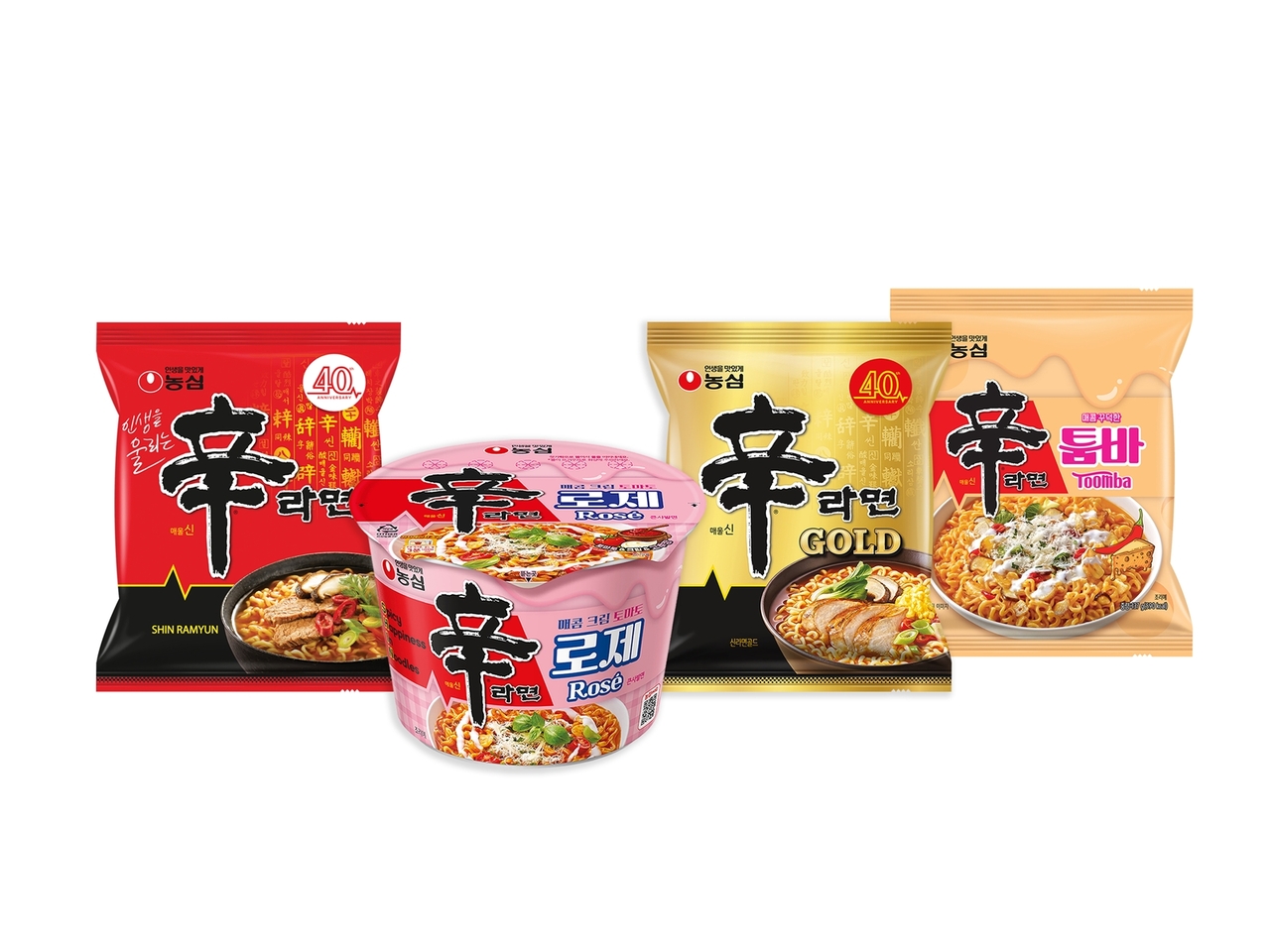
Le scoop d'entrée de jeu : 신라면 a gagné en étant standardisé, pas le meilleur
Permettez-moi de mettre la controverse de côté. Le 신라면 (Shin Ramyun) n'est pas le ramyeon coréen le plus savoureux. C'est le plus standardisé. Ce sont deux choses très différentes, et la domination de Nongshim depuis 40 ans est une histoire d'ingénierie de la cohérence, pas de supériorité gustative. Dégustez à l'aveugle le 신라면 à côté du 진라면 (Jin Ramen) d'Ottogi à Séoul avec un groupe de Coréens d'une trentaine d'années et les résultats seront à peu près équitablement répartis, parfois en faveur du Jin. Demandez lequel ils gardent réellement dans leur garde-manger et le 신라면 l'emporte. L'écart est une question d'infrastructure de marque, pas de chimie.
Ce que Nongshim a maîtrisé en 1986, c'est un profil de saveur reproductible : une base de bouillon de bœuf et de champignons, une chaleur de gochugaru calibrée à 2 700 Scoville, et une nouille moelleuse mais pas trop épaisse. Cette spécification a à peine bougé en 40 ans. Les consommateurs savent exactement ce qu'ils obtiennent dès la deuxième gorgée. Le 진라면 d'Ottogi est sans doute un bouillon plus doux et plus agréable (certains Coréens l'appellent 순한맛의 정석, le standard de la douceur), mais Ottogi est arrivé plus tard et n'a jamais dépassé l'emprise de distribution de Nongshim. La distribution l'emporte sur le goût. C'est toute l'histoire du top des ramyeon.
L'ampleur est à souligner. Le 신라면 a vendu 1,66 milliard de paquets dans le monde entier rien qu'en 2024, soit environ 53 paquets par seconde. Le Shin Ramyun Toomba (la variante crémeuse carbonara, inspirée par les « modisumers » en 2024) a dépassé les 100 millions de ventes en un an, ce qui est un chiffre de début plus typique des lancements de produits de Nongshim combinés il y a une décennie. Nongshim construit sa deuxième usine aux États-Unis pour suivre le rythme, et l'Amérique du Nord, la Chine et le Japon représentent déjà plus de la moitié des ventes de 신라면 à l'étranger. Ce n'est pas une affaire de nostalgie. C'est une entreprise de produits de consommation mondiale qui fonctionne.
불닭볶음면 : Le « Fire Noodle Challenge » était un produit conçu d'abord pour l'exportation
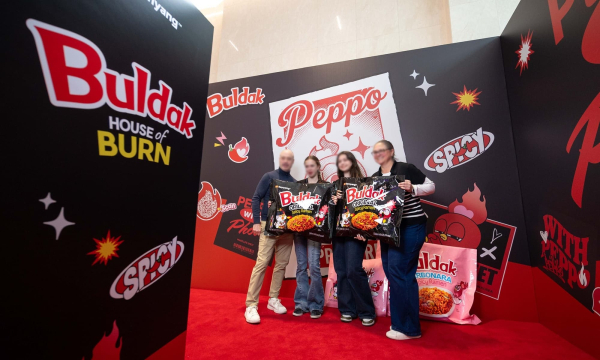
Voici mon deuxième point de vue brûlant. Le 불닭볶음면 (Buldak Bokkeummyeon, nouilles sautées au poulet épicées) n'est pas une cuisine coréenne authentique. C'est un produit marketing conçu pour la viralité, et Samyang l'a conçu ainsi dès le départ. Lancé en avril 2012 avec 4 404 Scoville (l'original) et poussé plus tard à 13 000 Scoville avec la variante 3X Haek Spicy, le 불닭 était le pari de Samyang sur la saveur extrême en tant que catégorie. Ce pari n'a été payant qu'en raison du Fire Noodle Challenge de 2014, une tendance YouTube lancée par un créateur coréen et reprise par des YouTubers mondiaux à la recherche de contenu de vidéos de réaction.
Le Fire Noodle Challenge n'était pas une viralité organique au sens pur du terme. Samyang a détecté la vague tôt et s'est investi à fond : échantillonnage auprès d'influenceurs, emballages qui se photographiaient bien sur les miniatures YouTube (ce graphique de flamme rouge néon est conçu pour un aperçu 480x360), SKU d'exportation poussés dans les Costco US, Amazon et les épiceries asiatiques avant la demande. En 2024, la ligne Buldak avait vendu 6,6 milliards de portions cumulées, et à la mi-2025, elle a atteint 10 milliards. C'est le rythme d'un produit de consommation viral, pas d'un aliment traditionnel.
Il convient de nommer honnêtement le point d'attrait pour les fans mondiaux. 불닭 n'est pas une question de profondeur de saveur. C'est une question de défi physique : pouvez-vous le manger, et pouvez-vous filmer votre visage pendant que vous le faites. C'est pourquoi la conversation sur le 불닭 coréen est une génération entière plus jeune que la conversation sur le 신라면. Les Coréens plus âgés ne mangent pas vraiment de 불닭. C'est le snack du marché d'exportation et des adolescents coréens de la génération Z qui ont grandi avec le mème. La victoire de la marque déposée coréenne en juin 2026 (Samyang a obtenu le nom domestique « Buldak » après un rejet en 2008) montre à quel point Samyang défend maintenant sérieusement la propriété intellectuelle à l'exportation. Ils luttent contre les contrefaçons dans 27 pays. C'est la forme qu'un produit viral prend en entrant dans sa deuxième décennie.
Là où le 불닭 mérite le respect, c'est l'ingénierie des saveurs sous le gadget. La sauce de base (gochujang, extrait de capsaïcine, ail, sirop de maïs, soja) est réellement bien équilibrée une fois que l'on a dépassé la brûlure. Si vous pouvez tolérer 4 404 Scoville, la combinaison umami-sucré-épicé est en fait sophistiquée. Le Carbo Buldak de Samyang (à base de crème, Scoville plus faible) est la version qui prouve que la formulation sous-jacente est bonne, pas seulement épicée pour le plaisir d'être épicée.
짜파구리 : Le moment Parasite qui a fait d'une tendance industrielle un phénomène mondial
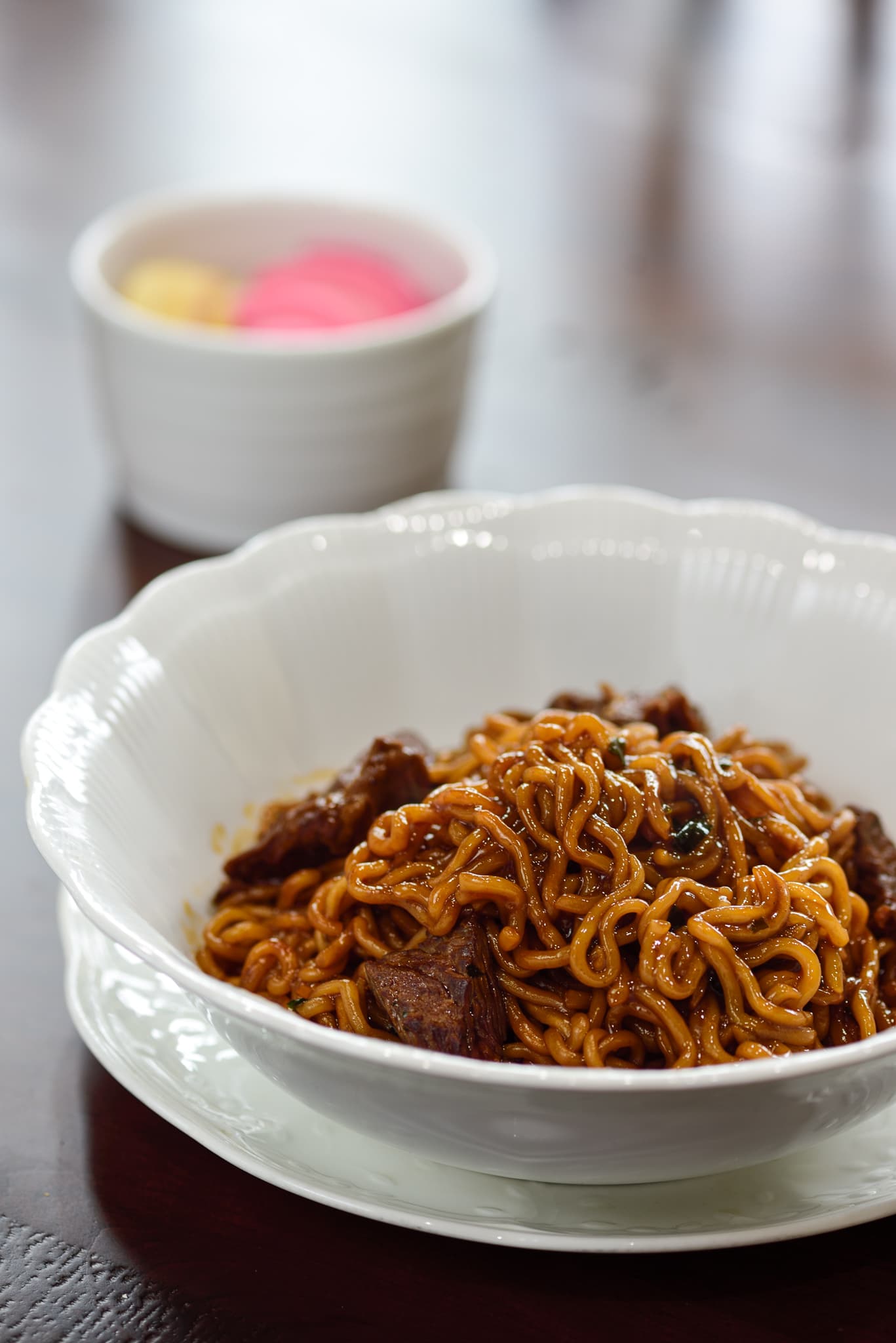
Troisième point de vue brûlant, et celui-ci concerne la mécanique de l'industrie. 짜파구리 (Chapaguri, parfois écrit Jjapaguri) n'est pas une invention de chef ni une invention de Parasite. C'est un plat créé par les consommateurs qui est apparu vers 2013 dans l'émission de variétés coréenne "Papa ! Où allons-nous ?" et était déjà une astuce courante lorsque Bong Joon-ho l'a mis dans Parasite (2019). Ce que Bong a fait, c'est lui donner un sous-texte de classe (des nouilles instantanées bon marché couronnées de bœuf Hanwoo de première qualité) et une plateforme mondiale. Lorsque Parasite a raflé les Oscars en février 2020 (Meilleur film, Meilleur réalisateur, Meilleur film international, Meilleur scénario original), l'intérêt de recherche pour 짜파구리 a augmenté de plus de 20 fois dans le monde et les ventes de Nongshim pour 짜파게티 (Chapagetti) et 너구리 (Neoguri) ont grimpé individuellement.
La réponse de l'industrie est là où ça devient intéressant. Nongshim n'avait pas de SKU Chapaguri en 2019, car le plat entier était le résultat de consommateurs combinant deux produits distincts. Quelques semaines après la victoire aux Oscars, Nongshim a mis en vente un produit Chapaguri en tasse unique pour le canal d'exportation. Le marché intérieur coréen l'a largement ignoré (les Coréens connaissaient déjà l'astuce), mais à l'étranger, le Chapaguri emballé est devenu une catégorie. Maintenant, allez dans un Costco aux États-Unis ou une épicerie asiatique à Londres et vous verrez la tasse de Chapaguri comme un véritable SKU. Tout ce mouvement de la chaîne d'approvisionnement s'est produit grâce à une traduction de sous-titres de film qui a transformé 짜파구리 en « ram-don ».
Le point d'attrait que Bong a réussi à capter est la texture. 짜파게티 vous donne la sauce aux haricots noirs sino-coréenne (savoureuse, douce, riche en umami), et 너구리 vous donne des nouilles udon épaisses et moelleuses aux fruits de mer épicées. Ensemble, ce sont des nouilles 쫀득 (jjondeuk, à la texture dense et moelleuse) qui transportent une sauce hybride aux haricots noirs et épicée qui ne ressemble à rien d'autre sur le marché. C'est cette histoire de texture qui a permis au Chapaguri de survivre au cycle de la mode post-Parasite. C'est vraiment un bon plat, pas seulement un produit dérivé de film.
진라면 : Le sous-estimé que tout le monde oublie
Si je devais nommer le ramyeon que je cuisine le plus souvent à la maison, ce serait le Ottogi 진라면 (Jin Ramen), version Douce spécifiquement. C'est le ramyeon que les professionnels de l'industrie coréenne considèrent discrètement comme le mieux conçu pour un usage quotidien, et pourtant il n'obtient jamais la presse anglophone que le 신라면 reçoit. Ottogi détient environ 25% du marché intérieur depuis des années, en hausse par rapport à environ 15% il y a une décennie, en gagnant des parts sur les SKU de milieu de gamme de Nongshim. Il a gagné cette part en surpassant les autres dans la catégorie des saveurs douces.
Le Jin Ramen Doux utilise un bouillon de bœuf légèrement plus clair (moins gras que le 신라면), une nouille plus large qui retient mieux la sauce, et un profil d'épices calibré pour la table familiale (les enfants le mangent, les parents âgés le mangent, les invités le mangent). Cette flexibilité explique pourquoi il se retrouve dans plus de garde-manger. La version Épicée existe et est bonne, mais le Jin Ramen a gagné en étant le ramyeon que l'on sert aux non-spécialistes du ramyeon. Si vous avez un ami coréen qui dit "여기에 진라면이 딱이지" (Le Jin Ramen est parfait ici) à propos d'un dîner pluvieux du mardi soir, ils savent de quoi ils parlent.
L'histoire de l'entreprise Ottogi est également importante. Ottogi est une entreprise familiale (la famille fondatrice Ham la dirige toujours), moins tape-à-l'œil que Nongshim, et a refusé de manière célèbre d'augmenter ses prix pendant le cycle d'inflation des années 2010, contrairement à Nongshim. Cela a valu à Ottogi une véritable fidélité de la clientèle et a aidé Jin Ramen à grimper dans les rayons. La beauté coréenne de Jin Ramen est qu'il n'a jamais cherché à être la superstar de l'exportation ou le mème. Il a simplement produit un meilleur ramyeon doux de manière constante et a laissé 신라면 faire le travail de marque.
Astuces de cuisine : Les règles du 계란, 김치, 치즈, 대파
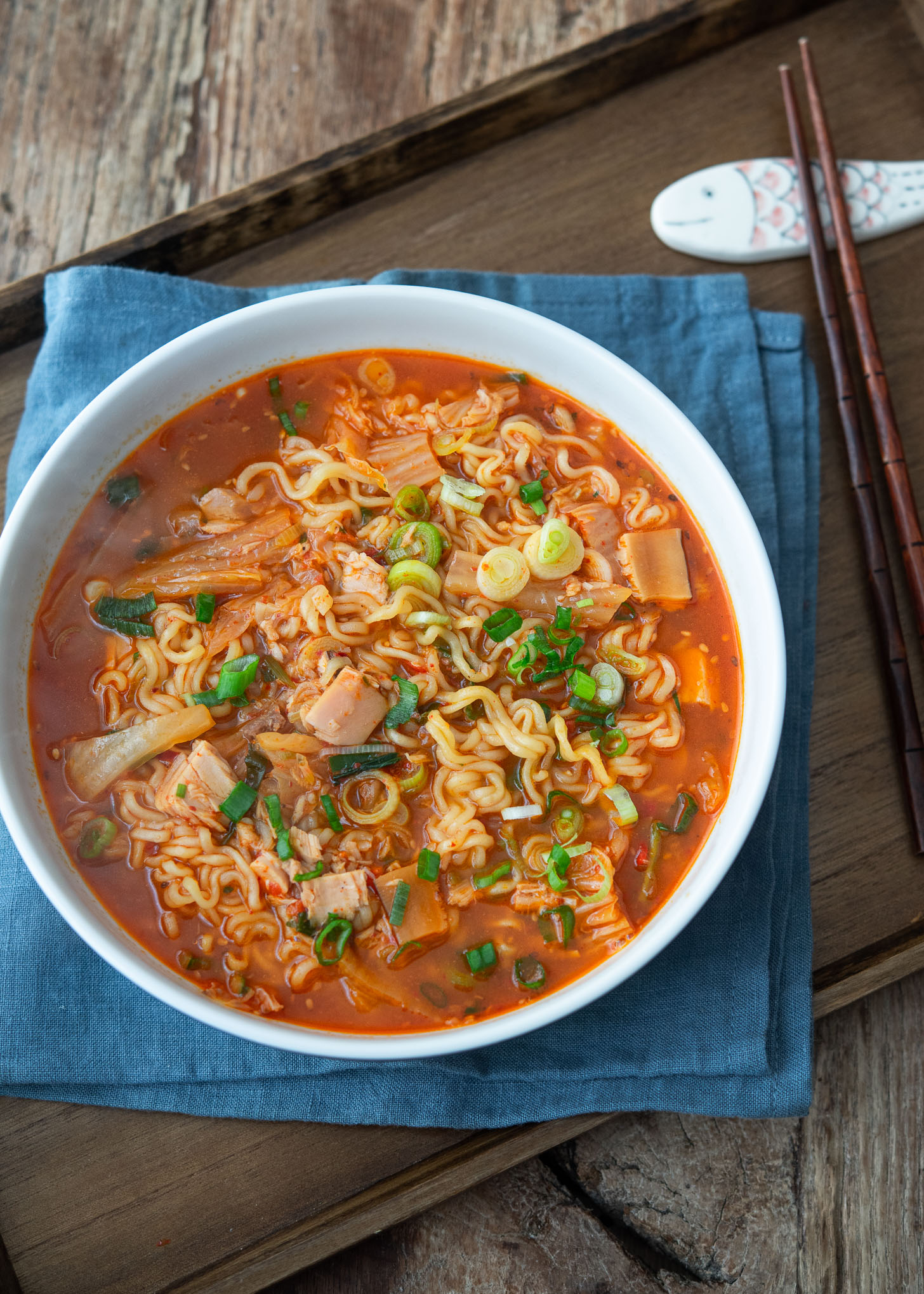
Maintenant, les connaissances pratiques. Un ramyeon instantané tel quel, c'est 3 sur 10. Avec quatre astuces maison coréennes (계란 œuf, 김치 kimchi, 치즈 fromage, 대파 oignon vert), vous atteignez 8 sur 10 en environ 90 secondes supplémentaires. C'est la routine que les Coréens apprennent de leurs mères et affinent dans les dortoirs universitaires, et chaque astuce a un timing spécifique.
Le timing du 계란 (œuf) est la variable la plus importante. Il y a deux écoles. L'école A casse l'œuf dans le bouillon bouillant pendant les 30 dernières secondes et ferme le couvercle pour pocher un blanc mollet avec un jaune coulant (vous cassez le jaune dans le bouillon en mangeant, ce qui enrichit la soupe). L'école B fouette l'œuf dans un bol d'abord et le verse en tourbillonnant dans le bouillon bouillant à la toute fin pour faire des rubans d'œuf (style 계란국). L'école A est la classique. L'école B est ce que vous faites lorsque vous voulez épaissir le bouillon. Ne cassez jamais l'œuf au début. C'est une erreur de débutant. L'œuf trop cuit devient une pastille caoutchouteuse.
Le 김치 (kimchi) doit être vieux et doit être ajouté dès la première minute. Le kimchi frais que vous venez de faire ne convient pas pour le ramyeon. Vous voulez du 묵은지 (mugeunji, kimchi fermenté vieilli d'au moins trois mois, idéalement six), haché, ajouté à l'eau avant les nouilles. La raison est l'acide de fermentation. Le kimchi vieilli apporte de l'acide lactique qui égaye le bouillon et atténue la lourdeur du MSG du sachet d'assaisonnement. Ajoutez aussi le jus de kimchi (2 cuillères à soupe est la norme). C'est la meilleure astuce, et c'est pourquoi la variante de ramyeon au 김치 est le ramyeon le plus cuisiné dans les cuisines coréennes.
Le 치즈 (fromage) doit être du fromage transformé en tranches, pas de la mozzarella râpée. Les Coréens utilisent la tranche jaune (pensez au Kraft American ou à la tranche de fromage Seoul Milk) posée sur le ramyeon terminé pour que la chaleur résiduelle la fasse fondre à moitié. Cela crée une couche crémeuse et fromagère à la surface qui épaissit chaque bouchée. Variante extra fondante : mettez le fromage pendant les 20 dernières secondes avec le couvercle. N'utilisez pas de mozzarella fraîche (trop aqueuse), n'utilisez pas de cheddar râpé (se décompose en huile). C'est de là que le Buldak 치즈 (cheese Buldak) tire son inspiration de la cuisine maison coréenne.
Le 대파 (oignon vert) est ajouté à la toute fin. Tranché en diagonale, d'un quart de pouce d'épaisseur, une généreuse poignée. Le 대파 est juste un peu cuit par la chaleur, libérant son piquant d'allium sur le bouillon. C'est la touche aromatique qui manque au ramyeon en sachet. Ne le sautez pas. Si vous voulez passer au niveau supérieur, faites du 대파기름 (huile d'oignon vert, dae-pa-gireum) en faisant frire des tranches de 대파 dans de l'huile de sésame pendant 30 secondes avant de les verser sur le ramyeon terminé. Ça, c'est le niveau restaurant.
La routine empilée est la suivante : 김치 vieilli dans l'eau froide, porter à ébullition, ajouter les nouilles ramyeon et le sachet, casser l'œuf pendant les 30 dernières secondes, une tranche de fromage sur le dessus lorsque le feu est éteint, et finir avec le 대파. Temps total en dessous de 5 minutes. Cela transforme un paquet à 900 wons en quelque chose qui vaut la peine d'être servi aux invités. Si vous voulez voir la variante tteok (gâteau de riz), Maangchi la réalise parfaitement.

La vérité de l'industrie : la consolidation est stable, et c'est une histoire
Ce que la couverture occidentale de la K-food ne saisit pas, c'est à quel point l'industrie coréenne du ramyeon est ennuyeuse au sommet. Les 3 grands, Nongshim (60%), Ottogi (25%), Samyang (10%), ont maintenu ces parts pendant plus d'une décennie. Paldo, le petit frère de Samyang, et quelques indépendants (Nongshim Kellogg, Hetbahn) se battent pour les 5% restants. Il n'y a pratiquement pas de nouvel entrant significatif. Cette stabilité est l'histoire.
Le ramyeon en Corée est une catégorie mature avec de solides barrières à l'entrée : une valeur de marque construite sur 40 ans, une distribution ancrée dans chaque 편의점 (supérette) et 대형마트 (hypermarché), une R&D qui produit une nouille à 5 000 Scoville reproductible année après année. Un nouvel acteur ne peut pas percer sur le marché intérieur. Ce qu'ils peuvent faire (et ce que Samyang a fait avec Buldak) est de conquérir une nouvelle catégorie mondiale avec un nouveau profil de saveur. C'est pourquoi l'action de l'industrie se situe désormais du côté de l'exportation. La construction de la deuxième usine américaine de Nongshim en 2025 n'est pas une mesure de marketing. C'est une réponse de la chaîne d'approvisionnement au fait que 40 % des ventes de Shin Ramyun proviennent de l'étranger.
Le boom des exportations post-2020 mérite d'être chiffré. Les exportations totales de ramyeon coréen ont dépassé 1,24 milliard de dollars en 2024, soit une augmentation de 30 % d'une année sur l'autre. Samyang a réalisé à lui seul environ 60 % de ce montant (oui, une seule marque). Nongshim a réalisé un quart supplémentaire. Le Japon, les États-Unis et la Chine sont les trois principales destinations, mais la croissance en Europe (Nongshim vient d'ouvrir une filiale russe) et en Asie du Sud-Est (Shin Ramyun Toomba, la variante au piment et citron vert thaïlandais, a atteint 100 millions de ventes en un an) est ce qui stimule les chiffres de 2025 à 2026. Le ramyeon coréen n'est plus une nouveauté. C'est un aliment de base mondial qui concurrence de front les nouilles instantanées du Japon et de l'Asie du Sud-Est, et qui gagne de plus en plus.
Le verdict, en quelque sorte
Ferais-je un classement de ces produits ? Grossièrement. Pour la cuisine quotidienne avec l'astuce 김치 : Ottogi 진라면 Doux. Pour la saveur coréenne classique que tout le monde connaît : 신라면 (respectez la standardisation). Pour une expérience texturale qu'aucun autre produit n'offre : 짜파구리 (faites la version steak une fois). Pour un défi et un moment de rire entre amis : 불닭볶음면, mais prenez la variante Carbo pour pouvoir réellement goûter la formulation sous-jacente. Et si vous cuisinez pour quelqu'un qui découvre le ramyeon coréen, commencez-le avec du 신라면, un œuf poché mollet et du 김치 vieilli. C'est la porte d'entrée. Tout le reste suivra.
Le point plus important est que le ramyeon est une véritable histoire de la culture de consommation coréenne, pas une simple collation nouveauté. Le fait de le voir passer d'un aliment de base domestique en 1986 à une catégorie mondiale de 10 milliards de dollars, en grande partie grâce à la discipline de Nongshim, au pari viral de Samyang et à un moment du film de Bong Joon-ho, est l'une des histoires d'exportation les plus claires de l'industrie coréenne des deux dernières décennies. Si vous n'avez pas vraiment interagi avec les trois principales marques (신라면, 진라면, 불닭) plus le combo 짜파구리 plus les astuces de cuisine maison, vous n'avez pas vraiment interagi avec le ramyeon coréen. C'est mon opinion tranchée.
Explorez les collations et ramens coréens avec Daebak
Envie de goûter vous-même 신라면, 진라면, 불닭 et le combo 짜파구리 ? Recevez d'authentiques collations et ramens coréens directement chez vous avec la Boîte SnackFever de Daebak.


