


Table of Contents
Here is a small confession from someone who has watched Korean food culture globalize for over a decade: my mother has never once told me "I love you" out loud. What she has done, roughly 8,000 times, is set a bubbling stone pot of 김치찌개 (kimchi jjigae) in the center of the table when I came home from the airport. That is the whole sentence. 찌개 (jjigae), the family of thick Korean stews served bubbling in earthenware, is how Korean love actually gets spoken. Boyfriends prove they are keepers by learning to make 부대찌개 for hungover Sunday afternoons. Wives develop a signature 순두부찌개 that husbands quietly compare to their mothers'. Post-illness recovery arrives as a bowl of 된장찌개 pushed toward you across a low table. This is the appeal point most Western food writers miss when they cover Korean cuisine as "spicy fermented flavors." The mechanic is quieter than that. 찌개 is a delivery system for 정 (jeong), that untranslatable Korean word for the accumulated affection built through years of unspoken care.

Why 찌개 does the work Western families give to hugs
The industry side of this is worth naming, because it explains why Korean supermarket shelves look the way they do. Home-meal-replacement (HMR) 찌개 in retort pouches has grown into a market cleared for well over 400 billion won annually across brands like Ottogi, CJ Bibigo, and Pulmuone, per Korea Times market reporting. The 40 billion won retort soup market Ottogi dominated a decade ago has fragmented into dozens of 찌개-specific SKUs. That growth is not because Koreans forgot how to cook. It is because the emotional labor of producing a proper 찌개 (three-hour anchovy stock, well-aged kimchi, a rice pot timed to arrive at the table hot) collides with 60-hour work weeks in Seoul. The retort pouch is Korean industry admitting that even when Koreans cannot make the love-language stew themselves, they still need to eat it.
1. 김치찌개 (kimchi jjigae): the mother stew
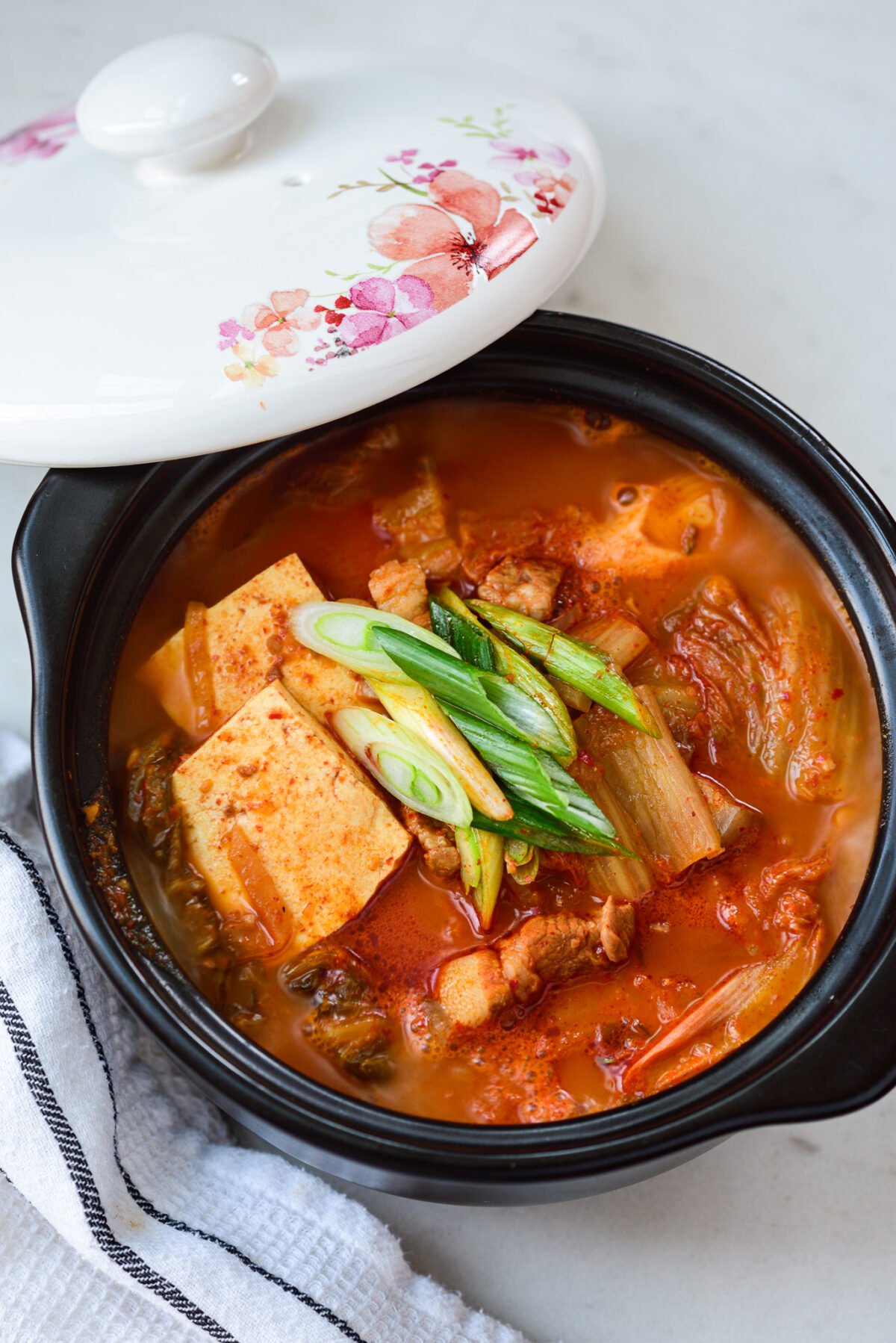
If Korean stews were a family, 김치찌개 would be the eldest daughter who runs everything. Every Korean has a specific mental image of it, and it is almost always their mother's version. The non-negotiable is the kimchi. Fresh kimchi makes flat 김치찌개. You want kimchi that has fermented for weeks, past the sour threshold where Western palates get suspicious, because that acidity is what balances the pork fat and gochugaru. Maangchi's classic recipe (published 2007, revised for anchovy stock in 2015) is the most trusted English-language version for a reason: she treats the aged kimchi as the star, not the seasoning. The rest is pork belly or shoulder, a block of soft tofu laid on top late in the simmer, green onion, and the pot goes to the table still bubbling on a portable burner. The signal is: sit, eat, do not talk about your day if you do not want to. The stew is the conversation.
2. 된장찌개 (doenjang jjigae): the Korean chicken soup equivalent
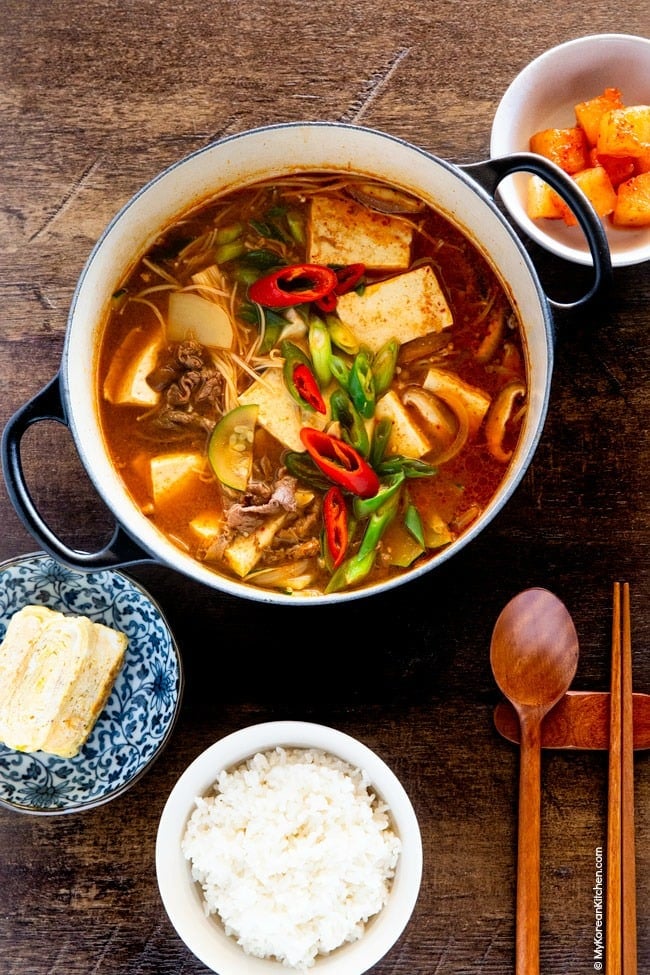
된장찌개 is what Koreans reach for when someone is sick, sad, or has been away too long. It is Korea's chicken soup for the soul, structurally: fermented soybean paste (된장) dissolved into rice water or anchovy stock, with zucchini, potato, onion, tofu, and often a handful of clams or thin-sliced beef brisket. My Korean Kitchen's Sue writes that Korean home cooks pass down 된장찌개 recipes with the same slight competitiveness that Italian nonnas guard tomato sauce, and I have watched exactly this play out at a mother-in-law's first-meal-for-the-son's-girlfriend dinner. The wife's specialty 된장찌개 is a marital status symbol. A good one has that specific mushroom-earth funk from properly aged 된장 (some Korean brands ferment two to three years), balanced with just enough gochugaru to lift it. It arrives quietly and quietly does the healing work.
3. 순두부찌개 (sundubu jjigae): the breakfast that fixes everything
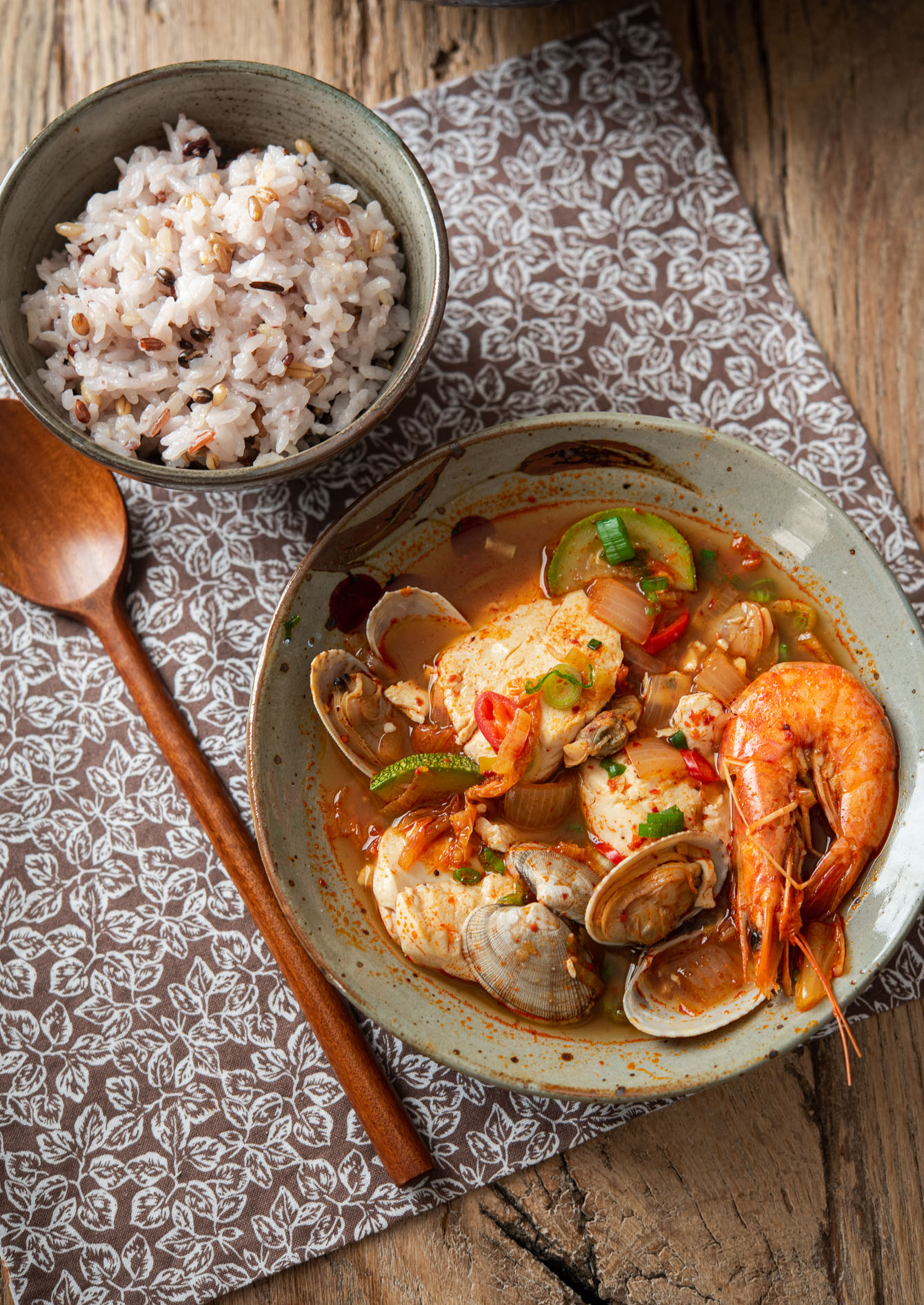
순두부 (soondubu, silken tofu) 찌개 is the one that shows up on Korean breakfast tables and hangover mornings. Beyond Kimchee's Hyegyoung Ford (Holly) makes the case that this is a distinct category from 김치찌개, not a variant: here the silken tofu is the star, the broth is gochugaru-and-anchovy driven, and clams or shrimp are traditional add-ins because their briny water deepens the stock in exactly the right way. The signature move is cracking a raw egg on top at the table so the residual bubbling heat sets the white while keeping the yolk molten. This is the 찌개 that Korean wives make on Sunday mornings when the household is fragile. It signals: I know last night was rough, sit down.
4. 부대찌개 (budae jjigae): army stew, boyfriend cooking
Nothing in the 찌개 canon is more Korean than 부대찌개, and nothing is more American either. Invented in the ruined years after the 1950 to 1953 Korean War near the US Army base in Uijeongbu, this is the stew Korean cooks built out of surplus Spam, canned baked beans, hot dogs, and instant ramyeon salvaged from the base, then folded into aged kimchi, gochujang paste, and anchovy stock. Maangchi's recipe (2014) is the definitive English-language version, and she is blunt that the anchovy-kelp stock is what separates good 부대찌개 from a Spam soup. In Korean dating culture, 부대찌개 is boyfriend food. Making it at home involves buying and arranging six to eight components (sausage, Spam, tofu, cheese slice, rice cake, ramyeon, kimchi) in the pot before cooking, and the arranging itself is the performative gesture. If your partner learned to make this for you, they are serious.
5. 감자탕 / 감자찌개 (gamjatang): the Gangwon workhorse
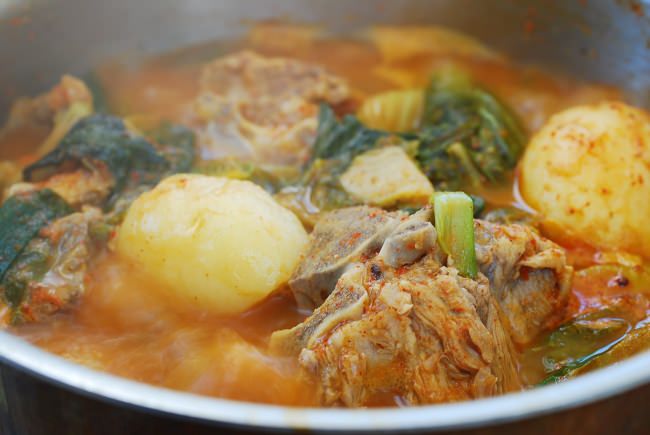
감자탕 is the pork-spine stew that most Koreans think is named after potatoes (감자 means potato) but actually takes its name from the specific vertebra cut called gamja-ppyeo. Korean Bapsang's Hyosun points out that most Koreans do not know this. It is a Gangwon-province specialty in origin, and it is the 찌개 you order at 4 a.m. with friends after a soju session. Pork neck bones simmered for over an hour into a milky broth, then perilla leaves, crushed perilla seeds, cabbage, whole potato chunks, and enough gochugaru to make you sweat honestly. This is not romantic love language. This is friendship love language, the stew that says: we survived the workweek, sit here for two more hours.
The K-drama tell: 찌개 as marriage barometer
Korean screenwriters know how loaded 찌개 is, which is why it keeps appearing at pivot moments. In Reply 1988 (응답하라 1988), the 김치찌개 shared between neighbor families is the shorthand for the alley's makeshift kinship. In The World of the Married (부부의 세계), the way Dr. Ji Sun-woo makes and stops making 찌개 for her husband tracks the collapse of their marriage across sixteen episodes. Korean audiences read these scenes as clearly as Western viewers read wedding-ring shots. The wife who stops making the husband's 찌개 has already left the marriage in her head. The husband who quietly starts learning to make 된장찌개 himself is asking whether he can win her back. This is why 찌개 works on screen: it is an emotional gauge that requires no dialogue.
The industry admission: retort-pouch 찌개 as love at scale
Back to the 400 billion won retort-pouch market. Bibigo (CJ CheilJedang), Ottogi, and Pulmuone are not selling convenience. They are selling emotional shorthand. The packaging cues (earthenware pot photography, hand-written brush-stroke fonts, phrases like 엄마의 손맛 or mother's hand-taste) are engineered to trigger the memory of the mother's 김치찌개 or the wife's 된장찌개. CJ's Bibigo brand pushed 500 million+ campaign views in the US and Japan through 2025, per Korea Herald reporting, riding exactly this positioning: the retort pouch is not a compromise, it is a portable love language. My honest read after a decade in K-content marketing: this positioning works globally because it does not translate. Non-Korean buyers still respond to the pot shot and the brush-stroke Korean text without knowing what 정 means. The feeling comes through the packaging.
So the next time someone slides a bubbling pot of 김치찌개 across the table toward you, or a Korean partner learns to make 부대찌개 for a hangover, or your mother-in-law hands you the recipe for her 된장찌개, understand what is happening. 찌개 is not lunch. It is Korean for I love you.
Bring Korean Comfort Home with Daebak
Craving Korean flavors between stew nights? The SnackFever Box delivers hand-picked Korean snacks, ramen, and treats straight to your door every month, so you can keep that home-cooked comfort within arm's reach.


