


Table of Contents
Here is the honest read after a decade in the Hallyu content space watching what Korean grandmothers actually reach for the second someone starts sniffling: it is almost never the 감기약 (over-the-counter cold pills) as the first line of defense. It is the kitchen. Korean home cold-and-flu remedies (한방 감기 치료법) run on a coherent playbook rooted in 한의학 (Korean traditional medicine), and that playbook has become a legitimate global export category. Ottogi plus Chungjungwon 유자차 (citron tea) syrup crossed the ₩100 billion category mark by 2024, Korean pear juice exports blew past $30 million the same year, and 삼계탕 (ginseng chicken soup) is on the Michelin Green Guide radar as a wellness dish. This is a field guide to the five specific remedies Korean households actually deploy, and why the underlying logic (warm plus cool, sweet plus sharp, food-as-medicine) makes them travel.

Why Korean home remedies survived the pharmacy era
Every K-drama has that scene: a character coughs once and someone appears with a mug of steaming yellow-orange tea. That is not a set decoration choice. It is documentary. 한의학 (Korean traditional medicine) has been the household default for centuries, and modern Korean pharmacies did not replace it, they layered on top. A Korean apartment kitchen in 2026 typically stocks both a blister pack of Panpyrin (감기약) and a jar of 유자청 (yuja marmalade), and the reasoning is philosophical: 감기약 handles the symptom, the kitchen handles the terrain the sickness lives in.
The industry mechanic behind why this stuck: Korean CPG brands productized what grandmas were making by hand. Ottogi and Chungjungwon quietly built the pre-jarred 유자청 category into a ₩100 billion-plus retail segment because they read the room. Koreans wanted the tea, they did not want to slice yuja by hand for two hours. Same logic applies to Kwangdong's 배도라지즙 (pear-bellflower juice) pouches now stocked at Costco Korea, and to the pre-portioned 삼계탕 retort packs Ottogi and CJ ship into Asian grocers globally. The remedy playbook did not shrink under modernization. It scaled.
1. 유자차 (Yuja Tea): The vitamin C bomb your grandma trusts more than a lozenge
유자차 is the first thing you drink when your throat starts to hurt. Yuja is a knobbly yellow citron, close cousin to Japanese yuzu, with roughly three times the vitamin C of a lemon and a fragrance that is somewhere between mandarin, grapefruit, and bergamot. The tea is not brewed. It is a marmalade dissolved in hot water: 유자청 (yuja rind and pulp cured in sugar or honey at a 1:1 ratio for weeks) spooned into a mug, hot water poured on top, and the pulp eaten with a spoon at the end. The sugar coats a raw throat, the citric acid cuts mucus, and the vitamin C dose per serving hits harder than most drugstore Airborne packets.

Industry read on why 유자차 became a global export: the fruit is impossible to ship fresh outside Korea (short season, fragile skin), so brands like Ottogi and Chungjungwon locked in the syrup format. That is why every H Mart in the US now stocks the jars, and why Trader Joe's ran a yuzu marmalade drop in 2023 that sold out. The tea is also the entry drug for Korean 청 (fruit-and-sugar curing) as a category. Once you understand 유자청, 매실청 (green plum), 도라지청 (bellflower), and 생강청 (ginger) all click into the same mental slot. What makes 유자차 specifically Korean is the ratio: Western citrus teas lean on hot infusion of dried rinds, Korean 청 uses raw fruit fermented with sugar, which preserves the vitamin C and gives you a spoonable pulp that feels like eating the medicine, not just drinking it.
2. 생강차 (Saenggang-cha, Ginger Tea): The warming engine for coughs and chills
생강차 is what you brew when the cold has moved into your chest. The Korean version is not a supermarket tea bag. It is peeled fresh ginger (80g) simmered with cinnamon sticks (20g) in 8 cups of water for 25 to 30 minutes, then strained, and served hot with a teaspoon of honey and a few pine nuts floating on top. 한의학 classifies ginger as a 열 (warming) ingredient, which in the yin-yang food framework means it opens circulation, expels cold air trapped in the lungs, and pushes sweat, all of which correlate to what modern medicine calls an expectorant plus mild vasodilator.
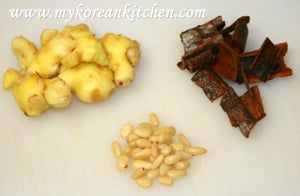
The appeal reason people who try this once end up making it weekly all winter: the cinnamon is what turns 생강차 from a functional medicine drink into something you actually crave. Chinese and Southeast Asian ginger teas skip the cinnamon and land as sharp, medicinal, single-note. The Korean version's cinnamon-plus-ginger axis was calibrated centuries ago at the royal court and has stayed the standard. My honest take from the industry side: this is why 생강차 concentrate pouches by brands like Damteo and Nokchawon now outsell most black tea SKUs at Korean cafes. It hits the same "warm, spiced, not too sweet" pocket as a chai latte but without the dairy load, which is why it is quietly gaining shelf space at US wellness cafes.
3. 배숙 and 배즙 (Korean Pear Cough Syrup): The kid's cough medicine of choice
If a Korean kid has a lingering dry cough, they are not getting Robitussin. They are getting 배숙 (steamed pear) or a squeeze pouch of 배즙 (Korean pear juice). The recipe your 할머니 makes: hollow out a whole Korean pear, stuff it with sliced ginger, black peppercorns, honey, and a dried jujube, then steam it for an hour. The pear collapses into a soft honey-ginger cough syrup you eat with a spoon. Korean pears (배) are 90 percent water with high natural sorbitol content, which is why they hydrate and soothe airway tissue in a way apples or Western pears do not.
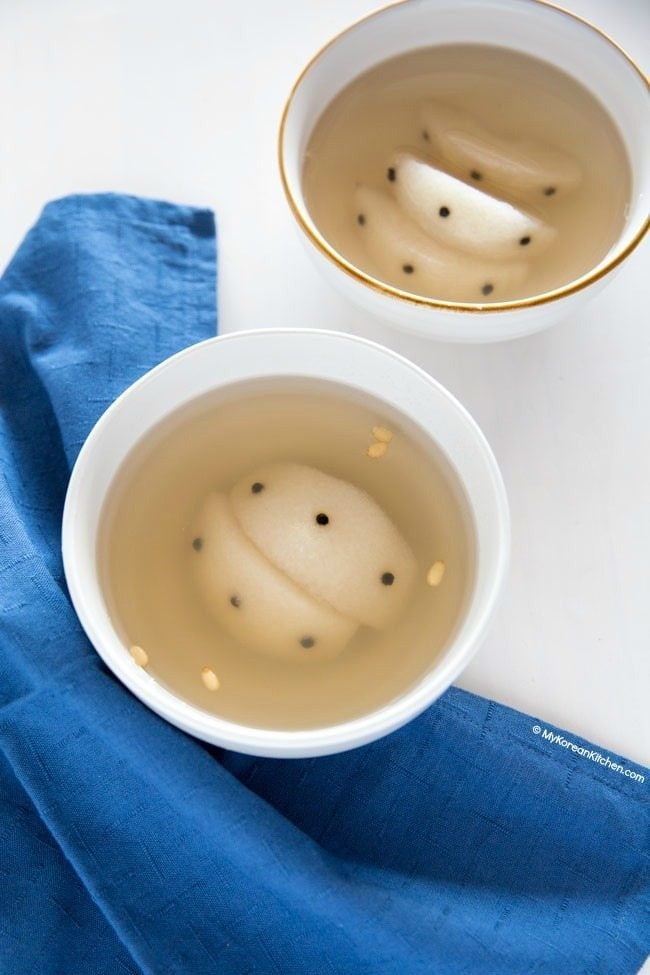
Industry insight that most Western wellness press misses: 배즙 is not a niche product in Korea. It is a full category. Kwangdong, Chunho Nature, and Ottogi all sell shelf-stable 배즙 pouches (한 팩 = 100ml squeeze packs) that Korean parents ship to college kids as care packages. The 2024 pear juice export number of $30M-plus is driven by Costco stocking the multipacks in the US and Europe. What makes this specifically Korean rather than a generic fruit juice: the pear variety. 신고배 (Shingo pear) and 원황배 (Wonhwang pear) are the big, crisp, high-sorbitol cultivars Korean farms selected for over 40 years for exactly this cough-suppressant use case. Western Bartlett or Anjou pears do not have the water content or the smooth cell texture to produce the same soothing effect.
4. 삼계탕 (Samgyetang, Ginseng Chicken Soup): The 이열치열 fever cure
삼계탕 is the flagship of Korean 보양식 (restorative food). A whole young chicken stuffed with glutinous rice, ginseng, jujube, garlic, and simmered for an hour in a clear herbal broth. Koreans eat it in mid-summer during 복날 (dog days) specifically because of 이열치열 (fight heat with heat): the theory that if you sweat your body out with hot food, your core temperature stabilizes and you flush the fever. Applied to cold and flu, the mechanic is identical. When you are running a low-grade fever and feel cold from the inside, 삼계탕 lifts you back to baseline in one meal.
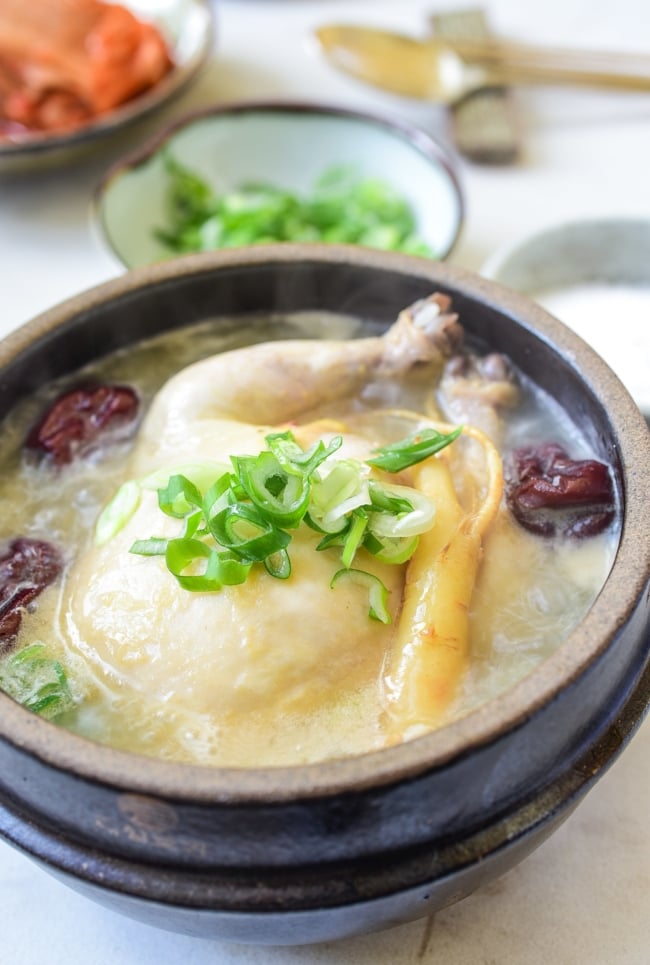
The industry angle: 삼계탕 has quietly become a global category through the retort pouch. Ottogi and CJ CheilJedang both ship shelf-stable 삼계탕 packs to Asian grocers worldwide, and the 2024 category revenue landed north of ₩200 billion in Korean retail alone. Michelin Green Guide added samgyetang to its Korean wellness dishes list in 2022. What makes it specifically Korean rather than generic chicken soup: the ginseng and the stuffed-in-cavity rice format. The ginseng root (인삼) contributes ginsenosides that pharmacology studies out of Seoul National University have linked to genuine immunomodulatory effects, not just a "warming" folk claim. The glutinous rice inside the cavity absorbs the herb-and-chicken broth and becomes a savory porridge that is the actual comfort payload, because when you are sick, you want carbs cushioned in fat and salt, not just soup.
5. 콩나물국 (Kongnamul-guk, Bean Sprout Soup): The hangover-and-cold cure with real chemistry behind it
콩나물국 is the soup Korean households cook when someone is either hungover or coming down with a light cold. Kongnamul (soybean sprouts) simmered in an anchovy broth with garlic and scallion, ready in 15 minutes, minimal effort. The reason it works on both hangovers and colds is not folklore. 콩나물 is unusually high in 아스파라긴산 (asparagine), an amino acid that helps the liver process acetaldehyde (the compound that causes hangover symptoms), and Seoul National University's Food Science department has published on the mechanism. For a cold, the light broth hydrates, the sprouts deliver vitamin C plus folate, and the whole thing is easy on a nauseous stomach.
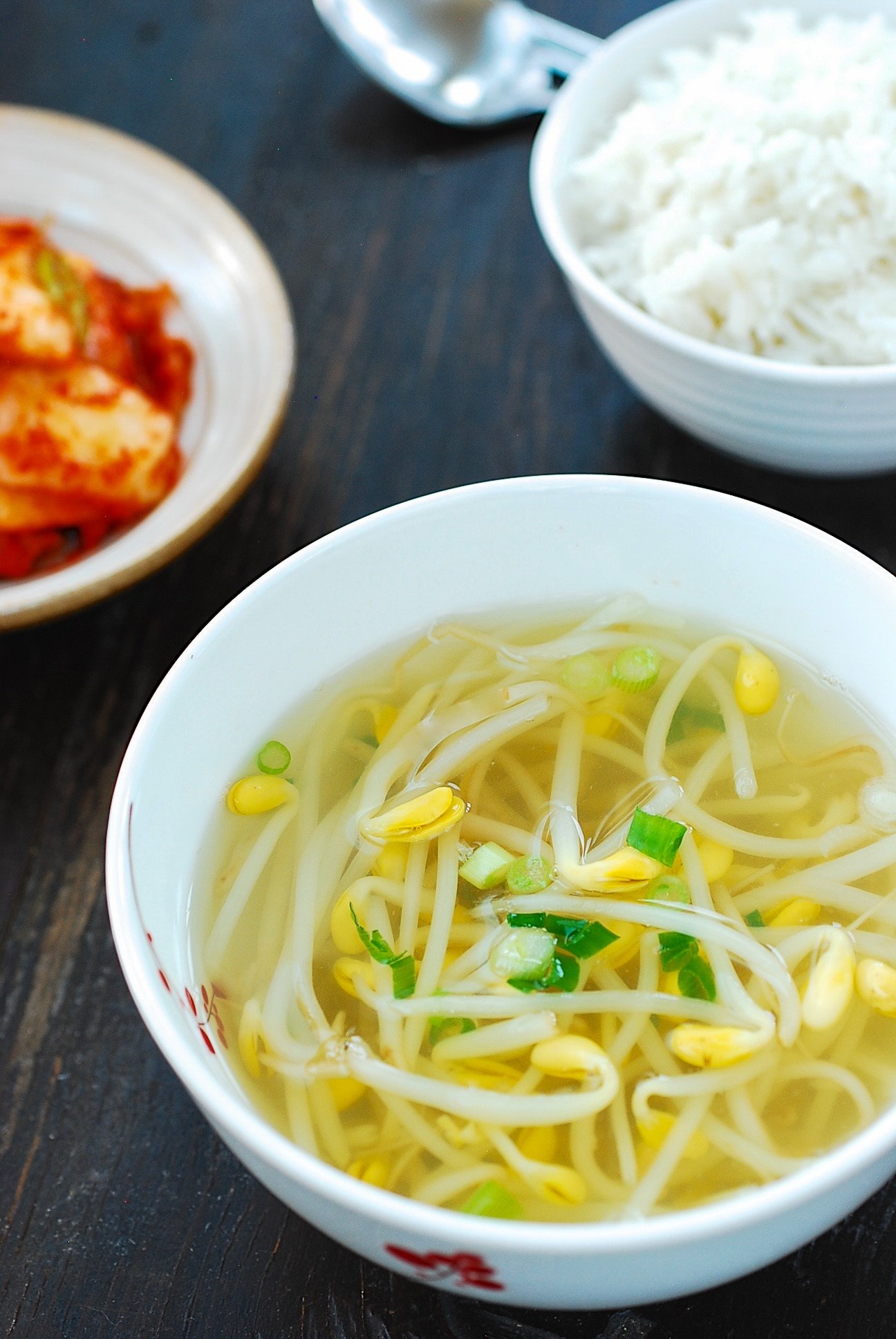
The appeal point globally: this is the easiest Korean remedy for a Western kitchen to actually replicate. Bean sprouts are at any Asian grocer or increasingly at Whole Foods, anchovy stock cubes ship from any Korean market, and the whole dish scales to zero cooking skill. My honest read from the food-media side: this is why 콩나물국 has quietly overtaken 갈비탕 as the "first Korean soup a non-Korean cook actually attempts at home" in the US according to Recipe search data on NYT Cooking and Serious Eats. It works because the pairing rulebook is simple: warm plus mineral-rich, light plus umami. Same three axes that make Korean snacks and remedies both scale globally.
The 한의학 rulebook: warm plus cool, sweet plus sharp, food-as-medicine
Strip out the specific dishes and every remedy above runs the same three axes. Warm plus cool covers 유자차 (cool sour fruit balanced with hot water and sweetness) and 배숙 (cool pear balanced with warming ginger and peppercorns). Sweet plus sharp is the 유자청 sugar cutting the citric acid, and the honey cutting the ginger heat in 생강차. Food-as-medicine is the whole architecture: 삼계탕 delivers ginseng at a therapeutic dose inside a comfort-meal envelope, 콩나물국 delivers 아스파라긴산 inside a five-ingredient light soup. Korean home cold remedies are not folk chaos. They run on the 음양 (yin-yang) balancing framework 한의학 has taught for 500 years, and that framework happens to correlate cleanly with modern nutrition science.
My take after a decade in Hallyu: the reason these remedies are exportable rather than exotic is that the framework is teachable. You can hand someone in Berlin a jar of 유자청 and one instruction (spoon into hot water, eat the pulp) and they end up doing what a Korean grandmother has done for three generations. Every remedy in this article is basically a portable lesson in why Korean food-as-medicine works. And why 감기약 will always be the backup plan in a Korean household, not the first move.
Explore More of Korea with Daebak
Want to bring a little piece of Korea into your life? The Daebak Box is packed with the best Korean snacks, wellness picks, and cultural goodies delivered monthly to your door.


