


Table of Contents
Jeju Island (제주) has always been Korea's escape valve. Locals fly down for a long weekend, honeymooners rent villas along the coast, and Chinese tourists once packed Jungmun's luxury complex three-deep in the pre-2017 THAAD era. What changed after COVID is how the island sells itself. Sightseeing itineraries lost ground to something Korea calls 웰니스 (wellness), and Jeju's volcanic geology, which used to be a geological curiosity, is now a headline product. I've watched Korea's hospitality industry for over a decade, and the shift from "island with hotels" to "island as a spa product" is the most calculated repositioning in Korean domestic travel this decade. Average daily rates at Jungmun's top-tier properties held premium pricing through 2024, largely because spa packaging did the heavy lifting.
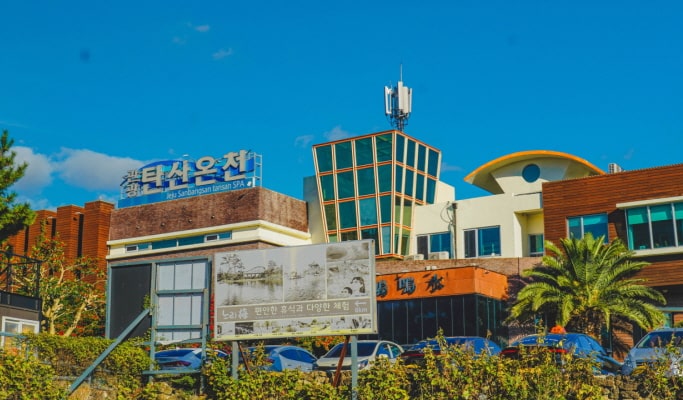
Sanbangsan Carbonate Hot Springs: The Volcanic Anchor
The pitch that closes deals with Korean spa tourists is a simple one. More than 95 percent of Korea's hot springs are ordinary thermal water. Sanbangsan Tansan Oncheon (산방산 탄산온천) at the foot of the Sanbangsan volcanic cone is not. Its water carries naturally dissolved carbon dioxide, the same fine bubbles that stimulate capillaries and, according to Korean domestic marketing, help with circulation and cardiac load. That claim gets repeated on every Korean travel blog for a reason. It is the one line that separates a Jeju soak from a jjimjilbang trip anywhere else on the peninsula.
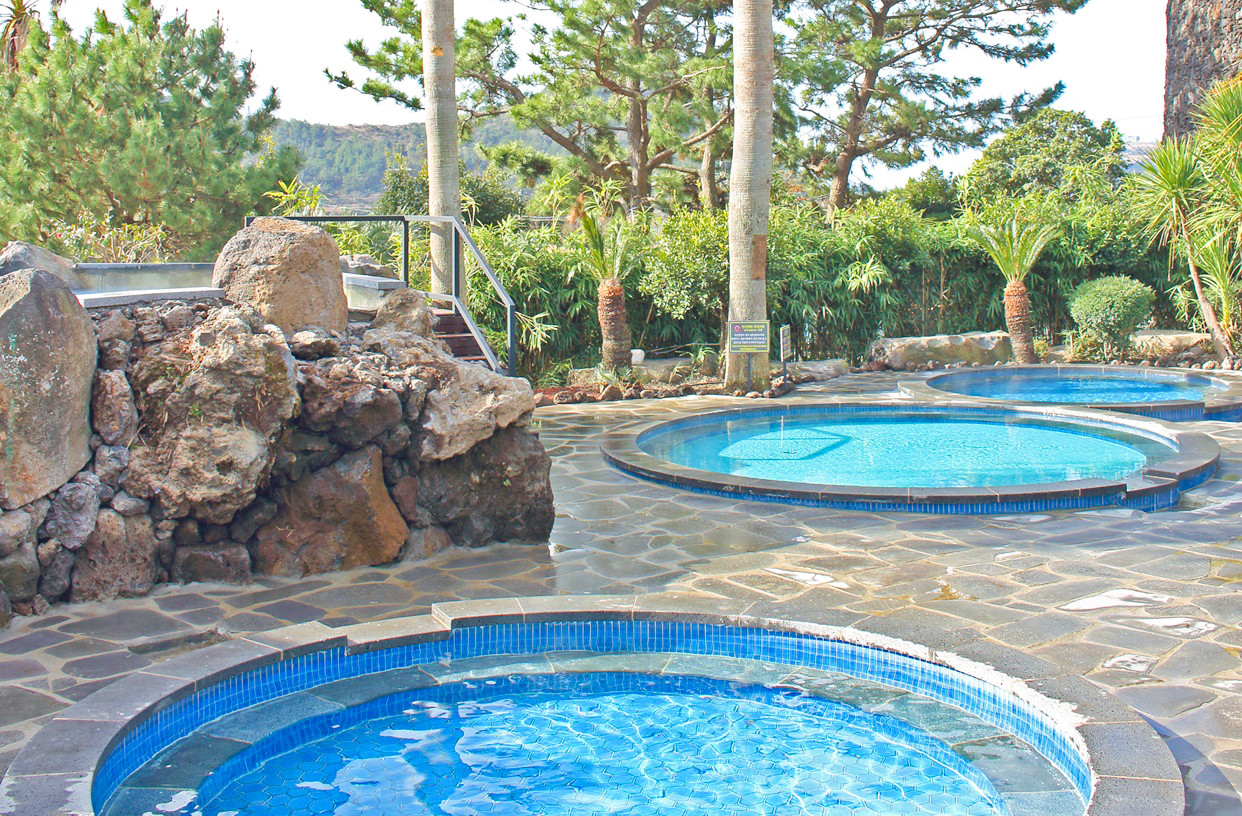
The real appeal is the combination, not just the chemistry. The outdoor baths sit under glass walls with Sanbangsan rising directly in front, a smaller volcanic cone off to the side, and Hallasan on clear days in the distance. Add a jjimjilbang (Korean-style sauna) block and indoor gender-separated nude bathing following traditional 찜질방 customs, and you get a facility that pulls both the domestic wellness crowd and international first-timers who want the "real Korean spa" box checked. The pricing signals it too: entry runs cheaper than a Seoul Dragon Hill day pass, but the outdoor pool and jjimjilbang each carry small add-on fees, which is the classic Korean regional-spa monetization model.
The Shilla Jeju and Jungmun's Luxury Cluster
Jungmun Tourist Complex (중문관광단지) is the story of how Korea decided to build a luxury spa neighborhood on purpose. The Shilla Jeju opened here in 1990, back when Samsung-affiliated Shilla was the only Korean hotel brand with the polish to sit next to Peninsula and Mandarin Oriental in Asia-Pacific rankings. That classic European-styled property parked itself on the southern coast facing the Pacific and made spa treatments part of the room-package economics, not an amenity buried on the sixth floor. When Chinese group travel peaked around 2015 to 2016, Jungmun was where the tour buses stopped for the spa half-day, and Shilla's brand equity carried the pricing.
The Shilla's Guerlain Spa is the sort of product you understand only when you know the industry logic behind it. Korean domestic guests do not require a Guerlain co-brand to book a Shilla suite. Chinese and Southeast Asian outbound guests, however, respond strongly to European luxury signaling because it de-risks the "is this really luxury?" question in an unfamiliar market. Shilla figured this out before most Korean chains, which is why the Jungmun property still commands premium ADR even as newer competitors moved in.

Grand Hyatt Jeju and Rosebay Spa: The Contrarian Bet
Grand Hyatt Jeju opened inside Jeju Dream Tower in December 2020, mid-pandemic, and it looked like a disaster on paper. Chinese tourists were locked out. Domestic travel was throttled. The 38-storey twin-tower had 1,600 rooms to fill. Then something the wellness industry has learned to love happened: revenge travel and 호캉스 (hocance, hotel-plus-vacation staycation culture) turned the property into a domestic wellness magnet by late 2021.
The spa architecture at Dream Tower shows the calculation. Rosebay Spa on the lower floors is the European-luxury product, eight treatment rooms including two VIP couple suites, and the signature Rosebay Journey and Instant Glow menus aimed at the Instagram-era guest who wants a photographable facial. Then, on Level 6, sits the Korean Jjimjil Spa: red clay, cypress, ice and salt therapy rooms, the traditional Korean body scrub (때밀이) still on the menu. That dual-track approach is unusual for a Hyatt-branded hotel and reads as a deliberate hedge. Chinese and international guests can book Rosebay. Korean domestic guests can head straight to L6 and use the property the way they would a proper 찜질방. Both crowds pay premium rates without one segment feeling shortchanged.
.jpg)
Yongduam Haesu Spa Land: The Ocean-Water Alternative
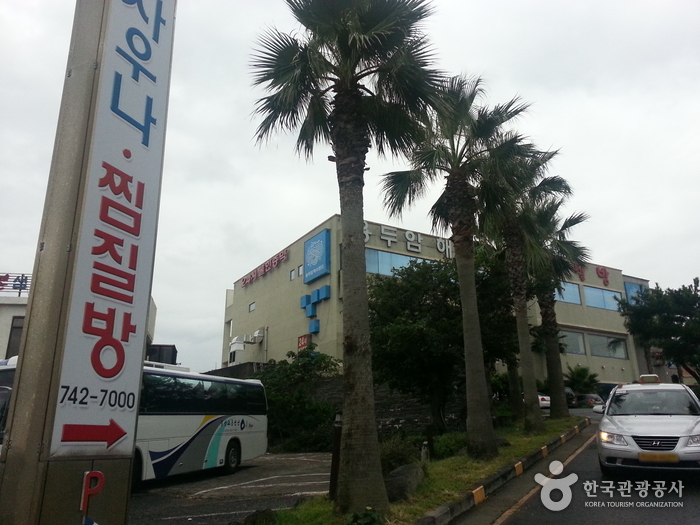
Not every Jeju wellness stop needs to cost 300,000 won a night. Yongduam Haesu Spa Land (용두암해수랜드) is the counter-programming, a large public spa near Jeju International Airport that runs on seawater. Adult entry to the public bath runs around 9,000 won, the sauna a bit more, and the facility layers a traditional hot sauna, a clay jjimjilbang, dry and wet saunas, and separate freshwater and seawater baths under one roof. This is the classic Korean 찜질방 economics: cheap enough to be a repeat visit, structured enough to fill a whole afternoon.
What tips it into "must-do" territory rather than "generic day spa" is the ocean view and the bulgama gyeran (불가마 계란, sauna-baked eggs) with sikhye (식혜, sweet rice punch) that regulars consider non-negotiable. Korean audiences understand that the eggs and 식혜 are half the fun. International visitors sometimes miss this and treat it as filler food. Skipping them means missing the actual cultural rhythm of a Korean 찜질방 day.
Why Jeju Is Korea's Wellness Export
The bigger picture is that Jeju is no longer just a domestic honeymoon spot. Korea's Ministry of Culture, Sports and Tourism enacted the Healing Tourism Industry Act in 2026 and selected 20 flagship wellness sites for a global marketing push, backed by up to 50 million won per venue and multilingual digital infrastructure. WE Hotel Jeju's clinically-backed hydrotherapy program made that list, sitting alongside Busan hot-spring complexes and Awon Hanok in Wanju. The framing matters: Korea is treating K-Wellness the way it treated K-Beauty in the early 2010s, as an export category with regulatory scaffolding.
Asia's wellness tourism market crossed 50 billion dollars pre-pandemic and the post-COVID recovery is running faster than the Korean government's original projections. Jeju's pitch to Chinese, Southeast Asian, and increasingly Middle Eastern tourists is basically "Bali with a jjimjilbang and mineral chemistry." It is a Korean product that survives translation, because you can explain 온천 (oncheon, hot springs) and 찜질방 to a first-timer in a single sentence. Whether you soak in a carbonated pool at Sanbangsan, book a couple's suite at Rosebay, or spend 12,000 won on an ocean-view seawater bath at Yongduam, you are participating in the exact same thesis that Korea is quietly selling to the rest of Asia.
Want a small piece of that story delivered to your door? The Daebak Box curates Korean lifestyle finds, from bath products to snacks, so you can taste Jeju's wellness culture without booking the flight.


