


Table of Contents
Every January a Gangwon border town of roughly 23,000 people balloons past a million visitors in about two weeks. That town is 화천 (Hwacheon), the fish is 산천어 (sancheoneo, a Korean mountain trout), and the pitch is deceptively simple: drill a hole in a frozen river, drop a line, pull up dinner. What actually pulls 1.5 million people up a mountain road in the coldest month of the Korean calendar is something more interesting, and after covering Korean tourism marketing for over a decade I can tell you the Hwacheon playbook is one of the smartest in the country.
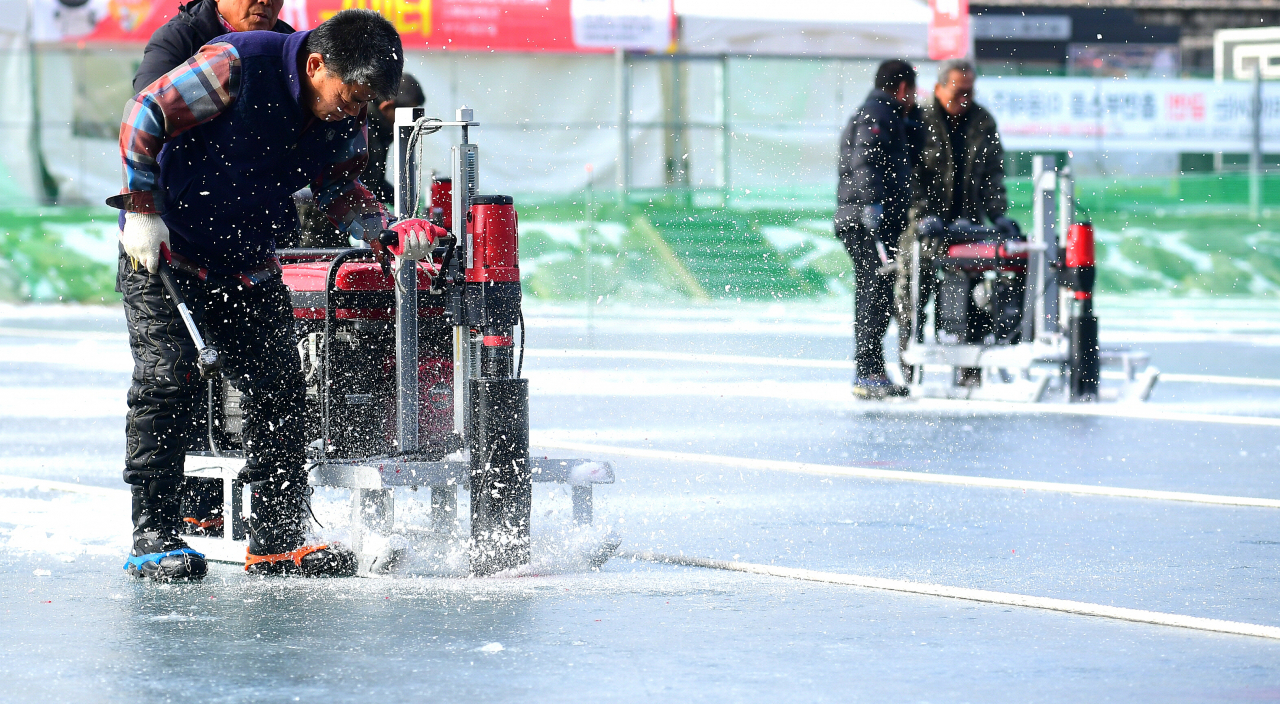
Why Hwacheon Became Korea's Winter Capital
The festival launched in 2003 as a survival move. Hwacheon sits 25 kilometers south of the DMZ, a former Korean War battlefield with a shrinking population and long, brutal winters that flatlined the local economy from December through February. The county's answer was to lean into the cold instead of hiding from it. Within three years the event was pulling more than a million visitors, and in 2011 CNN listed it among the "World's Seven Wonders of Winter," the citation that basically minted its international brand.
Here is the industry mechanic worth knowing: Hwacheon returns roughly half of the ₩17,000 adult admission back to visitors as gift certificates redeemable at local farms, restaurants, and shops. That closed loop is why the event now generates around ₩100 billion in direct economic effect per year, per the county office, and why the Korean government keeps holding it up as a template for regional tourism revival. It is not a passive tourist attraction. It is a village recycling foreign wallets into its own supply chain.
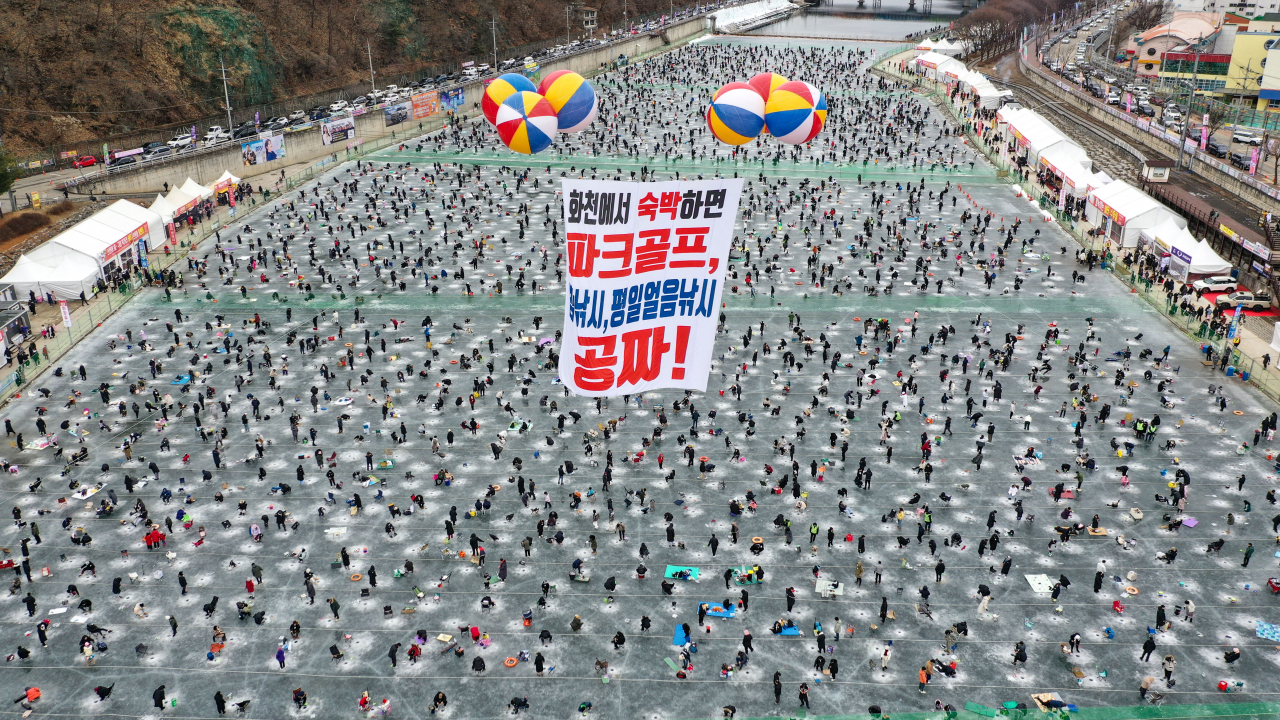
The Ice Fishing Experience: 얼음낚시 on the Bukhan
The main event is 얼음낚시, ice fishing, on a stretch of the upper Bukhan River system where the water has to freeze at least 30 centimeters deep before organizers open the ice. You pay for a numbered hole, get a short rod with a lure, and wait. Organizers dump around 160 tons of live sancheoneo into the frozen river across the festival run, so the odds are actively engineered in your favor. This is not fishing as a spiritual exercise. It is fishing as a group activity, closer in energy to a rowdy K-drama company picnic than to a Montana trout stream.
Two other formats exist. Lure fishing at open sections of the stream is quieter, and 맨손잡기 (bare-hand catching) is the one you have seen if you have ever watched a foreign travel show about Korea. Visitors change into festival-issued shorts and jerseys, jump into a stocked ice pool, and grab live trout with their hands while the crowd screams. It looks absurd because it is absurd, and that visual is exactly why the festival travels well on social media. Hwacheon officially calls bare-hand catching "an event that can only be experienced in Hwacheon," and I would argue it is the single biggest reason foreign visitor numbers have jumped past 100,000 a year.

얼음 위 회: Eating Your Catch on the Ice
What you do with the fish is arguably the more Korean part of the day. You have two options at the on-site food tents. The first is grilled sancheoneo, salt-crusted and cooked over charcoal, which is what most first-timers pick. The second, and the one locals will push you toward, is 얼음 위 회 (sashimi on the ice): the trout gutted, sliced, and eaten within minutes of coming out of the water, dipped in gochujang or chojang. Korean 회 culture rewards ultra-fresh fish and pronounced 쫄깃 (chewy, springy) texture. A trout that was swimming ten minutes ago hits both marks in a way even Noryangjin market cannot match.
Prices are set by the county and standardized across the festival tents. A grilled sancheoneo plate runs about ₩12,000, a sashimi set for four sits around ₩70,000, and if you did not catch anything you can just buy the fish. There is also the local trick most guides skip: a spicy sancheoneo 매운탕 (spicy fish stew) at ₩10,000, ideal after two hours in single-digit Celsius wind.
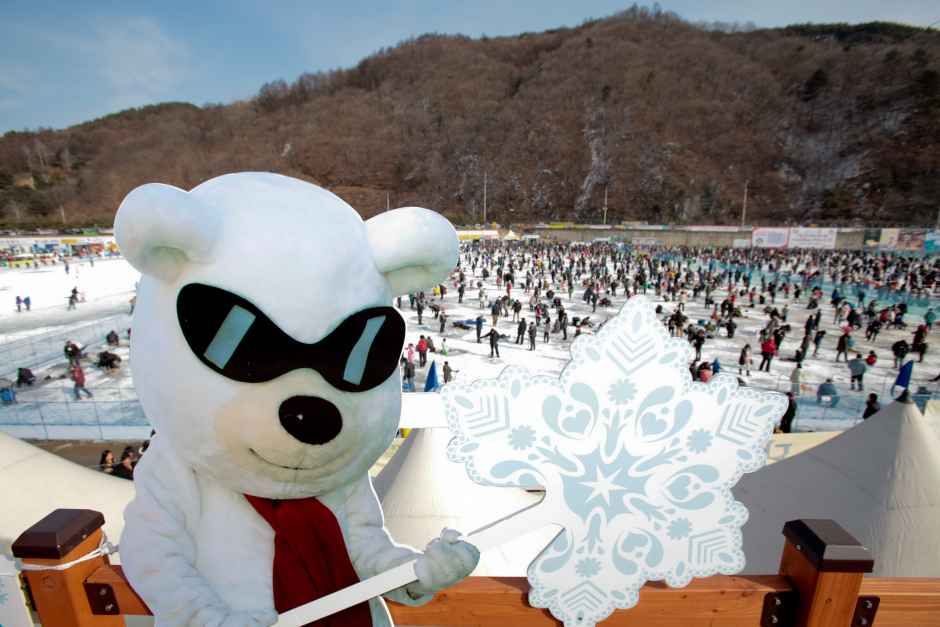
Beyond the Fishing Holes: Sculptures, Sleds, Snow Soccer
The fishing is the anchor, but the reason people stay a full day is the surrounding programming. Around Eolgomi Castle you get large-scale ice and snow sculptures, plus indoor ice sculpture halls built with visiting artists from Harbin. Kids gravitate to the ice sledding runs (both a 40-meter slope and a 60-meter river section), inner-tube slides, and the family bobsleigh tube. Adults drift toward the snow soccer pitch, the bubble suit ring where people body-check each other for laughs, and a zipline over the stream.
The programming borrows deliberately from other winter icons. Officials are on record modeling the weekly Seondeung Street lantern parade on Quebec's Winter Carnival, the Eolgomi Castle Santa Post Office on Finland's Rovaniemi village, and the snow sculptures on Sapporo. That collage strategy is not a lack of originality. It is Hwacheon reading the global winter tourism market and stitching together every proven format that translates well on Instagram.
If you have watched Korean dramas set in Gangwon (Descendants of the Sun (2016) filmed several scenes in the region, and countless winter romance shots pull from these snowscapes), the visual vocabulary of the province is already in your head. The festival essentially lets you step into that palette in a way ski resorts do not.
The Climate Question and What Hwacheon Learned
The awkward truth for any ice festival in the 2020s is that Korea's winters are warming faster than the tourism playbook can adapt. The 2020 edition was disrupted by unseasonable warmth and rain. 2021 and 2022 were canceled due to COVID. The 2023 opening was postponed after the ice failed to reach the required 30 cm thickness, and that scare is now the single biggest asterisk on Hwacheon's brand promise. Korean media has started treating warm winters as a baseline condition rather than an anomaly, and researchers have flagged that pure-nature winter festivals across Gangwon face uncertain futures.
Hwacheon's response has been to diversify hard. Night fishing (introduced in 2016, a Korean festival first) added an entire second daily attendance window. Indoor ice sculpture plazas insulate a chunk of the experience from outdoor temperature swings. The lantern night parade runs regardless of whether the fishing pool is fully solid. Read that as a working model of how a Korean regional festival hedges against climate risk: keep the iconic ice moment as the marketing hook, but build enough all-weather programming around it that a warm week does not kill the trip.

Getting There, Timing It Right
Hwacheon is roughly 90 kilometers northeast of Seoul, about a 2 to 2.5 hour drive or intercity bus ride from Dong Seoul Bus Terminal to Hwacheon Bus Terminal, then a short shuttle to the festival grounds. The festival typically runs from early January through the first week of February; the 2026 edition ran January 10 to February 1, and 2027 dates are set for January 9 to January 31. Adult admission is ₩17,000, and reserved ice fishing spots book out on weekends, so if you can move a weekday you should.
Two tactical notes from people who go every year. First, dress in warmer layers than you think you need; wind on an open frozen river is a different animal from a Seoul cold snap. Second, if you want to eat 얼음 위 회 without lining up for an hour, get to the food area right when the fishing session opens rather than after your session ends. The demand curve is predictable and the tents fill fast.
Hwacheon is a small town punching massively above its weight, and the reason it works is that the county treats the festival as a piece of civic infrastructure rather than a seasonal side hustle. That is the real Korean story here: a village that lost its industry, built its own economy out of ice, and is now teaching the rest of Gangwon how to do it.
Explore More of Korea with Daebak
Want to bring a little piece of Korea into your life? The Daebak Box is packed with the best Korean snacks, ramen, and cultural goodies delivered monthly to your door.


