


Table of Contents
In the K-content industry, we spend a lot of oxygen on idol groups and drama exports, but there is a category we quietly underrate: the cartoon characters that built a multi-hundred-billion-won licensing empire out of a chat app. LINE FRIENDS (라인프렌즈) is the clearest case study. If you have walked through Harajuku, Myeongdong, or Times Square in the last decade and stopped for a photo with a two-meter plush Brown bear, you have already walked past the receipts.
Quick backstory, because context matters here. LINE the app launched in June 2011, roughly three months after the Tohoku earthquake and tsunami wrecked Japan's communication grid. Naver's Japanese subsidiary built it specifically as a disaster-recovery messenger. Within eighteen months, LINE hit 100 million users. The Korean parent, Naver, was quietly running Japan's dominant chat app while KakaoTalk owned home turf, and the sticker economy inside those messengers became something Western platforms simply never figured out.
The stickers are where the characters come in. Users in Korea, Japan, and Taiwan pay real money for animated 이모티콘 (emoticons) the way Americans pay for Netflix, and once a character sells, LINE promotes it into merchandise. That flywheel (sticker sales, then plush, then flagship stores, then IP licensing to Uniqlo or Samsung) is basically the Japanese kawaii playbook, Sanrio's Hello Kitty model, but with a Korean tech company steering it aggressively. By 2015 LINE FRIENDS was spun into its own subsidiary. By 2019 it operated 28 official stores across 11 countries.
Meet the Original Cast: Brown, Cony, Sally, Moon, James, Choco
Every K-fandom eventually ends up at the "which one is your bias" question, and LINE FRIENDS ran on that exact mechanic long before BTS lightsticks existed. Six 캐릭터 carried the brand from sticker pack to global storefront, and each of them is engineered for a very specific emotional job in a group chat.
Brown, the flat-faced brown bear, is the introvert stoic. He almost never smiles, and that is the whole point. In a chat sticker library, Brown is the one you send when words feel like too much, and Japanese users especially latched onto him because his flat expression maps onto the country's cultural preference for restraint (that 空気を読む "read the air" aesthetic). Merchandise data across years consistently shows Brown as the top-selling silhouette. He is, essentially, the Jungkook of the LINE FRIENDS roster: quiet, high-value, moves the most units.
Cony, the white rabbit, is Brown's on-again off-again girlfriend and by far the most expressive character in the lineup. She flips between manic-pixie-cute and jealous-drama-queen inside a single sticker pack, and that range is exactly why she sells. Cony gives users a full emotional dictionary to send: kiss faces, sulking, sparkles, meltdowns. She was designed the way K-drama female leads are designed, which is not an accident when your product team sits in Seoul.
Sally, the yellow chick, is comic relief and design efficiency. Tiny, round, and easy to draw at any size (crucial for a 32-pixel app icon), Sally became the default "cute little sibling" character in LINE sticker packs. Commercially she is a workhorse: pens, keychains, phone charms, sticker sheets, anything with a small footprint.
Moon, the round bald man, is the roster's chaos agent. He exists to react at maximum volume, which is exactly what Korean and Japanese group chats need when someone texts "OMG" or "왜?!" (why?!). Moon stickers dominate the big-emotion category and stayed in circulation because that hyper-reactive energy is what makes stickers actually get sent versus just collected.
James, the blonde vain dandy, looks like the most niche personality on the roster, but he stays in the lineup precisely because he covers a specific fan psychology: the self-aware pretty boy. Every friend group has one, and stickers of James checking his own reflection are how you tease that friend without being cruel. Character design as social lubricant.
Choco, the pink puppy with the floppy ear ribbon, closes out the core six and represents pure warmth. Choco is what LINE FRIENDS uses when they want to sell to the 귀엽다 (baby-cute) segment: baby onesies, kid plush, Valentine's collabs. She is the character you see on packaging when a brand wants to say "unthreatening and lovable" without any edge.
Why LINE FRIENDS Worked When Western Emoji Did Not
Here is the industry insight you rarely hear stated plainly: LINE FRIENDS is the reason Western platforms started taking stickers seriously. Facebook, iMessage, and Snapchat all tried to catch up after watching what LINE and Kakao pulled off in East Asia. The mechanic they missed was character continuity. A LINE sticker is not just a cute image, it is Brown or Cony in a specific mood, and users build parasocial relationships with those characters the way K-pop fans build them with idols. Once someone loves Brown, they buy the Brown mug, the Brown plush, the Brown x Uniqlo tee. The stickers are the funnel; the merch is the monetization.
Estimates put LINE FRIENDS' annual global licensing revenue at roughly 500 billion won at peak. The rough split, based on public IR disclosures and industry chatter: merchandise around 60 percent, digital stickers around 20 percent, licensing collabs around 20 percent. That is a very different mix from Disney (heavily licensing dominant) and much closer to Sanrio's model, but with a Korean tech-company aggressiveness on flagship retail that Sanrio spent decades avoiding.

Flagship retail matters more than it looks. LINE FRIENDS Square in 명동 (three floors, the giant Brown out front), the Gangnam Station location, Harajuku's Cat Street shop, Times Square NYC at 1515 Broadway (opened 2017 to mark LINE's NYSE listing anniversary), San Francisco, Bangkok: these stores exist as much for Instagrammable content as for actual sales. K-content tourism from Southeast Asia and North America means fans want a photo hugging a two-meter Brown plush at the entrance, and that photo goes viral, and the flywheel spins another rotation. Sales per square meter at the Times Square store were reportedly among the highest on that block in 2018.
BT21: The 2017 Fandom-IP Fusion That Changed Everything
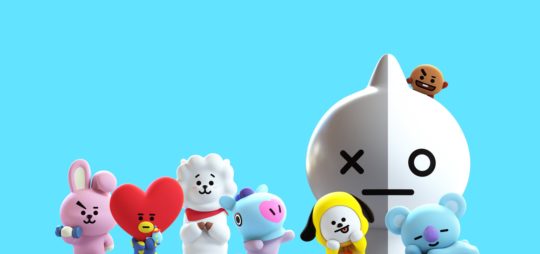
The single most important thing LINE FRIENDS ever did was BT21 in 2017. HYBE (then Big Hit) and LINE co-developed a character line where each BTS member sketched their own creature: RJ (Jin's alpaca), Chimmy (Jimin's puppy), Cooky (Jungkook's rabbit), Mang (J-Hope's horse), Shooky (Suga's cookie), Koya (RM's koala), Tata (V's heart alien), and Van (the ARMY's robot guardian). The stickers dropped September 2017 and cleared 8 million downloads in the first ten days. Twitter mentions ran into the hundreds of millions.

Why BT21 mattered is the part most explainers miss. It was the first serious attempt to fuse a global fandom with a character IP business at the exact moment the fandom was still exploding. ARMYs already parasocially loved the members; the characters gave them a way to buy into that love at a $12 keyring price point instead of a $200 concert ticket. HYBE takes a slice of the licensing, LINE takes a slice, retailers stock it, and every BT21 doll sold reinforces BTS brand loyalty at zero marginal cost to the label. December 2017 the NYC flagship sold out because 1,000 plus ARMYs lined up in freezing weather at 7am. That is not a normal retail day, that is a fandom conversion event.
The BT21 blueprint is now standard operating procedure across the industry. NewJeans got Bunini in 2023, designed by the same LINE FRIENDS team that shepherded BT21. ITZY, TREASURE, and a growing list of groups have followed the format. If you read HYBE's IR filings, non-music revenue (merchandise plus IP) is now a multi-hundred-billion-won line item, and BT21 is where that model was proven at scale.

The IPX Pivot (2022) and the Kakao Friends Problem
In 2022 LINE FRIENDS rebranded to IPX. On the marketing deck it was about digital IP and Web3 (they launched an NFT arm and started calling themselves a "character IP platform"). In reality, the rebrand was also a strategic retreat. Kakao Friends had won Korea outright by then. Ryan the lion is genuinely inescapable in domestic 이모티콘 rankings, and Kakao's dominance at home forced LINE FRIENDS to double down on Japan, Taiwan, Thailand, and B2B licensing to K-pop labels. The BT21 model became the moat: whoever runs the K-pop character factory keeps growing as long as new groups keep debuting.
What makes LINE FRIENDS specifically Korean, even though the app was born in Japan, is the pace. Sanrio built Hello Kitty over five decades of patient licensing. LINE FRIENDS did the equivalent in ten years by riding the K-content export wave and the smartphone-messaging boom simultaneously. That combination (a national industry's export machine plus a native digital distribution channel) is very hard to replicate anywhere else, which is why fifteen years in, the Brown plush at the Myeongdong flagship still has a queue of foreign tourists on a random Tuesday afternoon.
Where to Find Brown, Cony, and the Rest in Person
If you are planning a trip: LINE FRIENDS Square Myeongdong is the flagship (three floors, the giant Brown statue out front, the most photo-heavy location). Gangnam Station has a smaller two-floor shop. Harajuku's Cat Street location is the Tokyo landmark. Times Square NYC at 1515 Broadway still operates. Bangkok, Shanghai, and Hong Kong all have official stores. For BT21 specifically, the LINE FRIENDS BT21 corner at The Hyundai Seoul in Yeouido stocks the fullest range in the country.
If you cannot fly to 명동, our monthly Daebak Box regularly features character-focused Korean pop culture drops, including limited BT21 and LINE FRIENDS collaboration goods we source directly from Korea. It is the easiest way to build a shelf without booking a flight. Get the Daebak Box here and start your collection with authentic Korean character merch delivered to your door every month.


