


Table of Contents
Hot take from someone who has watched the Korean F&B category from the inside for a decade: the Korean corn dog is not a variant of the American corn dog. It is a completely different product built on a different batter, a different coating, and a different consumer occasion. If you have only ever eaten a state-fair corn dog on a stick with yellow mustard, walk into a 명랑핫도그 (Myungrang Hot Dog) in Seoul, order a 모짜치즈 (mozzarella cheese) one hot out of the fryer, and rip it in half. The stretch you get is why this thing colonized TikTok in 2018 and put 500-plus Chungchun Rice Dog stores across the US inside four years. It is engineering, not luck.

The Korean corn dog is not the American corn dog. Read this first.
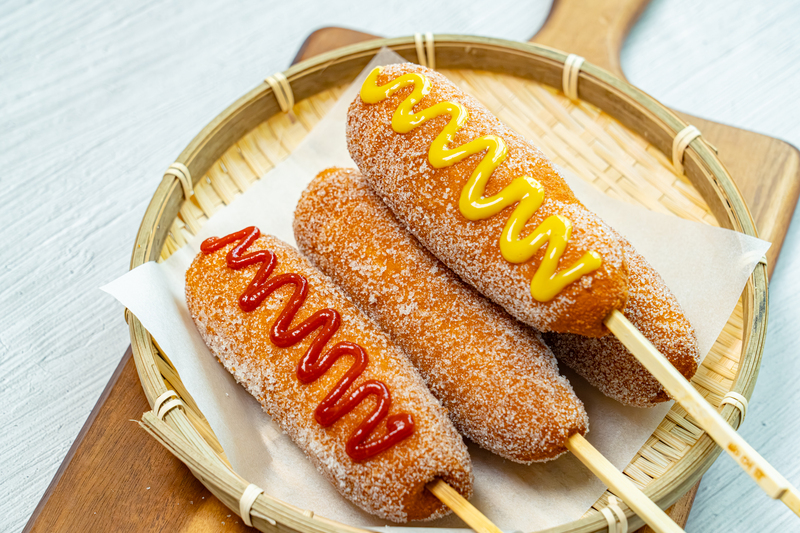
The American corn dog is one thing: yellow cornmeal batter, a plump frankfurter, deep fried, mustard. Full stop. The Korean 핫도그 (hotdog) is engineered around three variables the American version does not touch: (1) the batter is a wheat-and-rice-flour dough closer to bread than to pancake, (2) the exterior gets an aggressive second coating (panko, crushed ramyeon, sweet potato cubes, or french fry chips) before it hits the oil, and (3) the whole thing gets rolled in sugar before you eat it, then hit with mustard, ketchup, and often a spicy powder on top. That sugar step is the tell. Koreans treat the corn dog the way Americans treat funnel cake, as a sweet-savory dessert-adjacent snack, not a ballpark meat delivery vehicle.
The interior is where it gets even further from the American reference. Instead of one sausage, a Korean corn dog is often half sausage and half 모짜렐라 (mozzarella), or all cheese, or sausage plus rice cake (that variant is called 소떡소떡, sotteok-sotteok), or a chunk of ramyeon block. The best-selling SKU at Myungrang is not the plain hot dog. It is 모짜치즈 (all-cheese). That single fact tells you the category is really about texture theater: the cheese pull, the crunch shatter, the sugar crackle. Beef is optional.
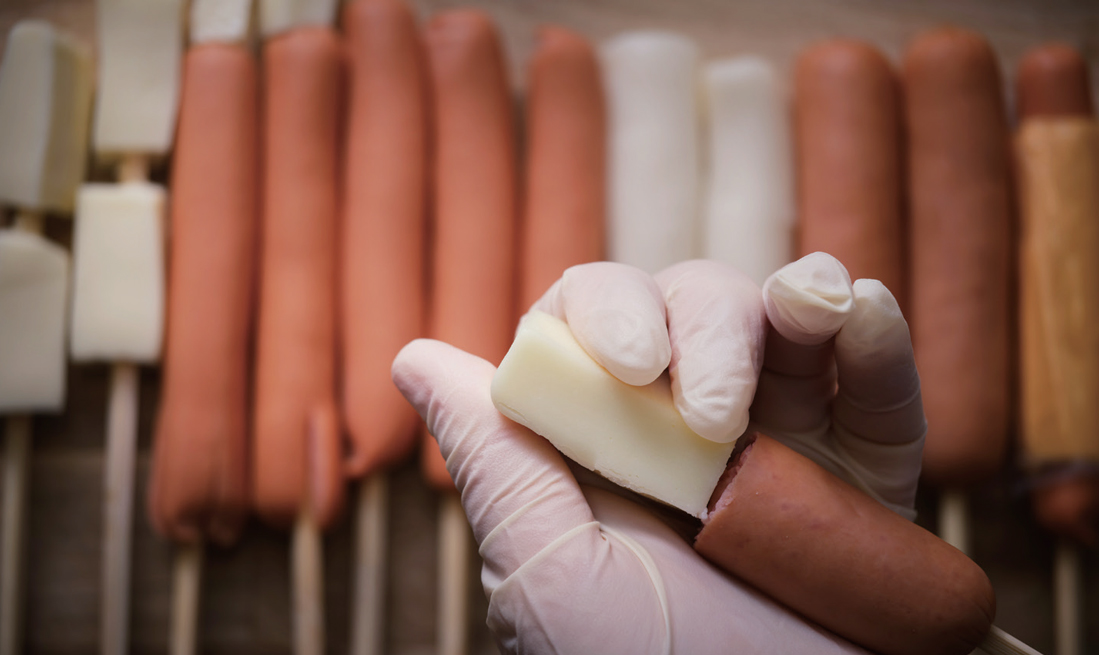
명랑핫도그 built the whole category on the 학원가 야식 economy
Here is the business context most non-Koreans miss. The Korean corn dog boom does not start at street food stalls in the abstract. It starts with 명랑핫도그 (Myungrang Hot Dog), a franchise launched in Busan in 2016 that hit 700-plus stores nationwide inside three years by cracking one very specific customer occasion: 학원가 야식 (hagwon-ga yasik), the late-afternoon and evening snack demand around Korea's after-school academy districts. Kids finish 수학학원 (math hagwon) at 9 pm, they have another two hours of self-study ahead, and they want something warm, cheap (usually 1,500 to 2,500 won), and photograph-able for KakaoTalk. Myungrang built the SKU sheet and the store footprint around that exact window.
The insider mechanic that made Myungrang scale so fast: they franchise with an initial setup cost far below the Korean fried chicken chains (roughly a fifth of a Kyochon or BBQ franchise), the equipment is one fryer plus a proofing rack, and the labor is one person. That is why 청년핫도그 (Cheongnyeon Hot Dog), Chungchun Rice Dog, and a dozen other me-too brands piled in behind Myungrang starting 2017. By 2020 there were four national franchises fighting over the same street corner near every subway exit within 500 meters of a hagwon district. The margin was thinner than fried chicken, but the volume was higher and the daypart was different (afternoon snack, not dinner).
감자핫도그 vs 치즈핫도그: the two coating wars that decided who won
Ask a Korean under 30 to name the two most important Korean corn dog variants and the answer is instant: 감자핫도그 (potato corn dog) and 치즈핫도그 (cheese corn dog). These are not toppings. They are structural coatings that were the arms race the whole 2017 to 2019 period.
The 감자핫도그 is coated in tiny cubes of raw potato before frying, so the exterior becomes a mosaic of golden crispy potato bits fused to the bread crust. Bite into it and the potato cubes shatter separately from the dough. Maangchi's home version walks through the process, and Beyond Kimchee explicitly notes the trick of leaving the potato cubes chunky so you get texture separation instead of a uniform crust. The other coating war was 라면가루 (crushed instant ramyeon noodles) as a breading. Nongshim Shin Ramyeon crumbs on top of a mozzarella corn dog was one of Myungrang's viral SKUs in 2018 and it still sells.
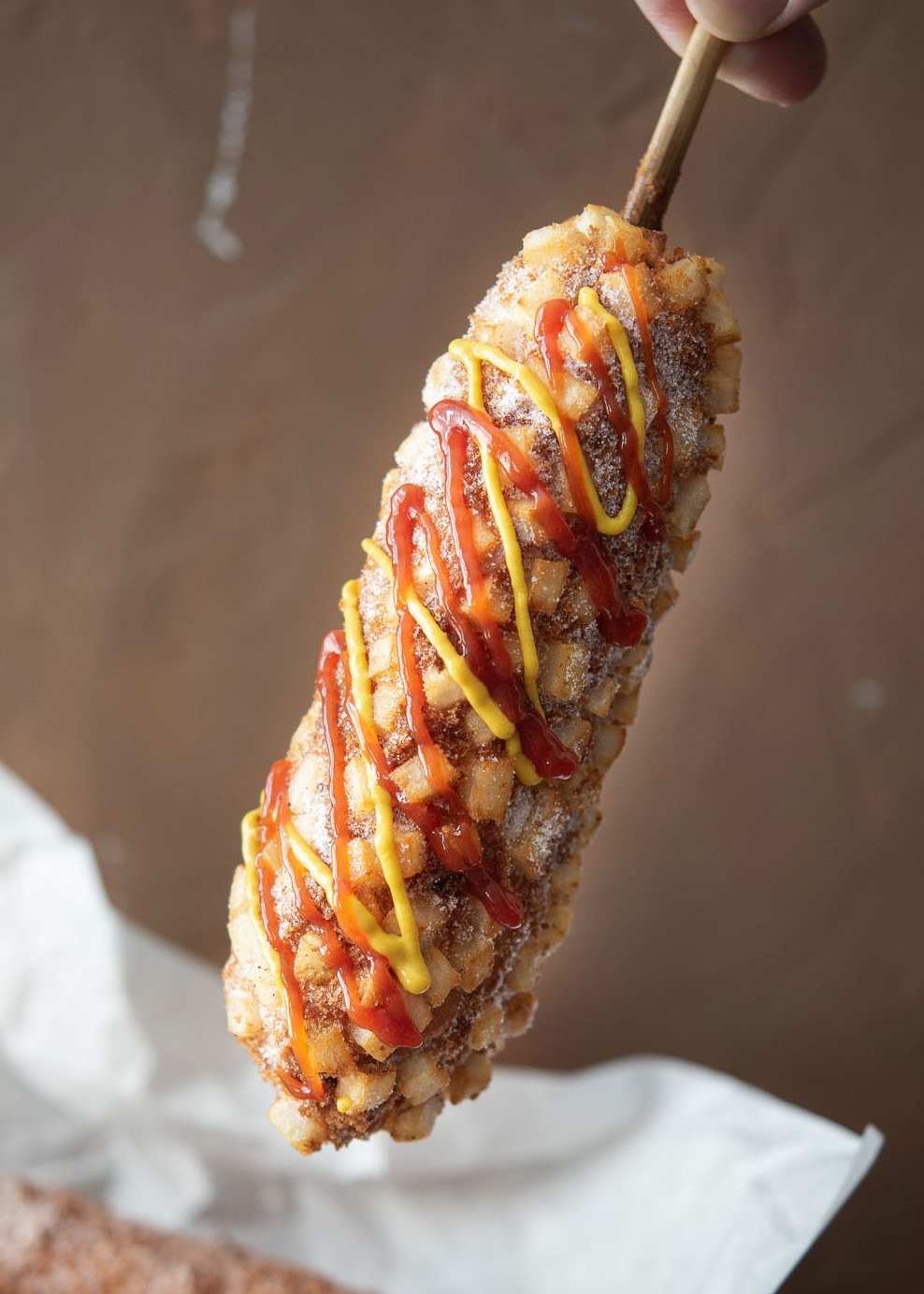
The 치즈핫도그 pushed the other direction: instead of playing with the outside, it doubled down on the inside. Half mozzarella, full mozzarella, mozzarella-plus-cheddar, mozzarella-plus-cream-cheese. The engineering problem was that molten cheese wants to escape the moment the dough splits. Myungrang solved it with a dough recipe that has just enough gluten development to seal the cheese under fry pressure. This is why cheap knock-off corn dog shops always leak: their dough is a batter, not a bread. Real Korean corn dog dough is proofed. That is a bakery skill, not a fry cook skill.
The TikTok cheese pull that built Two Hands NYC and Chungchun in the US
Here is how a hagwon snack became a $200 to $300 million US retail category. In 2018, Two Hands Corn Dogs opened in Los Angeles and started posting slow-motion cheese pull videos on Instagram. That format was already viral for Turkish ice cream and Detroit pizza, but nobody was doing it with a portable stick snack. The engagement rate on those videos was absurd (five to ten times a normal food post) because the visual payoff was so dense: sugar crackle, then dough crack, then mozzarella string stretched two feet from your face. TikTok launched in the US market that same year, and the cheese pull was already an optimized asset when the algorithm arrived.
By 2020 the ecosystem had scaled. Two Hands Corn Dogs went from one LA store to a nationwide franchise, and Chungchun Rice Dog (the American brand of 청년핫도그) crossed 500 US stores by 2023, mostly clustered around H-Marts, universities, and Asian-American strip malls. Trade analysts pin the US Korean corn dog category around $200 to $300 million by 2024, and the growth curve was pulled almost entirely by two factors: (1) TikTok organic reach that a traditional QSR marketing budget could never buy, and (2) franchise unit economics that let a store break even inside 12 months on roughly $150K of capex. That is a rare combination.
How to eat one, ranked by a Seoul industry insider
My personal ranking after way too many field visits over the last decade, ordered by what I would actually recommend to someone trying their first Korean corn dog:
- 모짜치즈 (mozzarella, full cheese). The one that made the category. Full mozzarella interior, panko outside, rolled in sugar, hit with ketchup and honey mustard. If a shop cannot make this stretch cleanly, everything else on the menu is theater. Start here.
- 감자핫도그 (potato corn dog). Sausage inside, potato cube coating outside. The texture separation between the crispy potato and the soft dough is what you are paying for. Do not eat this with condiments the first time. Taste the coating first.
- 라면핫도그 (ramyeon corn dog). Crushed Shin Ramyeon noodle crumbs as the exterior breading, usually over a half sausage half cheese interior. Weirdly great. This is what my Korean industry friends actually order when we are just messing around.
- 소떡소떡 (sotteok-sotteok). Not technically a corn dog, but sold at every corn dog shop. Alternating rice cake and mini sausage on a skewer, glazed with a sweet-spicy gochujang sauce and grilled. This is the on-the-go format when you do not want fried and want something you can eat walking.
- Two Hands / Chungchun signature in the US. Both American brands now sell hybrid SKUs the Korean parent shops do not carry (Flaming Hot Cheetos coating, Fruity Pebbles coating). These are optimized for TikTok, not for taste. Try one to understand the marketing, then order the mozzarella.
What Koreans actually think of the American reception
Talk to a Myungrang franchise operator in Seoul about the US Chungchun explosion and you will get a wry smile. Koreans are proud of the export success, but the general read inside the industry is that the American version has drifted into carnival food territory (Flaming Hot Cheetos coating, cotton candy topping, purple 4th of July batter) while the Korean parent category is still evolving on serious flavor axes. New 2024 releases in Korea include a 크림치즈 김치 (cream cheese kimchi) hot dog and a 흑임자 (black sesame) sugar coating that leans into Korean dessert flavor logic rather than American maximalism. The gap between what a Seoul teenager eats and what a Los Angeles teenager eats is now real, and that gap is only going to widen.
The appeal point that translates cleanly in both markets, though: the format solves an under-served consumer need for a portable, warm, texturally-loud snack in the 2,000 to 6,000 won price band, and there is no American equivalent that hits all three variables at once. A pretzel is portable but not warm and not loud. A slice of pizza is warm and loud but not portable. A funnel cake is warm and loud but not portable. The Korean corn dog is the only snack on a stick that is warm, portable, and delivers three separate texture events (sugar crackle, dough crunch, cheese pull) in one bite. That is a real product-market fit, not a fad.
Last hot take, then I will stop: if a Korean corn dog shop in your city is not proofing its dough, is not double-coating, and is not sugar-dusting before it hands you the stick, that is not a Korean corn dog. That is a state-fair corn dog with mozzarella inside. Walk out, find the shop where the fryer is running constantly and the line is teenagers not tourists, and order the 모짜치즈. Everything else is a costume.
Want to eat Korea's snack economy the way Korean teenagers actually eat it? The SnackFever Box by Daebak ships the Shin Ramyeon flavors, honey butter chips, and convenience-store staples that turn into corn dog coatings, sotteok glazes, and 야식 (yasik) staples in Seoul. Handpicked from Korean CU and GS25 shelves, delivered to your door.


