Hyunwoo Cho

Hyunwoo Cho

With over 10 years of experience in the Hallyu industry, Hyunwoo has dedicated his career to connecting Korean culture with the world. As the founder of Daebak, he works closely with Korean brands and stays ahead of the latest trends to deliver an authentic taste of Korea to fans globally.

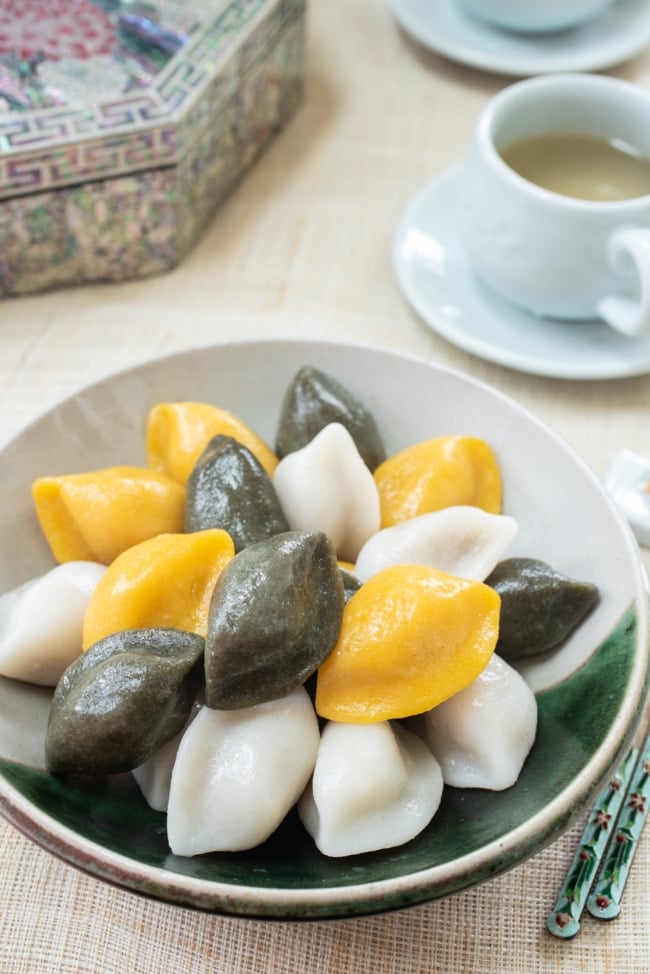
Colorful half-moon songpyeon rice cakes piled on a plate, the must-have Chuseok delicacy of Korean autumn

Korean Autumn Foods: Chuseok Spreads, Persimmons, and Songpyeon

Hyunwoo Cho

Table of Contents

Autumn in Korea is the year's busiest food season. Chuseok, the harvest holiday, usually falls between mid-September and early October on the lunar calendar, and families gather to share a table built around freshly harvested rice, fruit, and meat. As October turns into November, attention shifts to street snacks like roasted chestnuts and gunbam carts, warming bowls of hobakjuk pumpkin porridge, and the gimjang weeks when households salt and seal months of kimchi. The recipes below cover the dishes Koreans actually eat from September through late November.

Colorful half-moon songpyeon rice cakes piled on a plate, the must-have Chuseok delicacy of Korean autumn
Songpyeon, the half-moon rice cakes families make for Chuseok. | Source: Korean Bapsang

Songpyeon: The Chuseok Rice Cake

Songpyeon (송편) is the signature food of Chuseok. The small half-moon rice cakes are shaped from short-grain rice flour dough, stuffed with fillings such as sweetened sesame seeds, mung beans, or red beans, and steamed over a bed of pine needles. The pine gives the cakes their name, since “song” means pine tree. Cooks color the dough with natural ingredients like mugwort, kabocha pumpkin, and beet juice, so a plate of finished songpyeon often shows pale green, yellow, pink, and white. Families traditionally shape them together the night before Chuseok, and an old saying holds that the prettier your songpyeon, the prettier your future daughter will be.

Korean Fall Fruits

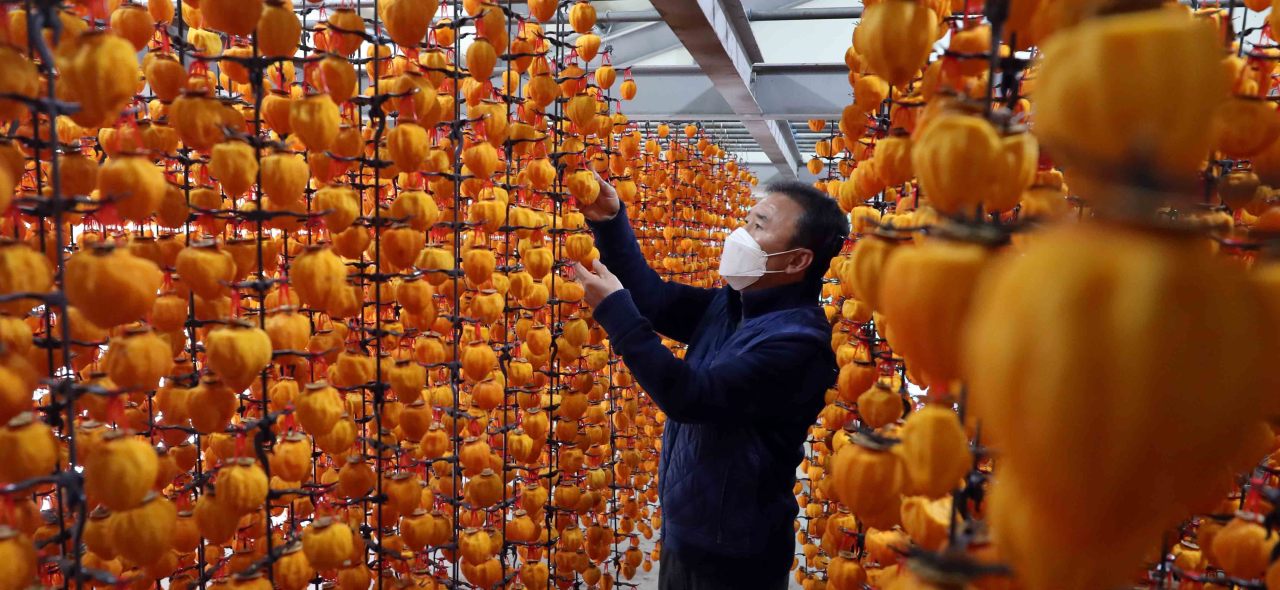
When Koreans talk about autumn fruit, three names come up first: persimmon, Asian pear, and pomegranate. Persimmons (gam, 감) are eaten three ways. Hard, crisp dan-gam are sliced like apples. Soft hong-si are spooned out like custard. The peeled and air-dried gotgam, a chewy traditional snack once reserved for royalty, are still produced in regions like Haman in North Gyeongsang Province, where mountain winds and freeze-thaw cycles concentrate the sweetness. Asian pears (bae, 배) are large, round, and crisp with a yellow-brown skin and very high water content; they appear on every Chuseok ancestral table and are one of the most common holiday gifts. Pomegranates (seokryu, 석류) round out the fall fruit bowl and are often turned into tea or juice.

Bundles of dried persimmons (gotgam) hanging in the autumn air at a Haman farm in North Gyeongsang Province
Gotgam, the dried persimmons that define late-autumn snacking, drying in the mountain air at Haman. | Source: The Korea Herald

Chestnuts and Roasted Sweet Potatoes

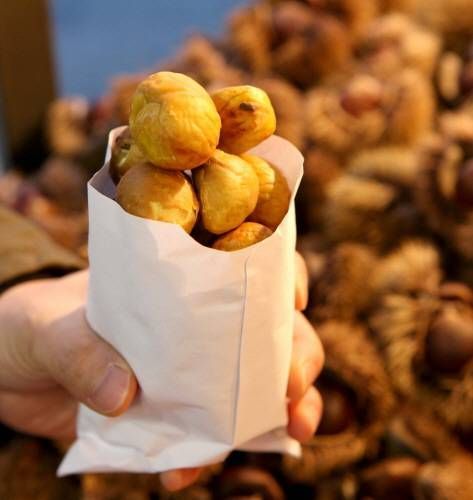
The chestnut harvest peaks in September and October, and roasted chestnuts (gunbam, 군밤) become one of the most recognizable cold-weather smells in Seoul. Street vendors and convenience-store roasters score the shells, then cook them over coals or in drum roasters until the skins split and the flesh turns sweet and floury. Roasted sweet potatoes (gungoguma, 군고구마) appear alongside them, sold from oil-drum ovens that vendors wheel out as temperatures drop. Koreans often eat gungoguma with a few bites of kimchi to cut the sweetness. Raw chestnuts also turn up inside autumn dishes like yaksik, sweet rice pudding, and as a garnish in galbijjim and hobakjuk.

Bag of glossy roasted chestnuts (gunbam) split open to show the sweet golden flesh inside, a classic Korean autumn street snack
Roasted gunbam, one of the season's defining street snacks. | Source: VisitKorea

Pumpkin Dishes: Hobakjuk and Hobakjeon

Korean kabocha-style pumpkin (danhobak, 단호박) ripens in autumn, and the most common way to use it is hobakjuk (호박죽), a smooth porridge of cooked pumpkin thickened with sweet rice flour and dotted with chewy rice-flour balls and red beans. It is sweet, mild, and easy on the stomach, which is why it is also served to people recovering from illness. Slices of pumpkin and zucchini are also battered and pan-fried as hobakjeon, one of the savory pancakes that appear at holiday tables. Yakshik, a sticky sweet rice dish studded with chestnuts and jujubes, uses the same autumn pantry and shows up at Chuseok alongside the rice cakes.

The Chuseok Holiday Spread

The Chuseok table is built around the charye ancestral rite. A typical spread includes new-harvest rice, a clear beef-and-radish soup, japchae glass noodles, namul seasoned vegetables, and several kinds of jeon: thin pancakes of fish, beef, zucchini, and mung bean batter. The centerpiece protein is usually galbijjim, beef short ribs braised with soy sauce, Asian pear, garlic, jujubes, chestnuts, and carrots until the meat slides off the bone. Apples and pears anchor the fruit row, and songpyeon and yakshik close out the meal. In 2022, Sungkyunkwan's Confucian ritual committee even issued simplified guidelines suggesting that nine dishes are enough and that jeon, which require hours of frying, are not strictly required, an attempt to ease the workload that has long fallen on women in the household.

Traditional Chuseok holiday spread with songpyeon rice cakes, fruit, jeon pancakes, and side dishes arranged for the harvest celebration
A Chuseok holiday spread, the centerpiece of Korea's autumn food calendar. | Source: 10 Magazine

Late Autumn: Gimjang Kimchi Preparation

Once Chuseok ends, Korean kitchens turn toward gimjang (김장), the communal kimchi-making that takes over households from mid-November into mid-December. The timing is practical: the last napa cabbages and Korean radishes come out of the fields in November, and the cold weather slows fermentation just enough for the kimchi to age properly through winter. A gimjang day usually involves several people salting hundreds of cabbages, mixing a paste of chili powder, garlic, ginger, salted shrimp, and fish sauce, and packing the seasoning leaf by leaf. The finished kimchi goes into onggi earthenware jars or kimchi refrigerators. UNESCO added gimjang to its Representative List of the Intangible Cultural Heritage of Humanity in 2013, and the November 22 Kimchi Day now marks the season nationally.

Participants in a gimjang event smearing red chili paste onto salted napa cabbage leaves to prepare winter kimchi at Korea House in Seoul
A gimjang kimchi-making session at Korea House in central Seoul, marking the late-autumn tradition recognized by UNESCO. | Source: The Korea Times

Where to Eat Korean Autumn Foods

Visitors who come during Chuseok will find that many family-run restaurants close for the holiday, but department-store food halls and large hotels run special Chuseok menus with galbijjim, jeon platters, and songpyeon boxes. For roasted chestnuts and sweet potatoes, look for street carts around Myeongdong, Namdaemun Market, and the alleyways of Insadong from late October onward. Hobakjuk is easy to find at traditional restaurants in Bukchon and Insadong, and at porridge chains like Bonjuk. For gimjang, several local governments run public kimchi-making festivals in November, including the Seoul Kimchi Festival at Seoul Plaza and the Gwangju World Kimchi Festival, both of which let visitors join the salting and seasoning process. Asian pear orchards in Naju in South Jeolla Province also run pick-your-own tours during the harvest weeks.

Explore Korean Snacks with Daebak

Love Korean food? Get authentic Korean snacks and ramen delivered straight to your door with the SnackFever Box by Daebak.

ブログに戻る