


Table of Contents
The cherry blossom hangover hits fast in Korea. One weekend Seoul is snowing pink petals; the next, the streets are just wet with rain and sidewalk-swept confetti. But the real photo season isn't over yet. If anything, it's just starting.
Working in Korean travel content for the past decade, I've watched 인생샷 (in-saeng-syat, or "life shot") culture completely reshape how domestic tourism moves through spring. Post-2020, weekly bloom updates on Naver blogs and Instagram Reels dictate where the crowds land next, and the peninsula's flower calendar has become a coordinated relay handoff from cherry blossoms to canola to tulips to roses, then all the way through green barley, hydrangeas and finally lotus. Korean flower tourism now pulls in an estimated 500 billion won annually, and regional governments plan festivals around 지역경제 (regional economy) revitalization more seriously than most people realize.

유채꽃 (Canola): Jeju's April-to-May Yellow Wave
The moment cherry blossoms drop, all eyes shift south. 유채꽃 (yuchae-kkot), or canola flowers, blanket Jeju Island in a saturated yellow that shows up in photos like the color was pushed one stop too far in Lightroom. The iconic backdrop is 산방산 (Sanbangsan), the dome-shaped volcanic peak on Jeju's southwest coast, with canola fields climbing right up to the base. Locals will tell you the honest tourist trick: the roadside fields around Sagye-ri and Hueree Natural Park are the free (or nearly free) versions of the more famous fenced "photo farm" plots that charge 2,000 to 4,000 won per shoot. Same flowers, better story.
K-drama viewers might recognize the mood from Twenty-Five Twenty-One, where a memorable canola-field sequence between Kim Tae-ri and Nam Joo-hyuk sent Jeju's spring accommodation searches to record highs in 2022. That's the industry mechanic worth understanding. Korean flower tourism doesn't spike on the flowers alone. It spikes on which drama or K-pop MV shot there in the last 18 months.
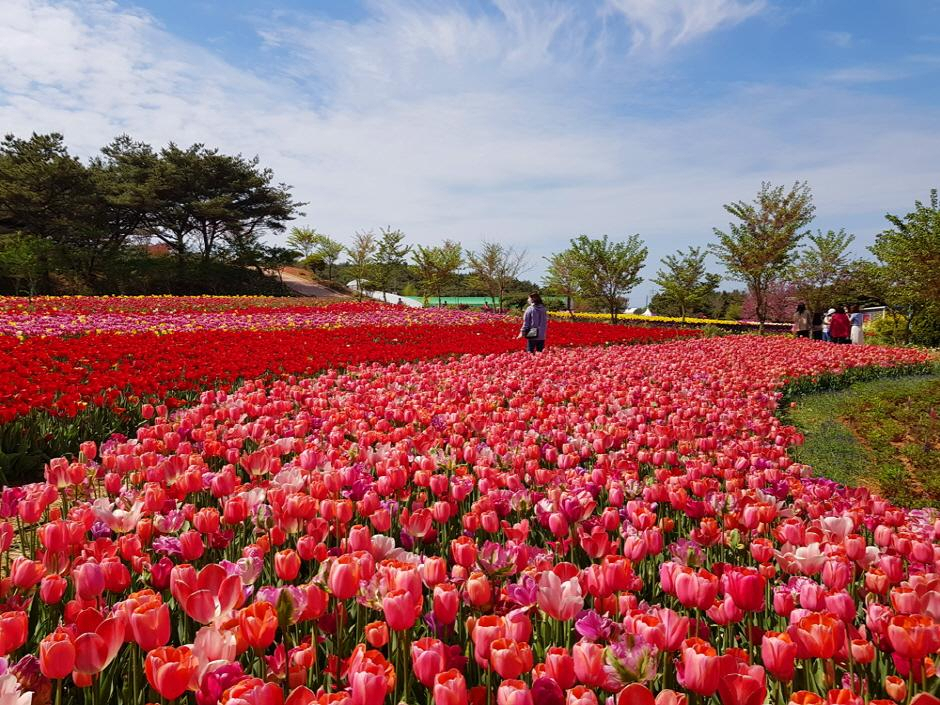
튤립 (Tulips): Taean and Everland's Engineered Color Blocks
When Korean growers took Dutch tulip cultivation seriously in the 1990s, the industry expected a niche audience. Instead, they built one of Asia's biggest flower tourism verticals. The 태안 세계튤립꽃박람회 (Taean World Tulip Festival) at Korea Flower Park in South Chungcheong now runs from mid-April into early May, and the World Tulip Society officially recognized it as one of the five top tulip festivals globally in both 2015 and 2017. Expect roughly 200 varieties planted in graphic-designer-tight color blocks: red, yellow and purple stripes engineered specifically for drone and aerial photography.
Everland's tulip festival in Yongin is the more urban-friendly option, roughly 1.2 million tulips across the Four Season Garden, usually paired with a themed IP collab (Sanrio characters in the 2025 edition, for example) to keep the visit repeatable for young families year after year. That IP layer isn't a gimmick. It's how theme parks convert one-time flower tourists into annual passholders.

장미 (Roses): The Serious Photographer's Late-May Move
Roses hit their stride when everyone else has already gone home from the spring festival circuit, and that's exactly the point. Everland's rose garden isn't just a garden. It's a 3-million-flower, 720-plus-variety operation that includes species the park's own horticulture team bred and won gold with at the Gifu International Rose Competition in Japan. That's the kind of institutional depth casual visitors never notice, but it's why the Rose Festival that opens in mid-May consistently pulls in serious flower photography crowds year after year.
Seoul Grand Park's rose garden is the free, no-ticket-required alternative in the capital, roughly 20,000 rose bushes across 200 varieties lining a lakeside path, best hit on a weekday morning if you actually want a photo without someone else's kid in the frame. Local Seoul photographers rate this spot over Everland for one reason: natural morning light hits the beds without theme-park install elements crowding the composition.

수국 (Hydrangeas): June's Chemistry-Lab Blues
수국 (sugook) shifts the entire mood of the calendar. Where canola and tulips are loud, hydrangeas are cinematic: blue, purple, dusty pink, sometimes white with a mint edge, all determined by soil pH like a chemistry experiment you can walk through. Jeju is the country's hydrangea capital thanks to volcanic soil that produces the deepest, most saturated blues. Camellia Hill on Jeju hits peak bloom by early June and stays photogenic through mid-July, and the newer 4est Garden in Haenam runs the country's only hydrangea genetic resource management center, with 9,000 bushes across 250 varieties.
Offshore, 임자도 (Imjado) off South Jeolla is the country's largest single hydrangea destination and worth the ferry ride if you want fields (not garden paths) of blue. On the mainland proper, Ulsan's Jangsaengpo Hydrangea Festival at the Whale Culture Village turns a coastal hillside into 30,000 plants of drenched blue and pink every June, plus night light shows for the after-dark Reels crowd.

청보리 (Green Barley): The Wind-Wave Photo Nobody Else Can Take
청보리 (cheong-bori), literally "green barley," isn't a flower, but it belongs on this list because it does something no cherry blossom can do. It waves. Gochang's 학원농장 (Hagwon Farm), also called Borinara Hagwon Farm, is the country's largest barley field at roughly 562,000 square meters. Every May the whole property becomes a rolling green ocean, and the Gochang Green Barley Field Festival programs live folk performances, kite flying and the very Korean tradition of making barley-leaf whistles right in the middle of the fields.
The reason this spot became an Instagram staple isn't the barley itself. It's that no other Korean landscape gives you that continuous single-color texture at that scale, so people show up in white dresses and denim just for the color contrast. Half the country's food-industry commercials, plus a rotating cast of K-drama location scouts, shoot here between April and early June before the barley yellows toward harvest.
연꽃 (Lotus) and the July Wrap: Buyeo's 10 Million Blossoms
By the time summer settles in, the flower calendar hands off to 연꽃 (yeon-kkot), lotus. The Buyeo Seodong Lotus Festival at Gungnamji, Korea's oldest man-made pond, opens roughly 10 million lotus blossoms across dozens of varieties for peak-summer photography every July. If you watched Extraordinary Attorney Woo, the lotus and whale imagery threaded through Park Eun-bin's scenes wasn't decorative set dressing. It leaned on a specific Korean cultural association of lotus with contemplation and clarity, which is exactly why the Buyeo festival gets a steady K-drama tourism halo every summer. Suggested hashtags for the calendar: #유채꽃 #튤립 #장미 #수국 #청보리 #연꽃 #인생샷 #꽃스타그램 #봄스타그램.
Explore More of Korea with Daebak
Want to bring a little piece of Korea into your life? The Daebak Box is packed with the best Korean snacks, ramen, and cultural goodies delivered monthly to your door.


