


Table of Contents
If you've watched any Korean variety show in the last five years, from Spring Camp to House on Wheels to Earth Arcade, you've already seen Korean camping culture. It's not the gear-heavy backcountry traversing that "camping" means in North America. It's idols in beanies sitting around an electric grill in matching camping chairs, ramyeon boiling on a portable burner, a Bluetooth speaker playing K-pop, and a heated tent already pre-assembled when they arrive. That gap between what Western audiences picture as "camping" and what Koreans actually do is the entire reason most foreign tourists miss this side of Korea completely.
I've spent the last decade-plus working with Korean travel and lifestyle brands, watching this market reshape itself twice. First during the COVID outdoor boom, then again when Hyundai and Kia started literally engineering SUVs around it. Korean camping isn't Yellowstone. It's closer to a Japanese onsen weekend with Korean BBQ in the middle of pine trees. Once you understand that framing, everything from the ₩300,000-a-night glamping resorts to the viral 차박 (chabak) car-sleeping trend starts to make sense.
Korean Camping Is Not Western Camping, and That's the Whole Point
The first thing to know: when a Korean says they're going camping (캠핑), they almost never mean what an REI catalogue means by it. They're not strapping a 40L pack on and walking eight miles to a backcountry site. The dominant mode is 오토캠핑 (auto-camping), where you drive your car to a designated parking spot at a campsite that already has electricity hookups, a flat platform for your tent, a shared shower block with hot water, and usually a convenience store on-site selling samgyeopsal, soju, and charcoal.
That's not a watered-down version of camping. That's the version Koreans actively chose. The appeal point that Western reviewers miss is convenience-stacked-on-nature, not nature-tested-against-discomfort. Koreans live in some of the densest urban environments on the planet. Seoul alone packs 9.4 million people into 605 square kilometers, and the weekend escape demand is to leave that density without losing any of the things that make modern life pleasant. Hot showers. Wi-Fi. Heated floors in winter. K-drama streaming on a tablet inside a heated tent.
According to the Korea Tourism Association, the country now has roughly 5 million campers and 3,600 registered campsite operators as of late 2023, nearly triple the pre-pandemic 2019 count. That's not a niche subculture. That's mainstream Korean leisure infrastructure that most foreign tourists never engage with because their guidebooks point them at Gyeongbokgung Palace and Myeongdong shopping.
오토캠핑: The Car-Camping Format That Built the Industry
오토캠핑 (auto-camping) is the load-bearing pillar of the entire Korean camping market. The format is straightforward: you drive in, park on a designated platform big enough for a sedan plus a 4-to-6-person tent, plug your car into the campsite's electrical hookup, and unload an absurd amount of gear from the trunk. Most Korean families running an auto-camping setup arrive with a multi-room tent (usually a Helinox or Snow Peak Korea model that retails around ₩800,000 to ₩2.5 million), a portable propane stove, an LED lantern setup, an electric pad heater for winter, and a folding kitchen table.
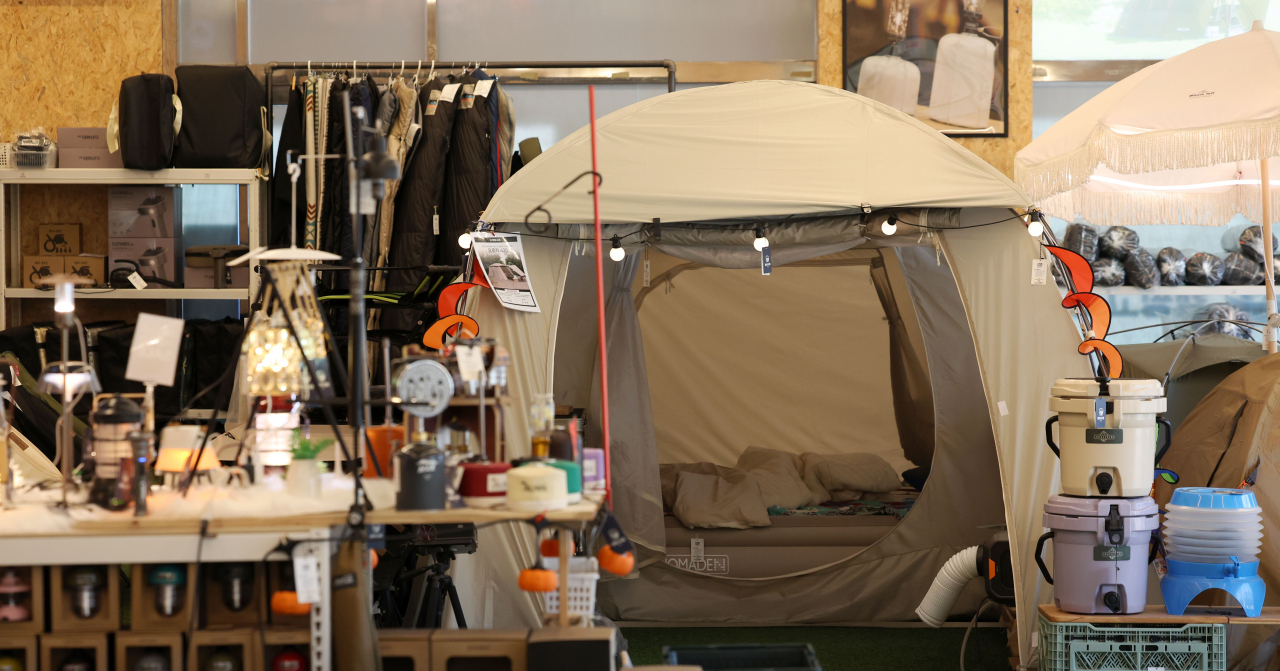
What separates this from a US car-camping trip is the gear arms race. Snow Peak Korea reported its highest-ever revenue years between 2020 and 2022, and the Helinox chair (the small folding seat used by every Korean camper you've ever seen on Instagram) became enough of a social currency item that secondhand resale prices regularly cleared retail. The underlying appeal: in a status-aware culture, your camping setup is a visible identity signal the same way your handbag is. A ₩300,000 Helinox Chair Zero says something about you the moment you sit in it at the riverside.
The best-known 오토캠핑 site in the country is Nanji Hangang Park (난지한강공원) in west Seoul, sitting on the Han River right next to World Cup Stadium. It runs 124 platforms across 27,000 square meters, including reservable glamping tents with beds and electrical hookups, plus dedicated car-camping zones. Reservations open one month ahead and weekend slots get cleared in minutes. The demand intensity is structural, not seasonal.
차박: How a Pandemic Trend Reshaped Korean SUV Design
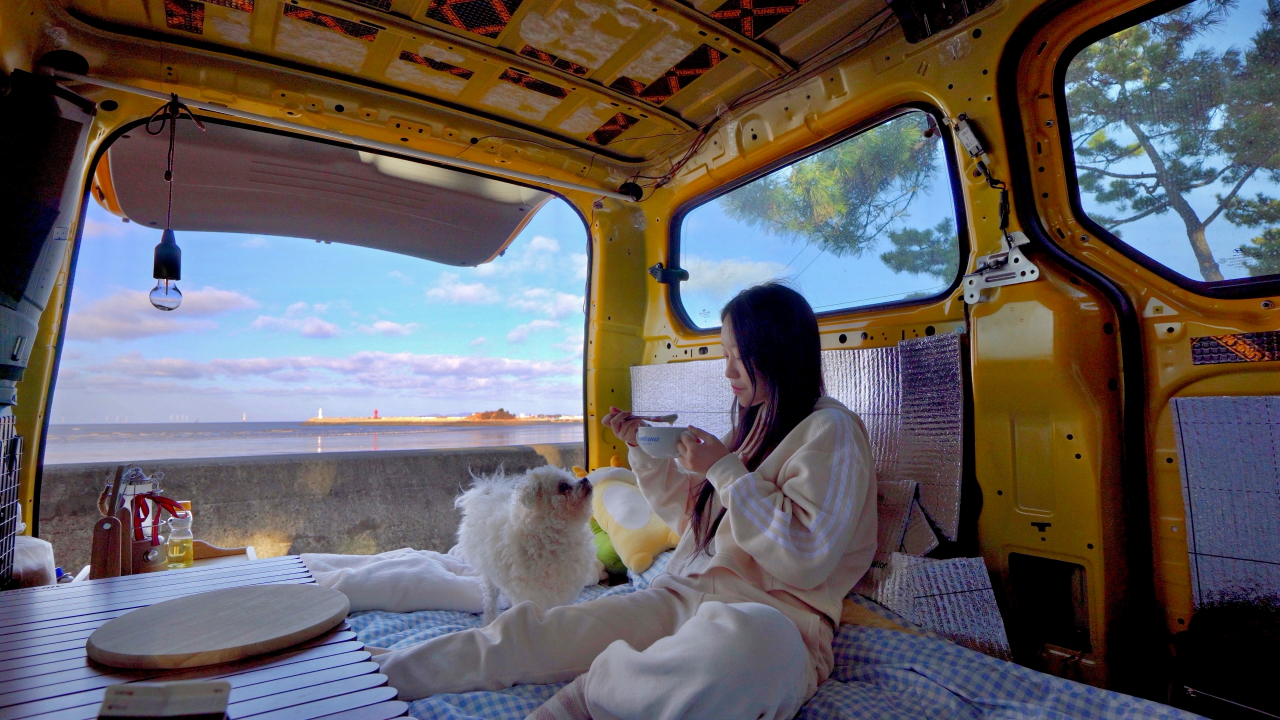
This is the part of Korean camping that genuinely has no Western equivalent. 차박 (chabak, literally "car-sleeping") exploded as a trend in 2020 when COVID restrictions made traditional campsites and hotels uncomfortable, and Koreans started just driving their SUVs to a scenic spot, folding the back seats down, throwing a memory-foam pad on top, and sleeping there for the night.
The numbers tell the story. By end-2022, 41.6 percent of Koreans said they had gone car-camping at least once, up from 4 percent the previous year, per a Korea Tourism Organization survey of 3,079 respondents. Camping vehicle registrations hit 48,836 by September 2022, an eightfold increase from the 6,040 in 2012. This is a market that grew 700 percent in a decade, and most of the acceleration happened in the 24 months after March 2020.

Here's the industry-side detail that nobody outside Korea notices: Hyundai and Kia openly redesigned their model lineups around 차박. The Hyundai Palisade, the Kia Carnival, and the Kia Mohave all got marketed as "chabak-ready" with seat configurations that fold completely flat in the back. Hyundai Motor's accessory division now sells branded camping equipment, including roof boxes, air purifiers tuned for tent interiors, and folding camping tables, that are designed to slot into specific model trunks. That's not opportunistic. That's a Tier-1 automaker reorienting product design around a cultural shift.
The deeper appeal point: 차박 strips out the heaviest friction point of traditional camping (setting up and breaking down a tent) and replaces it with the convenience of "I drove here, I sleep here, I drive away." For Seoul professionals trying to escape Friday-night gridlock and be back by Monday morning, the time savings are the entire pitch. A car-camping slot costs ₩40,000 to ₩50,000 a night. A caravan slot runs ₩150,000+. Glamping clears ₩200,000 to ₩300,000. 차박 is the budget tier that lets weekend campers go five times a year instead of one.
글램핑: Why Korean Glamping Is a Different Animal
Western glamping is usually a bell tent on a farm with a real bed and maybe a hot tub. Korean 글램핑 (glamping) is a fully kitted-out resort experience where the operator has pre-assembled everything. Bedding with hotel-grade linens, a private deck with a charcoal-ready BBQ pit, an electric range, a mini-fridge, an air conditioner in summer, underfloor heating (온돌) in winter, and often a hot tub or sauna on the deck.
The price point is intentional. At ₩200,000 to ₩300,000 a night, Korean glamping sites are not budget. They are Korean luxury travel's entry tier for nature, the equivalent of a mid-range hotel weekend, except you're inside a tent under pine trees in Gapyeong instead of inside a concrete tower in Gangnam. Florence Glamping and Pine4rest in Gapyeong are two of the most-booked properties, both within 90 minutes of Seoul by car, both pre-stocked with private campfire areas and dining utensils so guests can show up with a grocery bag and nothing else.
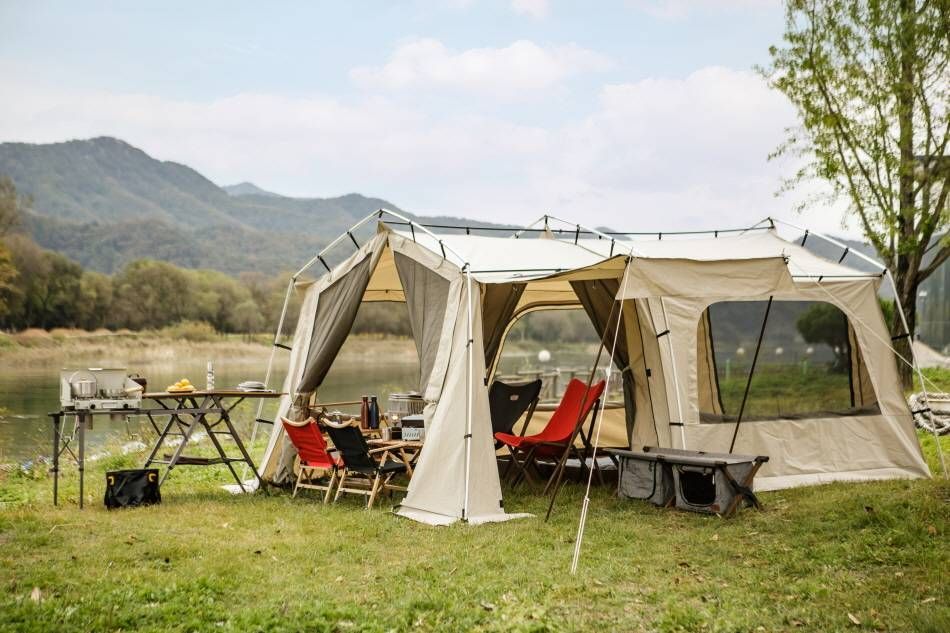
Why Korean families prefer this format to backpacking is straightforward once you see the math. Korean parents with two kids under ten are not going to drag a four-person tent, sleeping bags, a camp stove, and a cooler into the woods for the privilege of badly cooking on a single burner. They're going to book a glamping site that costs ₩250,000, drive 90 minutes north, hand off the cooking to the pre-installed BBQ pit, let the kids run around a fenced lawn, and sleep in a real bed. That's not camping the way an REI customer would frame it. But that is the appeal for the people actually paying.
The market signal here is that glamping is what unlocked outdoor leisure for the demographic that would otherwise not camp at all. Korean Camping Federation industry data suggested the auto-camping and glamping market combined sat around 1.6 trillion won (~$1.6 billion) by 2021, with glamping the fastest-growing segment year-over-year. That growth came almost entirely from converting Korean families who would have booked a hotel into people who book a glamping site.
The Underrated Tier: Mountain Valley and Riverside Campsites (산골짜기 & 노지캠핑)
Below the polished glamping tier is the more local, less Instagram-friendly version that most foreign tourists never see: 산골짜기 (mountain valley) campsites tucked into Gangwon-do and Gyeongsangbuk-do, and 노지캠핑 (no-jicamping, free-form camping on unmanaged land near rivers and beaches). This is the version where you actually do bring your own everything, and the campsite is often a graveled lot next to a stream operated by an ajummah who runs the place out of her house.
The appeal here is different from the glamping tier. Mountain-valley camping in places like Inje-gun or Bonghwa-gun is what Korean campers go to when they specifically want quiet, want to fish in a stream, want the smell of pine, and want to actually unplug. The campsite owners typically charge ₩20,000 to ₩40,000 a night, sell firewood for ₩10,000 a bundle, and provide a shower block that might be cinder-block but works. This is the format with the most direct overlap to American state-park camping, and yet it's the one foreign travel writers cover the least.
노지캠핑 is more controversial. It's the practice of just pitching a tent on a riverbank or beach that doesn't officially charge a fee, which Korean campers have done forever but which has been increasingly regulated since the Ministry of Oceans and Fisheries revised the beach management act in 2023, and the Parking Lot Act was updated in September 2024 to ban camping, cooking, and fire-lighting in public parking lots (fine: up to ₩500,000). The crackdown is the reaction to a real problem. Tent-squatting (albakgi, 알박기), where campers leave tents up for weeks to reserve prime spots, became a national irritation around 2022-2023. If you want to experience 노지캠핑 the legal way now, you stick to designated free-camping zones that local governments have set aside.
The Korea Times Riverside Camping Format: Why Nanji Became the Default Recommendation
The Korea Times has covered Nanji Camp at Hangang Park as the entry-level camping recommendation for foreigners specifically because of the zero-equipment-required model: you arrive at the gate, pay, and the Seoul Metropolitan Government's operator has everything pre-rented (waterproof tents, heated floors, grills, chairs, blankets, even meat at the on-site supermarket). The pitch is that you can decide on Saturday afternoon to camp Saturday night and pull it off without owning a single piece of gear.
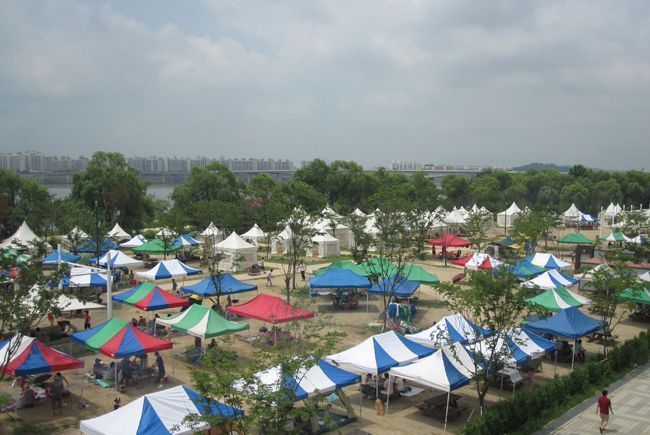
That's deceptively important from an industry-design perspective. The Seoul city government is essentially using Nanji as the on-ramp campsite for the entire camping demographic. The place a Korean who has never camped goes first, decides they like it, then graduates to buying their own gear and going to Gapyeong or Gangwon-do the next time. The five other Seoul city government campsites (Noeul Park, Jungnang, Gangdong Greenway, Seoul Grand Park, plus Han River parks at Yeouido, Ttukseom, Jamwon, Jamsil) all run the same playbook. That's policy-driven leisure infrastructure that quietly built the entry funnel for the country's billion-dollar camping market.
The COVID Boom That Permanently Reset the Market
Every conversation about modern Korean camping eventually traces back to a 30-month window between March 2020 and late 2022. The COVID social-distancing rules killed indoor leisure (movie theaters, karaoke, indoor restaurants over a certain capacity), and outdoor leisure was the only remaining socially-acceptable weekend activity. Camping was the perfect format: outdoors, small-group, easy to keep distance.
What actually happened in the market is more interesting than just "demand went up." The customer base demographic shifted permanently. Pre-2020 camping was dominated by men in their 40s-50s with serious gear obsessions. Post-2020 brought in three new customer segments that have stayed: young families with kids under 10 (drove the glamping boom), couples in their 20s-30s using 차박 as a cheap travel format, and solo female campers (the most surprising segment, large enough that YouTubers like Kimseonjji and BongBongCamping built six-figure subscriber channels just documenting their solo trips).
The brand winners from that window were predictable but instructive. Helinox saw inventory clear out every season. Coleman Korea expanded its retail footprint. Snow Peak Korea hit record revenue. Hyundai and Kia reoriented vehicle product design around the trend. And SoCar, the local car-sharing service, launched a dedicated camping-vehicle rental tier in August 2023 priced at ₩110,000 to ₩130,000 a day, which is what tells you the gig economy started chasing the same dollars.
Why Foreign Tourists Miss This Almost Entirely
Here's the gap that I find genuinely strange after a decade in this industry: the Korean camping market is now a billion-dollar leisure category, the country has 3,600+ campsites, and the Korea Tourism Organization actively promotes glamping through Visit Korea English-language portals. And yet the average Western tourist's Korea itinerary is still Seoul-Busan-DMZ-Jeju with maybe a Nami Island day trip thrown in.
Part of the explanation is logistical. International travelers don't rent cars in Korea as often as they do in Japan or Thailand, and Korean camping is fundamentally a car-dependent activity outside the Han River sites. Part of it is the booking friction. The Korea Tourism Organization's Go Camping portal (gocamping.or.kr) is in Korean, the Nanji reservation system is partially English-localized, and most caravan-and-glamping operators run Korean-only Naver booking pages. Part of it is just inertia: travel guides recommend palaces and street food because those are the legible "Korean" experiences.
But the appeal point Korean residents already know: a weekend at a Gapyeong glamping site or a Nanji riverside camp is a faster, deeper window into how modern Koreans actually relax than another temple visit. The cultural mechanics (the gear-arms-race, the food-delivery-to-the-tent (yes, you can have fried chicken delivered to the Han River campground), the 차박 SUV culture, the family glamping booking pattern) are all visible if you spend one night at any decent campsite. The reason this article matters is that the version of Korea that K-drama, K-variety, and K-pop production crews film for tone-setting B-roll is the camping version, not the palace version. The smart move for travelers in 2026 is to add one night of camping to their Seoul itinerary and see what the cameras have actually been showing them all along.
Explore More of Korea with Daebak
Want to bring a piece of Korea home? Get curated Korean snacks, drinks, and lifestyle goods delivered straight to your door with the Daebak Box.


