


Table of Contents
To everything there is a season. Autumn pairs falling leaves with falling temperatures and shorter days. Winter brings long cold nights, holiday stress, and a new year. Spring is a season of showers and flowers. After a long year, we earn summer, a period of long days and freedom. It is the time to relax, see family and friends, and dive into hobbies, especially watching films. When most people think of summertime movies, the latest blockbusters come to mind. In contrast, our recommendation for your summer watchlist is the independent Korean film Little Forest (리틀 포레스트). It combines everything we love about each season with our desire to unwind.
Despite the title, there is a whole lot to love about this little Korean indie film. Little Forest placed second at the Korean box office on opening day, held third for about three weeks, and went on to be nominated for and win several awards. Through a simplified plot, it packs a tremendous amount of heart.
What Is It About?
Hye-won (The Handmaiden's Kim Tae-ri) grows weary of the busy, lackluster city life. After she fails her teachers' exam while her boyfriend passes his, she decides to visit her childhood home for a little while. Her old friends, Eun-sook (The Secret Life of My Secretary's Jin Ki-joo) and Jae-ha (Reply 1988's Ryu Jun-yeol), are surprised by her arrival, having had no notice, but they soon fall into step again. Hye-won claims it is a short visit of a few days, yet a few days turn into seasons. Back home, she wrestles with her past while feeling frustrated about her future. During this uncertain time, she discovers ways to sustain herself and prepares traditional Korean meals that stir up memories of her mother, who plays a major role in her emotional unrest. With each season, Hye-won goes through personal revelations.
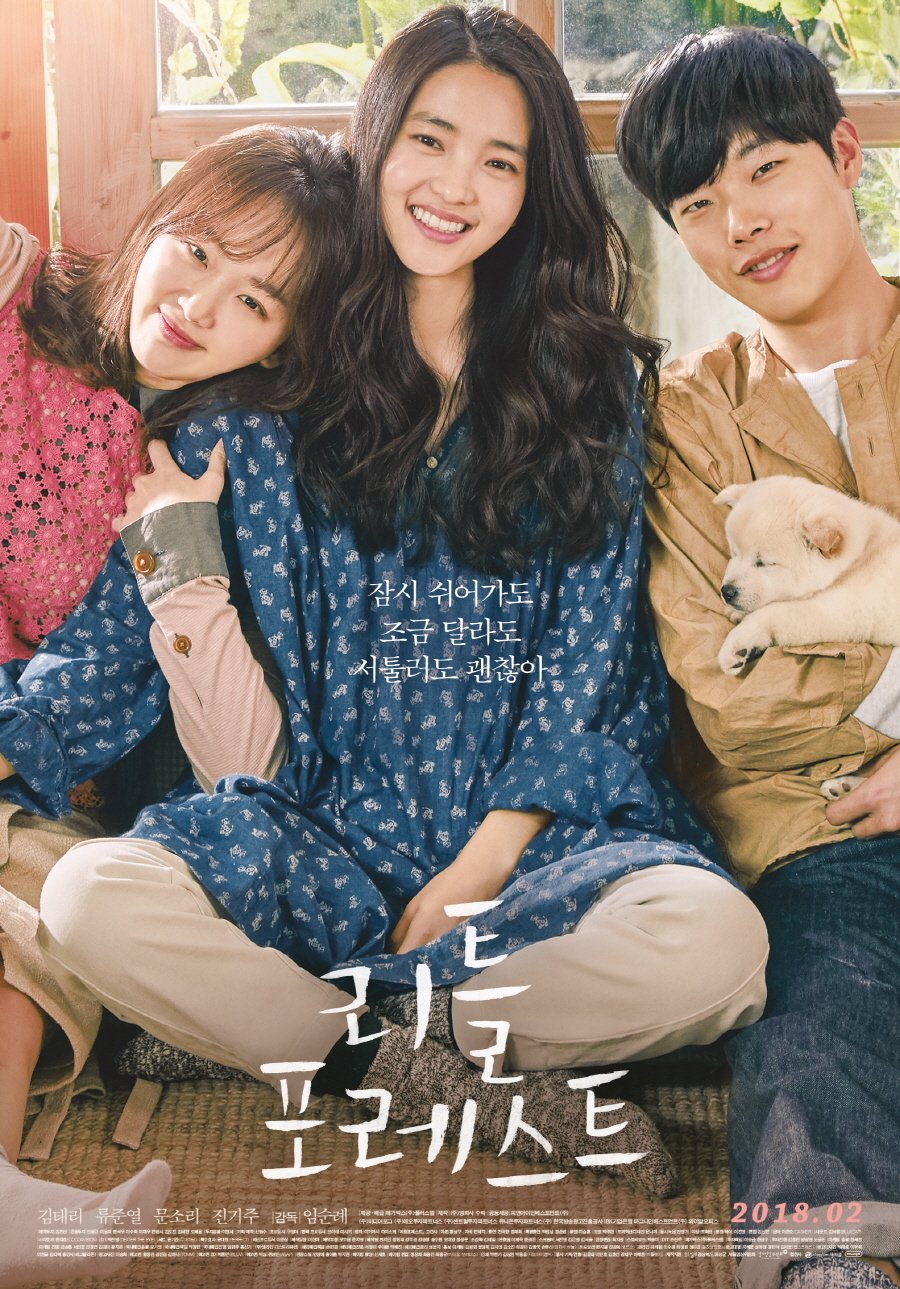
Originally, the story came from a Japanese slice-of-life manga series called Little Forest (リトル・フォレスト) by Daisuke Igarashi (五十嵐 大介), who is known for his bold, detailed art style and innovative storytelling. His works are often described as fantastical as he draws inspiration from folklore and nature combined with surrealism and spiritual themes, a style that has earned comparisons to the films of Hayao Miyazaki (宮崎 駿). Igarashi has stated in interviews that Miyazaki's My Neighbor Totoro was a key influence on his decision to become a manga artist.
It was later adapted into a film duology by Junichi Mori. Part 1, Little Forest: Summer/Autumn, screened at the 2014 San Sebastian International Film Festival, and Part 2, Little Forest: Winter/Spring, screened at the 2015 Berlin International Film Festival, both under a Culinary Cinema section. This Japanese adaptation is actually the inspiration for the Korean film. Director Yim Soon-rye (임순례) explained that the producer of her Little Forest adaptation had seen the Japanese film and was besotted by it, and so the project was offered to her. Technically, Yim's film is an adaptation of an adaptation.
Why It Is Special
Yim says that the whole intent of Little Forest is to heal and soothe the young generation of Korea, but it is such a moving film that it can expand its healing message across the globe. Overall, it is a great movie because the plot as a whole veers from the typical classical design and tastefully adheres to prominent realist elements, which allows it to address a multifaceted ideology within such a simple storyline. This multifaceted ideology is one that just about every person faces. It is the idea of growing and thriving as a person in the best environment for themselves, much like crops grow best in a specific area and season. To grow as you should may mean going against what society says, including where you should thrive and at what time this growth should happen.
The film is especially atypical as there is no antagonist, no external conflict, and a vague ending with loose ends. It is unconventional in its content as it never quite goes the way we expect. While there is neither antagonist nor substantial conflict, both usually thought to be essential to screenwriting, there is still a lot to captivate the viewer. After all, our daily lives are already increasingly hectic. Films can be our gateway to relaxation.
Going Against Stereotypes
The top five highest-grossing movies in Korea are of the action genre with the top being the 2014 war film The Admiral: Roaring Currents (명량). Due to its popularity, most Korean films produced fall under this genre. Yim emphasized that she accepted the project of Little Forest because nowadays most of mainstream Korean cinema is very violent and big-budgeted, and she wanted to make a small film, a film which can heal and soothe.

In contrast, the stereotypes of K-dramas adhere to romance-focused storylines along with superficial plotlines. Little Forest does contain romantic themes, as it is a true aspect of life, but it plays out realistically and there is no resolution or happily ever after concerning relationships, nor does it focus on melodrama.
In Korean culture, society expects children to go off and contribute by moving to big cities, such as Seoul, and holding down a respectable nine to five job. Little Forest offers an alternative. As Natalie Ng wrote for Filmed In Ether, sometimes you have to go away from what you know to realize what you really need. Like every country-to-city story, people from the village, and Hye-won herself, regard thriving in Seoul as success. To return to the countryside implies failure. But ultimately, what the film shows us is that everyone grows at their own pace and will thrive in the environment that best suits them. In East Asia, there is an increase in popularity of a phrase or even way of life known as sohwakhaeng (소확행), which translates to small but certain happiness, basically appreciating the simple things of life. The heart of the film is ultimately about becoming at peace with oneself.
Symbolism
As mentioned, the film follows an unusual narrative. Rather than following the typical Freytag pyramid, the seasons define and dictate the narrative structure, which plays into the realism of the film. It coincides with the importance of symbolism. Seasons reflect Hye-won's emotions and revelations. They are all times of different growth, but each growth is specific to the season and helps to capture a true struggle and reality for many. As an example, winter is a time of indifference, anguish, and cold-heartedness. Spring is a time of recollection and remembering one's roots. Summer is a time of perseverance. Autumn is a time of acceptance and understanding.

Additionally, the growing and preparation of food are used as metaphors throughout the film. As Ng explains, despite its simplicity there is meticulous attention and care in the way the camera follows how food goes from the land, is prepared, and is finally consumed and shared with people. It is easy to see that the care we have for our food is a metaphor for how we treat ourselves and others.
Cinematography and Score
Although the film plays out like the slow indie it is, it is easy to watch thanks to tasteful editing along with scenic cinematography. Lee Seung-hoon's cinematography is gorgeous as it captures the beauty and detail of a simple life, a contrast to what many of us envision when we picture Korea given that the Korean Wave mainly focuses on city life. Lee Yun-oh's score complements the cinematography perfectly. It adds a charming, ethereal element to the film without overpowering it. Most of the time you do not even notice it because it supplements the rest of the sound design so well, especially in the preparation of food. Imagine a very high quality video of Buzzfeed's Tasty with the addition of the best ASMR.
The filmmaking techniques are also unique, as Yim prefers a slower-paced style which is not the norm nowadays. This is evident in her frequent use of long takes of dialogue and little to no cuts. When she can, she uses slow cuts or easy transitions through match cutting. One of the most aesthetically pleasing techniques is that each passing season is marked by a different hue to emphasize the changing chapter. We can see this technique used also in the case of changing locations. Scenes in the city are murky and dark with artificial lighting while those shot in the country are bright with natural lighting.
If you are looking for an escape from your hectic or mundane life, seek healing, a sanctuary of sorts, through this film, Little Forest, as you and Hye-won take a break to figure out life. Along the way, you may discover your calling, which could be moving and finding a new vocation or it could be as simple as trying out some new food. Films have the power to initiate great contemplation, and this one certainly inspires the viewer to find their own happiness, whatever that may look like.
You can watch Little Forest on Viki or Amazon Prime. Let us know what Korean film you would like us to review next in the comments below.
Written by Tiffany Simms. Special thanks to Stephanie Ferrell for her assistance and contribution to this article.
Explore More of Korea with Daebak
Want to bring a little piece of Korea into your life? The Daebak Box is packed with the best Korean snacks, ramen, and cultural goodies delivered monthly to your door.


