


Table of Contents
Korean royal court cuisine, called gungjung eumsik (궁중음식) or gungjung-yori, was the highest expression of Joseon dynasty (1392 to 1910) culinary art. Court cooks combined tribute ingredients from every province of the peninsula with strict rules of balance, color, and ceremony, producing a tradition that still anchors modern Korean fine dining. From the twelve-banchan sura table to dishes like gujeolpan and sinseollo, the cuisine of the Joseon kings has shaped how Koreans think about a complete meal.
What Is Gungjung Eumsik?
Gungjung eumsik refers to the food prepared inside the Joseon royal kitchens for the king, queen, dowager, and crown prince. Records preserved in the Wonhaeng Eulmyo Jeongni Uigwe, an 18th-century royal protocol describing King Jeongjo's eight-day procession to Hwaseong Fortress, document the daily meal cycle in detail. Meals were served roughly five times a day, including an early-morning porridge, a main morning sura, a light afternoon dish, an evening sura, and a late snack. Recipes were passed down orally among court ladies known as sanggung and male cooks called daeryeong sukshu.
The Sura Table and the Twelve Banchan
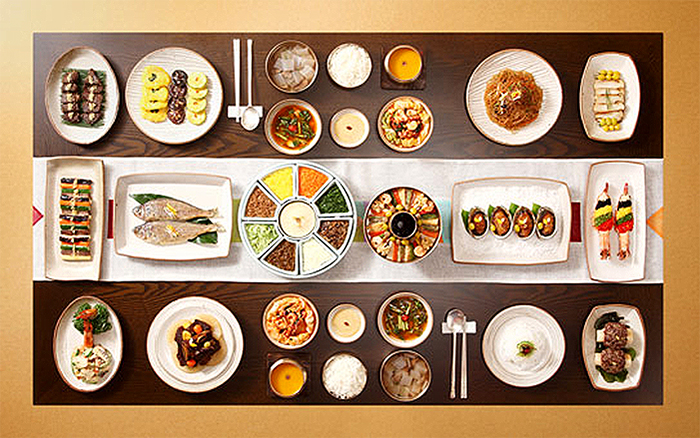
The royal main meal, surasang (수라상), was set with twelve side dishes plus rice, soup, stew, hot pot, kimchi, and sauces. Two rice bowls were standard, white rice and red bean rice, paired with seaweed soup (miyeok-guk) or beef bone broth (gomtang). The table actually consisted of three settings: the large round daewonban that held the main dishes, a smaller gyeotban for additional bowls, and a square chaeksangban with a clear soup and condiments. Strong, salty, or pungent flavors were avoided so that the natural taste of each ingredient could be appreciated by the king.
The Five Colors Principle: Obangsaek on the Plate
Royal cuisine followed the obangsaek philosophy of five cardinal colors, blue or green, red, yellow, white, and black, derived from Korean cosmology. Court cooks arranged ingredients so that each spread carried all five colors, believed to bring nutritional balance and harmony with the natural order. Egg garnishes were divided into yellow yolk strips and white sheets, red came from chili threads or jujubes, green from minari or spinach, and black from pyogo mushrooms or stone-ear fungus. The visual logic still guides dishes like bibimbap and gujeolpan today.
Signature Dishes of the Joseon Court
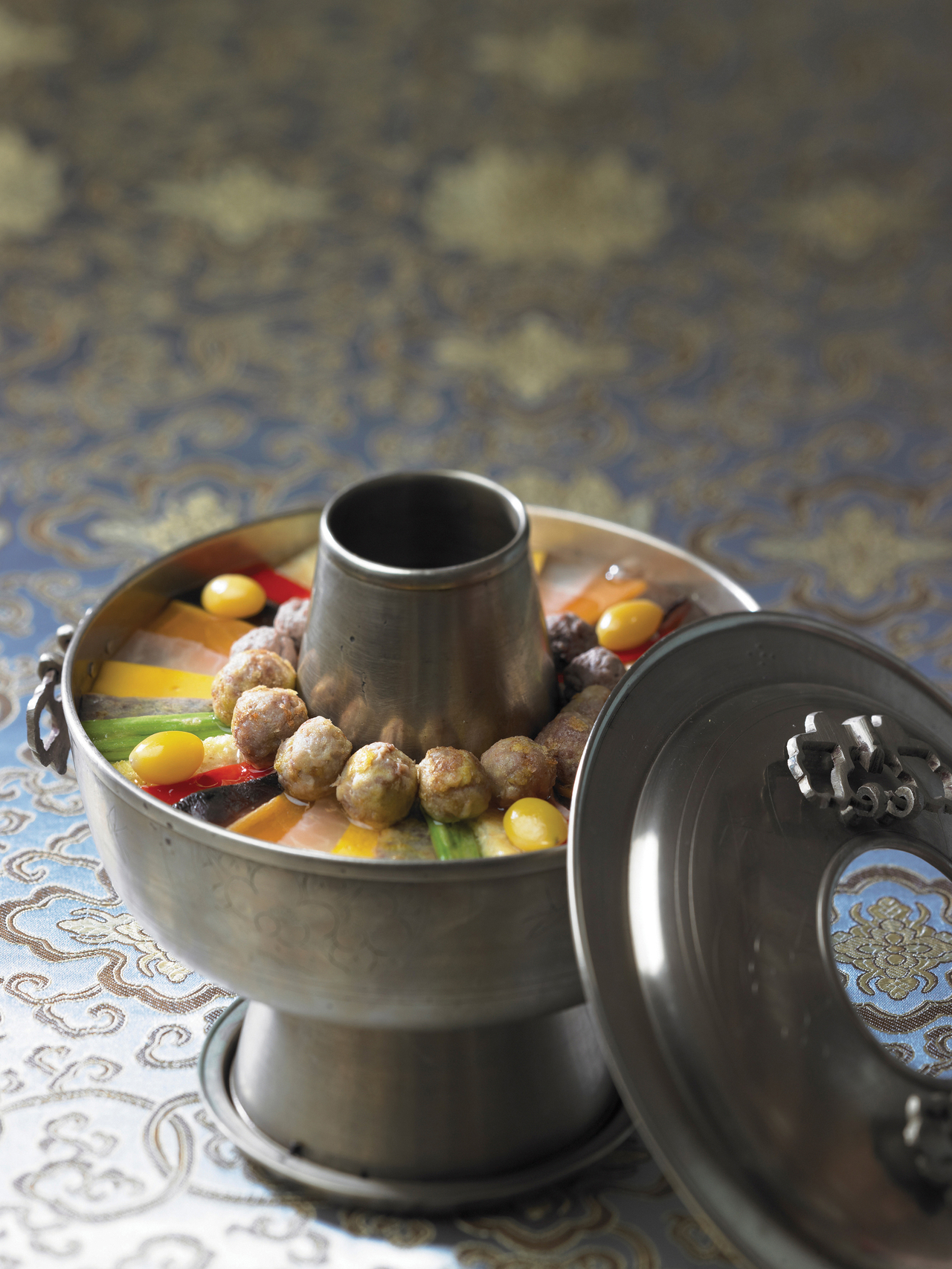
Gujeolpan (구절판), the nine-section platter, is among the most elaborate royal appetizers. Eight finely shredded ingredients of beef, shiitake mushrooms, carrot, cucumber, bean sprouts, and egg yolk and white pancakes are arranged in the outer compartments around thin wheat crepes called miljeonbyeong in the center. Diners wrap small portions in the crepes. Sinseollo (신선로), the brass hot pot mentioned earlier, was historically called yeolgujatang, or the soup that pleases the mouth, and combined sliced beef, fish jeon, mushrooms, beef balls, walnuts, ginkgo nuts, and pine nuts in a clear broth.
Other dishes that began at the palace include tangpyeongchae (탕평채), a mung bean jelly salad named for King Yeongjo's policy of political balance; seongnyu-mandu, pomegranate-shaped dumplings; the original palace bulgogi, which evolved from a charcoal-grilled dish called noeuijuk; and the royal hot-broth naengmyeon eaten at summer banquets. Japchae, today a household staple, debuted at the 17th-century court of King Gwanghaegun.
Jinyeon and Jinchan: The Royal Banquet
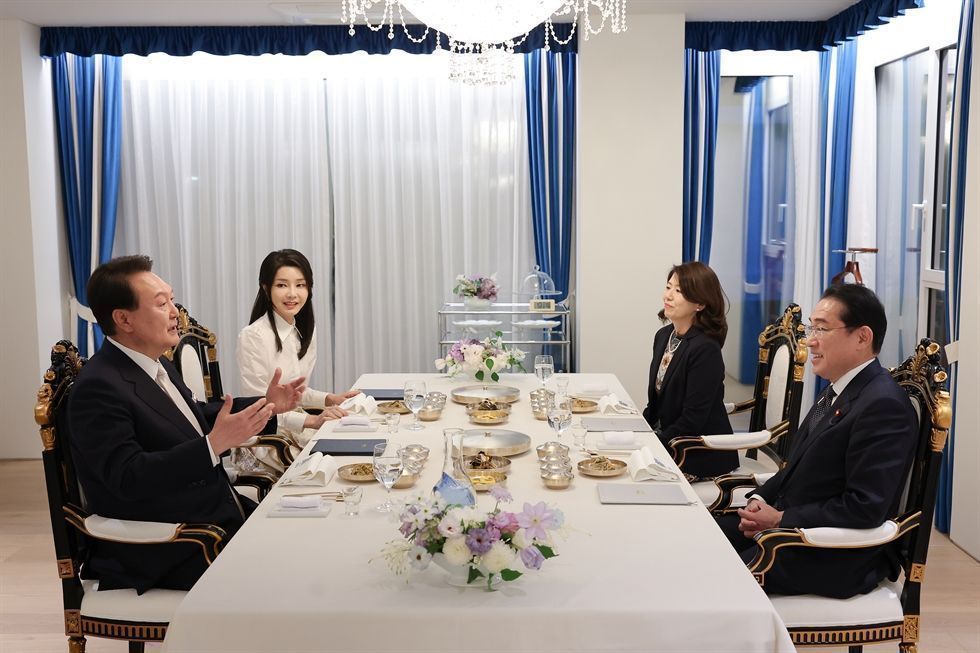
Beyond daily meals, the Joseon court staged elaborate banquets called jinyeon for national events and jinchan for celebrations within the royal family. Tall stacked tables called goimsang were piled with rice cakes, hangwa confections, and fruits arranged 40 to 60 centimeters high in symbolic patterns that wished the monarch prosperity and long life. These towering displays were ceremonial rather than edible. The king ate from a smaller side table of simple noodles and side dishes, while the leftover banquet food was later distributed to relatives, servants, court musicians, dancers, and soldiers.
Living National Treasures and the Royal Cuisine Institute
South Korea designated Joseon royal cuisine an Important Intangible Cultural Property in 1970, with a lineage of holders called Living National Treasures. Han Hui-sun, who cooked for the last two kings of Joseon, Gojong and Sunjong, was the first master. Her successor Hwang Hae-sung helped found the Institute of Korean Royal Cuisine (한국궁중음식연구원) in central Seoul, which has trained generations of chefs in 20 court recipes. Han Bok-ryeo, daughter of Hwang and the current third master alongside Chung Gil-ja, served as the food consultant on the 2003 MBC drama Dae Jang Geum.
Dae Jang Geum and the Global Awareness Boom
The 2003 MBC sageuk Dae Jang Geum (대장금), known internationally as Jewel in the Palace, became the single most influential vehicle for global awareness of Korean royal cuisine. Starring Lee Young-ae as a real historical figure who rose from the royal kitchen to become the first female royal physician of Joseon, the drama aired in more than 90 countries and pushed royal dishes into mainstream view from Hong Kong to Iran. Lee Young-ae trained for a month in royal cuisine under Han Bok-ryeo to film the food scenes accurately, and a wave of Dae Jang Geum cookbooks and themed restaurants followed.

Royal Cuisine vs Yangban Jongga Cuisine
Royal cuisine is often confused with the cooking of the yangban aristocracy, but the two traditions diverged in scale and intent. Jongga eumsik, the cuisine of the head families, focused on ancestral rite tables, hyangto (regional) ingredients, and dishes meant to last across long ceremonial periods. Royal cuisine, by contrast, pooled tribute from every region, demanded fresh seasonal ingredients prepared the same day, and avoided strong seasoning so the king could taste the produce itself. Many famous regional dishes such as Andong jjimdak or Jeonju bibimbap trace partly to yangban kitchens rather than the palace.
Modern Royal Cuisine in Seoul
Today travelers can sample gungjung eumsik at several venues in Seoul. Korea House (한국의집) in Chungmuro, operated by the Korea Heritage Agency, runs a fine-dining royal menu with seasonal Joseon-tribute ingredients such as black-feathered ogye chicken, top-grade red ginseng, and pine mushrooms. Yongsusan (용수산) in Bukchon and Sogong-dong specializes in Gaeseong-style noble cuisine. Jihwaja (지화자), founded by Han Bok-ryeo's family, is the most direct heir to the royal kitchen. Two-Michelin-starred restaurants Mingles and La Yeon at the Shilla Seoul reinterpret royal techniques for a contemporary tasting menu.
Drinks, Etiquette, and Heritage Status
Royal meals were paired with refined Korean liquors. The Joseon court favored cheongju clear rice wines and the modern soju brand Hwayo (화요), made from Korean rice and named for the same character as the day of fire, is often served at royal-cuisine tastings. Court etiquette demanded silence at the table, careful posture, and slow consumption. Korea's tradition of communal ceremonial food, which includes elements of royal banquet practice, was inscribed on UNESCO's Representative List of the Intangible Cultural Heritage of Humanity in 2024, formal global recognition of a culinary system that has survived more than six centuries.
Explore Korean Snacks with Daebak
Love Korean food? Get authentic Korean snacks and ramen delivered straight to your door with the SnackFever Box by Daebak.


