


Table of Contents
Hongdae is the one Seoul neighborhood I always tell first-time visitors to see at least twice, once during the weekday afternoon and once on a Saturday night, because they are almost different places. I have spent close to fifteen years watching this district reshape itself through indie music, gentrification, K-pop's global surge, and a post-COVID rebuild that is still working itself out. The name itself is a nickname. 홍대 (Hongdae) is short for 홍익대학교 (Hongik Daehakgyo), Hongik University, whose art and design school anchored the whole cultural gravity of the area from the early 1990s onward. Art students bleed into any neighborhood in interesting ways, and Hongdae was where Seoul got its first serious indie rock scene, its first messy DIY culture, and eventually its first mainstream tourist crush.
The 1990s Indie Roots Nobody Advertises Anymore
The Hongdae most tourists see in 2026 has almost no visible trace of what built it. In the mid-1990s, when rents around Hongik were still cheap and the Sinchon student corridor was Seoul's default nightlife, a small circle of underground rock clubs opened in basements and second floors around what is now the Playground area. Drug (drug), Slug, Skunk Hell, later Club FF, later still Club Ta. If you have ever heard a Korean say that Crying Nut and No Brain are the founding fathers of Korean punk, this is where they broke through. Crying Nut's "Speed Up Losers" (1998) came out of that scene. So did every 90s to 2000s Korean rock band you can name.
Here is the industry insight most guidebooks skip. Through the 2000s and 2010s, Hongdae's live-venue circuit was estimated to have supplied roughly 40 percent of Korea's working indie band talent pool at any given moment. It was not a big number in absolute terms, but it was concentrated. Labels like Ruby Salon Records, Sound Holic, and Beatball were physically headquartered inside walking distance. If you were a Korean kid in the mid-2000s who wanted to be in a real band, you moved to Hongdae. That is the reason the district still feels different from any other Seoul neighborhood even after tourism papered over most of the venues. The bones of a music scene are still there, even if the flesh is thinner.
Hongdae Playground and the Busking Ritual
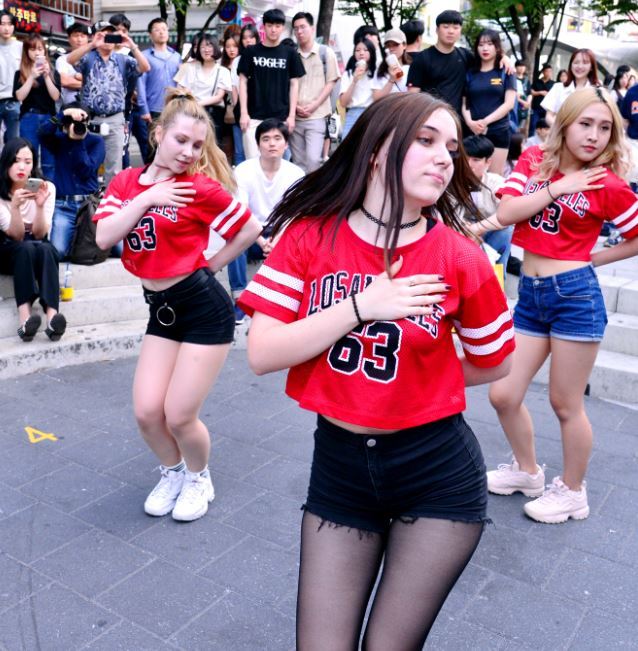
Walk out of Hongik University Station exit 9, take about a two-minute walk, and you land at 홍대 놀이터 (Hongdae Nolteo, literally "Hongdae Playground"), which is a small park that is arguably the single most-filmed spot in K-pop influencer TikToks. On weekend nights, this park and the pedestrian streets radiating off it are wall-to-wall buskers. Some are teenage dance crews grinding through NewJeans and aespa choreo for a live cover audition portfolio. Some are one guitarist, one loop pedal, one 400,000-won Boss RC-500 rig cranking out acoustic Coldplay to a crowd of exchange students. Some are legitimate signed indie acts using the park as a free promo tour before their real gig at MU:CON in September.
What Mapo-gu (the district government) did around 2016 was formalize the whole thing into what they call the Red Road, a roughly 2 km corridor with lettered sections. R1 became a retro-themed cultural market, R2 became the official Busking Street with a permit system so acts do not step on each other's amps. The appeal for a foreign visitor is that busking here is the rare thing in Seoul that is both totally free and genuinely high-caliber. You can watch a dance cover crew that has 400,000 Instagram followers and pay nothing. Compare that to Times Square, where any decent street performer is nine times out of ten actually a hustle for photo money. Hongdae buskers mostly want you to scan their QR code and follow their Instagram. Different economy.
The Club Scene, Then and Now
The Hongdae 클럽 (club, meaning dance club) scene deserves its own explainer because the international reputation is bigger than the current reality. In the 2010s, Cakeshop (now closed at its Itaewon location and reopened smaller), Vurt, Faust, Contra, and Pistil were the internationally famous names, with a mix of house, techno, and hip-hop nights that drew tourists specifically from Tokyo, Taipei, and Shanghai. Hongdae Club Day, the district-wide pass event that ran from 2001 to around 2011, put the district on the global electronic music map alongside Berlin's Berghain scene and London's Ministry of Sound. It was that big for a hot minute.
Post-COVID recovery has been uneven, and this is where I put my industry hat on. The dance clubs came back reasonably fast because the model is scalable. You need one big room, a good sound system, and a solid booking. The small live-music venues, which needed 50 dedicated fans buying 15,000-won tickets four nights a week to survive, took a much harder hit. Between roughly 2015 and 2020, rents in the Hongdae core (Sanggu, Seogyo-dong, Yeonnam-dong) went up an estimated 60 percent, and the pandemic hit landlords already leaning on their tenants. Places like Prism Hall and V-Hall survived. Dozens of smaller rooms did not. The venues that came back after 2022 mostly repositioned toward K-pop cover shows, K-pop dance classes for tourists, and Instagram-first dessert cafe formats.
Yeonnam-dong, the Gentrification Case Study
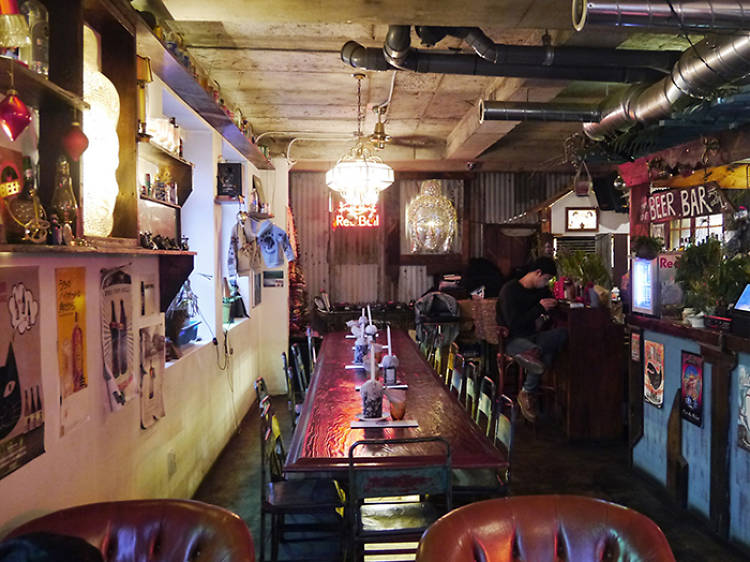
Yeonnam-dong (연남동) is the neighborhood you actually want to spend a slow Saturday afternoon in, and it is technically adjacent to Hongdae rather than inside it. The area sits between Hongik University Station and Gajwa Station, wrapping around the linear Gyeongui Line Forest Park, which used to be a train track and got converted into a walkable green corridor around 2016. That single infrastructure move triggered maybe the fastest gentrification cycle Seoul has ever seen. Land values in Yeonnam doubled between 2015 and 2019. Every house that had been a family residence became either a cafe, a wine bar, or a small design studio.
What makes Yeonnam feel different from the Hongdae main drag is scale. The alleys are narrow, the buildings are two or three stories tops, and most of the businesses are individual owner-operators rather than chains. This is where you find things like the roasted-corn latte cafe that has 15 seats, the natural wine bar run by a former Nolboo employee who trained in Copenhagen, or the record store that stocks Japanese city pop reissues alongside HYUKOH LPs. If you have watched any Korean lifestyle YouTuber film "a day in Seoul" content in the last three years, they almost certainly filmed at least one segment in Yeonnam. It has become the visual shorthand for hip young Seoul.

Sangsu Station Corridor and the Overlooked South Side
If Hongdae proper feels too touristy on your first walk-through, and Yeonnam is booked solid on OpenTable, the honest recommendation from any local who actually lives here is Sangsu Station corridor. Sangsu (상수) is one stop south of Hongik on Subway Line 6, and it has quietly absorbed a lot of the small live-music venues that got pushed out of the Hongdae main drag by 2020 rent hikes. Places like Strange Fruit, Roll:ing:Hall's smaller offshoots, and a scattering of jazz and singer-songwriter rooms keep the analog Hongdae spirit alive with much lower foot traffic. You can walk into a Sangsu 라이브클럽 (live club) on a Wednesday, catch two unknown acts for 15,000 won, and end up sitting next to the drummer's parents in a way that has not been possible on the main Hongdae strip since around 2015.
Sangsu also has the advantage of being a five-minute walk from the Han River, which is the escape valve most tourists forget exists. If you cross under the Yanghwa Bridge you land in the Mangwon Hangang Park section, where you can grab a convenience-store instant ramyeon (a real 편의점 ramyeon eaten by the river at 11 p.m. is one of Seoul's most underrated free experiences), sit on the concrete steps, and watch the Nanji sunset. This is the balancing move to a heavy Hongdae night, and locals do it constantly.
How to Actually Spend a Weekend
Here is the honest itinerary I give friends. Start Saturday at 3 p.m. in Yeonnam-dong walking the Gyeongui Line park. Do the cafe crawl through around 5 p.m. Walk east to Hongdae proper by around 6 p.m. and hit the Playground for buskers as the crowd density peaks around 8 p.m. Grab dinner at a 갈매기살 (galmaegisal, pork skirt meat) joint on one of the side streets off Wausan-ro, because Hongdae still has a solid cluster of second-generation Korean BBQ spots that do not get the tourist mob because they do not have English menus posted outside. Drop into a live venue around 10 p.m. Vurt or a Sangsu 라이브클럽 depending on your genre preference. If you still want to dance, hit the club circuit around 1 a.m. Emerge for haejangguk (hangover soup) at 6 a.m. at any of the 24-hour Yook-gaejang spots. That is a proper Hongdae weekend.
The Appeal Point Foreign Fans Miss
Here is the thing about Hongdae that even long-time Korea watchers sometimes get wrong. The district is not important because of any single venue, band, or cafe. It is important because of density. Within a 15-minute walk you have a working art university, a live indie music circuit (thinner than it was, but still functional), a club scene, a photocard-selling K-pop fandom infrastructure, an art-book cafe cluster, a gentrified alt-neighborhood next door in Yeonnam, and easy Han River access one metro stop south. Nowhere else in Seoul concentrates that variety of youth culture in one walkable footprint. Not Itaewon (which is more nightlife-heavy and less student-driven), not Gangnam (which is corporate), not even Sinchon (which is more purely a university drinking district).
The appeal that keeps global fans coming back, even now that the Instagram gloss makes Hongdae look interchangeable with any hip Asian neighborhood, is the busking specifically. When a five-person dance cover crew hits an aespa "Whiplash" routine at 8:47 p.m. on a Saturday in front of 300 phones, the energy is not something you can replicate in a controlled venue. It is a bit ragged, occasionally out of time, and completely dependent on the crowd cheering. That collision of aspirational K-pop performance culture with actual live audience feedback is the deepest reason Hongdae still matters. The best dance covers here get scouted. The best acoustic singer-songwriters get signed. The line between amateur and professional is thinner in Hongdae than anywhere else in Korea, and standing in that Saturday-night crowd is the closest a visitor can get to watching that line get crossed in real time.
Explore More of Korea with Daebak
Want to bring a little piece of Korea into your life? The Daebak Box is packed with the best Korean snacks, ramen, and cultural goodies delivered monthly to your door.


