


Table of Contents
Parasite (기생충) is the film that most industry conversations about K-content default to when they need a single reference for the moment Korean cinema crossed over. After a decade watching this business from the K-content trade side, I can tell you what the mainstream Oscar recap always misses: Bong Joon-ho (봉준호) did not win Best Picture on February 9, 2020 because Hollywood suddenly noticed a foreign film. Neon and CJ ENM ran a nine-month campaign that started at Cannes in May 2019, the Kims-versus-Parks premise was culturally translatable in a way most Korean films are not, and Bong had already spent 15 years building Western audience familiarity through Snowpiercer and The Host. What follows is the industry-side read on why 기생충 became the film that broke the subtitles ceiling, and what happened to Korean content spending in the two years after it did.

Cannes, May 2019: The Palme d'Or Nobody in Hollywood Priced In
Parasite premiered at the 72nd Cannes Film Festival on May 21, 2019, and won the Palme d'Or five days later on a unanimous jury vote led by Alejandro Gonzalez Inarritu. That unanimous vote is the industry detail worth pausing on. Cannes juries typically deadlock on the top prize for hours (Pain and Glory by Almodovar and Young Ahmed by the Dardenne brothers were both in serious contention), and a unanimous read means the room was not arguing. Bong became the first South Korean director to win the Palme d'Or in the festival's 72-year history. Before him, Park Chan-wook had come closest with the Grand Prix for Old Boy in 2004, and Im Kwon-taek had taken Best Director for Chihwaseon in 2002. Six Korean films had picked up main-competition awards at Cannes across two decades. None had won the top prize.
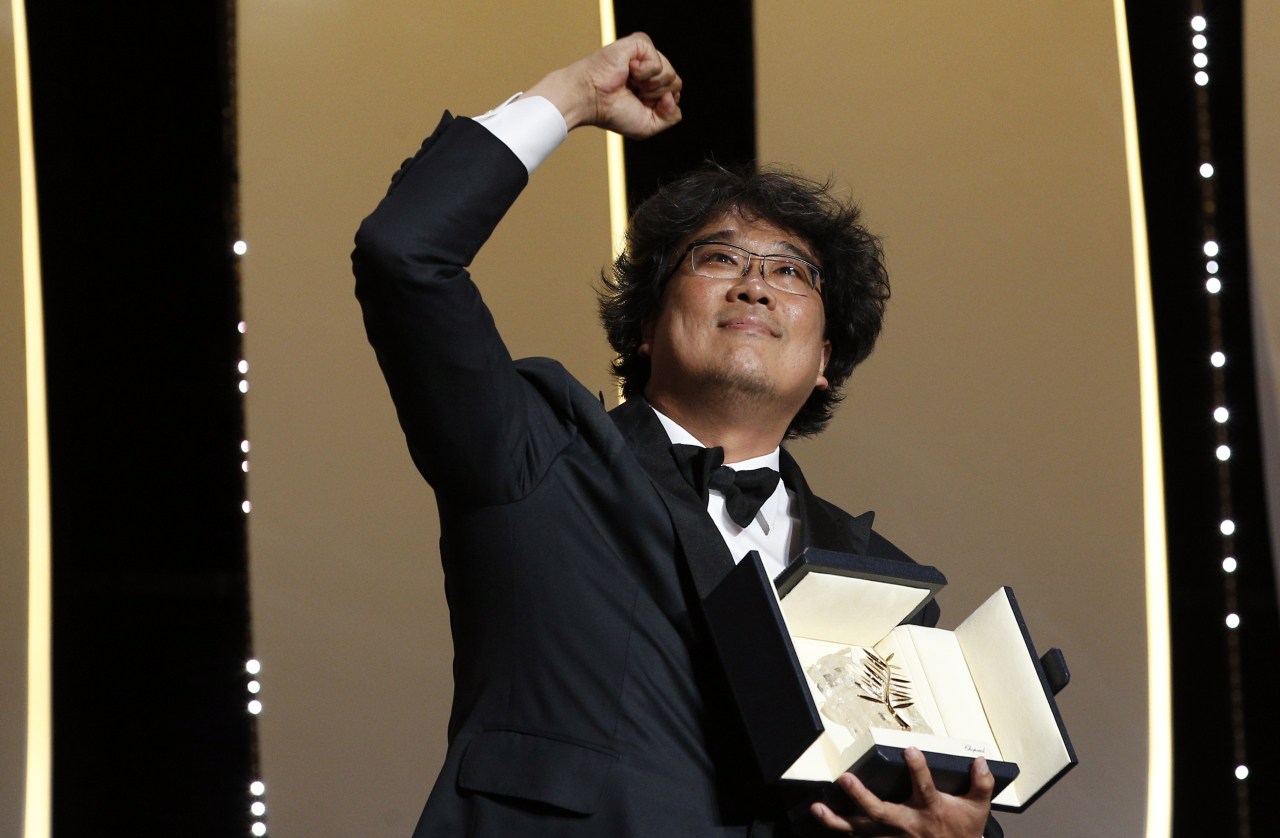
What the Cannes win did in industry terms was compress the film's US release timeline. CJ ENM had already sold North American rights to Neon (Tom Quinn's boutique distributor, previously behind Palme winners including Titane and later Anatomy of a Fall) in early 2019 for a reported low seven-figure number. Neon originally slated a fall arthouse release. After Cannes, Quinn's team accelerated. Parasite opened in the US on October 11, 2019 in just three theaters, and pulled a $393,000 opening weekend, the biggest per-screen average since La La Land and the biggest ever for an international film in the US. That per-screen number is the leading indicator specialty-film buyers watch for, and it told the industry the film had exit velocity beyond the arthouse core.
Why the Class-Divide Premise Translated Without a Cultural Footnote
This is the point most Western coverage of Parasite's Oscar run got wrong. Reviewers kept describing the film as a Korean movie that happened to travel. It traveled because Bong wrote a premise that requires zero cultural translation. A poor family infiltrates a rich family through gig work (English tutoring, art therapy, driving, housekeeping) and the two households collide. Late-stage capitalism looks the same in Seoul, Paris, and Los Angeles, and MoMA chief curator Rajendra Roy nailed the appeal point in Variety when he said the film takes a global crisis and puts it in a Korean microcosm that amplifies the consequences. American viewers do not need to know what a 반지하 (banjiha, semi-basement apartment) is to understand that the Kims live below street level and the Parks live above it. Bong's staff even joked internally that Parasite was a 계단 영화 (stair movie), because roughly 90 percent of the story takes place in the Park house's vertical geometry.

Contrast this with why Memories of Murder (2003) or Mother (2009) never crossed over the way Parasite did. Both are technically better paced than Parasite in Korean-market opinion, but Memories of Murder needs viewers to understand the specific texture of 1980s Chinese-military-era Korean small-town policing, and Mother's plot pivots on Korean caretaking obligations that read as opaque in the West. Parasite's plot mechanics work in any economy with a housekeeper class. That is not accidental. Bong wrote the screenplay with Han Jin-won specifically to strip out cultural specificity that would slow non-Korean viewers.
Bong's Seventh Feature: The Snowpiercer and Host Bridge to Western Audiences
Parasite is Bong Joon-ho's seventh feature (after Barking Dogs Never Bite, Memories of Murder, The Host, Mother, Snowpiercer, and Okja). This filmography order matters because it is the Western audience runway. The Host (2006) drew over 10 million viewers in Korea and hit international festivals as a smart genre film. Snowpiercer (2013) was Bong's official Hollywood debut, a $40 million English-Korean co-production with Chris Evans, Tilda Swinton, and Ed Harris that Radius handled in North America (where Tom Quinn was based before founding Neon, which is why Bong-to-Neon for Parasite was a warm handoff, not a cold deal). Okja (2017) was Netflix's second-ever Cannes competition entry, and the streaming release model triggered the theatrical vs. streaming debate that dominated Cannes 2017.
By the time Parasite arrived, US critics who mattered (New York Film Critics Circle, National Society of Film Critics) had already spent 13 years reviewing Bong Joon-ho films. Quentin Tarantino publicly listed Bong on his favorite-directors annual roundups. Rian Johnson name-checked The Host as an influence on Looper. This is the base of critical familiarity that Parasite dropped into, which is why the reviews in October 2019 skipped the "who is this director" explainer and went straight to analysis. Compare with almost any other Korean film that got a US release in the 2010s, and you see the difference. Bong had a reputation to build on. Nobody was starting from zero.
The Neon Bet: $11.4M Production Budget, $258M Global Gross
Parasite cost approximately $11.4 million to produce (CJ ENM's investment) and grossed around $258 million worldwide across its theatrical run, including $54 million in North America. That is a 23x return on production budget, and for a subtitled international film without a franchise or a star system Western audiences recognized, it is the kind of number that changes distributor behavior. Neon paid a modest advance for rights and captured the upside. Tom Quinn has since ridden the Cannes-to-Oscar pipeline every year (Titane in 2021, Triangle of Sadness in 2022, Anatomy of a Fall in 2023, Anora in 2024), and the Parasite model is what Neon replicated: buy the Palme d'Or, run a nine-month campaign, ride the theatrical release into awards season. The industry read is that Parasite's economics validated a whole distribution thesis that had been theoretical until then.

Parasite also became the most commercially successful Korean film in Japan (topping $39.6 million by March 2020, beating A Moment to Remember from 2005 that had held the record for 15 years), and the fourth-highest-grossing foreign-language film in North American history behind Crouching Tiger Hidden Dragon, Life Is Beautiful, and Hero. That Japan number is the one industry people underappreciate. Japan-Korea cultural exports normally hit resistance because of political tensions, and Parasite blowing past a 15-year record during a bilateral trade dispute year (2019-2020) meant the film was overriding audience-level historical friction. That is the appeal point Netflix and CJ noticed.
February 9, 2020: The Four-Oscar Sweep at the Academy Awards (아카데미)
Parasite went into Oscar night with six nominations. It won four: Best Picture, Best Director (Bong Joon-ho), Best Original Screenplay (Bong Joon-ho and Han Jin-won), and Best International Feature Film. Best Picture was the historic call. Ninety-two years of Academy Awards had never given the top prize to a foreign-language film, and Parasite took it over 1917, The Irishman, Joker, Once Upon a Time in Hollywood, Little Women, Marriage Story, Jojo Rabbit, and Ford v Ferrari. The Best Director win made Bong the second Asian director to take the category (after Ang Lee), and his acceptance speech (offering to Texas-chainsaw the trophy into five pieces for his fellow nominees, and crediting Martin Scorsese for the "most personal is the most creative" quote he had studied in film school) is the moment that stuck with Hollywood.
What did not happen that night is also revealing. Parasite was nominated for Best Production Design (the Park mansion set was built entirely on a soundstage) and Best Film Editing, and lost both. Song Kang-ho was not nominated for Best Actor. The Academy did what the Academy tends to do: it gave Bong the directors' and writers' awards and the international recognition, but held back on craft categories where a Korean crew was up against Hollywood veteran unions. That gap is why Song Kang-ho's SAG ensemble speech ("I am a little embarrassed. It feels like we are parasites of Hollywood now") landed as both a joke and a real observation. The film had made history, but the Academy's category boundaries had not fully bent.
Post-Parasite: The Korean Content Halo That Funded Squid Game
Here is the industry consequence that gets buried in the awards-night recaps. Netflix increased Korean content spending by roughly 40 percent year-over-year in 2020 through 2022, committing $500 million to Korean originals in 2021 alone, and $2.5 billion to Korean content across 2022-2025. That spend is the direct downstream of Parasite proving that Korean content could carry a mainstream international audience without subtitles being a barrier. Squid Game (2021), a $21.4 million production from Hwang Dong-hyuk, was partially funded from that expanded Netflix Korean commissioning budget. The Glory (2022-2023), All of Us Are Dead (2022), Extraordinary Attorney Woo (2022), Physical:100 (2023) all landed inside the Netflix Korea line item that Parasite unlocked.

The other post-Parasite move worth flagging is that CJ ENM (the film's investor-distributor) doubled down on prestige international co-productions in the years after. Broker (2022, directed by Japanese auteur Hirokazu Kore-eda with Song Kang-ho winning Best Actor at Cannes), Decision to Leave (2022, Park Chan-wook, Best Director at Cannes), and Past Lives (2023, Celine Song's directorial debut co-produced by A24 and CJ, six Oscar nominations) all trace back to a CJ strategy that Parasite validated: bet on Korean auteurs at Cannes-level competitions, and the global streaming and theatrical returns follow. That strategy is the reason Korean cinema currently occupies a permanent seat at Cannes competition every year, not the exception it was pre-2019.
Jjapaguri (짜파구리), 반지하, and the Cultural Markers That Went Global
Two Korean cultural markers exploded in global search volume during Parasite's award season, and both tell you something about how cultural products spread when a film hits critical mass. First: jjapaguri (짜파구리), the instant noodle dish from the scene where housekeeper Chung-sook cooks a $6 luxury version by combining two Nongshim products (Chapagetti and Neoguri) topped with Hanwoo beef sirloin for the Park family's spoiled child. English-language subtitle translator Darcy Paquet chose ram-don as the translation, and after the film's release, jjapaguri searches jumped 400 percent globally. Nongshim reported a 60 percent sales spike in the days following the Oscars, and upscale Korean restaurants in New York started serving $25 ram-don dishes. The dish itself is a Korean home-cook staple older than the film, but Parasite exported it as a globally recognizable food item in a way no marketing campaign had managed.
Second: 반지하 (banjiha), Seoul's semi-basement housing type where the Kim family lives. After the film, BBC ran a feature on real banjiha residents, architecture critics ran think pieces on the socioeconomic implications, and Seoul city announced in 2022 (after separate deadly flooding that killed banjiha residents) that it would phase out below-ground residential units. Bong's framing of the banjiha as a space that is "still half above ground with sunlight coming in, but afraid of falling completely underground" turned a specific Korean housing typology into a globally-legible metaphor for precarity. That is what a film does when it hits cultural saturation. Korean audiences already had opinions about banjiha before Parasite. Global audiences learned the term and the concept in a single viewing, and the discussion has not stopped since.
The way to think about Parasite six years on is not as an anomaly but as an inflection point. Before 2019, the industry conversation was whether Korean film could sustain a global mainstream audience. After 2020, that question was closed, and the conversation shifted to which Korean auteur or IP or streaming show was next. Bong Joon-ho's next feature, the animated Ally (announced with Neon in 2026), and Squid Game seasons two and three, and Park Chan-wook's continued Cannes presence, all sit downstream of the ceiling Parasite broke on February 9, 2020. The film's actual craft, and it is a genuinely great film, is separate from what it opened up for the industry. But the two are inseparable in the Korean content conversation now.
Explore More of Korea with Daebak
Want to bring a little piece of Korea into your life? The Daebak Box is packed with the best Korean snacks, ramen, and cultural goodies delivered monthly to your door.


