


Table of Contents
Spend a week working in the K-content industry and you learn that 벚꽃 (beotkkot, cherry blossom) is not just a flower in Korea. It is a content category. Every spring, drama PDs sketch in a hanami sequence the same way they pencil in a piggy-back ride: it is shorthand for a relationship turning the corner. Marketing teams at HYBE, SM, and Kakao M block off late March for B-roll shoots. K-tourism stakeholders refresh the 개화 (gaehwa, first-bloom) forecast like brokers refresh a Bloomberg terminal. The aesthetic side of cherry blossoms in Korea is built on top of an enormous, deliberately engineered industrial calendar, and once you see it, you cannot unsee it.

Why Korea's Cherry Blossom Looks Different from Japan's Sakura
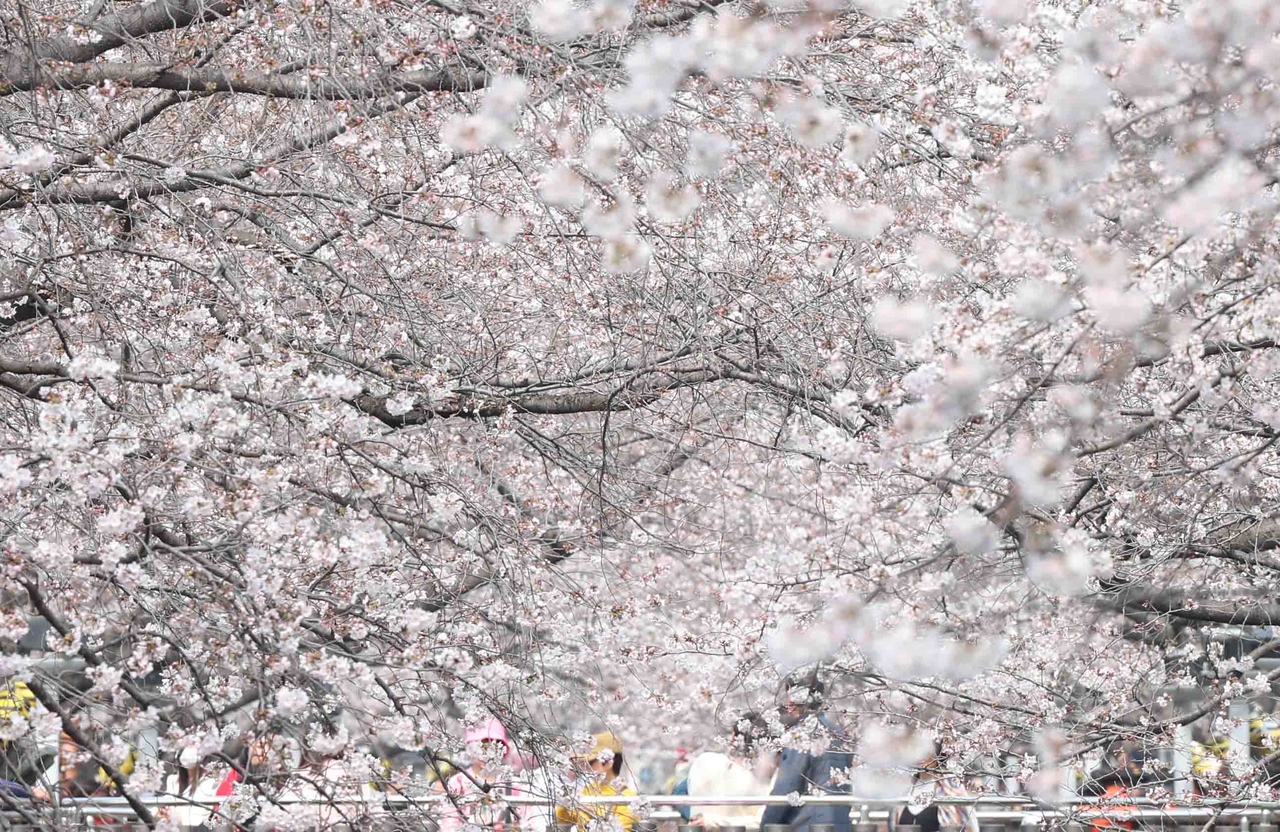
Japanese sakura culture is fundamentally a sit-down event. 花見 (hanami) means picnic mats under the trees, bento boxes, cold beer, three hours of slowly burning daylight. Korea inherited the same Yoshino tree (왕벚나무), but rebuilt the ritual around the camera. The dominant Korean verb for cherry blossom season is not "to picnic under" but 벚꽃 보러 가다 (beotkkot boreo gada, "to go to see the cherry blossoms"), and the word "보러" carries the implicit weight of looking, photographing, posting. That is why Seoul spots like Yeouido, Seokchon Lake, and Gyeongju's Bomun Lake all share one specific design feature: long parallel tree-lined walking paths that create perfect symmetry shots when you stand in the middle and aim your phone down the corridor.
The appeal is not just pretty flowers. It is the geometry. Hanami invites you to settle in one spot; Korea's beotkkot meongso (벚꽃 명소, cherry blossom famous spots) invite you to walk the line and become the subject. Drama directors have used this exact composition for over a decade. Think of Goblin's flashback scenes, Crash Landing on You's reunion sequence, the closing shot of nearly every spring tvN drama. The corridor shot is the most reproduced visual in Korean spring TV, and the public spaces were quietly redesigned to match.
벚꽃 as K-Drama Atmospheric Currency
If you work in K-content for any length of time, you learn that a spring K-drama almost always has to land at least one cherry blossom scene. Not for plot reasons. For algorithm reasons. Cherry blossom scenes get screenshotted, GIF-ed on X, reposted on TikTok with romantic OST clips, and become the dominant Pinterest exports of the show. The CJ ENM and SLL drama studios calculate this. When the production calendar pushes a shoot past peak bloom, location teams will literally truck in artificial branches, or shift to Jinhae where the bloom holds 5 to 7 days later than Seoul. That is how seriously the industry treats this.
Jinhae Gunhangje: The Industrial Cherry Blossom Festival
Jinhae is the Champions League of Korean cherry blossom locations. Roughly 360,000 cherry trees, originally planted as part of a naval base reforestation project in the 1950s, now anchor the Jinhae Gunhangje Festival every late March. The festival pulls more than 4 million domestic visitors during its 10-day run, plus a heavy contingent of Southeast Asian and Western tourists who have learned to time their Korea trips around it.
Two locations matter more than the rest. The first is Yeojwacheon (여좌천), a 1.5-kilometer stream where pedestrian bridges arch over water and the cherry tunnels meet overhead. The Romance Bridge here has been a K-drama backdrop for shows including Romance, Marriage Not Dating, and a slew of web dramas. The second is Gyeonghwa Station (경화역), a disused railway lined with cherry trees where a retro train sits permanently parked. The visual of a single-track railway disappearing into a tunnel of pink is the most photographed image of Korean spring on Korean Instagram, hands down. Tour bus operators schedule their stops to give visitors a precise 25-minute photography window before moving on.
Yeouido: Seoul's Office-Worker Cherry Blossom
The Yeongdeungpo Yeouido Spring Flower Festival has 1,886 cherry trees packed into a 1.7-kilometer corridor of Yeouiseo-ro, behind the National Assembly. What makes Yeouido distinctly Korean is its access pattern. The blossoms are flanked by Seoul's densest white-collar district. On peak bloom Friday afternoons, you see suits walking the corridor in groups of three or four, phones out, on what is functionally an extended lunch break.
This is where the MZ세대 (MZ generation, Korean Gen Z and millennials) photography arms race plays out most visibly. Compact ring lights clipped to phone cases. Picnic mat aesthetic competitions where everyone has the same beige linen blanket from Daiso. Photo-friendly Korean BBQ pop-ups and convenience-store-style picnic kits sold within 200 meters of the festival entrance. The 인생샷 (insaeng-syat, "life shot") culture has turned Yeouido into a stage where the goal is less to see the flowers than to produce an image of yourself among them. None of this is cynical, by the way. It is just the operational reality of a generation that grew up on Cyworld and Instagram.

Seokchon Lake: The Lotte World Tower Composition
Seokchon Lake (석촌호수) sits next to Lotte World, Lotte World Tower, and Jamsil Station on Line 2. The 2.5-kilometer cherry blossom path holds over 1,000 royal cherry trees, and at night the city turns on the lights to extend viewing hours. The reason Seokchon Lake matters as an aesthetic location, more than as a botanical one, is the Lotte World Tower backdrop. At 555 meters, the tower is the tallest building in Korea and the sixth tallest globally. When you frame a low-angle photo of cherry blossoms with the tower spiking up behind them, you get the single most recognizable "Seoul spring" image. It is the composition that won the city the unofficial title of futuristic hanami capital.
The Songpa District Office actively curates this. Pop-up vendors, photo-spot markers painted on the ground, and nighttime LED illumination are all calibrated to extend the photographable window from sunset deep into evening. Couples come here for what is essentially the prescribed 봄 데이트 (bom date, spring date) template: Lotte World during the day, Seokchon Lake walk and photos at golden hour, dinner at one of the Songpa rooftops afterward.
Gyeongju Bomun Lake: The Quieter, More Cinematic Option
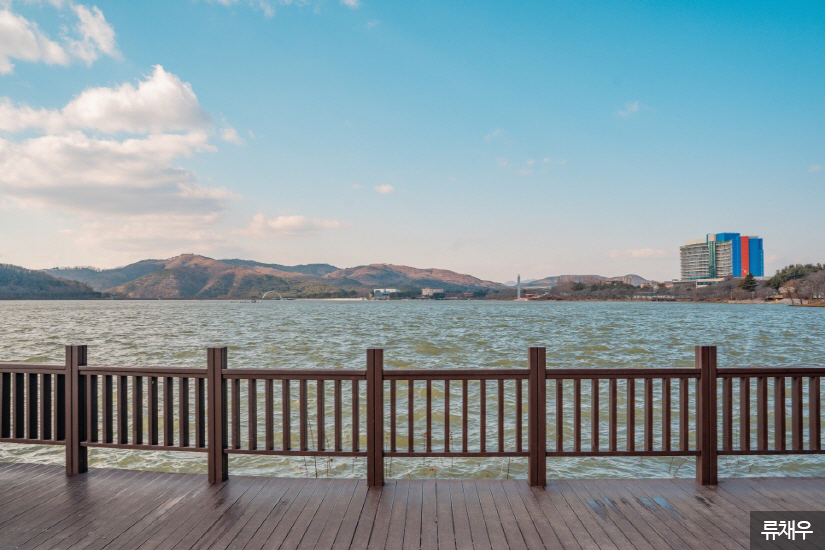
If Seoul's spots are about urban density and Jinhae is about volume, Gyeongju is about scale and silence. Bomun Lake (보문호) is a man-made 1.65 million square meter lake in the eastern hills of Gyeongju, ringed by an unbroken cherry blossom road that catches the morning mist coming off the water. Gyeongju is the former capital of the Silla dynasty (57 BCE to 935 CE), and the city is dense with stone pagodas, royal tombs, and Bulguksa temple, all of which become extraordinarily photogenic when surrounded by drifting petals.
This is the location K-drama costume teams favor when they need a historical or romantic-period feel. The annual Gyeongju Cherry Blossom Marathon, held when the trees peak in early April, is essentially a televised B-roll feast. From an industry perspective, Bomun Lake is also where domestic Korean visitors go to escape the Seoul crowds, which is part of why so many recent dramas film their "characters find peace" episodes here.
The KTO's $300M Bet on Spring Tourism
One detail outsiders rarely catch: the Korea Tourism Organization runs an English-language 개화 예보 (gaehwa yebo, bloom forecast) every year, updated weekly through the spring. They do this because cherry blossom week is one of the highest-yield foreign tourist arrival windows on the Korean calendar, conservatively worth around 300 million USD in shoulder-season inbound spending. KTO coordinates with KMA (the meteorological office), the major airlines, and the festival organizers in Jinhae, Changwon, Gyeongju, and Seoul to time promotional pushes within a 5-day window before peak bloom.
Hotel ADR (average daily rate) in Jinhae jumps roughly 80 to 120 percent during the festival window. Yeouido area hotels see similar spikes. Knowing this, savvy travelers book January or earlier. The other operator move: the bloom moves south-to-north, starting in Jeju and Busan around late March, then sweeping up to Seoul by early April. If you miss the Jeju window, you have not missed the season. You just chase it north.
Gyeongui Line Forest Path: The Underrated Seoul Alternative
If you have time for only one Seoul spot and you want fewer crowds, the Gyeongui Line Forest Path (경의선숲길) in Mapo and Yeonnam-dong is the answer. It is a 6.3-kilometer linear park built on top of a disused freight railway, lined with cherry trees, indie cafes, used bookstores, and the sort of low-rise, slightly faded neighborhood texture that makes for cinematic walking shots. The park sees a fraction of Yeouido's foot traffic but produces some of the prettiest residential-Seoul cherry blossom photography. Locals call this area "Yeontral Park" as a tongue-in-cheek nod to Central Park, and it has quietly become the location of choice for indie K-drama showrunners who want spring intimacy without the festival noise.

How to Plan the Photography, Not Just the Trip
A few field-tested notes from people who shoot this every year. Bloom holds for 4 to 7 days under calm weather, and one stormy afternoon will end the season. Mornings between 7 and 9 a.m. give you soft east-facing light and almost no crowds. The hour after sunset at Seokchon Lake and Yeouido gives you the LED-lit nighttime composition that is genuinely hard to replicate anywhere else in Asia. Bring a wide-angle phone lens or a 35 mm equivalent on a real camera for the corridor shots. And take note: cherry blossom photos look best when there is one human element in the frame for scale, which is why so many Korean Instagram shots feature a single person walking away from the camera. That is the template.
Whether you go for the K-drama atmosphere, the photography, or the spring date logic, Korea has built a deeply curated infrastructure around cherry blossom viewing. Treat it as the orchestrated cultural moment it actually is, plan within the 5-day bloom window, and you will come back with the images everyone hopes for.
Explore More of Korea with Daebak
Want to bring a little piece of Korea into your life? The Daebak Box is packed with the best Korean snacks, ramen, and cultural goodies delivered monthly to your door.


