


Table of Contents
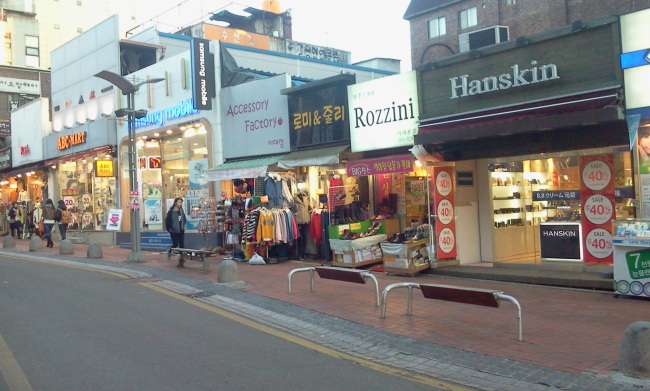
Every K-pop stylist I know keeps a rotation of 이대 (Idae, the shorthand for Ewha Womans University's front-gate district) stops in their sourcing notebook. Not for red-carpet looks. For the everyday off-duty pieces that idols wear to Incheon airport and that fans then screenshot into Pinterest boards labeled "Korean fashion aesthetic." After more than a decade watching how Korean youth style translates for global audiences, I can tell you the funny thing about Idae shopping. The district is smaller than Hongdae, quieter than Sinchon, and specialized in a way neither of them is. This is the corridor where 대학가 (daehak-ga, the university-front commercial strip) fashion was essentially invented in the 1980s, where Korean streetwear DNA got its first proof of concept, and where a very specific 편집샵 (pyeonjipsyop, curated multi-brand boutique) energy still lives on the back alleys behind KFC.
이대 앞: Why This Corridor Was Korea's First Real Fashion District
Before Garosugil, before Seongsu, before the Hannam-dong flagship boom of the 2010s, there was 이대 앞. From the mid-1980s through the late 1990s, the two lanes that fan out from Ewha's front gate ran the country's most concentrated youth fashion economy. Korea Times' history desk pegs this era neatly. School uniforms became optional in 1983, color TV had just arrived in 1981, and the 1988 Seoul Olympics opened the floodgates for Levi's, Nike, and Guess. Young women in their late teens and twenties suddenly had spending power and no state-mandated uniform code, and the Ewha district was where they went to figure out what a Korean personal style even was. The 편집샵 concept, curators picking a tight range of pieces to signal a specific aesthetic, was born on these streets before the term existed. Every serious Korean fashion buyer I have worked with over the years traces their eye back to walking these alleys in high school.
The Chinese Tourist Boom and the Very Public 2016 Crash
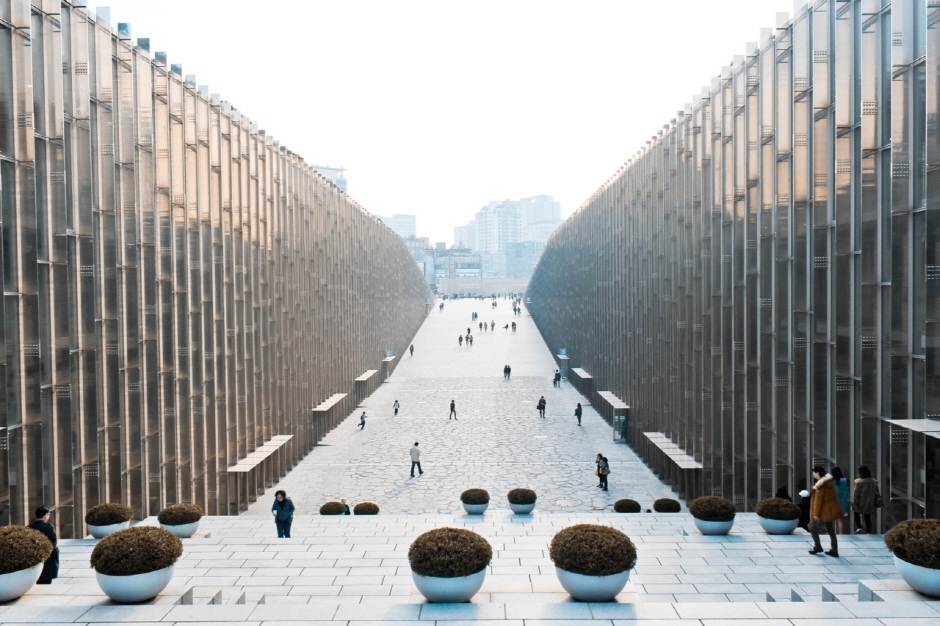
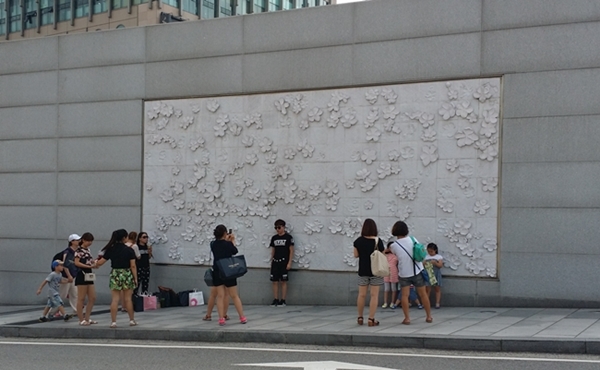
Here is the part most global K-culture guides skip. From roughly 2010 through 2016, the Ewha district ran through a Chinese-tourist gold rush that fundamentally reshaped every storefront on the strip. Korea Herald reporters counted rows of cosmetic shops with Chinese-language signage promising 买一送一 (buy one, get one), Chinese-speaking clerks on every corner, and dakgangjeong carts flipping fried chicken cubes to Beijing tour groups queued for photos at the campus pear-blossom wall. CCTV had put Ewha on its "Nine Tourist Attractions of Korea" list, Weibo users spread a rumor that photographing the pear-blossom engraving guaranteed a boyfriend, and the district rebuilt itself around that traffic. Then in mid-2016, Korea deployed the THAAD missile defense system, Beijing retaliated with a de facto tourism ban, and Chinese arrivals dropped 40 percent year-on-year by March 2017. The Ewha strip, which had leaned hard into that single revenue stream, took the hit worse than Myeongdong. Entire blocks of cosmetic shops closed within eighteen months. This is the sharp economic backdrop behind the "Ewha is dead" narrative that circulated on English-language travel blogs from 2017 through 2020.
2016 Urban Regeneration: What SMG Actually Did on Ewhayeodae 5-gil
What foreign fashion coverage almost universally misses is that the Seoul Metropolitan Government did not sit still and watch Ewha die. In October 2016, SMG and Seodaemun-gu launched a coordinated urban regeneration project on Ewhayeodae 5-gil, one of the specific back alleys behind the main strip. Nine teams of young Korean designers were selected, given subsidized rent, one year of covered lease payments, and municipal funding for exterior signage, all to backfill the empty storefronts that had emptied out as the tourist economy cratered. The alley got repaved with a design borrowed from European commercial streets, custom signage was installed for each store's aesthetic, and a Fashion Business Start-up Academy was set up to train the next round of tenants. This is not the kind of intervention Western commentators tend to associate with municipal governments, and it is the reason Ewha did not fully hollow out the way some 2018 obituary pieces predicted. If you walk the back alleys today and see a tight cluster of designer-run 편집샵 with idiosyncratic signage, that is not organic recovery. That is a 2016 Seoul municipal policy that actually worked.

Vintage and Y2K: Why 대학생 Are Actually Walking These Alleys Again
The current Ewha comeback story is not driven by cheap trend clothing. Fast fashion won that war a decade ago; Zara and H&M on the Sinchon end of Line 2 killed Ewha's low-price positioning. What actually pulled Korean 대학생 (daehaksaeng, university students) back to these alleys is the Y2K and 빈티지 (vintage) revival that kicked into gear around 2021. Korea Herald reporting shows Y2K search volume jumped sixty-one times year-on-year in early 2022, and Gen Z fashion sales tagged Y2K rose eighteen times in the same window. The Ewha alleys, with their small independent operators and short lease terms, adapted to that pivot faster than any Sinchon big-box tenant could. Curated racks of low-rise 청바지 (jeans), varsity jackets, oversized cable knits, and the specific late-90s Korean-idol silhouettes now flooding TikTok all live in these back-alley shops. What Ewha offers that Hongdae vintage stores do not is proximity. A student can walk from an Ewha lecture to a fitting room in under ten minutes, which is exactly the kind of low-friction advantage that keeps a 대학가 fashion corridor alive.

Ewha vs Hongdae vs Sinchon vs Yeonnam: The Honest Comparison
The four adjacent 대학가 fashion neighborhoods on Line 2 all pull different demographics for specific reasons, and Ewha's spot in that map is worth naming clearly. Hongdae runs on scale and party energy, big-name streetwear brands anchor the main drag, and the crowd skews younger and more international. Sinchon is the utility corridor, cheap eats and chain stores, fashion is not really the point. Yeonnam, one stop west, has become the coffee-and-slow-boutique zone that Instagram influencers photograph for lifestyle content. Ewha is the smallest of the four and the most fashion-specialized, and that is precisely its value. There are no big-box distractions to compete for foot traffic, the alleys are tight enough that a curated 편집샵 with an idiosyncratic aesthetic actually gets seen, and the buyer profile is narrow enough (Korean female college students, ages 19 to 25, with mid-tier budgets and high fashion literacy) that boutique owners can merchandise with precision. If your goal is browsing Korean youth fashion at the point where trends actually start rather than where they have already been packaged for tourists, Ewha remains the corridor to walk.
Practical Notes: Getting There, Paying, What to Actually Do
Take Seoul Metro Line 2 to Ewha Womans University Station, use Exit 2 or 3, and walk the straight road toward the main gate. The main strip runs the width of Ewhayeodae-gil, and the interesting boutiques branch off the perpendicular back alleys, especially Ewhayeodae 5-gil where the 2016 designer regeneration happened. Bring cash. A meaningful number of the independent operators still add a small credit card commission, and the nearest global ATM sits in the GS25 inside Yonsei's SK Global House dormitory a short walk north. Sizing runs small; most independent boutiques still stock 프리사이즈 (free size), which in practice reads as Korean XS to S, so try before you buy and do not assume Western sizing translates. Store hours skew late, most open at 11 a.m. or noon and close between 9 and 10 p.m., which fits the college schedule but frustrates early-bird shoppers. And do not skip the strawberry-candy carts, the waffle stands, or the row of Innisfree, Nature Republic, and Missha flagships that survived the tourism crash by pivoting back to serving local students. That K-beauty concentration alone is worth the trip.
Explore More of Korea with Daebak
Want to bring a little piece of Korea into your life? The Daebak Box is packed with the best Korean snacks, ramen, and cultural goodies delivered monthly to your door.


