


Table of Contents
Every November on a Thursday morning, South Korea quiets itself for a single test. Planes are grounded during the English listening section, the stock market opens an hour late, and police motorcycles escort late students to exam halls. The test is the Suneung, and the pressure to pass it shapes nearly every part of Korean childhood, from after-school hagwon schedules to the neon canyons of Daechi-dong.

Suneung: The Day Korea Stops
The Suneung, formally the College Scholastic Ability Test (CSAT), is a roughly nine-hour multiple-choice exam administered by the Korea Institute for Curriculum and Evaluation. Around 550,000 students sat for the 2026 edition, including 114,000 in Seoul alone. To protect concentration, the government suspends all domestic flights for 35 minutes during the English listening section, reroutes 140 flights, and forces aircraft to hold above three kilometers in altitude. Seoul adds 29 extra subway runs, deploys 646 shuttles for late arrivals, and pauses noisy construction near 228 test centers. The Kospi, Kosdaq and Konex markets all open at 10 a.m. instead of 9.
The cultural rituals around the day are just as striking. Mothers pray for hours at temples and churches, juniors form cheer rallies and saber tunnels for departing seniors, and Kyobo Book Centre fills front windows with lucky pencils, sticky rice candies and good-fortune charms. Sociologists call it less an exam than a national event.
Daechi-dong: The Hagwon Mecca
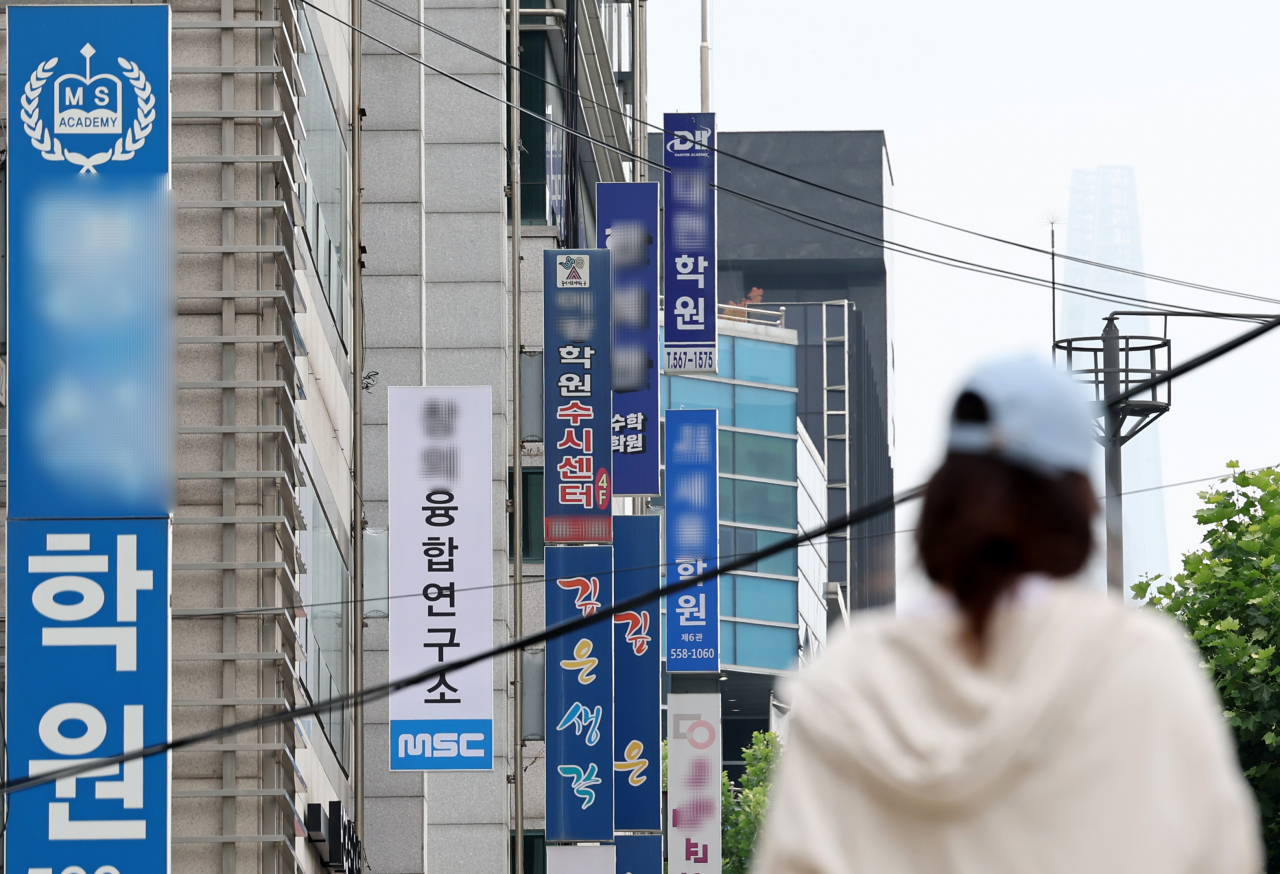
If the Suneung is the destination, Daechi-dong is the engine room. The neighborhood, tucked into Seoul's Gangnam district around Daechi Station on Line 3, holds more than 950 private academies known as hagwon, with several hundred clustered within 500 meters of the station. Its skyline is a dense stack of signboards covering math, English, science, Korean literature, coding, art and physical education academies.
The district even shapes Seoul's traffic patterns. Because hagwon are legally required to close by 10 p.m., the Eunma Apartment intersection turns into one of the city's worst nightly jams as parents arrive to collect their children. During school vacations, students from other neighborhoods commute in for the entire day, and some families now park camper vans on side streets to give kids a place to rest and eat between classes. A 30 square-meter studio near Eunma rents for about 1.4 million won a month, so a parked van can be the cheaper option.
The 29 Trillion Won Industry
Korean households spend a record amount on private education. According to the Ministry of Education and Statistics Korea, total private education spending reached 29.2 trillion won (about 20.1 billion US dollars) in 2024, even as the school-age population fell by 1.5 percent. Eighty percent of all primary, middle and high school students attended some form of private tuition, including 87.7 percent of elementary students. Average monthly spending per student rose 9.3 percent year-on-year to 474,000 won.
The income gap is stark. Households earning more than 8 million won a month spend about 676,000 won per child on private education each month, while families earning under 3 million won spend roughly 205,000 won, an amount comparable to what those families spend on food. Among 31 education companies listed on the Korean stock market, 12 derive most of their revenue from hagwon. Megastudy, one of the largest, has been valued at about 669 billion won.
Star Teachers and Billion Won Salaries
The Korean hagwon market produces a small group of celebrity instructors whose earnings rival those of K-pop idols. Math instructor Hyun Woo-jin, a Stanford graduate, has been described as the highest-paid lecturer across all subjects, with annual income reportedly estimated in the tens of billions of won and Nonhyeon-dong land holdings valued at about 65.7 billion won. When Hyun signaled in 2022 that he might not renew his Megastudy contract, the company's share price fell more than 7 percent in a single session; news of the renewal later sent the stock up over 5 percent.
Other names familiar to Korean students include English instructor Cho Jung-sik and the late former StarCraft pro Yim Yo-hwan-era turned business mogul Choi Tae-seong. The model rests on so-called star lecturer marketing, in which hagwon promote individual teachers as the key to higher Suneung scores. In December 2025, prosecutors indicted 46 people, including Hyun and Cho, on charges of illegally buying CSAT-related test questions from current schoolteachers, a scandal that exposed how much money flows around even a single exam item.

SKY Castle and the Drama of Pressure
No piece of Korean media has captured the hagwon system as sharply as JTBC's 2018 to 2019 drama SKY Castle. The title refers to the abbreviation for Seoul National, Korea and Yonsei universities, the three institutions that anchor the country's academic hierarchy. The show follows four wealthy families in a gated Gangnam-style complex who hire elite admissions coordinators to engineer their children into Seoul National University medical school. At its peak, SKY Castle drew a 23.8 percent rating, the highest in the history of Korean cable television at the time.
The drama dramatizes real practices, from million-won-an-hour college consultants to round-the-clock supervised study rooms, and pushed terms such as "admissions coordinator" into everyday Korean conversation. Its closing arguments about parental ambition, child mental health and the cost of measuring children only by scores still echo in policy debates today.

Study Cafes and the New Self-Study Boom
Around the hagwon ecosystem has grown a quieter parallel industry of study cafes, or seuteodi kape. Unlike Western cafes, these are silent, library-style spaces with individual cubicles, locker rentals, kiosk check-in and rules against food and conversation in the study area. A two-hour pass runs about 3,000 won, six hours about 7,000 won, and a monthly pass roughly 100,000 won. Most operate 24 hours a day.
For students who cannot afford supervised study rooms costing 650,000 won a month or more, study cafes are a low-cost alternative for cramming during exam season and university entrance prep. They have also become popular with adults preparing for civil service exams, professional certifications and graduate school admissions.

Reform Attempts and the 2024 "Killer Question" Ban
The Korean government has repeatedly tried to slow the private education arms race. In June 2023, then-President Yoon Suk Yeol ordered the Suneung committee to remove so-called killer questions, items with a correct-answer rate of 20 percent or lower that critics said could only be tackled with expensive hagwon coaching. The ban took effect with the November 2024 exam.
The result was not what reformers hoped. With the most extreme items gone but the same need to rank students, exam writers shifted to a wave of "sub-killer" questions, raising the number of high-difficulty problems from around seven to twelve or thirteen. The 2024 Suneung became one of the most difficult exams on record, with only a single perfect scorer, and the head of the Korea Institute for Curriculum and Evaluation resigned over its difficulty. CSAT retake numbers, meanwhile, have hit record highs as students chase medical school admissions.
Stress, Mental Health and Global Comparisons
South Korea regularly ranks at or near the top of the OECD's Programme for International Student Assessment in mathematics and reading, but the same students post some of the world's lowest scores for school happiness and sleep. The National Health Insurance Service has reported that teenagers have the highest rate of ADHD medication prescriptions of any age group, at 2,305 per 100,000 people, with Gangnam-gu, Seocho-gu and Songpa-gu posting the highest prescription rates nationwide. In the weeks before the Suneung, pharmacies in Gangnam report a surge in inquiries about methylphenidate from students hoping to extend study hours, despite warnings from psychiatrists about insomnia, anxiety and heart palpitations.
The hagwon system is not only a Korean concern. Japan has its juku, Taiwan its buxiban and Vietnam its supplementary classes, but Korea remains an extreme case in scale, cost and intensity. As generative AI tools begin solving CSAT math sections in minutes and birth rates fall to record lows, more Korean educators are asking whether a system designed to sort hundreds of thousands of students by a single exam still fits the next generation.
Explore More of Korea with Daebak
Want to bring a little piece of Korea into your life? The Daebak Box is packed with the best Korean snacks, ramen, and cultural goodies delivered monthly to your door.


