


Table of Contents
Walk into any GS25 in Seoul at 11 pm and you will spot three generations at the same standing table. A grandmother picking at a 삼각김밥, a college student slurping cup noodles from a paper cup, a salaryman washing down a soft boiled 반숙란 with a cold can of Cass. This is not unusual. In Korea, 편의점 (pyeon-eui-jeom) stopped being a quick stop more than a decade ago. It is the default hangout, the affordable dining room, the after club refueling station.
Why 편의점 became Korea's default third place
Korea has around 55,000 convenience stores across four major chains: CU (BGF Retail), GS25 (GS Retail), 7-Eleven, and eMart24. That is roughly four times the density per square kilometer of Japan, which used to be the global benchmark. Why did Korea overshoot? Two reasons the industry rarely brags about openly. First, restaurant prices have climbed 19 percent since 2021 while an entire 편의점 lunch stays under 5,000 won. Second, Korean apartments are small, cafes are noisy, and 편의점 quietly delivered what Seoul was missing: 24 hour open seating with a microwave, a hot water dispenser, and no minimum spend.
The post 2010 youth generation basically colonized these spaces. Instead of drinking at expensive Itaewon bars, they buy 3,000 won worth of beer and snacks at the CU by their goshiwon and sit at the plastic table until sunrise. The industry noticed. Now every new store gets designed with counter seating and outlet plugs baked in. That is not accidental urbanism. That is BGF and GS Retail responding to the reality that their customers treat these stores like living rooms.
삼각김밥: the 1,100 won engineering marvel
The triangular seaweed wrapped rice ball is the single item every foreign visitor tries first, and there is a specific product design reason it works. CU rotates roughly 150 삼각김밥 flavors a year. Tuna mayo and Jeonju 비빔밥 are the perennials. Everything else is A/B testing at retail scale, timed to K-drama drops and film releases. When Reply 1988 trended again on Netflix, CU rushed out a Doo-tae fried egg 삼각김밥 tied to a scene. That is not clever marketing. That is operational hallyu, where the retail shelf and the streaming service are running on the same content calendar.
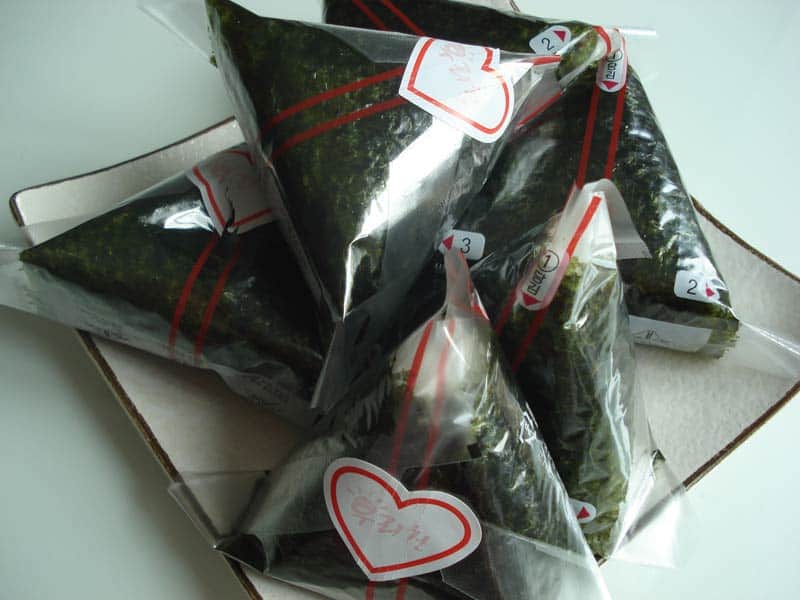
Here is the appeal point Western retail keeps missing. The 삼각김밥 is not just cheap protein. It is engineered so the 김 (seaweed) stays crispy inside a plastic film until the exact moment you eat it. The three tab wrapping system is a genuine piece of Japanese invented, Korean refined industrial design. That kind of texture preservation obsession, 쫄깃 rice against 바삭 seaweed, is why Korean fans on TikTok will fly to Seoul and film themselves opening one on camera. GS25 alone reportedly sells 50 million triangle gimbap per year.
컵라면: the hot water dispenser as social contract
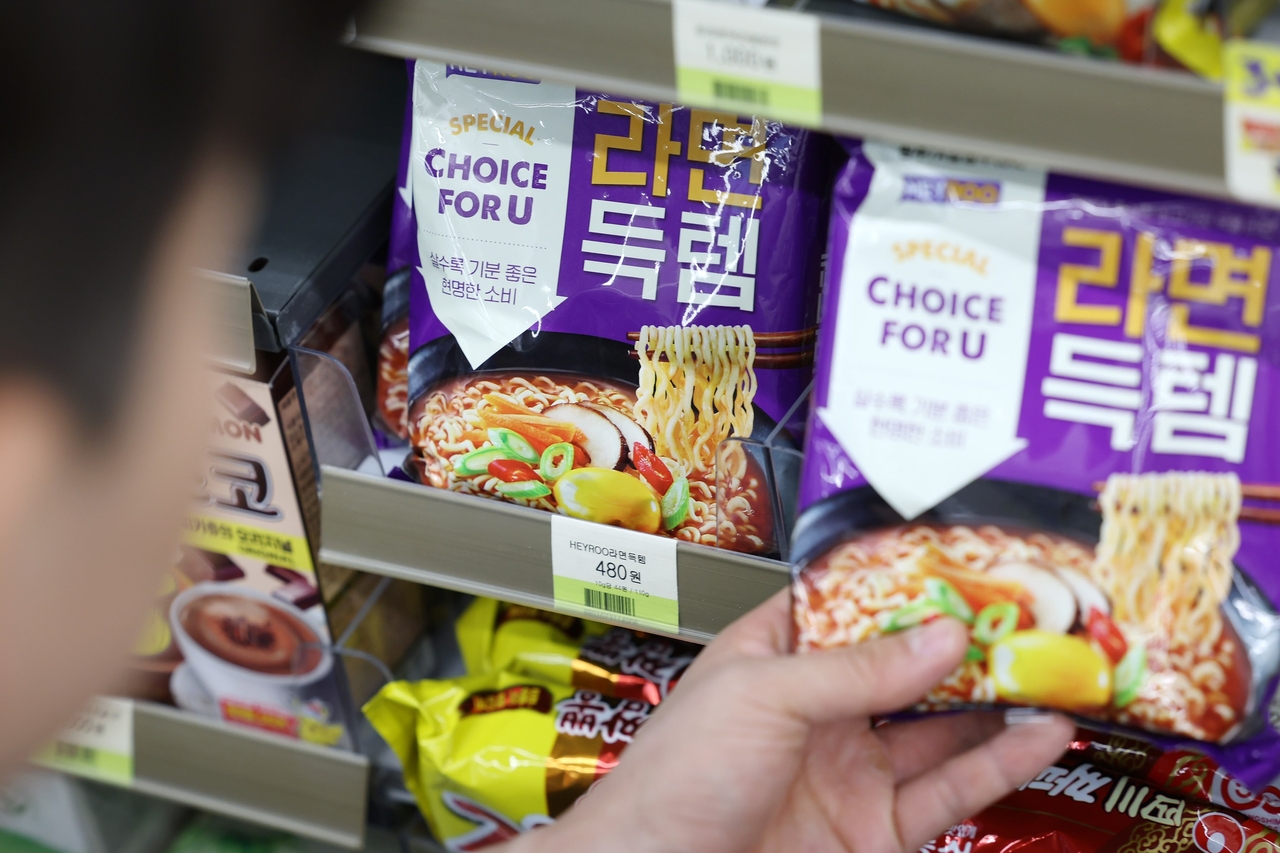
Every Korean 편의점 has a stainless steel hot water dispenser and a stack of paper cups. There is no fee. Bring your own cup noodle, punch in the seconds, sit down. This unspoken policy is what made 컵라면 the country's default cheap meal. Nongshim's Shin Ramyun and Samyang's Buldak Bokkeummyeon dominate the shelf, but the real move over the last five years has been PB (private brand) noodles. CU's Deuktem Ramyeon sells for 480 won, roughly a third of Shin Ramyun's price, and its sales grew 37.5 percent in June alone. Often it is the same OEM factory making both, just with a different label.
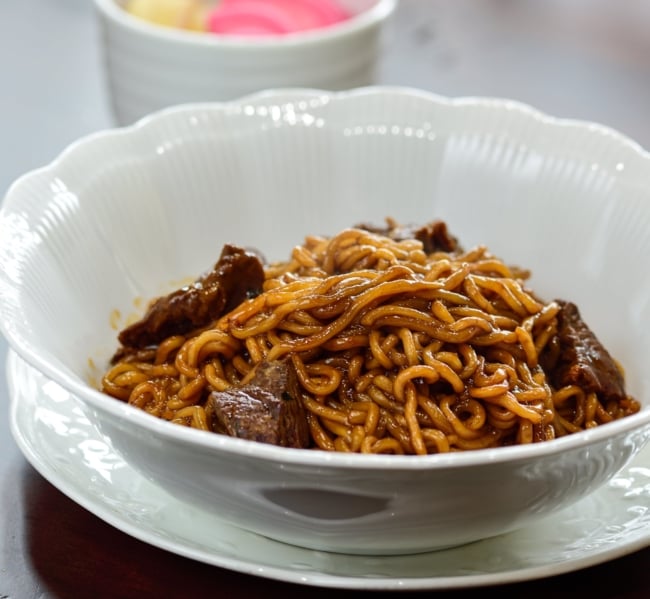
Why do fans love it so much? Because Korean cup ramyeon is not the sad plastic cup snack Westerners grew up with. The 스프 (soup packet) uses real 다시마 kelp and 멸치 anchovy for base flavor, then layers 고춧가루 chili on top. Soup first, spice second, which is exactly the balance Buldak takes to a 매콤 extreme. And because the microwave is right there, you can crack a raw egg into the soup, drop in a slice of cheese, or mix in a slice of Spam. This 편의점 라멘 조합 (combo) is documented in a hundred K-dramas. The most viral scenes of Itaewon Class basically showed characters doing exactly this.
반숙란: the protein hack Korea gets right
Grab a wire basket at the 편의점 counter and there is usually a small chilled dish of 반숙란, soft boiled eggs marinated in soy broth. Marinated eggs (마약계란) are one of the smartest cheap protein products on the shelf. Six minute jammy yolk, salty sweet soy marinade with garlic and sesame, single serve plastic packaging. About 1,500 won, roughly 6 grams of protein, and pairs perfectly with a cup of ramyeon. It is the K-drama equivalent of eating an energy bar, without the actual energy bar taste problem.

The appeal is textural, and this is where Korean food culture consistently outmaneuvers Western snacking. The yolk is not hard boiled. It is not raw. It sits exactly at the 반숙 stage where cutting the egg lets the yolk pour just slightly. That controlled runny yolk on top of hot rice, or dropped into a cup of Shin Ramyun broth, is what people mean when they say 편의점 food feels like home cooking. Because it actually does. Korean grandmothers have been boiling eggs to 반숙 for decades. The convenience store just industrialized it and put a barcode on it.
매콤 감자칩 and the PB economy that runs the shelf
Walk down the snack aisle and you will spot two very different categories. One shelf holds legacy brand chips (Haitai Honey Butter Chip, Nongshim 새우깡, Orion 오징어땅콩). The other holds PB (private brand) versions the convenience stores design themselves. This is where the industry gets interesting. Standard SKU chips margin at roughly 15 percent. Convenience store PB chips margin at 40 to 50 percent. That gap is why CU, GS25, and 7-Eleven have quietly become the biggest experimental snack makers in Korea, launching 김치 jjigae potato chips, 매콤 buldak crisps, soy sauce chicken puffs, and dozens more each year.
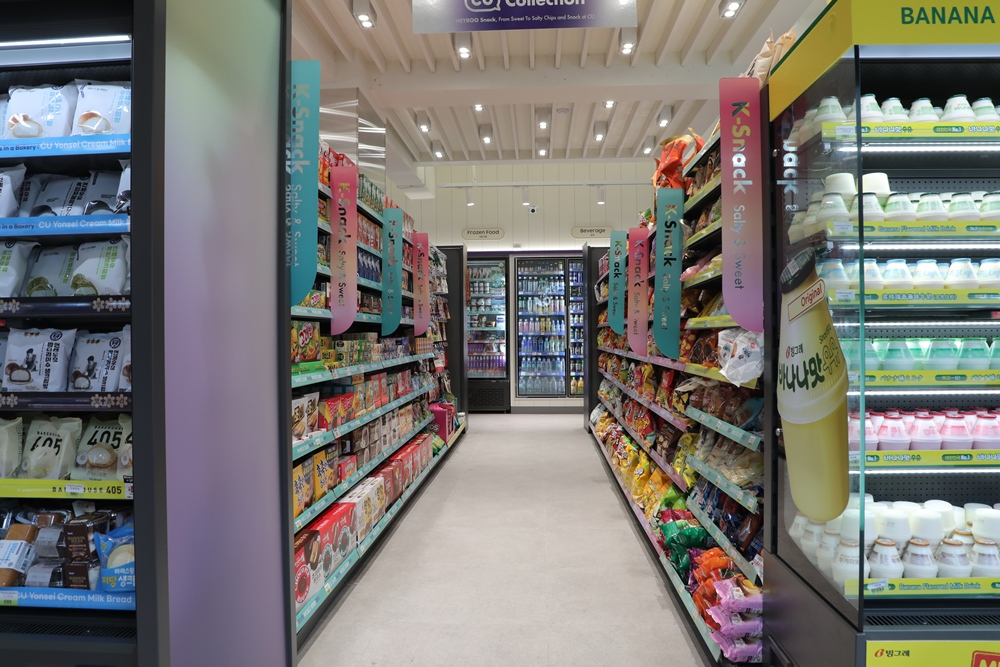
The 매콤 감자칩 in particular is more than a flavor. It is a merchandising thesis. Korean spicy chips lean on 고춧가루 chili powder plus 마늘 garlic, sometimes with a hit of 김치 seasoning powder, so the heat has body, not just burn. What Nongshim, Orion, and the convenience store PB kitchens all realized around 2015 is that global fans specifically want 매콤 as a taste category, not merely a translation of hot. That is why Amazon US now stocks Korean spicy chips as a distinct search term. 편의점 shelves are the R&D lab where new flavors get tested before they ship overseas. Every time a foreign fan finds a new PB spicy chip in a Seoul GS25, that is a product Korea is essentially prototyping for global export. Post mukbang, K-content tourism drives roughly 200,000 annual arrivals whose first Seoul checklist item is the 편의점. Not the palace. Not the museum. The convenience store.
Explore Korean Snacks with Daebak
Love Korean food? Get authentic Korean snacks and ramen delivered straight to your door with the SnackFever Box by Daebak.


