


Table of Contents
I have spent enough time in Korean cafes to know when a menu item is real and when it is a trick built for a phone camera. C. Through Cafe in Itaewon sits closer to the first category than most people give it credit for. The cafe belongs to Lee Kang-bin, the barista who invented what Koreans call cream art (크림 아트), the technique of hand-painting reproductions of Van Gogh, Munch, and Da Vinci onto a chilled cup of coffee using colored cream instead of steamed milk foam. It went viral around 2016 and never really stopped.

The barista behind the trick: Lee Kang-bin and the birth of Cremart
Lee Kang-bin is the reason 씨스루 (C. Through, pronounced ssi-seu-ru) exists at all. He grew up in Sangju, a small city in North Gyeongsang Province with, in his own words, no proper cafe. He taught himself by roasting beans on a frying pan and cobbling together a home espresso machine. He was 18 when he first heard the word barista. That backstory matters, because most of the copy-cat cafes that followed him after 2016 were opened by investors who saw an Instagram trend, not baristas who spent a decade grinding on frying pans.
Lee invented cream art in 2014 in an empty kitchen while developing a new menu. He drew a cherry blossom tree on the cream of an Einspaenner with chocolate and strawberry sauce. In his interview with the Korea Herald, he said he knew immediately it was a business, not a hobby. The name he chose, Cremart, is the giveaway. It is not latte art with a heart or a rosetta poured through steamed milk. It is a painted canvas, and the canvas happens to be cream.
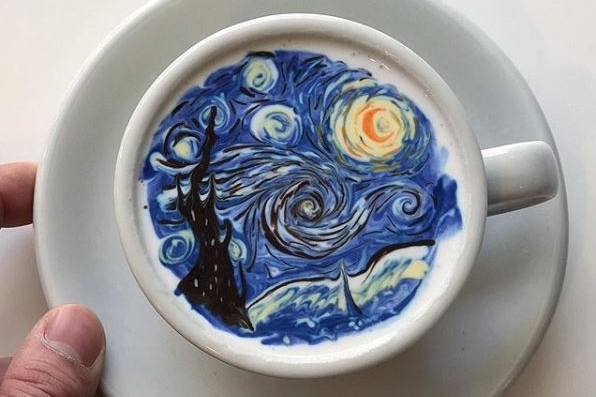
Why cream, not milk foam: the technical trick most fans miss
Here is the point that gets flattened in the "Instagram cafe" write-ups. Standard 라떼 아트 is poured. The barista tilts the pitcher, breaks the microfoam through the crema, and draws with the flow of steamed milk. You have maybe 60 seconds before the foam collapses and the design blurs. That is why traditional latte art tops out at hearts, tulips, rosettas, and swans.
Lee's technique bypasses the physics entirely. He whips a dense sweet cream, floats it on cold brew (not hot latte, because heat cooks the cream and warps the colors), and paints on the surface with food-safe dyes as if the cup were a small round canvas. The Starry Night that once took him 50 minutes is now a 6-minute job because he has drawn it more than a thousand times. Complex commissioned pieces can take up to 30 hours. That is why the cafe accepts only a handful of custom Cremart orders a day, by reservation through Instagram. The scarcity is not marketing theater. It is a working constraint of the medium.

Why C. Through won a war it did not know it was fighting
Here is the industry number that explains why C. Through matters more than it should. South Korea passed 100,000 registered cafes at the end of 2022, up from about 69,000 in 2019, and Seoul alone runs around 18,000 to 20,000 cafes depending on which quarter Statistics Korea reports. That works out to roughly one cafe for every 500 Seoul residents, higher density than New York or Tokyo. In an environment that saturated, a menu no one photographs is a menu no one hears about. 인스타 감성 (an Instagrammable feel) is not a bonus. It is survival.
That is the context Cremart landed in. When Lee started uploading the paintings around 2015 and 2016, the algorithm rewarded him almost immediately. He now sits at nearly 200,000 followers on Instagram, and outlets from CNN Travel to Saveur to Art Net wrote him up as the coffee equivalent of a fine artist. Global baristas from the US, Canada, China, Japan, Taiwan, and the Philippines flew to Seoul specifically to learn the technique. That is unusual. Most Korean cafe trends move outbound through franchise expansion, not by foreign baristas showing up with notebooks.
The imitation wave, and why nobody caught him
After 2017, a wave of Instagram-first cafes opened across Seoul chasing similar visual gimmicks. Foam-art cafes, character-latte cafes, 3D 무스 (mousse) cafes that stack whipped shapes above the rim, sculpted bear lattes, cotton-candy espresso, drink-in-a-lightbulb, drink-in-a-shoe. Some cluster in Hongdae, others in Seongsu, others in Ikseon-dong. Most closed within two years. The Korea Times has documented how the specialty scene has since pivoted toward small espresso bars, single-origin drip flights, and craft roasteries, where the barista's technique is the product instead of the drink's photo. Cream art was, in retrospect, an early answer to a problem the whole industry has been trying to solve since.

C. Through held its ground for a very simple reason. Lee never tried to scale Cremart into a franchise or a menu that any hired barista could execute. He kept himself as the bottleneck, which meant the product could not be diluted by a second location. Korean barista academies now teach a category they informally call "포토 지향 라떼" (photo-oriented latte) as a core skill, not just standard rosetta technique. Almost all of that curriculum traces back, one or two steps removed, to what Lee did in 2014.
How to actually visit C. Through in Yongsan-gu
The cafe sits at 37, Noksapyeong-daero 40na-gil in Yongsan-gu, on the hilly stretch between Itaewon and Gyeongnidan-gil that locals have quietly turned into one of Seoul's most interesting coffee corridors. Come out of Noksapyeong Station on Line 6, exit 2, and walk about 10 minutes uphill. The building is a compact gray facade with a pastel pink door and the Hangul letters #ㅁㅜㄴ stenciled on the glass. If you keep looking for a bright sign you will walk past it three times.
Prices sit around 6,000 won for the Scotchino (a butterscotch-tasting mini-cup with cacao dusted foam that gets recommended more than the Cremart itself), and 10,000 won for a standard Cremart. Custom commissioned Cremart is much higher and reservation-only. If you cannot get one, order the Scotchino, watch Lee work, and understand that the queue is doing you a favor. Hot drinks are dodged on principle. Even non-coffee drinkers can request a vanilla milk swap for the base. Hours are noon to 22:00 most days, with a slight afternoon start on Mondays and Tuesdays.
The real reason cream art still hits
Cremart is often filed under "Instagrammable Korean cafe" as if the phrase explains anything. It does not. What Lee actually built was a small, specific answer to a hard question: how do you make a cup of coffee memorable in the most cafe-saturated city on earth? His answer was to treat the cream as a canvas and slow the process down until it stopped resembling latte art at all. Every foam-art cafe that opened after him in Hongdae or Seongsu was reverse-engineering that answer. Most stopped at the photo. Lee kept going to the technique. That is the difference between a viral moment and a decade-long career, and it is the reason C. Through is still on the hill in Noksapyeong when almost every copycat has closed.
Explore Korean Snacks with Daebak
Love Korean food and cafe culture? Get authentic Korean snacks and ramen delivered straight to your door with the SnackFever Box by Daebak.


