


Table of Contents
Korea's interactive cafe scene is one of those cultural exports that never quite went global the way K-pop or K-drama did, and that is precisely why it is so telling. I have been covering the K-culture space for over a decade, and the cafe industry here is where you see everyday Korean creativity actually building product. It is not a scene manufactured in Gangnam boardrooms. Small operators in 홍대 and 성수동 keep launching concepts that would never survive a Western real estate market, and the numbers back it up: the Korean interactive cafe segment moves an estimated ₩200 billion a year at peak, according to industry chatter and cafe association reports.

양 카페 (Sheep Cafe): Where It All Started in 2011
Thanks Nature Cafe in 홍대 is the origin point most people forget. Owner Lee Kwang-ho opened it in 2011 after 20 years in commercial business, and the concept was almost anti-commercial: two sheep, Nana and Berry, penned on a small outdoor patio next to a coffee bar. The genius was in the restraint. The sheep are separated from the eating area, which sidesteps the hygiene arguments that would later cripple the raccoon cafes. That structural choice is why Thanks Nature is still open in 2026 while dozens of copycats folded. What people actually pay for here is the 힐링 (healing) tag, a Korean word that Anglo readers translate as "healing" but that really means "a decompression ritual." The sheep are the prop. The ritual is the product.
라쿤 카페 (Raccoon Cafe): The Gangnam Boom That Broke
Between 2015 and 2020, raccoon cafes were the loudest segment. Blind Alley near Sookmyung Women's University and the Raccoon Cafe branches in 강남 and 홍대 kept 30 to 40 raccoons across a few rooms, plus rotating combinations of pigs, corgis, and (in the wilder years) wallabies. Entry was usually ₩8,000 to ₩10,000 including a drink. This is the segment that gave Korean animal cafes a global viral moment on YouTube and TikTok, and it is also the segment that broke under ethics pressure. Animal Welfare Awareness Research and Education (Aware) and other activists spent years arguing that raccoons are wild mammals, not pets, and that the stress markers were obvious to anyone who visited twice. The Ministry of Environment agreed. In December 2023, a Wildlife Protection Act amendment banned exhibiting wild animals in facilities not registered as zoos, with a four-year grace period ending December 2027. Touching or climbing on the animals was banned immediately.

미어캣 카페 (Meerkat Cafe): 명동 as the Tourist Circuit
Meerkat Friends in 명동 and 홍대 was the most tourist-legible of the exotic animal cafes. The pitch was simple: pay around ₩15,000, get a drink and roughly 10 to 15 minutes inside the meerkat pen with feeding snacks included. The customer base skewed heavily toward foreign tourists, which is exactly why Meerkat Friends took the 2023 ban harder than domestically focused cafes. The same law swept up desert fox cafes, wallaby cafes, and genet cafes in one motion, since the amendment targets mammals specifically (birds and reptiles remain in a regulatory gray zone). What is worth flagging: activists were not celebrating either. Aware's Lee Hyung-ju told The Korea Times that the ban is too narrow, and cafe owners like the Mapo District operator surnamed Goo openly worried about what happens to their animals with no formal rehoming plan. This is a case study in how Korean regulation frequently lands in the messy middle: enough to shift the market, not enough to solve the underlying problem.
고양이 카페 & 개 카페 (Cat & Dog Cafes): The Legally Unbothered Segment
Here is the quiet winner of the 2023 legislation: cat and dog cafes were exempted, because dogs and cats are legally classified as companion animals rather than wildlife. That means the 홍대 and 이대 cat cafes (Roof Cat Me, Godabang, Cat Attic, Cats Living) and the 성수동 small-breed dog cafes kept operating with no policy pressure. Standard economics: ₩10,000 to ₩15,000 entry that includes a drink, mostly no time limit at the cat spots, hourly at the dog cafes. What Western coverage misses is that these places doubled as low-key coworking spots long before 카공 (cagong, cafe-studying) became a national trend. A student in Seoul who cannot afford a pet in a Gangnam apartment can rent 90 minutes of cat time for less than one drink at Starbucks Reserve. That is a real value proposition, not just an Instagram hook, and it is why the segment keeps quietly growing while the flashier concepts churn.
보드게임 카페 (Board Game Cafe): The ₩3,000 Per Hour Insurgency
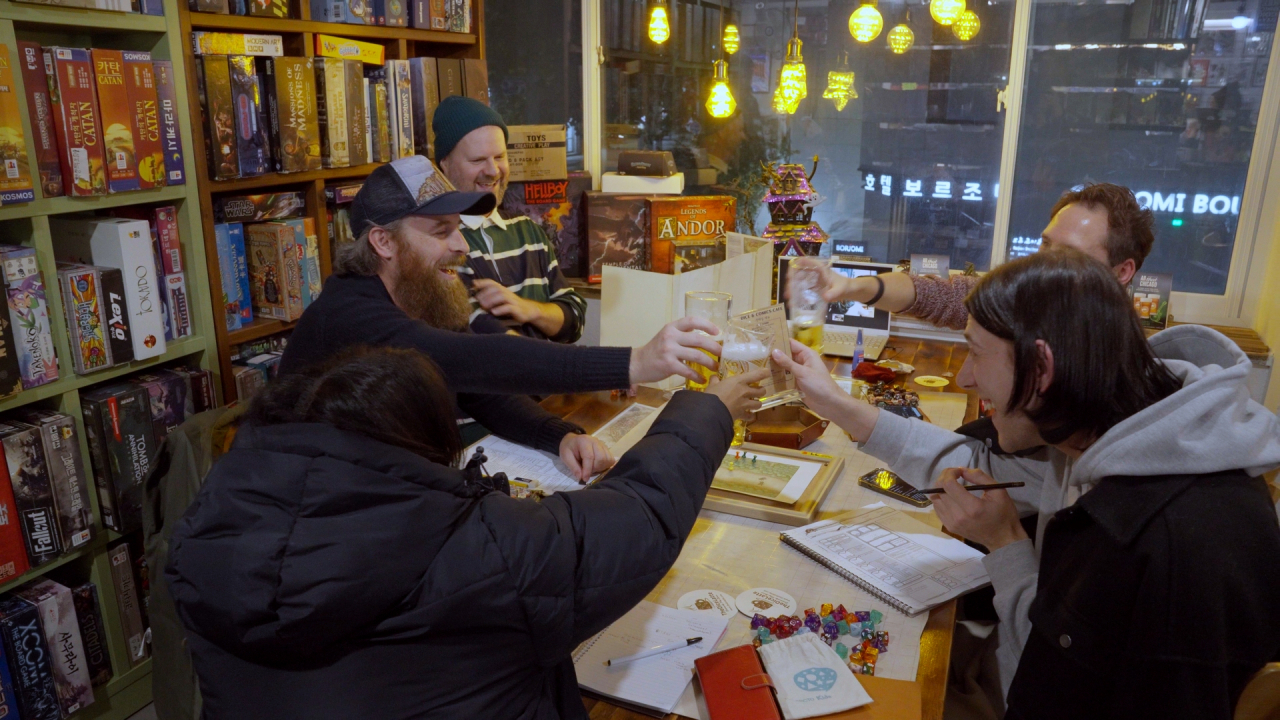
Board game cafes are the segment that Anglo travel writers underrate. Red Button, Rolling Dice, Super Board, and the growing role-playing scene at Dice and Comics Cafe in Dongdaemun-gu are running on rates as low as ₩3,000 to ₩5,000 per hour, which is 2010s pricing that has barely moved in a decade. That is deliberate. Owners like Joey Croner at Dice and Comics told The Korea Herald in early 2024 that around 80 percent of his customers are Korean, and Call of Cthulhu specifically has become huge among Korean women (Roll20 reported 10 percent of all Call of Cthulhu players use Korean language settings). The appeal here is not games as a hobby. It is games as an excuse to sit somewhere for four hours with a group of friends without a hoesik (회식) after-work drinking obligation hanging over the plan. In a culture where solo time and group time are both rigidly scripted, boardgame cafes carved out a third option.
VR 카페 and 점술 카페: Fortune Meets Silicon
The two segments most Anglo guides file under "novelty" both outlasted the hype phase. VR 카페 in 강남 (usually attached to VR방 arcades) started as a 2016 gimmick, but Meta Quest headset drops and PSVR2 releases keep pulling foot traffic back. Session pricing sits around ₩10,000 to ₩20,000 for 30 minutes plus a drink. Meanwhile 점술 카페 (fortune telling cafes) built a completely different demographic in 인사동 and around Hongik University. The Korea Times reported that Hongdae alone has 148 fortune telling shops in a compact radius, and the newer 사주 (saju) and tarot cafes charge around ₩20,000 for a quick reading and ₩50,000 for an in-depth session, often bundled with tea. Younger shamans (30s, some who received a 신내림 spiritual calling) are running kiosks and Instagram accounts. This is one of the very few segments where Korean tradition, spiritual practice, and Gen Z aesthetic meet without one killing the other two.

Post-2020 Shift: K-pop and K-drama Themed Cafes as the Ethics-Safe Alternative
The story Korean cafe operators have been telling each other since 2020 is that the ethics conversation around animal cafes fundamentally changed the risk profile of the segment. Nobody wants a viral video of their raccoon looking miserable. So capital rotated. The growth genre since 2020 has been K-pop and K-drama themed cafes: SMTOWN@coexartium in 삼성동, YG Republique in 홍대, HYBE Insight during its run, plus the constant rotation of pop-up 생일카페 (birthday cafes) that ARMY, MOA, and NCTzens rent out on member birthdays. Kakao Friends Gangnam flagship pushed the character IP angle. What is interesting from an industry mechanic view: these cafes solve two problems at once. They give K-pop labels a low-cost merchandise and fan engagement channel, and they give cafe operators an ethics-clean concept that can go viral on Weverse, X, and Instagram without an animal welfare backlash lurking underneath.

The 카공 Layer and Why It Matters for Interactive Cafes
The bigger cafe story running underneath every subsegment is 카공 (cagong), the phenomenon of Koreans using cafes as their primary workspace or study space. Statistics Korea counted 100,729 coffee shops nationwide in 2022, roughly double the number of convenience stores, and Korea now averages 405 cups of coffee per person per year (second globally, twice the world average) according to Euromonitor. In that saturation market, an interactive cafe is not competing with other themed cafes. It is competing with the Starbucks two blocks away that lets you sit for six hours with a laptop and a ₩4,500 americano. That is why so many interactive concepts fold within 18 months and why the survivors (Thanks Nature, Meerkat Friends, Dice and Comics, the fortune cafes) all built a repeat-visit ritual on top of the interactive gimmick. The gimmick gets you the first visit. The ritual keeps the cafe alive.

What to Actually Do If You Are Visiting
If you have one afternoon in Seoul, do the 홍대 loop: Thanks Nature for the sheep, then Meerkat Friends' Hongdae branch (still open under the grace period), then a board game cafe like Red Button before dinner. If you have a second day, head to 인사동 for fortune telling with tea. If you are ethics-cautious, skip the raccoon and meerkat cafes and pick a rescue cat cafe (many partner with 유기묘 shelters). And if you want to see where the industry is actually heading, book a member 생일카페 pop-up on Instagram in advance. That is where the money and creativity are moving in 2026.
Want more curated Korean culture picks to explore between cafe hops? The Daebak Box ships handpicked K-culture goods every month, so you can bring a piece of the 홍대 vibe home whether or not you make the trip yourself.


