


Table of Contents
Walk into a Seoul gallery today and you might catch a wide-eyed tiger staring back at you, surrounded by chattering magpies and impossibly bright peonies. This is minhwa (민화), the joyful, irreverent folk painting tradition of late Joseon Korea (1392 to 1910). Painted by anonymous artists for ordinary homes rather than the royal court, minhwa is having its biggest revival in a century, helped along by museum exhibitions, Insadong studios and a certain Netflix animation about K-pop demon hunters.
What Is Minhwa? Folk Painting for the People
Minhwa literally means painting (hwa) of the people (min). It flourished in the late Joseon dynasty, especially through the 17th to 19th centuries, when a rising commoner class began commissioning decorative paintings for weddings, birthdays and New Year blessings. Unlike formal court painting, minhwa was anonymous, affordable and unapologetically practical, hung on walls and folding screens to invite good fortune and ward off evil spirits.
Five qualities define the style: anonymous authorship, bold flat colors, naive perspective, dense symbolism, and a magical or protective purpose. Subjects ranged from tigers and cranes to fish, books, peonies and the sun. Each motif carried a wish, longevity, fertility, scholarly success or marital harmony, that ordinary viewers could read instantly.
Hojakdo: Tigers, Magpies and the Idiot Tiger
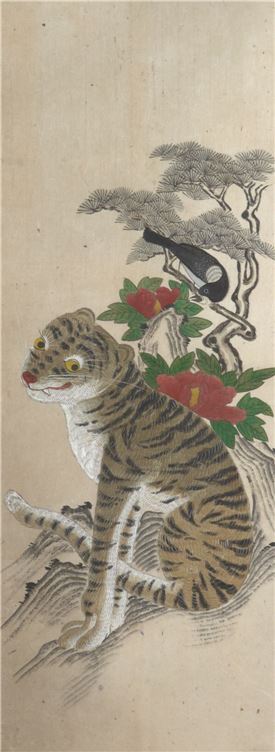
The most beloved minhwa motif is hojakdo (호작도), the tiger and magpie. Hung at New Year for good luck, these paintings cast the tiger as a clumsy aristocrat with bulging eyes and a lolling tongue, while the clever magpie perched in a pine tree represents the common people. By the 19th century the pairing was openly satirical, a sly jab at Joseon's feudal hierarchy. Korean folklorists nicknamed the silly cat the babo horangi, or idiot tiger.

Chaekgado: The Joseon Bookshelf Painting
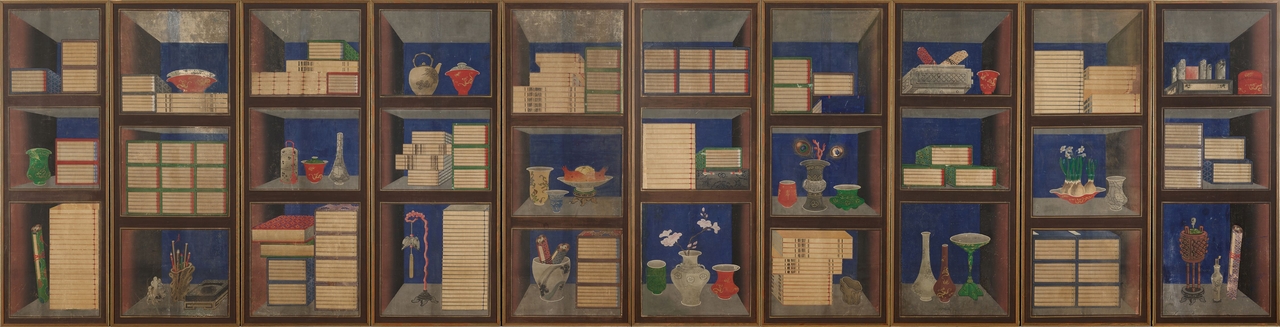
If hojakdo speaks to humor, chaekgado (책가도) speaks to ambition. These multi-panel folding screens depict towering bookcases packed with classics, brushes, inkstones, porcelain, peaches and pomegranates. The genre began in the late 18th-century royal court under King Jeongjo, who loved books so much that he hung a painted bookshelf behind his throne, then spread to commoners as a wish for scholarly success and prosperity. Chaekgado even uses early Western linear perspective, picked up through Qing-dynasty contact, which makes it a fascinating bridge between East Asian and European traditions.
Subjects and Symbols: A Visual Dictionary
Minhwa is divided into more than a dozen subgenres, each with its own coded meaning. Shipjangsaengdo (십장생도), the Ten Symbols of Longevity, gathers the sun, mountain, water, rock, cloud, pine tree, turtle, deer, crane and the lingzhi fungus on a single screen as a wish for long life. Hwajodo (화조도) features flowers and birds for marital harmony, eohaedo (어해도) shows fish and crabs for children's blessings, and sansuhwa (산수화) offers a simplified folk version of literati landscape. Mountain god (sanshin) paintings, often paired with tigers, blended Korean shamanism with Buddhist iconography in temple shrines.
From Decline to Revival: Zo Za-yong and the Museums
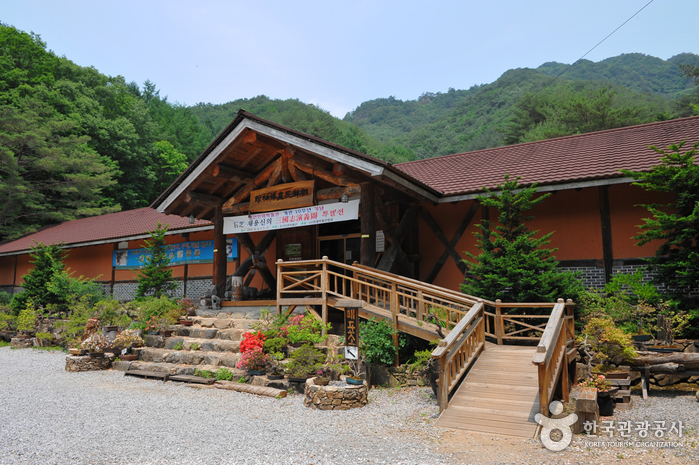
By the early 20th century, with the Joseon dynasty gone and modernization in full swing, minhwa was dismissed as crude souvenir art. The revival began in the 1970s thanks to architect-turned-collector Zo Za-yong, who founded the Emille Museum and championed minhwa to Korean and foreign audiences. Today the Gahoe Minhwa Museum in Bukchon Hanok Village in central Seoul holds more than 1,500 paintings and amulets and runs hands-on classes, while the Chosun Minhwa Museum in Yeongwol, Gangwon Province, houses about 3,000 Joseon-era folk paintings and organizes the prestigious Korean Folk Painting Awards. Major works also sit in the Met Museum's new Lea R. Sneider gallery, the Asian Art Museum in San Francisco, the V&A in London and Seoul's Leeum Museum of Art.
Minhwa Goes K-Pop: From BTS to KPop Demon Hunters
If you have ever paused on the set of BTS's "Idol" music video, you have seen minhwa in the wild: psychedelic chaekgado bookshelves and a giant tiger flash by in the chorus. BLACKPINK followed in "How You Like That," framing Rose in front of a chaekgado-style bookshelf set draped in hanbok colors. Most recently, Netflix's animated hit KPop Demon Hunters introduced Derpy the bumbling tiger and Sussie the sharp magpie, modern reincarnations of the hojakdo duo, to a global Gen Z audience. Tattoo artists in Hongdae now ink mini minhwa motifs, peonies, lotus, koi, on shoulders and forearms, turning Joseon folk symbols into wearable amulets.
Where to Try Minhwa in Korea
The best place to actually pick up a brush is Insadong, central Seoul's traditional arts district and likely the historical birthplace of minhwa. The Korea Minhwa Association runs the longest-running classes here, where beginners practice straight brush lines before moving on to peonies, tigers and birds. The Gahoe Minhwa Museum offers one-day workshops painting tigers, peonies and mandarin ducks on paper, wood or fans, and modern studios like Alloc Seoul, Minhwa Gain and Lucysson Atelier in Jeju cater to English-speaking visitors. For locals, community centers from Mapo to Gangnam now offer weekly minhwa courses, with an estimated 200,000 people across Korea learning the form, a number that has exploded since the K-culture wave began.
Why Minhwa Still Matters
Minhwa is not just decorative nostalgia. Each painting is a tiny portable wish, for children, for long life, for promotion, for protection, made by and for ordinary people. That democratic spirit, combined with the cheeky humor of the idiot tiger and the maximalism of the chaekgado bookshelf, makes minhwa feel surprisingly contemporary. In a world of disposable images, it offers something rare: art that means something specific, that protects you, and that any home, palace or studio apartment, can hang on its wall.
Discover Korean Craft with SULSUL
Bring home a piece of Korea's living craft tradition with the SULSUL Box by Daebak, featuring handcrafted norigae, a dragonfly brooch, and a DIY knotted bracelet kit that celebrate traditional Korean artistry.


