


Table of Contents
Every couple of years, a K-drama sends the internet down a rabbit hole about ancient Korean diets, and it lands on the same word: Hwarang. I have spent over a decade inside K-content, watching production companies pitch, package, and eventually cash in on Silla-era aesthetics. The last big push was KBS's Hwarang: The Poet Warrior Youth (2016), which stacked V of BTS, Park Seo-joon, Park Hyung-sik, Choi Minho of SHINee, and Go Ara into one costume drama. Ratings lagged competing shows in its Monday-Tuesday slot, but the food and lifestyle questions the drama triggered never went away. People still google "what did the Hwarang actually eat" because Korea has quietly built a multi-billion-dollar wellness industry on the answer.

Who the Hwarang Actually Were (Beyond the K-Drama Version)
The historical 화랑 were not the pretty-boy squad KBS packaged for prime time. They were a Silla Kingdom (57 BC to 935 AD) youth elite: sons of aristocratic families drilled in archery, horsemanship, poetry, and Buddhist ethics, then sent into battle when Silla was fighting Baekje and Goguryeo for peninsular control. What makes them culturally load-bearing, and why food writers keep circling back to them, is that Silla integrated martial training with what we now call wellness. 인삼 (insam, ginseng) as daily fuel, mountain foraging as ritual, and food as medicine. Silla documented a specific relationship between diet and physical readiness centuries before Western supplement culture existed.
The reason the 2016 drama's food scenes stuck in people's heads (even when the ratings did not) is that most of them were accurate. Six dongmu around a shared meal of 밥 (bap, rice), 된장국 (doenjang-guk, soybean paste soup), and simple 반찬 (banchan) is close to what Silla commoner households actually ate. What the show smoothed over is the class stratification. Aristocratic Hwarang had access to game meat, honey, and cultivated ginseng; commoners subsisted on grains and mountain herbs. Both diets share the same backbone, and that backbone is the part worth eating like today.

인삼 (Ginseng): Silla's Original Performance Supplement
If you strip the marketing away, Korea has one native ingredient that has been branded consistently for over a thousand years: 인삼. During the Silla and Goryeo periods, wild mountain ginseng was gifted as diplomatic tribute to Tang China and Nara Japan, effectively a state-run luxury export before "K-anything" existed as a category. The Hwarang connection is that Silla warriors were among the earliest documented consumer groups to chew raw ginseng root as a stamina aid before long marches and mountain campaigns. The saponins and polysaccharides doing the actual physiological lift were not named until modern pharmacology caught up, but Silla physicians already had empirical knowledge of the effect and had coded it into royal medicine.
Today that translates to a real industry. Korea Ginseng Corporation, whose 정관장 (JungKwanJang) red ginseng brand you will see stacked in every Incheon duty-free display, does roughly ₩1.5 trillion in domestic sales and ships red ginseng products to more than 40 countries. The company is now on its 127th year of continuous cultivation, and Korea has filed with UNESCO to inscribe the entire 인삼 tradition (cultivation, processing, rituals, gift-giving) on the Intangible Cultural Heritage list. Read that as: ginseng is not a folk supplement anymore, it is a national heritage asset being deployed in the same soft-power playbook as K-pop and K-drama.
삼계탕 (Samgyetang): The Medicinal Soup Every Korean Grandmother Still Prescribes
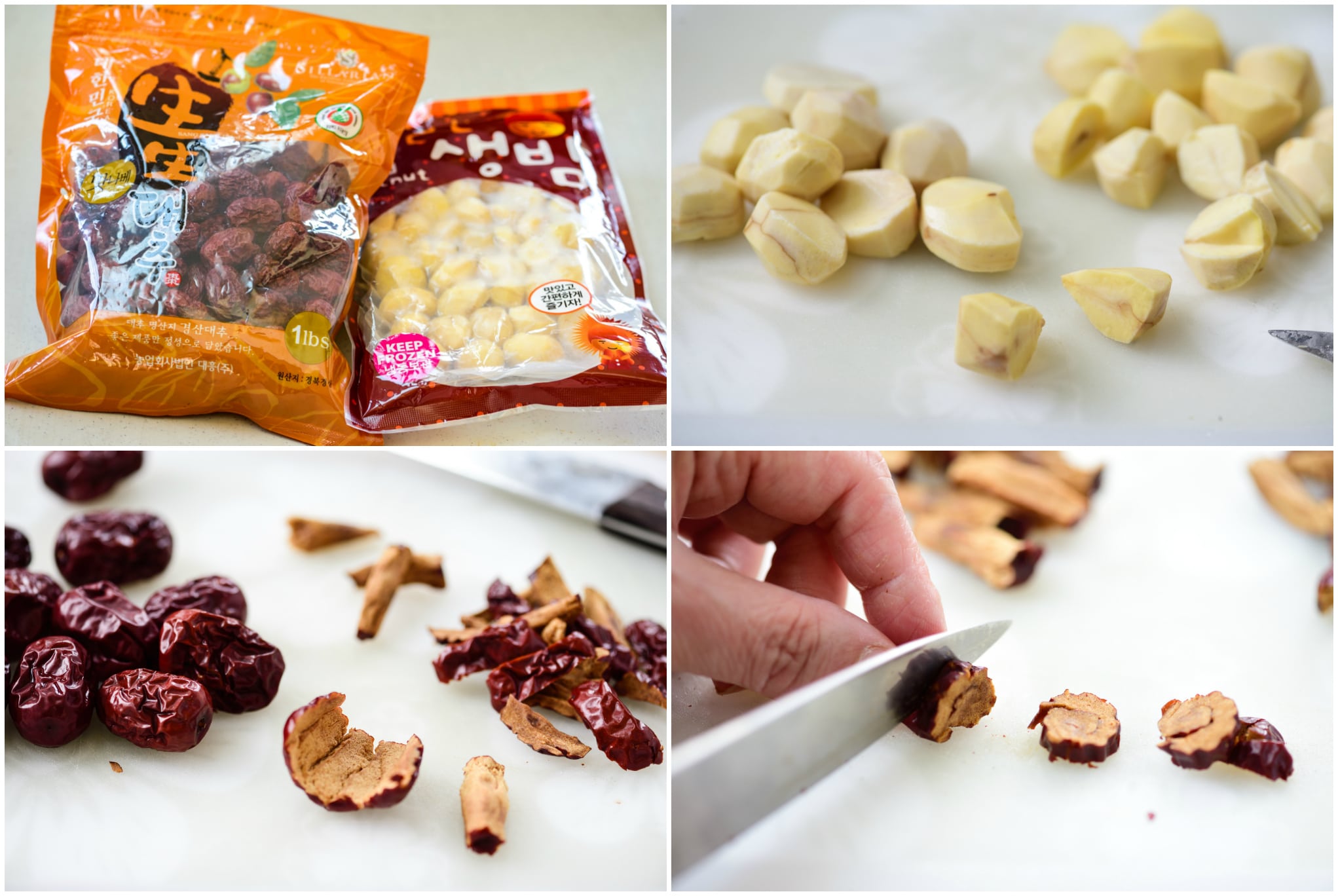
Samgyetang, the whole young chicken stuffed with sweet rice, ginseng, jujubes, and garlic then simmered until the meat slides off the bone, is the clearest surviving example of Hwarang-era 약식 (yaksik, "medicinal eating") logic. Modern samgyetang was formalized during Joseon, but the ingredient stack (poultry, ginseng, 대추 daechu jujube, 밤 bam chestnut, 마늘 garlic) is straight out of Silla royal court medicine. That is why Koreans still eat it on 삼복 (sambok, the three hottest days of summer). The traditional belief is that you fight heat by piling on heat, and specifically piling on adaptogenic warmth. Nutritional research eventually confirmed the collagen, ginsenosides, and lean protein combo does something real for recovery.
The appeal, in a way Western chicken soup never quite lands, is textural and ritual. Each spoonful hits soft rice grain, tender chicken, a wedge of ginseng root you can bite through (yes, actually eat it), and jujube sweetness. You season the broth yourself at the table with salt and pepper because the soup is intentionally under-seasoned. That "you finish it" element is very Korean, and it is part of why samgyetang travels well on Korean-restaurant menus abroad without needing to be dumbed down. Legend even traces the origin of Silla's 정월대보름 (Jeongwol Daeboreum) rice offering, the ancestor of 약식, to King Soji, saved from an assassination plot by a crow that led him to a mysterious old man. Whether or not you buy the mythology, the through-line is that Silla royalty already understood chicken plus ginseng plus jujube as a legible unit of medicine.

산나물 (Mountain Vegetables): The Foraged Backbone of the Warrior Pantry
Ask any grandmother from a mountain province what she considers "real" Korean food and she will not say bulgogi. She will say 나물 (namul), specifically 산나물 (sannamul, mountain-foraged greens). The Hwarang trained in the mountains, and the same plants they lived off (취나물 chwinamul aster scaber, 고사리 gosari bracken fern, 두릅 dureup Aralia sprouts, 더덕 deodeok lance asiabell) are still foraged today by professional 시마니 (simmani), roughly 10,000 of them across Korea. Some pull in seven-figure won for a single wild ginseng root. That is not folk-industry decoration. It is a real supply chain feeding Michelin-starred Seoul kitchens.
What makes 산나물 specifically Korean, and worth eating for the same reasons the Hwarang did, is the seasonality discipline. Each mountain green has a two to four week window before it turns bitter or fibrous, so 반찬 rotation forces a rhythm you do not get from year-round supermarket produce. Season them the traditional way: blanch, squeeze dry, dress with 참기름 (chamgireum, roasted sesame oil), a whisper of 국간장 (guk-ganjang, soup soy sauce), toasted sesame seeds, and grated garlic. That is the entire Hwarang seasoning kit, still in daily use fifteen centuries later.

청국장 (Cheonggukjang): The Fast-Fermented Warrior Fuel
Every Korean fermentation-nerd conversation eventually arrives at 청국장, and it belongs in a Hwarang piece because it is the pre-Joseon version of 된장 (doenjang). Doenjang takes months of aging with salt. Cheonggukjang takes about three days, no salt, just soybeans and airborne Bacillus subtilis fermenting under a warm blanket (traditionally on top of a heated 온돌 ondol floor). For a warrior camp or a mountain temple that could not wait six months for a batch of soybean paste, 청국장 was the answer. On any honest gut-microbiome scoreboard, it also happens to be more probiotic-dense than either doenjang or Japanese natto.
The tradeoff is smell. 청국장 smells strong enough that some Koreans, mostly people who grew up eating it in shared apartment buildings, still hesitate to make it at home. That funk is exactly why the flavor works. Earthy, umami-heavy, cutting through kimchi's acid in stew form. If you have never tried it, order 청국장찌개 at a country-style Korean restaurant and eat it over rice. The Hwarang, on winter campaign in the mountains north of Gyeongju, were almost certainly eating some version of this straight out of a clay pot.
Eating Like a Hwarang, Now
The through-line across ginseng, samgyetang, mountain greens, cheonggukjang, and yaksik-style jujube-and-chestnut rice is that none of these were ever marketed as wellness. They were survival food that happened to work. Silla did not have a supplement industry; it had cooks who understood 약식동원 (yaksik dongwon, "food and medicine share the same source"), a phrase you can still hear inside Korean pharmacy shops today. That is the operating principle worth stealing. Not a superfood of the week, but a repeatable pantry of six or seven ingredients you rotate seasonally and eat until you are 66 like 시마니 Lee Kyoung-suk, still climbing 700-meter peaks for lunch.
If you want a low-friction entry point to Silla-era Korean pantry building without sourcing everything yourself, our Daebak Box ships a curated monthly rotation of Korean snacks, ingredients, and lifestyle items pulled straight from small Korean brands. It is the closest thing to having a Seoul-based friend pack a care package for you every month.
Written by Hyunwoo Cho


